Introduction.
1. No one shouted ‘Stop’.
The brutality displayed by Soldier F and Soldier G of 1 Para on Bloody Sunday, in Derry, on 30 January 1972, was not an aberration. After murdering a string of unarmed civilians, they transported a large group of other perfectly innocent people to Fort George, where they beat many of them up. They then returned to Belfast where they continued in the same vein. One of their practices was to use their armoured personnel carrier or ‘pig’ as a mobile torture chamber where they electrocuted people. They did so in the weeks after Bloody Sunday. Everyone in the British army knew this was going on. No one shouted ‘stop’.
2. The ‘Beasting’ of prisoners in Derry
After the Bloody Sunday, Soldiers F and G led the ‘beasting’ of prisoners at Fort George in Derry. According to a local priest, Fr Terence O’Keeffe, who was among the prisoners, G had “scary eyes” and an “almost psychotic look”. The pair “roamed” among the prisoners, stamping on their feet, kneeing them in the groin, forcing their faces up against electric heaters, spitting in their mouths and engaging in other acts of “idle brutality”. Fr O’Keeffe recalled G as having had “the sadistic edge” on F.

3. Torture and mutilation
When they got back to Belfast they showed no remorse. Byron Lewis (Soldier 027) was a radio operator who accompanied them on their patrols. In 1975 he provided an account which was discovered by Tom McGurk in 1997. This key discovery led to the establishment of the Saville Inquiry as it constituted new evidence. Some passages from it were published in The Sunday Business Post, and later at Saville. The unpublished passages reveal that a few weeks after Bloody Sunday, F and G, and others, were briefed by ‘Lieutenant 119’, another veteran of Bloody Sunday, for an operation at the Divis Flats on the Falls Road.

According to Lewis “several blokes”, by which he means young Catholic residents of the area were “beasted severely”. Lewis was
“in a pig parked in between the main tower and the annex 30 or 40 metres away was [Redacted] pig on waste ground among some derelict buildings. Beyond that could be seen the glow of the fires. Then I noticed [F] and [G] running towards the pig with a bloke bent double between them. They kept him going head first into the armour plating. The bang was quite audible where I was. He was temporarily knocked out but was revived and thrown into the back of the pig.“
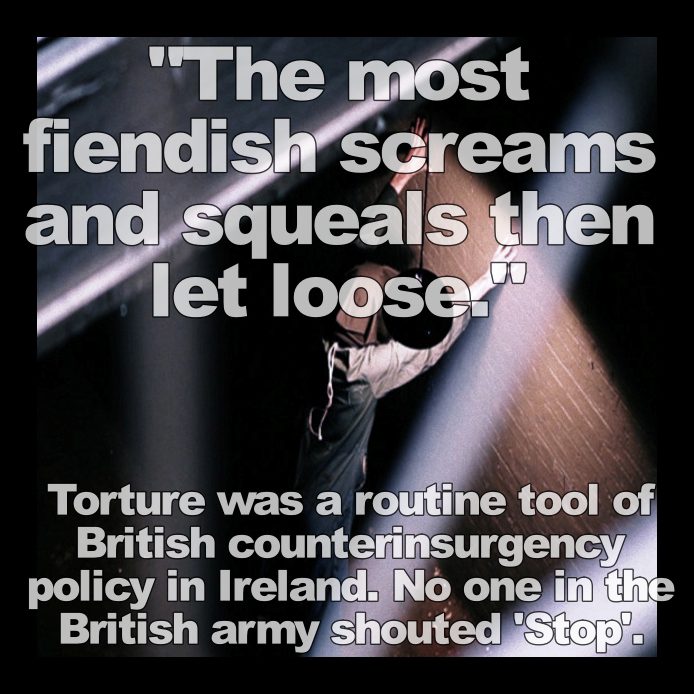
There was a purpose in hauling the prisoner to the rear of the ‘pig’. Soldiers F and G had prepared it for the torture of any prisoner they brought back to it. Lewis wrote:

“The most fiendish screams and squeals then let loose [F and G] had wired [the captive] to the batteries and were electrocuting him.“
Lewis and his comrades in 1 Para referred to other regiments of the military as ‘crap-hats’. The ‘crap-hats’ on duty with them let the torture session continue. As Lewis has revealed:
“Meanwhile during this racket the [Commanding Officer] of the crap-hats had walked over to where I was standing. He remarked about what was happening. [Soldier H] and I passed it off lightly. He then went on to ask if we had been in Derry the previous month. On answering, yes, he turned and walked away with an air of turning a blind eye.“
This deplorable behaviour was not confined to F and G. Lewis reveals that:
“At this point the other pig disappeared for ten minutes. The bloke inside had been castrated, electrocuted, the features of his face sliced with a knife and generally kicked and beaten. Lt 119 was also aware of what was going on but the bloke was in no fit condition to be taken to Musgrave [Hospital] or vetted as was the normal practice. So he had no other choice than to turn his back on the situation while the body was taken to the Shankhill to be dumped – a fate worse than death for a Catholic to be placed in the middle of a Protestant area if his identity is known or vice a versa . He was dropped outside the Horseshoe Bar and Provs [presumably ‘Prods’] were informed (at this time, a few weeks after Bloody Sunday we were angels in their eyes and could do no wrong). The fellow crawled to try and get back on the vehicle as it drove off.“
As there is no recorded death of a Catholic in Belfast in February 1972 which matches the delivery of the young man to the Shankill, this victim must have survived the ordeal.
Lewis has described how the individual “had been castrated, electrocuted, the features of his face sliced with a knife and generally kicked and beaten”. Lewis was not present in the small confines of the ‘pig’ to witness the steps taken during the torture. One can only hope that the victim was not actually castrated, rather stabbed in a way which occasioned no permanent injury. In either event, it is deeply shocking that the soldiers involved in that assault later boasted that they had castrated the captive believing that this was what had happened. Or at least hoping others would believe their account.
4. Torture and mutilation as a counter-insurgency tactic in Her Majesty’s Colonies
The use of torture – including castration – was a tactic deployed by the British army in the colonies. It was used in a widespread fashion in Kenya during the Mau Mau uprising in the 1950s and 1960s. The key figure in the development of counter-insurgency tactics in Northern Ireland was Brigadier (later General Sir) Frank Kitson. He had served in Kenya where brutal tactics were deployed extensively. He made no comment about it in either of his books which covered his experience in Kenya, thereby implying that it had not taken place. The British government has since acknowledged that these sorts of crimes took place.

In ‘Cruel Britannia, A Secret History of Torture’, Ian Cobain summarises some of the atrocities in Kenya:
“Men were whipped, clubbed, subjected to electric shocks, mauled by dogs and chained to vehicles before being dragged around. Some were castrated. The same instruments used to crush testicles were used to remove fingers. It was far from uncommon for men to be beaten to death. Women were sexually violated with bottles, rodents and hot eggs.“
This all took place against a background of curfews, internment and capital punishment. Over 1,200 Kenyans died dangling at the end of a noose.

One of the torture victims was Hussein Onyango Obama who had served with the British army during the Second World War in Burma. When released after six months in detention, he was emaciated, suffering from a lice infestation of his hair and had difficulty walking. He died in 1979. His wife informed journalists that he had told her that the British had ‘sometimes squeezed [his] testicles with parallel metallic rods’. They had also ‘pierced his nails and buttocks with a sharp pin, with his hands and legs tied together with his face facing down’. Hussein Onyango Obama was the grandfather of Barak Obama.

One British officer quoted by David Anderson in ‘Histories of the Hanged’ revealed just how brutal the campaign became. He described how a police officer was interviewing three suspects:
… one of them, a tall coal-black bastard, kept grinning at me, real insolent. I slapped him hard, but he kept on grinning at me, so I kicked him in the balls as hard as I could … when he finally got up on his feet he grinned at me again and I snapped. I really did. I stuck my revolver right in his grinning mouth … and I pulled the trigger. His brains went all over the side of the police station. The other two [suspects] were standing there looking blank … so I shot them both … when the sub-inspector drove up, I told him the [suspects] tried to escape. He didn’t believe me but all he said was ‘bury them and see the wall is cleaned up.
Kitson also served in Malaya. A form of ‘agent orange’ pesticide was sprayed on farm lands in Malaya. Entire villages were uprooted and sent to live in camps against their will. British troops routinely tortured, mutilated and murdered civilians during the uprising in Malaya. None of this featured in Kitson’s books.

An interrogation centre in Aden (now part of Yemen) was known as the ‘fingernail factory’.
In Cyprus a range of brutal counter-insurgency tactics were deployed including murder and torture. One torture tactic was to place a naked man on a block of ice until he suffered near genital frostbite.
5. The Hooded Men.
The British army refined their counterinsurgency torture techniques for deployment Ireland where a more careful approach was required.
An account of the ordeal of the ‘Hooded Men’ who were tortured by the RUC officers who were trained by British army torture specialists can be found on this website at: Sir Richard White’s black heart.

6. Delegating murder and torture to British agents in Loyalist paramilitary gangs.
Soldiers F and G were not the only people to use electricity to torture people in Belfast at this time. A man called Davy Payne of the UDA did too. He was almost certainly an RUC-MI5 agent. He was involved in the UVF’s Dublin -Monaghan bombings of 1974.
Payne was a member of the UDA’s Inner Council. He had served with the Parachute Regiment before he returned home to Belfast. He was known ‘The Psychopath’. He joined the UVF in the mid-1960s and worshipped at Ian Paisley’s church in Belfast. He later moved over to TARA, another Loyalist terror group run by a friend of Paisley called William McGrath. McGrath was also an MI5 agent (he ran Kincora Boys’ Home). In a normal society, Payne would have ended up in a mental institution. However, in the world occupied by Loyalist groups such as the UVF, Red Hand Commando, TARA and the UDA, people like him were in demand to perform the stomach-churning work of a terrorist organisation: torture and murder.

As a UDA/UFF killer, Payne became addicted to the use of knives to torture and mutilate the Catholics he snatched off the streets. Payne believed that any Catholic from a Nationalist community that fell into his hands was likely to have some knowledge about the IRA.
Payne was also an adept at torture inflicted through electric probes. He invented the term ‘Romper Room’ to describe the human abattoirs where he and others such as Albert Baker and John McKeague (both British agents) carried out their gruesome work, sometimes in front of an audience of Loyalist gang members and their girlfriends.

Henry McDonald and Jim Cusack, authors of ‘UDA, Inside the Heart of Loyalist Terror’, described the terror Payne invoked. “Mutilation was taking place [in 1972] and Davy Payne, a psychopath, was torturer-in-chief”. In August of 1972 he and his gang were responsible for murdering Frank Wynne and Thomas Madden. The Madden murder is described in grisly detail in the book as follows:
“The following night the gang kidnapped 48-year-old Thomas Madden, by all accounts a quiet man with no enemies, who lived with his mother, worked as nightwatchman and almost certainly knew nothing about the IRA. He was last seen leaving a pub in the city centre at around 8:45 p.m. to walk home. He was grabbed by the gang and taken to a lock-up [garage] off the Oldpark Road, believed to be the one where Frank Wynne was tortured and killed. Madden, it was later deduced from post-mortem examination, was tied by the wrists and strung up to a roof beam so that he had to stand on the tips of his toes – a recognised and agonising torture used by many brutal regimes. The UDA gang, eager in its work, also subjected their victims to a protracted and grotesque additional torture, inflicting shallow stab wounds all over his body. The pathologist counted some 110 punctures. People living in the Oldpark, near the lock-up, later told police they heard a man screaming “kill me, kill me” – Thomas Madden beseeching his tormentors to end his agony. Eventually they tired of torturing this innocent man and shot him in the head, dumping his body in a nearby doorway.” (page 41).
McDonald and Cusack also described how Payne was “hated by his men, several of whom had received vicious beatings, torture – including the use of a blowtorch and electrocution with an infamous ‘black box’ – and humiliation”.
Brian Nelson served his time as an apprentice torturer to Payne. He later became the UDA’s intelligence chief and an acknowledged agent of Force Research Unit (FRU) of British military intelligence. In 1973 before he became an agent, Nelson was arrested along with two other UDA members after they had tortured a Catholic called Gerry Higgins. The arrest took place as they were putting him into a car. He had been kidnapped earlier that day and tortured in a local drinking club with an electric torture device similar to Payne’s black box. Indeed, Payne may have been involved in the torture.

Tommy Lyttle of the UDA’s Inner Council was yet another MI5 agent. Lyttle’s son John has described how, when he was a boy, he once searched:
“through the pockets of my father’s overcoat for loose change. We kids are not supposed to, but we do. I plunge my hand in and feel this wet, wringing wet. I drag it out. It’s a handkerchief. With an embroidered ‘T’. The linen is as red as the red hand of Ulster, soaked with blood, saturated with blood, dripping with blood. I squeeze, though I shouldn’t. The red trickles through my fingers. I watch, repelled and exhilarated. My father is in the front room. I hear football match results. He isn’t injured, hasn’t said anything about a nosebleed, a fall. He hasn’t mentioned a friend’s accident. I return the handkerchief, go to the bathroom, wash my hands”.

John Lyttle has also written about an incident when he was “nine or ten”: ‘The wee small hours of the morning. I come downstairs. I want a drink of water. In the front room a man is tied to a chair. He’s battered and bruised. My father is there with how many others? Three? Four? I stare until I’m noticed. What do you want?’, my father asks. ‘A drink of water’. ‘Get him a drink of water’. I continue to stare until my water is brought. I drink it on the spot. ‘Not so fast’, my father cautions. I hand the glass back and tread quietly back upstairs and climb into bed beside my brother Bill. By daylight, I’m certain it’s a dream. It must be: I’ve dreamt of it ever since”. Even if it was a dream, it was exactly what Lyttle got up to in real life.
Davey Payne was far from the only Loyalist who kidnapped and murdered random Catholics. There is no evidence that Payne was a British agent, but he was surrounded by them. The NIO, MI5/6 and the RUC could have shut down the ‘romper rooms’ if they had wanted to, but they didn’t.
7. Torture, mutilation and murder by a British agent in the Provisional IRA.
Another former sadistic torturer and murderer is a man called Freddie Scappaticci. He was a British agent for decades inside the Provisional IRA. He engaged in horrific crimes while ‘interrogating’ Republicans suspected of being British agents. He was able to deflect attention from British moles who had penetrated the IRA and eliminate genuine IRA operatives to make way for other British agents.

The Provisional IRA, however, must bear the lion’s share of the blame for Scappaticci’s violent crimes. It was the IRA which gave him free reign to torture and execute suspected informers.
The behaviour of F, G, and others in the Parachute Regiment was not an aberration. It followed a well-established colonial pattern of abuse. While F and G engaged in the practice in the early 1970s, it seems that British military intelligence – along with MI5, MI6 and the RUC Special Branch – were happy to let their agents in Loyalist paramilitary gangs take over the practice as the Troubles dragged on. No doubt, this was because there was greater media scrutiny of British Army activities in Northern Ireland by the media as the early 1970s came to an end. Unfortunately, there was no media scrutiny in the colonies where British journalists turned a blind eye to one atrocity after another.
David Burke is the author of four books published by Mercier Press.
