Author and broadcaster Kevin O’Connor reflects on a declassified UK file about his fellow Limerickman, Sean Bourke. O’Connor is the author of Blake and Bourke & the End of Empire (2003), the story of Sean Bourke, the Irishman who staged one of the most audacious prison breaks in Britain’s history, that of George Blake. Blake betrayed MI6 to the KGB.
Sean Donlon, one of the Republic of Ireland’s most influential diplomats and negotiators, paid a discreet visit to Belfast during 1972. He was taken aback to see the notorious Sean Bourke in the city. So surprised was he that he mentioned the sighting in passing to the Northern Ireland Office (NIO) official with whom he was having secret talks. At the time Donlon was acting for the State in the negotiations that would culminate in the Sunningdale Agreement, a stepping stone to the eventual Peace process.

It is likely that Donlon, a personally charismatic diplomat, as part of amiable chit chat, mentioned in passing that he had seen Bourke. The latter was a well-known figure who had organised the escape of George Blake from Wormwood Scrubs in 1966. Blake was a serious spy, a man who had betrayed the British Secret Service (MI6) to the Soviet Union. Among many infidelities, Blake (originally Dutch, Behar) had revealed to Soviet intelligence the joint Anglo-American project to monitor Warsaw Pact communications between the Eastern European military and Moscow. The project involved the covert excavation of a tunnel under the Soviet’s East-West confidential cable phone lines. US and British Post Office technicians then set about listening to the secret traffic they carried.
Blake had been the trusted note-taker of the planning committee for the tunnel, details of which he passed to a Soviet handler in London. The Kremlin knew about the project ‘before a spit was dug’ resulting in a collapse of trust relations between American and British planners.

Blake had also revealed identities of East European double agents working for the Allies at the height of Cold war tensions.
Bourke, who had been the key player in the escape of Blake, fled to Russia but became speedily disillusioned with Soviet life and returned to Ireland from where he resisted extradition in a blaze of media, part of which included the publication of his account of the escape.
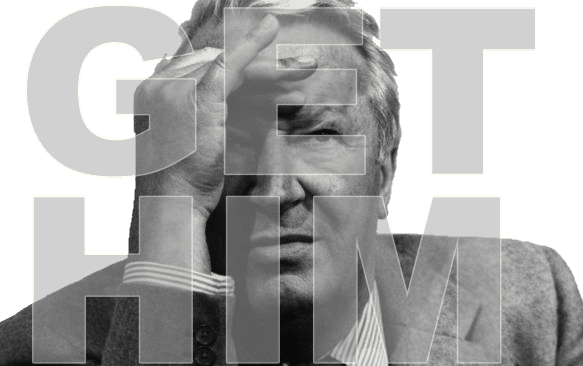
All in all, Bourke was persona non grata to the British establishment. Therefore, to be told by a leading Irish diplomat that he was in Belfast provoked a flurry of exchanges between Belfast and London. The declassified document shows a prime ministerial command from Ted Heath to ‘get him’, reflecting years of exasperation at Bourke’s media taunting of Britain by Bourke.

Alas, the declassified files do not detail the flurry of activity unleashed by Heath’s command in Belfast to catch Bourke, but we do know he was not captured.
Bourke had hidden Blake at a flat under a mile from Wormwood Scrubs after the break out. The fugitive pair laid up to watch the BBC main evening news where a mug shot of Blake flashed up as lead sensation. Bourke had installed champagne and theatrically raised a glass to Blake with the incantation, ‘Mischief thou art afoot’, a sop to his time in the South London Shakespeare Society, where he imagined he might emulate the migrant trajectory of his cousin, actor Richard Harris.
As I learned when researching my twin biography of the pair, Bourke regularly telephoned Roly Watts the commander of the Special Branch office at the time of Blake’s escape. ‘Why don’t you visit me in Limerick’, he invited Roly, to which the office responded ‘Sean why don’t you come over and collect your old Humber car? It’s still in the Scotland Yard garage?’, Watts wearily recalled when I interviewed him in the stark office of Saladin Security, off Sloane Square where he worked post-retirement.

Bourke got to emulate notoriety and manipulation of media headlines, all the while chasing the cliche of fame and fortune he imagined could fulfil appetites since adolescence. They were, however, to remain unrealised as an adult, save for periodic parabolas of media excitement. The life of Sean Bourke was of trembling chaos which required excitement and the proximity of danger to make him feel alive, to disperse the anxieties of despair and depression, deepened by alcohol.
Hence the flirtations with the IRA who gave him a pistol when he returned from Russia, as he claimed Britain’s secret service, in revenge for the escape would kidnap him in Dublin.

Bourke’s time back in Limerick was marked by drunkenness and attention seeking. When restored from refusal in a pub, he hired the Boherbuoy Brass and Reed Band to march up a main street to the hostelry, himself at the head, paid for drinks all round. Centre of attention, where he constantly yearned to be. No surprise that he would be in Belfast when he was wanted by UK authorities. Wherever his bones are in St Lawrence cemetery , I imagine they are rattling with satisfaction at the resurrection of British classified documents in which he is prominently mentioned.
He will give an extra shake at being mentioned in No 10. ‘Gotcha!’

BLAKE AND BOURKE by Kevin O’Connor , Prendeville Publishing , London 2003. A DEATH IN JANUARY, a radio documentary about the life of Sean Bourke (RTE Player), includes the original recording of the two-way radio chat preceding the escape.