I met friends of Gusty Spence in the mid 1960s when I ran a small business that dad had formed in the early 1940s after I was born. I joined the Orange Order in the early 1960s, and often sat beside Gusty’s brother, who thought highly of him and said of someone who had criticised Gusty that he was not worthy to tie Gusty’s shoelaces. Later I met two other men who said they were UVF members. One was a friend of Gusty and had come from the same area in the lower Shankill. I was then revising my politics and asked one of them to introduce me to Gusty, and that was the beginning of a friendship that continued for many years.

Gusty had been imprisoned for 18 plus years and from a very early stage he was rethinking his politics and tried to understand the circumstances that made this country what it was. Like myself he read, thought and discussed our history. Meeting him gave me hope for better things. A friendly Policeman had seen Gusty sitting with a book reading as he often did.
Gusty enjoyed meeting many Loyalist and Republican prisoners and when he returned to civilian life, he was a new man with a greater appreciation of NI politics and the need for change. I was impressed by what I knew of his life in prison and was keen to meet him and to learn more about his thinking and that of other prisoners. I felt I would like to meet some of them in the prison to learn what it was like to be there.

I first met Gusty shortly after his release from prison when he was working in premises on the Shankill Road. I met him regularly after that at his own home and found we had much in common. I was never a member of the UVF or the UDA but like Gusty my views had changed significantly, and I was open to new possibilities. Gusty told me to contact William Plum Smith who arranged for me to meet Loyalist prisoners inside the Maze prison. I will never forget meeting the prisoners. I expected to spend up to an hour with them, but our discussion went on and on for four hours and I enjoyed every minute of it.

In prison Gusty was in contact with other Loyalists and Republican prisoners and met influential people like Cardinal Tomás Ó Fiaich and academics like Frank Wright and he made a big impression on all he met. He met Jim Lynch, a leading OC of Republicans in Cavan/Monaghan who was providing facilities for needy children from the Shankill area during the summer months in Cavan. Gusty introduced Jim Lynch and his wife Norma to me and attended meetings I spoke at in the Boyne Valley Hotel.

On the journey to Cootehill we called to the home of one of my Monaghan friends with Dr Tony Buckley of the Ulster Folk Museum and presented the big drum that had once been used by the Hand and Pen Lodge. The Lodge had once received strong support from local people and the band was successful in various competitions in the Republic.
Some of my information on the band came from Jimmy Bothwell who lived in north Monaghan and he had documents relating to the Lodge and Band of which he had been a member. When I last visited him with one of my sons, he had been through an ordeal returning from a Black Institution meeting when the IRA took him and his friend captive. They shot Jim’s friend dead and left his body in a ditch at the side of a road. Jim however was taken home and would have resisted but had lost an arm after a horse kicked him. The IRA never attacked or hurt him. He was a kindly old man who was looking after a duck and her ducklings in his barn. He gave me information on the Hand and Pen Lodge 597 and band of which he had once been a member.

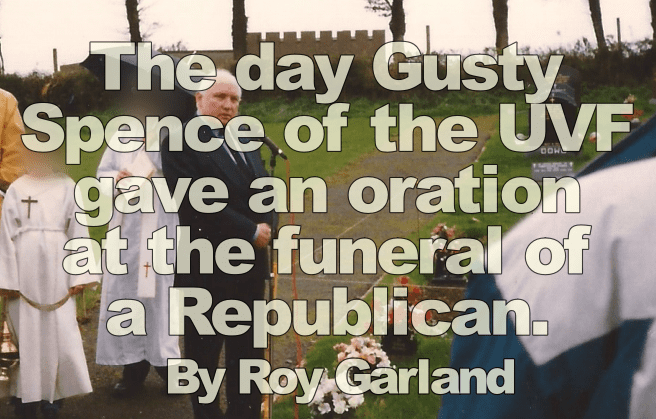
Jim Lynch wished to find out more about the Orange tradition and he and his wife and a sister, who was a nun, accompanied me to an Orange festival in Windsor Park Belfast. Jim was keen to meet Orange Grand Master Rev Martin Smyth, who readily agreed, and Jim was overjoyed to meet this prominent Orangeman. They greeted each other kindly, and it was a lovely day for all concerned. Sadly, Jim Lynch died later but a very unexpected and helpful event followed when Gusty and I attended Jim’s funeral in Cootehill County Cavan. I drove Gusty to the local Catholic Church service at Cootehill and on the way we delivered the drum to a friend.

Afterwards we met with the others at the graveside. As we stood there at the graveside, a relative of Jim Lynch asked me if Gusty would say a few words at the graveside. Gusty readily agreed and spoke of the cuff. According to the Irish Times Jim Lynch’s wife Norma said that same day, “the late Catholic Primate of Ireland, Cardinal O Fiaich, had said “if there was a hope for peace in Ireland it would come through Gusty.” The Cardinal often spoke highly of Gusty and he also gave support to relatives of John McMichael after his murder. She said when Jim first contacted Gusty “it was like talking to someone we had always known.” She also said Gusty was “an eternal optimist” and he was quoted in the Irish Times saying:
While the talks may be slow, they are the only glint on the horizon… We have to get in there, and stay in there, it took several hundred years to bring about this situation, so we must have a little bit of patience. Progress is being made, inch by inch. Slowly.[1]
An article in the Independent said,
The two men met through a mutual acquaintance, Ireland’s late Catholic Primate, Cardinal Tomas O’Fiaich, who had met Mr Spence in prison…This unlikely dialogue led to a celebrated present from the loyalist of a prison delicacy, tobacco soaked in poteen, to the fellow pipe-smoking cleric. Mr Spence told the Cardinal gleefully it was made illicitly in a secret still by the loyalist inmates in the Maze Prison.[2]
It was small steps that made new things possible. We need to respect those we do not agree with. At the opening of the hall at the Ulster Folk Museum people from all background across Ireland gathered as a mark of respect at the opening. Most were members of the Guild of Uriel who for twenty years had sat together in County Meath under the chairman ship of Julitta Clancy and Roy Garland. We brought people together from all backgrounds in both part of Ireland to speak together in peace and mutual respect in what turned out to be dynamic and fruitful encounters. The Hall was donated to the Ulster Folk Museum in 1989.
[1] Irish Times 2 November 1996.
[2] Independent 2 November 1996.
