
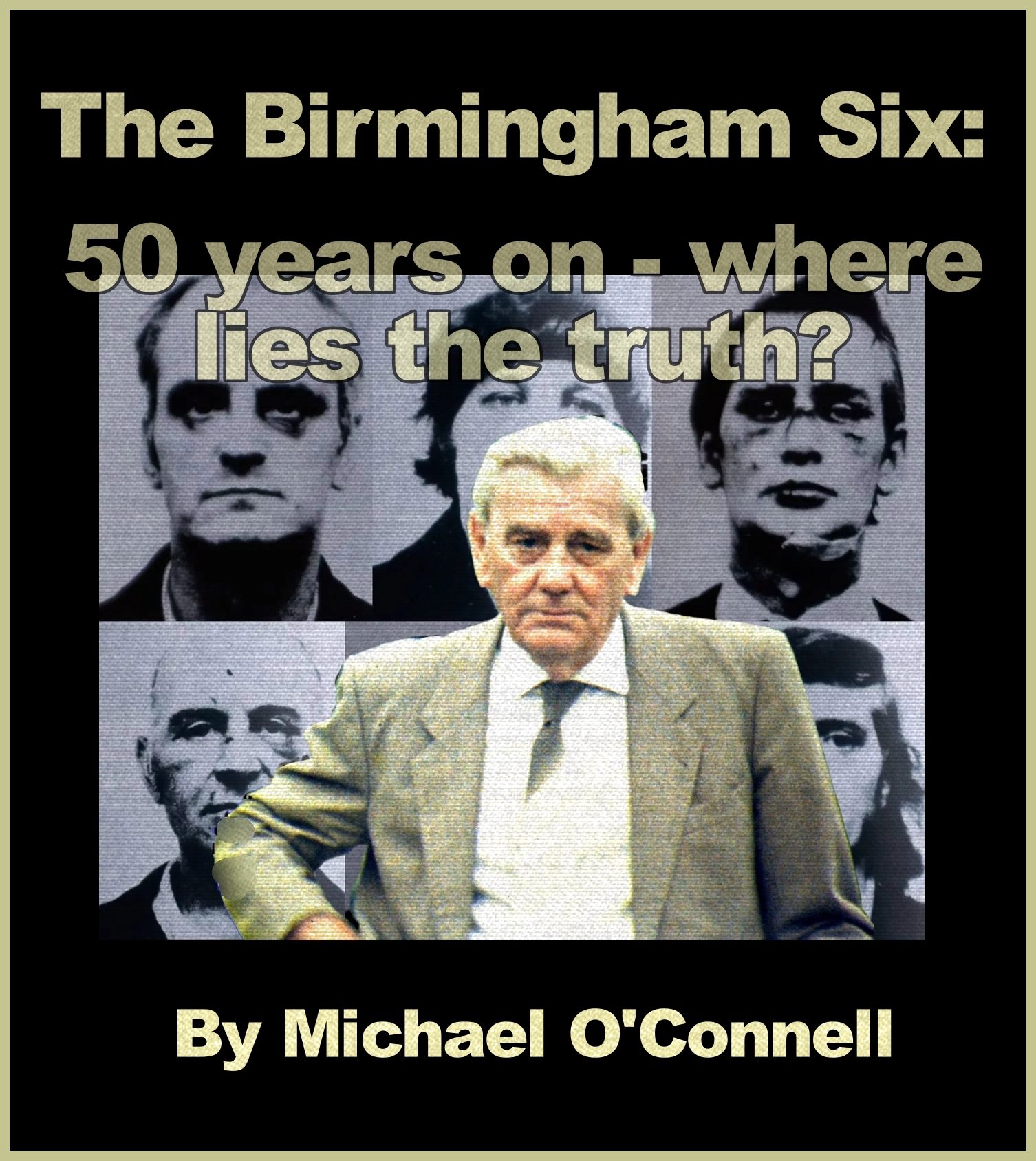
The author of this article, Michael O’Connell, arrived in Ireland with his family from England in 1939 at the outbreak of the Second World War. He was then two years of age. After returning to England he was educated by the Marist Fathers and then at the Inns of Court Law School in London. He was called to the Bar of England and Wales in 1966 and to the Bar of Ireland in 1977. He retired from practice in 2006. He was for 15 years the honorary legal adviser to the Catholic Social Services for Prisoners, (now the Bourne Trust), which helps serving prisoners and their families. He has a master’s degree for research into the powers of arrest, detention and interrogation of An Garda Siochana. He is the author of several books, including ‘Delusions of Innocence; the tragic case of Stefan Kiszko’ published in 2017. He now lives in Ireland.


**********
The Birmingham Six – 50 years on – where lies the truth?
In October 1993 three former West Midlands detectives appeared before a judge and jury at the Old Bailey in London accused of perjury and conspiracy to pervert the justice arising out of the conviction of six men, universally known as the Birmingham Six. The Six had been convicted on 15 August, 1975 of twenty one murders that occurred in the bombing of two pubic houses in Birmingham on the evening of 21 November 1974. Fourteen men and seven women died in the Mulberry Bush at the foot of the Rotunda and the nearby Talk of The Town, an underground bar below the Tax Office in Birmingham city centre. Two hundred and twenty people were injured. One police officer who attended the scene told me that the sight of the dead and the sounds of the dying was something he would never be able to forget. The Six innocent men spent almost seventeen years in prison before they were freed by the Criminal Division of the Court of Appeal on 19th March 1991.

The Old Bailey jury was sworn in to try the three former police officers and to return a verdict in accordance with the evidence. The accused men were ex-Superintendent George Reade, ex-Detective Sergeant Colin Morris and ex- Detective Constable Terence Woodwiss. The jury retired to their room while defence counsel, notably the late Edmund Lawson QC, (who also appeared for the defence in April 1993 in the case of the three former Surrey police officers acquitted of fabricating and falsifying evidence against four individuals collectively known as the Guildford Four), addressed the trial judge in their absence. The defence sought to have the trial stopped. However, amongst the matters that required explanation was the forensic evidence that notes of police interviews had been rewritten, and that a schedule prepared by the senior investigating officer in the case George Reade was allegedly a blueprint for perjury. At the Birmingham Six trial in 1975 one of the accused, Patrick Joseph Hill, had claimed in his evidence on oath that he had been interviewed by three officers on Saturday 23 November at Queen’s Road police station. That was forcefully denied by the police. In that schedule, which was concealed by the police in 1975, there appears a record of the interview which is then crossed out. When he was interviewed by the Devon & Cornwall police and asked to explain that schedule George Reade gave a number of conflicting explanations, including his claim that he had prepared it for the use of prosecuting counsel at the trial. It was neither used nor asked for by any counsel in the case. Mr Lawson did not address that point at all. It was easier to ignore it than explain it.

For three days the defence argued that Reade, Morris and Woodwiss could not receive a fair trial because of the ‘saturation publicity’ that surrounded the freeing of the Birmingham Six after their successful appeal. Mr Justice Garland, the appointed trial judge agreed with the defence submissions. He ruled that ‘the volume, intensity and continuing nature of the publicity referring to the case has made the Birmingham Six synonymous with forced confessions, and that specific publicity directed at the three accused added personal prejudice to general prejudice against them’. The jury was sent for and without hearing a single word of evidence they were directed by Mr Justice Garland to return verdicts of not guilty and they did so. They had no other choice. The three retired officers left the court without making any public comment to the media. Apart from saying the words ‘Not Guilty’ to the indictment with which they were charged and read out to them in the courtroom, just like the three former Surrey officers at their trial in April 1993, they uttered not a single word in their defence.

The following day an editorial in the Independent newspaper dated Friday 8 October 1993 called the judge’s ruling a ‘final insult’. It claimed he appeared to be ‘half-hearted’ and that he had made a terrible error by abandoning the case against the three former police officers. ‘He said that publicity prejudicial to a fair trial prompted his decision. As an explanation, that is deeply disillusioning – a final insult to people who spent 16 years in jail for crimes they did not commit……..And the authorities have yet to identify those who framed the wrong people’.

The background to the case is to be found in the events of Thursday, 14 November 1974. James McDaid, originally from Belfast but living in Birmingham died instantly when an explosive device he was planting at the Central Telephone Exchange in Little Park Street, Coventry went off unexpectedly and without warning at 8. 25 p.m. on that Thursday evening. It was known only to a few in the area that McDaid was a member of the IRA. He was better and widely known as a talented singer in the predominately Irish pubs in the Birmingham area. The closely knit Irish community in Birmingham was shocked beyond belief at the news of his death. Some decided they would travel to Belfast on the day that James McDaid’s remains were being returned to Belfast for burial. That was fixed for the following Thursday, 21 November 1974. They decided that some of them would take the 6.55 boat train from New Street railway station in the centre of Birmingham to Heysham in Lancashire, followed by the ferry to Belfast. The railway station was within walking distance of the two bombed public houses.

The six men involved in the discussions about travel were as follows, listed in the order in which they were charged on indictment at their trial in Lancaster Crown Court between 9th June 1975 and 15th August 1975. William Power, then aged 29, a native of the Ardoyne, a predominately Catholic, working class, Republican area of North Belfast had left there in 1963. He eventually ended up in Birmingham. He had taken a bus from his home in Cranwell Grove, Erdington in that city, where he lived with his wife and four young children, to New Street station. He arrived there at about 6. 30 p.m. expecting to see the others and together they would catch the earlier train to Heysham, leaving New Street station at 6.55 p.m. He too was unemployed so there was a difficulty over raising the fare. He borrowed £9 from his wife and £5 from her brother to cover the cost of the ticket.

Hugh Callaghan was born in the Ardoyne district of Belfast in 1930. He was one of nine children. He left that city in November 1947 and moved to Birmingham. He was only 17 years of age at that time. He obtained employment in a factory. He married in 1956. There was one daughter of the marriage, Geraldine, born in 1958. At 44, he was the oldest member of the group of Six. His wife Eileen from Ballina in County Mayo, worked part time as a school dinner attendant. His daughter Geraldine began her first job in a Birmingham office in the summer of 1974. His physical health was not good. He had not worked for some years. He did not find life easy. He had travelled on the No. 5A bus to New Street station and later on, on Friday 22 November, he returned to his home and family where the police were waiting for him. How the police discovered his identity and his home address is not known.

Patrick Joseph Hill (Paddy Joe) is a native of Belfast. He was born on 20 December 1944 in the Ardoyne. He went to Birmingham in 1960. There he married a local girl. He had some difficulty with raising the fare to Belfast, which was £12.69 for a return ticket and £7.51 for a single. He was unemployed at the time, and had to rely on social security benefits to support himself, his wife and their six children all of whom were under the age of 14. The youngest child, a boy, was only two years old. Paddy Joe asked a Catholic nun in a local convent, Sister Bridget of the Little Sisters of the Assumption, for a loan of £15 and she gave it to him. He told her the reason for his return home to Belfast was to see an elderly relative who was ill. That was true, although the primary purpose of the visit was to attend the McDaid funeral in Belfast. It is doubtful that she would have advanced the money if she had been told the entire truth.

Paddy Joe Hill left home carrying a small case, stopped at the Crossways public house for a drink, left there about ten minutes past seven and took the 42K bus to New Street Station, intending to catch the 7. 55 p.m. boat train (not the earlier one the others intended to catch) to Heysham and then the overnight ferry from there to Belfast. He arrived at the train station just after 7. 45 p.m. At his trial Harry Skinner QC, leading counsel for the prosecution, assured the jury that the suitcase he carried contained a bomb. No evidence in support of that contention was ever adduced by the prosecution.

Four of the accused men made written confession statements. They did not agree in those statements, written for them by the police, on the number of bombs they planted. The number of bombs varied from three to seven. The manner in which they were carried, two of the Six said in parcels, while three said in plastic bags, and the numbers of bombs in each pub varied from one individual to another. Some that there were two bombs left in the Mulberry Bush but the numbers in the Tavern in the Town varied from one to five. The Appeal Court in 1991 did comment on this conflict in the confession evidence, (noting at page 318 of the law report) ‘by way of example, Walker said he went with Hunter to place his bomb in the Tavern in the Town. Callaghan said he went with Hunter to place his bomb in the Mulberry Bush. So Hunter was in two places at once. There were also inconsistencies with the facts now known. Thus Power said he placed his bomb by the juke box in the Mulberry Bush. The scientific evidence showed that could not be right.

In his autobiography ‘A drink at the Bar’ Graham Boal Q.C., (later an Old Bailey judge), who was leading prosecuting counsel at the successful appeal of the Six in March 1991, stated at page 197 that there were two time bombs involved.[1] He had been instructed by the Director of Public Prosecutions, Sir Alan Green Q.C., and the Attorney General, Sir Patrick Mayhew Q.C., not just to conduct the appeal but to oversee every stage of the police investigation from the day in August 1990 that the Home Secretary, David Waddington Q.C., had referred the case back to the appeal court for a third hearing. It is my view that Mr Boal knows more of the detail of this infamous case than any other person working within the criminal justice system in England and Wales. The scientists who examined the debris in the public houses were unable to decide whether there was one explosive devise or two placed in each one of the two bombed premises. If Mr Boal, who had access to every piece of available evidence is right, and I think he is, one wonders why there were six members of a bombing team required to place two bombs.
If Paddy Joe Hill had one bomb, one wonders why it required five others to convey the second bomb to the scene of the crime.

Robert Gerard Hunter is a native of the Ardoyne and left there for the UK at the age of 17, ending up in Birmingham in 1963. He was married with three young children. He knew James McDaid and his family well. He was a painter by trade, but had not worked for the previous seven weeks, so money was in limited supply. He borrowed the cost of a single ticket from Richard McIlkenny and John Walker. Much was made of the fact that the single ticket indicated he had no intention of returning to Birmingham, at least not in the short term. He too took the number 5A bus to New Street railway station with Noel Richard McIlkenny, then aged 40, a married man with six children, a native of the Ardoyne in Belfast, who had only met James McDaid about five times in all, although his wife was a cousin of that family. He was working in a factory and had sufficient money to buy a return ticket to Belfast.

John Walker, whose date of birth is shown on a police statement as being 13 April 1935, so that would have made him 39 years old at the relevant time, was from the city of Derry. He left there in 1952, eventually settling in Birmingham. He was married with seven young children. He knew James McDaid and his wife and young child when they met on social occasions in local clubs and pubs in the Birmingham area where McDaid frequently sang. John Walker was working and could afford a return ticket to Belfast. He was carrying with him in his bag a total of 21 Mass Cards for the McDaid family. It is part of the Catholic tradition, most especially in Ireland, that a Catholic priest should be asked to celebrate Mass for the repose of the soul of a deceased person at the request of friends or family of that person. A funeral card was also found in his house when it was searched. That printed funeral notice described James McDaid as a lieutenant in the IRA. McDaid of course never disclosed his membership of that organisation to anyone who did not need to know. The jury at the Lancaster trial might well have attached significant weight to this evidence as being not sympathetic to, but supportive of, the IRA.
John Walker was the fourth traveller on the number 5A bus. It seemed not to have troubled anyone, least of all the jury at the trial, that an Active Service Unit of the IRA had to search around at the 59th minute of the 23rd hour for cash to pay for the journey, use public transport to get to their destination, risk being stopped and searched by the police on route, presumably carrying explosives, and presenting a danger not only to others but also to themselves, as part of a conspiracy to kill other totally innocent people.

If this was a planned operation undertaken by a terrorist organisation, would the participants have really had to borrow money for the journey to the crime scene? If the nun had not provided the loan to Paddy Joe Hill, what would he have done with the bomb he was alleged to have carried to the railway station? Why was he intending to take a later train than his alleged accomplices? Would they not have been a planned route of escape? Would they not have separated leaving the scene? Instead of buying rail tickets in the booking office at New Street Station and travelling together, drinking and playing cards on the train, thereby drawing attention to themselves by doing so, why did they not go in different and opposite directions? What did they expect to happen once the five arrived in Belfast? Where would they live? Would they have expected a hearty welcome from anyone? Would they have expected to escape detection and arrest by the Royal Ulster Constabulary in Northern Ireland and perhaps most important of all, when in the future would they expect to see again their wives and 27 children? Would they have left those women and those children, the oldest of whom was only 16 years of age, to face the unmitigated hatred and threatened violence of those who would seek them out and inflict harm upon them? If Hugh Callaghan was part of the conspiracy to bomb the two public houses in Birmingham city centre, why was he still at home and arrested there on the night of Friday 22 November 1974 more than 24 hours after the detention of the other? Would he not have gone on the run to escape detection if he was involved? Would he not have been tipped off to leave home? It is a fact that not a one single eye witness ever claimed to have seen any one of the Six convicted men in or even near the bombed public houses which were within walking distance of the railway station.

Five of the Six travellers were detained by police at Heysham on the night of 21/22 November. The fifth man, Hugh Callaghan, was arrested late in the evening of the following day at his home in Birmingham.
On Sunday, 24 November 1974, the West Midlands police called a press conference; this was three days after the dreadful public house bombings. The atmosphere was electric. The police were ecstatic. They were convinced they had caught the bombers and were prepared to say so. They had written confessions from four of the six, and allegedly self incriminating remarks from the remaining two. At that time someone decided to dispense with the right to a fair trial before an impartial judge and an unbiased jury and spoke openly of the guilt of the six men. It was, in my view, a deliberate and callous decision made to ensure that whatever criticism might be directed at the police for their alleged violent treatment of the six in police custody in order to obtain the confessions and admissions, that mattered little if the police had arrested the actual bombers.

Certainly this tactic ensured a conviction before trial, rather than at it. The prejudicial statements, which was widely reported in the media, were clearly in breach of Article 3 of the European Convention on Human Rights were as follows:
‘The Assistant Chief Constable, Maurice Buck, addressed a crowded press conference. “We are satisfied” he told the assembled journalists “that we have found the men primarily responsible but enquiries will continue very actively in respect of other matters. He called for continued vigilance, and no reprisals. He said there had been incidents in this city and elsewhere which have been attributed as backlash or reprisals. I urgently need to continue the enquiries into the outrages at Birmingham on Thursday”.’ [2] In other words, he told the press, we have arrested the guilty men, the Birmingham bombers. For a senior police officer, was this a case of “let’s not bother with a trial, these are the ones that did it?” It is a matter of record that none of the defence counsel in the case subsequently raised this point and argued it deprived the Birmingham Six of a fair trial. It is now unlikely that we will ever be told why they did not.

Damning as it was however, Maurice Buck’s prejudicial statement was outclassed by one made in the House of Commons by Jill Knight, the Tory Member of Parliament for Birmingham Edgbaston, a politician who could not be described as ‘publicity shy’. She told the House on 11 December 1974, (so 17 days after Buck’s comment), “There was a backlash after the Birmingham massacre and it was held in check because people realised that new measures were being taken by the Home Secretary to protect them. Now they are not so sure. They want to know why the Birmingham bombers were not charged with treason, for which the punishment is death. It seems probable that they were guilty of treason (Hon. Members – ‘oh’). They have been apprehended, and it seems very likely; that is all I say. It is astonishing that all members opposite have so little faith in the police that they believe they have got the wrong men.”[3]

There was no reprimand from the Speaker of the House for this outrageous comment, nor did anyone suggest that she should withdraw her remarks. Mrs Knight clearly favoured conviction before trial, and the imposition of the death penalty, which was still in force for treason. To call the six men in police custody the ‘Birmingham Bombers’ prior to their trial might be regarded by most people as inconsistent to their right to a fair trial.
Whatever may be the answer to those questions, it is a fact that following the acquittal of the three former police officers at Lancaster the Sun newspaper published an article headed ‘Sue us challenge to Birmingham 6 by cops in the clear’.
It quotes a statement by ex-Detective Sergeant Michael Hornby in which he said “We would be happy if the Six sued. It would give us the opportunity to produce all the new evidence we know exists and clear the name of the officers involved in the case once and for all”.

Michael Hornby was one of the longest serving members of the Serious Crime Squad (SCS) of the West Midlands police, He was in post from 1974 to 1989 when the Squad was disbanded in disgrace. Officers of that Squad took an active part in the investigation of the Birmingham pub bombings. Michael Hornby was the officer who obtained a confession statement from Hugh Callaghan, without which he would not have been convicted of any offence. All that could be said against him was that he travelled to New Street railway station with the five others and eventually went home to his wife and daughter. A full and complete written confession was required; Hornby was tasked to obtain it and he did.

The Serious Crime Squad, or “The Serious” as they liked to be known, was first formed in February 1952 in the City of Birmingham police as an experimental unit to assist the work of the regular Criminal Investigation Department, the CID. At first it was known as the Special Crime Squad. After a number of changes and reorganisations in April 1974 the Squad was given the name it bore until its disbandment on 14 August 1989 within the enlarged West Midlands police. Their first major case was their investigation into the Birmingham public house bombings.

Members of the Squad regarded themselves as an elite police unit, dealing with ruthless and dangerous criminals committing serious crime, mainly armed robberies against soft targets, and their speciality seemed to be the obtaining of evidence, especially confession evidence, in cases where but for that evidence there would be no convictions. They worked in groups of three, known as a crew, with a detective sergeant, detective constable and a uniformed constable acting as driver. The total number of officers in the Squad is difficult to establish; it seemed to be between twenty five and thirty five at any one time. Applications to join the Squad from members of ethnic minorities or by female officers were not numerous, perhaps on the basis that they were not likely to be successful. The Squad operated a very closed shop, working very long hours, maintaining its own sources of information and contacts in the criminal fraternity. As a sign of its exclusiveness and solidarity, it even had its own distinctive brand of clothing, a neck tie with a swooping eagle as the emblem.[4]

A number of officers of the Serious Crime Squad including Detective Sergeant Michael Hornby, were at the forefront of the investigation into the Birmingham pub bombings. His name appears with some frequency in the Law Reports. He was awarded the Queen’s Police Medal on his retirement. That honour is bestowed on police officers in the United Kingdom for gallantry or distinguished service.
Hornby was the subject of an Early Day Motion (EDM 516) dated 26 February 26 February 1996 tabled by Chris Mullin, Labour MP and later Minister, in the House of Commons the text of which reads as follows:

“That this House notes that the career of Detective Sergeant Michael Hornby, one of the West Midlands police officers who persuaded Mr Hugh Callaghan, an innocent man, to confess to the Birmingham pub bombings, was dogged by allegations of similar malpractice; further notes that records disclosed by the West Midlands police show that during his time with the now notorious Serious Crimes Squad Mr Hornby was the subject of 37 complaints and that, of the 20 for which files exist, most allege fabrication, perjury and duress, or a combination of all three, notes with interest that the wording of one of these alleged confessions, extracted from Mr Leo Morgan in 1996, bears a remarkable resemblance to that obtained by Mr Hornby 12 years earlier from Mr Callaghan; is not surprised that, so far as it is possible to tell, not one of the complainants against Mr Hornby, who is probably the most complained about officer in the most complained about police force in the country, was awarded the Queen’s Police Medal and that the citation should describe him as ‘a superb detective officer’ who ‘imports valuable experience to junior detective colleagues who benefit great from the excellent example of professionalism which he sets’; and believes that the West Midlands police are better off without Detective Sergeant Hornby and his like”[5]. The Motion was signed by 27 Members of Parliament.
The reference to the absence of some 17 files will sound a cord with those involved in a number of cases where exhibits, documentary and otherwise, seemed to go missing without any sort of explanation for their non-appearance.

A second Early Day Motion, EDM 517, relating to former Detective Sergeant Michael Hornby was also tabled by Chris Mullin M.P., on 26 February 1986. It reads ‘That this House notes that former Detective Sergeant Hornby was one of a number of West Midlands police officers complained about by Mr Derek Treadaway who alleged that he had been persuaded to confess to a crime of which he was innocent by having a bin liner held over his head, and notes that after nine years in prison Mr Treadaway’s conviction was quashed and he was awarded £50, 000. 00 compensation”. That motion attracted 27 signatures of members of Parliament.
I have been unable to find a single case where that officer was described by a trial judge as being either gallant or giving distinguished service. I did discover however a reference to Detective Sergeant Michael Hornby’s ‘… misconduct was calculated to lead to false convictions by the very invention of untruthful evidence’.[6]
He was allowed to retire from the West Midlands Police on health grounds very shortly after the Serious Crime Squad was disbanded in August 1989. In consequence he had not been subjected to disciplinary proceedings which the Police Complaints Authority might otherwise have thought appropriate had he still been a serving officer.

Later, in the judgment in the O’Toole and Murphy case, Lord Justice Laws said, citing another case, that ‘there is other material before the court, into the detail of which it is unnecessary to go, to show that DS Hornby was deeply involved in the reprehensible activities of the West Midlands Crime Squad prior to its abandonment’. For good measure Lord Justice Laws later added ‘The appellants rely on further details relating to Hornby gleaned from the reports of the Shaw Enquiry and associated materials, which have been disclosed by the Crown.
It was further noted that Detective Sergeant Michael Hornby was involved in the case of Jones and others in Wolverhampton Crown Court in 1987. Hornby gave evidence relating to an interview where scientific tests showed that two pages containing admissions were written at a different time from the rest of the interview and then inserted between existing pages of notes. He was also involved in the case of the Gaul brothers and Daniel Lynch, where he was found to have been involved in the suspicious disappearance of a file of witness statements and the manufacture of offences which an informant, Jarvis, later asked to have taken into consideration by the sentencing court.

Lord Justice Laws recounted the criticism directed at this officer by Lord Justice Rose in the case of Derek Treadaway where he said – “There is other material before the court, into the detail of which it is unnecessary to go, to show that Detective Sergeant Hornby was deeply involved in the reprehensible activities of the West Midlands crime squad prior to its abandonment.”[7]
In the case of Michael Dunne and others, counsel for the Crown accepted in the appeal matters for which chapter and verse is given. The court said ‘The important fact here, as it seems to us, is that the Crown have categorically accepted that Hornby cannot properly be relied on as a witness of truth’.[8]
On 11 July 1987 four men, John Bullivant, Hubert Forbes, Leo Morgan and Wesley Stewart were acquitted by a jury at Birmingham Crown Court on a charge of conspiracy to rob.
Detective Sergeant Michael Hornby and Detective Constable Hugh McLelland interviewed one of the accused, Leo Francis Morgan at Steelhouse Lane police station. It was claimed that a contemporaneous record of the interviewed was made. Another officer, Police Sergeant Dugmore was alleged to have been there; no information as to who wrote the notes is available.

Detective Sergeant Hornby invited Leo Morgan to sign the caption at the top of the written record. He declined to do so. It is not known why. He was shown a series of photographs which appeared to show that he was in the general vicinity of Barclays Bank in Hockley in the city of Birmingham in the company of Wesley Augustus Stewart. Leo Morgan was asked to comment on why he was in that vicinity. He didn’t. He merely admitted he was with Mr Stewart. He was shown another set of photographs, showing the two men in what Detective Sergeant Hornby described as ‘….in the vicinity of Barclays Bank and also the National Westminster Bank in Well Street at Gt. Hampton Street…. Why were you there at that time?’. Leo Morgan replied, ‘at this stage I will say we were just looking around at some premises. That’s all I want to say about that just now’.
He was then questioned about his use of some motor vehicles, some of which he admitted he knew were stolen. Detective Sergeant Hornby then showed him more photographs and told him that he and Mr Stewart were seen leaving a café together and then standing at a bus stop. This was about 10. 00 a.m. when a delivery was made to Barclays Bank in Gt. Hampton Street. He was asked ‘why stand at bus stops? Why hang around there?’
According to Detective Sergeant Hornby’s witness statement ‘Morgan sat with his head between his knees. He then said. “My God, I’m done!”. Morgan started to sob.
I said, “we will stop for a moment to give you a chance to pull yourself together”. At 10. 15 p.m. there was a coffee break. At 10. 20 pm. We resumed and I said, “Leo, we will resume now. Are you fit enough?” Morgan replied “Just about. Carry on. What else have you got?”
Detective Sergeant Hornby then indicated how Leo Morgan and Wesley Stewart were seen driving off in separate cars, both following a Security Express van which had made a delivery or collection at Barclays Bank in Frederick Street near to where he and Stewart had previously parked. Both followed the van. Leo Morgan was asked why. He replied ‘I don’t think you need an answer. You know, don’t you?’
Detective Sergeant Hornby then said ‘you were planning a robbery, weren’t you? That’s why you were hanging about there? That’s why you followed the delivery van?’
Leo Morgan replied, ‘I am not going to deny it, but let’s see what else you’ve got.
More photographs were shown to him by the police officer. More than one showed him with two other men; he agreed they were Hubert Lloyd Forbes and Wesley Stewart and in reply to the question ‘for what purpose were you altogether? Leo Morgan replied ‘if you hadn’t got the photographs, I would never admit it, but we’re dead with those. We were planning a robbery. I can’t get round it.’
According to Detective Sergeant Hornby Leo Morgan started to break down, sobbing.’
The officer enquired, probably in a sympathetic voice, saying “take it steady now. Do want to tell us about it? Remember you are still under caution. Go and have a wash in the toilet.
The interview was resumed shortly after. More photographs showing Forbes, Bullivant and Stewart were shown to Leo Morgan. Those showing the men paying particular interest in a security van and bank premises, but some more compelling evidence was required for prove the existence of a conspiracy to rob. A confession would be ideal, and one duly appeared.
According to Detective Sergeant Hornby, Leo Morgan said ‘I wouldn‘t have believed it possible for us to get caught like that without spotting you lot…..We were going to do the blokes when they were making a call at Barclays Bank’. Asked by the officer, ‘which one?’ Mr Morgan replied, ‘the one at Well Street was favourite with the others, I fancied doing it up St. Paul’s Square.’ [9]
If this was a true and accurate record of this interview surely Leo Morgan had made an unequivocal confession to an offence of conspiracy to rob a bank. It did not turn out that way. On 11 July 1987 the jury at Birmingham Crown Court acquitted him and John Bullivant, Hubert and Wesley Stewart on the grounds that confession evidence was fabricated, evidence was planted, timings of interviews were inconsistent, evidence of visual identification was flawed and a relevant document in the case was missing. The reaction of the police officers involved is not known.
According to the Reade Schedule there was only one interview with Hugh Callaghan. There were other interviews but they do not appear in that Schedule. The entries show that the date of that interview was 23. 11. 74 and the time from 3.5 to 4.30 p.m. The officers involved were ‘DS Hornby & crew’. The interviewee is named as ‘Callaghan’ and beneath his name are the words ‘vol statement brought to Queen’s Rd. 5. 15 p.m.’
The voluntary statement reference is to the confession statement, allegedly made voluntarily, and of the maker’s own free will. Queen’s Road is the other Birmingham police station where the remaining five men were being interrogated and detained.

On Thursday 18 June 1975 Detective Sergeant Michael Hornby was called into the witness box by Mr Patrick Russell Q.C., to give evidence at the trial of the Six. The following is extracted from the court transcript of the proceedings.
Q. Is your name Michael Hornby? A. Yes, my Lord
Q. A Detective Sergeant in the West Midlands Police, attached to the Serious Crime Squad?
A. Yes, my Lord
Q. At 2. 30 p.m. on Saturday, 23 November 1974, together with Detective Sergeant Bryant and Detective Constable Davies did you go to the Sutton Coldfield Police Station?
A. I did.
Q. And in company of those two officers, did you see the accused Callaghan.
A. I did.
Q. Did you interview him?
A. I did, yes, my Lord
Q. What did you say to him?
A. May I refer to my notes?
Q. When was the note taken?
A. Immediately after the interview.
Q. Did you compile the note yourself?
A. I did, my Lord
Q. May he refer to it?
Mr Justice Bridge: Certainly
Mr. Russell: What did you say to him, Mr Hornby?
A. I said to Callaghan “You know why you are here, and I believe you wish to tell us the extent to which you were involved in the bombing incidents in New Street, Birmingham, during the evening of Thursday, 21st November 1974. Do you wish to make a written statement about this? If you do, you can write it, or I can write it at your dictation. I cautioned him and he said ‘Is it true sir, that all those people are dead and injured?’ “I said, Yes Mr Callaghan, as a result of those explosions, there are a large number of people dead and injured. Do you wish to make a statement? Callaghan said “Yes, I want to confess. Mary, Mother of Jesus, help me and forgive me”. He then threw his arms around Detective Constable Davies and sobbed on his shoulder. After some minutes I was able to console him and I then said to him, do you want to write the statement?

Q. Did you take down a statement?
A. I did, my Lord.
Mr Russell of counsel read the statement to the jury the next morning. In it Hugh Callaghan signed his life away for the following 17 years. His claim of ill-treatment in the police station was rejected by the jury that convicted him, believing as they must have done, that he openly and freely confessed to mass murder. They could not have known that Detective Sergeant Hornby had a repetitive capacity to encourage suspects in police custody to weep before they confessed, as the cases of Jimmy Robinson and Leo Morgan were later to establish. The statement had commenced at 3. 5 p.m. and concluded at 4. 30 p.m. During that time neither of the other officers, Bryant or Davies said a single word. One wonders why not? Was their presence not required elsewhere to make inquiries into what was at that time the worst case of mass murder in criminal history in England?
When the Devon & Cornwall police carried out their investigation into the case that led to the quashing of the convictions in 1991 they interviewed, amongst others, Detective Sergeant Bryant and Detective Constable Davies.
The Detective Sergeant was asked to explain in particular why Hugh Callaghan, having been interviewed by two officers named Higgins and Buxton in the morning of Saturday 23 November (which was not recorded on the Reade Schedule), was not further interviewed by the same two officers in the afternoon. Instead they were interviewed by three different officers of which he was one. I can find no explanation being offered for that.

Detective Sergeant Bryant was then asked why there were no preliminary questions at the start of the interview, and why three officers were needed to interview Hugh Callaghan in the cell and whether they were all sitting down. He seems not to have replied to any of those three questions. Does it not seem extraordinary that at the very outset of the interview it was expected that someone who had callously killed 21 innocent individuals should immediately cry, and then confess, to what he was supposed to have done?
He was further asked how Hornby managed to write down the statement (writing for one hour and 25 minutes, it will be remembered) in a cell occupied by four persons. Again I can find no response. He was then asked what did he use to rest the paper on? Again no reply is recorded. Detective Sergeant Bryant was asked why the interview was so shallow and no further evidence obtained and discrepancies between the six not followed up. The officer was asked why there were no follow up questions about the wrong placing of the bombs, for example Hunter had allegedly placed his at the wrong point in the Mulberry Bush and Callaghan on the main roadside of the Mulberry Bush. Again, if Detective Sergeant Bryant replied to these questions I cannot trace that reply in any of the documents available to me. One wonders why some of these rather difficult questions had not been posed at the trial, I have been unable to find any evidence that Detective Sergeant Hornby was asked these same questions. If he had been his replies would have been of considerable interest.
The Devon & Cornwall officers then turned to the evidence, or more accurately the lack of it, on the part of Detective Constable Davies, who had provided the comforting shoulder to the weeping Hugh Callaghan. He had not given evidence as a witness at the original trial of the six between 9 June and 15 August 1975.
The court was told during the holding of the ‘voir dire’, the trial within a trial held in the absence of the jury for the judge alone to decide on the admissibility of the confession evidence, that he was unable to attend to give evidence because he was ill, suffering from suspected appendicitis.
When it came to the trial proper in the presence of the jury, his absence was explained by his suffering from a nervous disability. Subsequent to that, when he was interviewed by the Devon & Cornwall police he stated that he was given time off for a domestic dispute. So there were three conflicting explanations for his absence from the witness box. According to the papers in my possession ‘Devon and Cornwall suggest that it was convenient to avoid his having to give perjured evidence’
When one looks at the Reade Schedule one finds there that Superintendent Reade had written the words; ‘Davies and Bryant will be o.k.’ Its interpretation is important.

At the appeal court hearing in 1990 Michael Mansfield Q.C. submitted the argument that Superintendent Reade had to ‘square up’ something with those two officers before entering their names in the Schedule, and it was for that reason he wrote ‘DS Hornby and crew’ without identifying the officers. He wanted to be sure that they would support the Hornby version of the interview but in the event, so far as Detective Constable Davies was concerned, he did not give supporting evidence on oath and his three explanations are in conflict, one with the others.
The appeal court then moved on to another entry in the Schedule which was described as ‘most puzzling of all’. Paddy Joe Hill had insisted in the course of his evidence at the 1975 trial that he was interviewed by the police on the afternoon of Saturday 23 November 1974. This was strenuously denied by the police. Yet on the Reade Schedule there is recorded from 3. 40 p.m. to 5 p.m. an interview at Queen’s Road police station with the prisoner – Hill – where the officers present are named as Detective Inspector Moore, Detective Sergeant Bennett (who was subsequently appointed as head of the Serious Crime Squad) and Detective Constable Brand. Under their names Superintendent Reade had written ‘Detective Sergeant Bennett leaves room at 4. 30 p.m. to 4. 40 p.m. to get information re Callaghan’s statement’. (It will be remembered from the above text that Hugh Callaghan’s statement, written by Detective Sergeant Michael Hornby, had concluded at 4. 30 p.m. that Saturday afternoon. Did that mean that Detective Sergeant Bennett went to Sutton Coldfield police station to collect the statement and bring it back to Queen’s Road, or would the matter be discussed over the telephone?).
Whatever the answer to that question it is immaterial because the entire entry in the Reade Schedule is crossed out with many lines crossing the page, and in the centre column under the name ‘Hill’ there is written the word ‘out’ and that is underlined three times.
When asked about this Superintendent Reade was unable to give any explanation other than he ‘must have been misinformed’. In summing up his role in the investigation the appeal court decided that the crossing out of the Hill interview on the Schedule ‘…..must cast additional doubt on the honesty and reliability of his evidence. It is highly reprehensible for a police officer to deceive the court. But it is another thing to be capable of organising a widespread conspiracy of deceit. We do not think we need go no further than to say, that on the evidence now before us, Superintendent Reade deceived the court. We do not think we should go further than that, without having heard Superintendent Reade, and the other officers alleged to be party to the conspiracy.[10]
The appeal court then moved on to consider the situation regarding the police failure to complete their records in the case, namely the charge sheets and the detention sheets. Some one in a position of authority had apparently given the order that the detention sheets should not be kept in the ordinary way. The court said that decision was taken at a high level. Does that mean by a senior officer? Why was this issue not raised by the defence at the trial in 1975? Why did the appeal court seek to discover who actually ordered that and why?
Oddly enough the scientific evidence relating to Hugh Callaghan’s partially completed detention sheet was of the opinion that the signature of Detective Sergeant Higgins was not actually his, but had been forged by none other than Detective Sergeant Michael Hornby. The appeal court did not accept that conclusion.
The Birmingham Six case has destroyed whatever credibility was attached to the activities of the Serious Crime Squad of the West Midlands police. Much of the responsibility for this begins, in my view, with the conduct over 15 years of Detective Sergeant Michael Hornby who, the evidence shows, was capable of falsifying and fabricating evidence on an industrial scale.

It was a less than crowded Chamber in the House of Commons when in the afternoon of Wednesday 25 January 1989, under protection of Parliamentary Privilege (which protects a member of Parliament from action for damages for defamatory statements) Ms Clare Short, the Labour member for Birmingham, Ladywood, raised the case of her constituent, Paul Dandy, and his treatment at the hands of some members of the Serious Crime Squad of the West Midlands Police. She told the House that whilst she investigated his case of false and fabricated confession evidence further serious allegations had been put to her by a number of solicitors and retired policemen in Birmingham alleging that the West Midland Serious Crime Squad had for many years been engaged in serious and widespread malpractice. That situation continued even as she spoke. ‘My constituent Paul Dandy was arrested in February 1987 and held as a Category ‘A’ prisoner for 10 months during which time he attempted to commit suicide.’ (He had slashed his wrists). ‘In November 1987 all charges against him were dropped because his solicitor had obtained forensic evidence which showed that his confession – the charge against him was based on his confession – had been forged by the police. The prosecution consulted its forensic expert, who confirmed the find and the charge was dropped…..the test showed that the crucial page containing Mr Dandy’s admission had been re-written and the confession inserted. It has not been there when the statement was taken. Not surprisingly Mr Dandy made a very serious complaint against the police….it amounts to a conspiracy to pervert the course of justice – forgery by the police in an attempt to frame an individual on a very serious charge….the case was investigated by the Birmingham police force…there was a long delay while inquiries were made….after that long delay the eventual finding was that the police were not to be charged with a criminal offences or even disciplined for having fabricated evidence. They were merely reprimanded for disposing of an original page of the statement.’
In the event Paul Dandy was awarded £70, 000 damages against the West Midlands Police. On 14 August 1989 the Serious Crime Squad was disbanded. The British Government had power to remove from Michael Hornby the Queen’s Police Medal but did not do so. There was more than one reason to do so. In the course of the murder inquiry into the brutal murder on 19 September 1978 of a 13 year old schoolboy, Carl Bridgewater at a farm in Stourbridge in the West Midlands, the police discovered that a criminal called Anwar ‘Spider’ Mohammad sold to another criminal a shot gun which was originally but wrongly believed to have been the murder weapon. In fact the gun was used in an armed robbery at a supermarket in Birmingham. That sale constituted a serious criminal offence. Mr Mohammad was not charged with any offence. He simply accepted a police caution which of course did not amount to a conviction. Evidence was later discovered that Mr Mohammad was a police informer whose handler was none other than Detective Sergeant Michael Hornby. Was that the reason for the caution? What part, if any, did Hornby play in this episode? Are we ever likely to find out?
[1] Published by Quiller Publishing in 2021
[2] The Guardian Mon 25 Nov 1974, article by Peter Chippindale
[3] Hansard 11 December 1974. Orders of the Day. Capital Punishment
[4] Unsafe and Unsatisfactory by Dr Tim Kaye. The Civil Liberties Trust
[5] EDM 516; tabled on 26 February 1996
[6] Transcript of the appeal court judgment in R –v- O’Toole and Murphy. (2006) EWCA Crim 951.
[7] Transcript of Appeal Court judgment 24 February 2006 at paragraph 32
[8] Ibid, at paragraphs 32 and 34 of the judgment.
[9] These comments are to be found in a witness statement made by Detective Sergeant Hornby, now in possession of the author.. .
[10] Transcript of the appeal court judgment (1991) 93 Criminal Appeal Reports at page 310.
