Introduction:
Dublin City was rocked by three car bomb explosions on 17 May 1974. The devices detonated in a coordinated fashion at approximately 5.30; all within ninety seconds of each other. Twenty-six people and a full-term unborn child (Baby Doherty) were slaughtered.
No warnings were provided.

Ninety minutes later, a fourth car bomb exploded in Monaghan town; again, without a warning. Seven people perished.
Approximately 280 people suffered significant injuries.

The three cars used in Dublin were hijacked in Belfast by a UVF gang led by William ‘Frenchie’ Marchant and supplied to UVF confederates who ferried them to Dublin.

Stuart Young of the UVF who bombed Monaghan.
The vehicle deployed in Monaghan was lifted in Portadown and taken across the Border by a unit of the Mid-Ulster UVF led by Stuart Young. It was driven by Samuel Whitten.

Insofar as the UVF was concerned, Billy Hanna was the mastermind of the attacks, but he was not acting alone.
The UVF was de-proscribed in May of 1974 by the British government. The order went through the House of Commons on 14 May and the House of Lords on 15 May. The legislation became effective on 23 May 1974.
1. London will not share MI5 and MI6’s files with Dublin.
The British government has been asked on a number of occasions for the files held by MI5 and MI6 relating to the bombings.
These requests were issued by the Barron Inquiry (chaired by a retired judge of the Irish Supreme Court), the Irish government, and by way of four motions passed by Dail Eireann (the Irish parliament).
They have all been rebuffed by London.
There is no doubt that MI5 (attached to Britain’s Home Office) and MI6 (Foreign Office) hold sensitive files.

When he was the Prime Minister of the UK, Tony Blair told the then Taoiseach, Bertie Ahern, that his intelligence services ‘probably’ had secret information about the slaughter. In May 2024 Ahern repeated his call for the UK to release the documents.
These files cannot be released because they would reveal that Britain’s intelligence services and the RUC special branch controlled the Glenanne Gang, the Loyalist organisation responsible for the slaughter.
2. The Corbet Lough conspiracy.
Charlie Simpson was a Loyalist terrorist. He was extremely friendly with Robin ‘The Jackal’ Jackson of the UVF. The Jackal drove the bombs to Dublin on 17 May. It can be revealed here for the first time that The Jackal told Simpson that:
‘the UVF in Belfast had been provided with pre-made explosive devices and scout cars were used to get the cars with the Dublin/Monaghan bombs on board safely delivered. The British did not organise the bombings but they supplied the equipment. Jackson mentioned people at Mahon Road army base in Portadown. He used nicknames of these people.

In his book, The Dublin Bombings and the Murder Triangle (2000), Joe Tiernan wrote of Billy Hanna that:
‘One former UVF man now in his seventies, who was a member of Billy’s squad and whom Gardai named as having been involved in the Dublin bombings, told me during research for this book that Billy worked as a UVF agent for army intelligence officers in Lisburn. He said two middle-ranking officers in plain clothes travelled down from Lisburn once a fortnight in a van to meet Billy and give him instructions on what they wanted done. They would visit his house from time to time and they took him fishing to Banbridge. I saw them in his house a couple of times through the window as I approached but as no member of the unit was allowed to meet them I turned and went home and saw Billy later. But mostly they met him away from his house in carparks or the like. They would meet him in Portadown, Lurgan, Banbridge or out the country somewhere. Occasionally when our unit met to plan operations someone might ask Billy a question about some aspect of the operation. If Billy did not know the answer his reply would be: “I’ll have to take advice on that.” No one pushed the matter further but everyone knew Billy was talking about the [British] army.‘ (Tiernan page 89-90)

Joe Tiernan wrote in The Sunday Independent in 1999 that on these fishing trips, which were to Corbet Lough, near Banbridge, Hanna and his handlers
‘planned the Dublin and Monaghan bombings throughout the early months of 1974. The Dublin and Monaghan bombings of 1974 … were organised exclusively by army intelligence officers based in Lisburn. The Sunday Independent has in its possession the names of four army officers as well as one RUC special branch officer involved.‘ (Sunday Independent, 16 May, 1999.
Billy Hanna’s grandmother was a Catholic. He reportedly hated her and was ashamed of his Catholic ancestry.
Hanna was born in 1929 to a labourer’s family. After leaving school, he found work in a factory in Banbridge that made shoe boxes and moved to Mourneview Estate in Lurgan. He later joined the Royal Irish Rifles and served in the Korean war. He also served in the B Specials and the Ulster Defence Regiment (UDR). He was refused entry to the ranks of the Orange Order on account of his grandmother’s Catholic religion.

Fred Holroyd, a military intelligence officer, kept detailed notes of the intelligence he collected while he was working in Portadown. He has shown them to me. The most significant ones are reproduced in Don Mullan’s book on the bombings. Mullan reproduces a key note (at page 274) wherein Holroyd recorded that William Hanna was providing bomb-making classes in the two months that ran up the Dublin and Monaghan attacks. Yet, the RUC special branch did not interfere with him, let alone arrest him. This only makes sense if he was a British agent.
The emerging picture suggests that a group of British intelligence operatives, along with Billy Hanna, plotted the Dublin-Monaghan attacks at Corbet Lough and other locations.
Hanna deployed his foot soldiers to execute the attack.
Significantly, Hanna’s UVF subordinates did not have face-to-face meetings with his British military contacts.
A year subsequent, Hanna was assassinated by his comrade, Robin Jackson.
Jackson was a British agent too.

It has long been suspected that Jackson worked with Captain Robert Nairac, a Dirty War British army undercover operative. Nairac answered to Denis Payne of MI5 who was based at Stormont Castle. Payne was in control of all British intelligence operations in Northern Ireland at this time. His title was Director and Controller of Intelligence (DCI). He was based at Stormont Castle, the same building that housed the office of the Secretary of State for Northern Ireland.

It can also be revealed here for the first time that Robin Jackson told his friend Charlie Simpson about his relationship with Capt. Nairac.
Simpson learned a lot about the Robinson-Nairac partnership. Simpson discovered from Jackson that Jackson:
‘worked hand in glove with [Captain] Nairac and [that Jackson] said that the British army officer [i.e. Nairac] had given the weapon to him. Nairac was passing information to Jacko on IRA people. Jacko bombed a pub in Dundalk and the bomb was made in an army base and was given to Jacko to go and plant it which he did.’
Once Jackson (a British agent) had eliminated Hanna (a British agent and Dublin and Monaghan bomb planner), the only living Loyalist witness to the Corbet Lough conspiracy was taken out of the picture. Others may have discovered what had happened, but they could never provide first-hand evidence in a court of law. (Hanna was but one of a string of top level Loyalist agents who worked for British intelligence who was betrayed by his handlers in this way – see section 88 below for further details.)
Jackson died, aged 49, in May 1998, from lung cancer.
3. 2024: A Legal action is being pursued by families and survivors of the Dublin and Monaghan bombings.
No one has ever been prosecuted for either of the atrocities.
The survivors of the slaughter and relatives of the victims are presently pursuing civil proceedings against the British government. They contend that British intelligence operatives were pulling the strings of the bombers who carried out the dual attack.

In April 2024 the High Court in Belfast rejected an application by the State to strike out their action.
Operation Denton (see below), an official UK inquiry, is investigating the crimes of certain members of the Mid-Ulster UVF who were associated with the so-called ‘Glenanne Gang’. It was this group that was responsible for the 1974 bomb attacks with the assistance of the Belfast UVF.
Operation Denton hopes to issue its report in 2025.
4. The President who spelt it out.
A commemorative event took place in Talbot Street in Dublin on the 50th anniversary of the atrocities. At it, the President of Ireland, Michael D. Higgins, told those in attendance that:
‘Even in the context of the many atrocities committed at that time, the Dublin and Monaghan car bombings of 1974 were crimes of a particular level of savagery, executed consciously upon workers and civilians with total disregard for human life and suffering.
‘Like the families of so many other victims and survivors of the Northern Ireland conflict, so many of you here today have been trying to find answers about what happened.
‘[It was] a matter of profound regret [and] unacceptable [that no-one had been held accountable for the atrocities].

He added:
‘The manifest failure of both the British and Irish governments to initiate suitable responses in the aftermath of the attacks has left a legacy that cannot be left unaddressed.‘
He then proceeded to criticise systemic failures at state level including what he feared was collusion between UK security forces and Loyalist paramilitaries, the disappearance of important forensic evidence and a refusal to supply information to the families.
‘I share with the relatives gathered or represented here their feeling of being abandoned and failed by the system, of their being denied justice for the loss of loved ones.’
The President also insisted that the relatives need more than an empathetic ear, adding: ‘Justice demands that they deserve the truth – no more, no less.’
He also attacked the current British Government’s Legacy Act:
‘The enactment of that unilaterally sourced legislation has resulted in families who have spent decades fighting for an effective investigation into their cases of not only facing further uncertainty and delays but of the deprivation of legal rights.’
He continued to say that there was a collective responsibility to deal with legacy issues in an ethical manner, adding:
‘A strategy of feigned amnesia, or hoping time will deliver one, is simply not an option, nor is any strategy of continuing the protection of previous evasions or failures to act.
‘It is not morally acceptable, nor is it politically feasible, to request that those affected by such tragedy should forget about the past, draw a line or move on in the name of any naive desire for a supposed closure that may never be attainable.’
He stressed that the families’ call for the full truth to emerge should be supported, ‘however embarrassing or painful it may be’.

Taoiseach Simon Harris and Tánaiste Micheál Martin also attended the ceremony as did former taoisigh Leo Varadkar and Bertie Ahern.
PSNI Chief Constable Jon Boutcher and Iain Livingstone, who leads Operation Denton, were among other attendees.
5. The Government has Garda surveillance records of the people who campaigned for the truth about Dublin and Monaghan.
It wasn’t always thus. For decades, the families were shunned and placed under surveillance by Garda special branch, as if they were subversives or criminals. This was especially so when Larry Wren was in charge of Garda intelligence, 1971-1979, and Garda commissioner, 1983-1987.
Treating the families as criminal suspects remained the practice of the Special Branch long after Wren had departed from Garda HQ. I saw Special Branch officers monitoring one such meeting, held at Buswells hotel, in the early 1990s. The officers were menacing and sparked a minor altercation.

For reasons that will become clear later, these officers were not acting on orders from the men who served as garda commissioner during the 1990s.
The only threat the Dublin-Monaghan campaigners posed was to the Glenanne Gang and MI5. Why did the Special Branch see that as something that required monitoring?
All of the Garda surveillance records relating to the Dublin and Monaghan campaigners should be made public, or, at the very least, furnished to the surveillance victims. There is no conceivable national security reason to conceal them. Upon their release, it will become clear from whom the Special Branch officers were taking their orders.

The retention of these surveillance records by Simon Harris’ government represents an ongoing declaration by the Taoiseach and his cabinet that there were valid national security reasons for the surveillance of the Dublin-Monaghan families and campaigners, i.e., they were criminals and/or subversives.

There were others in society who held the families and survivors in equal contempt. At around this time, the relative of a former taoiseach told me that even if British intelligence had been involved, ‘it doesn’t matter now, what matters now is that we concentrate on defeating the IRA’. The murder of over thirty people ‘doesn’t matter?’ I responded. ‘No’, I was told firmly. This, sadly, was the view that prevailed in South County Dublin. I have absolutely no doubt that this level of condescension was fuelled by the fact most of the victims were working-class people.
The courageous families of those who perished during the Stardust fire tragedy will recognise the symptoms of snobbery and disdain I have described. They were once accused of having reared delinquent children who set fire to the infamous Stardust nightclub when they had done nothing of the sort.
Richard Boyd Barret raised the issue of the classified and missing files, and also the grotesque surveillance of the Dublin-Monaghan families, survivors and campaigners in the Dail on 20 June 2024 with the Minister for Justice. See the link below:
6. An army of allegedly silent informers
Approximately twenty-five men took part in the Dublin and Monaghan bomb attacks. There is a body of evidence that at least nine of the UVF killers were agents of the RUC special branch, including Robin Jackson (more details below.) The RUC special branch was controlled by MI5. The top brass of MI5 were stationed at the Northern Ireland Office (NIO).
According to former British intelligence operatives, it is inconceivable that the RUC and MI5 did not have advance knowledge of the attacks on Dublin and Monaghan.

For decades the UK has denied that British officials ran assassination programmes in collusion with Loyalist paramilitaries. This myth has been demolished in recent years by the British government itself which has handed over millions in compensation to victims of collusion. The survivors and relatives of the Miami Showband massacre are the most high-profile of those compensated thus far. Three band members were murdered in 1975 by a team led by Jackson.
7. Britain’s black sheep.
The UK’s intelligence services have undoubtedly thwarted many terrorist attacks, saving innumerable lives in Britain, a country where a significant number of Irish people have established their homes. Nonetheless, this should not shield them from scrutiny for their excesses, which have occurred all too often, regrettably.
The British intelligence community comprises various secretive services. Their operations, shrouded in mystery, are largely unknown to the world, particularly to the British populace. If the full scope of their historical actions, particularly in Ireland, were to be revealed, it would likely shock the British public profoundly.

The UK’s intelligence and security services sometimes have to resort to the use of gagging orders – called D Notices – to prevent British journalists from reporting the truth to the wider public.
Criticizing the unethical and unacceptable actions of these services should not be interpreted as an endorsement of terrorism.
Furthermore, it is logical to condemn all wrongdoing. The bombing of Birmingham in November 1974, by the IRA, is an example of a reprehensible act, so egregious that the IRA itself concealed the identities of the men who perpetrated it, while six entirely innocent men rotted in jail for sixteen years.

In February 1972 the Army Council of the Official IRA, directed an attack on the HQ of the British Army’s 16th Parachute Regiment Brigade at Aldershot in Hampshire. At the time, the Army Council consisted of Cathal Goulding, Sean Garland, Tomás Mac Giolla, and others. On 22 February a time bomb was conveyed to the Aldershot complex in a Ford Cortina vehicle. It weighed 280 pounds (130 kg). The driver alighted and fled the scene with the bomb detonating seconds later. The Officials who had scouted the complex cannot have missed the fact there were many civilians in the vicinity. A few seconds later five kitchen staff were slaughtered:
- Jill Mansfield (34); a mother of an eight-year-old boy. Her body was identified by a tattoo on her arm;
- Margaret Grant (32);
- Thelma Bossley (44);
- Cherie Munton (20);
- Joan Lunn (39), a mother of three.
So too was a gardener, John Haslar (58) who died from a fractured skull. Finally, a Catholic priest, Gerry Weston (38) perished. 19 others were wounded by the explosion.

Thousands of Nationalist and Loyalist paramilitaries ended up behind bars. Billions were spent curtailing their activities. Yet, no one from MI5 has ever been convicted for a crime committed by MI5 during the Troubles. Only John Wyman of MI6 went to prison (3 months in Mountjoy in Dublin). A group of SAS officers who crossed the Border in May of 1976 were arrested and received noncustodial sentences for possession of arms. Many of those in MI5, MI6 and the RUC’s special branch, who were responsible for criminal acts, instead received knighthoods and other awards.
The truth about Britain’s black sheep must be established. Their victims deserve nothing less. It is childish to suggest that facing up to the truth equates with being anti-British or supportive of the IRA.
8. Operation Denton.
Operation Denton was established to look at the activities of the Glenanne Gang, many of whom participated in the bombing of Dublin and Monaghan. The Glenanne Gang was made up of UVF members with links to the UDR and RUC. Some members of the Glenanne Gang were serving UDR and RUC officers.
Operation Denton was led by Jon Boutcher until he became temporary, and then permanent, Chief Constable of the PSNI.

The scorching hot issue for Operation Denton is to establish the nature of the relationships between Billy Hanna, Robin Jackson and others in the gang, and British intelligence.
The files of the PSNI could answer a lot of questions. Time will tell if Jon Boutcher is a lame duck chief constable or is really in charge of the PSNI, i.e., will he be able to get his subordinates to deliver up the relevant secret files to Operation Denton.

On the basis of past behaviour, the PSNI as well as the Ministry of Defence (MoD), MI5 and the NIO will deliver up a mountain of paperwork, but will not surrender a single page of real interest.
9. Operation Denton and Colin Wallace.
Colin Wallace was a psychological operations officer attached to the British Army at HQNI in Lisburn. He was privy to regular military intelligence briefings and many of the dark whispers that passed along the corridors of the intelligence community at HQNI. Some of them related to collusion in the UVF’s bombing of Dublin and Monaghan in May 1974.
In 2021, Colin Wallace spoke to, and provided officers from Operation Denton, with records from the 1970s, concerning members of the gang. The officers told Wallace twice, at the end of 2023, that they fully intended to have a further meeting with him. There was then a long silence. This lapse was reported in The Phoenix magazine in Dublin in April 2024. Contact – but not a meeting – was resumed in May.

Wallace knows what is written between the lines of these documents. He was central to the psychological operations that were launched against certain of the Loyalist murder packs in the 1970s. Wallace also sought clearance to target members of the Glenanne Gang, only to be told to stand aside. The killers were allowed to continue their ghastly work for the next twenty years. This only makes sense if key members of the gang were British agents.
10. The Police Ombudsman.
The RUC’s relationship with the Glenanne Gang has also come under the spotlight of the Police Ombudsman for Northern Ireland.
A report is expected in June 2024.
It is unlikely in the extreme that it will confirm collusion on an official covert basis.
It is likely to simply report that a handful of individuals were involved in collusion with terrorists, though without the approval or knowledge of their superiors or the Northern Ireland Office.
11. An illogical set of affairs.
As indicated earlier, the families of the Dublin and Monaghan bombings of May 1974 are pursuing an action against the British state for collusion with the UVF bombers.
It is perplexing, illogical and contradictory for Britain to have thrown in the towel over the Miami showband massacre – led by Robin Jackson of the Glenanne Gang, yet it is fighting tooth and nail over the Dublin and Monaghan atrocity – which was planned by Jackson (and Billy Hanna).
The British state brought a motion before the High Court in Belfast seeking to have the Dublin-Monaghan action struck out on a variety of grounds including delay. The application was rejected in April 2024. A copy of the decision can be read by clicking the link below

The British state will now also have to comply with discovery of document orders, i.e., hand over certain files to the families. See the statement made by Kevin Winters, the solicitor for the families, in the next link. https://krw-law.ie/dublin-monaghan-bombing/
Brigadier Kitson once wrote about deploying the judiciary as an instrument of Britain’s counterinsurgency policy:
The law should be used as just another weapon in the government’s arsenal, and in this case it becomes little more than a propaganda cover for the disposal of unwanted members of the public. For this to happen efficiently, the activities of the legal services have to be tied into the war effort in as discreet a way as possible … [Kitson, Low Intensity Operations (1971), p. 69]
The exploitation of the legal system was permitted by the Lord Chief Justice of England and Wales John Widgery (author of the infamous Widgery Report into Bloody Sunday) and other equally cooperative judges. This was possible during the Troubles because the Northern Ireland bench was a perch for Freemasons, former members of the Unionist Party and other biased groups. On occasion the judges and officials journeyed far beyond the Pale. Even before the Troubles, John McKeague, was able to avoid child rape charges. During the Troubles, his associate Alan Campbell, avoided prosecution for the same crime with the assistance of a corrupt court official who was also a paedophile.
The ruling in the Dublin-Monaghan case may be a sign that things have improved in more recent times (ignoring, if you can, the preposterous error strewn 2017 report by the retired – and self-declared ‘lazy’ – judge Sir Anthony Hart into Kincora).
12. Motivation.
Virtually all commentators on the Troubles believe Robin Jackson was a British agent, run by the RUC special branch, while he was a member of the ‘Glenanne Gang’.
He wasn’t the only agent in the gang.
There is plenty of evidence that British Intelligence knew about the attacks in advance.
So, why did they let the UVF attack Dublin and Monaghan?
The answer to this question has at least two extremely dark components:

- First, it suited these parties to terrify the Irish government and public and, thereby, turn opinion against the IRA by demonstrating that IRA violence in the North could lead to retaliation in the South.
- Second, a cabal inside MI5, including Peter Wright, Michael McCaul and Denis Payne, wanted to tear down the Northern Ireland Power Sharing Executive to destabilise the recently elected Labour party government led by Harold Wilson.
When these two streams flowed into one in February 1974, it produced a torrent.
The massacres occurred on the third day of a Loyalist strike which sought to topple the Unionist-Nationalist Power-Sharing Executive. The Executive was led by Brian Faulkner of the Ulster Unionist Party. Gerry Fitt of the SDLP served as his deputy.
The Executive had been set up as part of the Sunningdale Agreement. Another dimension of that arrangement was the establishment of the Council of Ireland which incensed many Unionists. They perceived it as an institution that gave the Republic an unwarranted say over the affairs of Northern Ireland.
The bombs helped tear down the Executive.
13. ‘Polluting the water’
It was the policy of the British officials who oversaw the British empire to punish communities whom they believed were harbouring anti-colonial insurgents.

Brigadier Frank Kitson, who commanded the British Army in Belfast 1970-72, was a counter-insurgency guru. He was also an advocate of the Maoist dictum that the relationship between insurgents and the population from whence they came was akin to that between a fish and water. He later propounded that if a
‘fish has got to be destroyed it can be attacked directly by rod or net … But if rod and net cannot succeed by themselves it may be necessary to do something to the water …’
This could even include ‘polluting the water‘.
In other words, non-combatant members of a community caught up in a conflict could become fair game for strong-arm tactics. A lot of water was polluted in this manner during Britain’s fight against the insurgents in Malaya, Cyprus, Kenya and Aden.

Kitson was the architect of the Dirty War in Ireland. It was he who instigated the policy of collusion with Loyalist terrorists (see more on this issue below in the section on ‘pseudo gangs’.)
Put simply, the core instrument of Britain’s counterinsurgency policy throughout the three decades of the Troubles can be summed up in one word – murder.
The Ballymurphy Massacre is a brutal example of this sort of thinking. Kitson’s paratroopers and other soldiers under his command murdered eleven unarmed people when the Nationalist community took to the streets to oppose internment. Kitson’s troops shot people lying on the ground.

Kitson departed from Ireland in April 1972, yet his actions laid the groundwork for the Dirty War that persisted until 1998. The Dublin and Monaghan bombings were consistent with Kitson’s strategic approach. Tragically, he along with his associates and successors, held the view that the Republic’s populace backed the IRA and offered them sanctuary in the South.

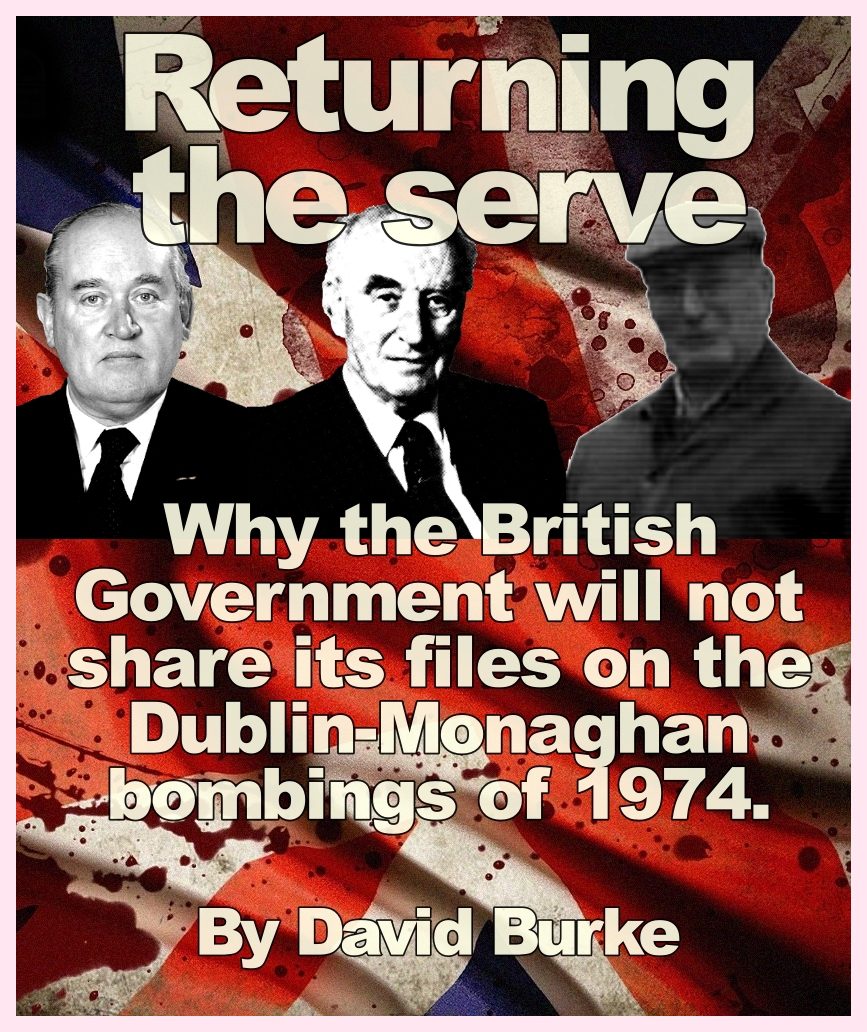
When British journalist, Peter Taylor, asked David Ervine, a former UVF member, about the motive behind the 1974 slaughter, Ervine replied that the UVF was ‘returning the serve’, i.e., the UVF wanted Catholics in the Republic to suffer as the Protestants in Northern Ireland had on account of the intense bombing campaign waged by the Provisional IRA. What Ervine and his colleagues failed to appreciate was that the Irish public consistently voted for parties that took a hard line against the IRA. Fianna Fail introduced the Offences Against the State Act in 1972. Fine Gael and Labour expanded the terms of that legislation when they held office, 1973-77. Fianna Fail, Fine Gael and Labour, the parties which held power during the entire period of the 1970s, ensured that the gardai were resourced to combat the IRA and incarcerate them. The Irish electorate did not let any political group which supported the Provisional IRA near the levers of political power in the Republic in the 1970s (nor indeed at any stage during the Troubles.)
Shortly after the bombings, Sammy Smyth, UDA press officer, said: ‘I am very happy about the bombings in Dublin. There is a war with the Free State, and now we are laughing at them.’ [Boyer Bell page 82.]
The bombings of 1974 demonstrated to the public that the IRA’s actions could unleash death and chaos within the Republic, a revelation that contributed to a tectonic shift in public opinion against the IRA. There were, of course, other factors, including the Birmingham bombing of November 1974 by the Provisional IRA and other atrocities.
[A group within Fine Gael opposed the 1972 legislation but that was largely motivated by political gain, i.e. they hoped to topple Liam Cosgrave TD as leader. The opponents, led by Garret FitzGerald TD, later not only supported the legislation, but expanded its terms.]
14. The Anti-Wilson Plots.
There are other factors that help explain why the NIO and MI5 let the UVF bomb Dublin and Monaghan. They are far more complex than a ‘return of the serve’.
A group of MI5 officers (attached to the Home Office) and a much smaller number of MI6 officers (attached to the Foreign Office) along with other right-wing elements, were involved in several plots designed to topple Harold Wilson, Britain’s prime minister. Wilson was the leader of the Labour Party. He had served as prime minister of the UK, 1964-70. In February 1974, after four years of Tory rule under Ted Heath, Wilson regained office.
Some senior MI5 and MI6 officers believed Wilson was a Soviet agent. Whilst this might sound absurd, at the time the CIA and MI5 were led by a deranged cohort of paranoid anti-communists who were convinced that a string of European leaders were in the thrall of the Soviet Union.

Some of those involved in the schemes against Wilson included right-wing serving and former military figures who tried to build private armies to counter the perceived threat from trade unions and the bogeyman that was the Soviet Union. One manifestation of the plotting was an attempt to replace Wilson with Lord Louis Mountbatten using the private armies and sympathizers in the military and the intelligence services.
The first official history of MI5, ‘The Defence of the Realm’ (2009), implied that an unofficial plot against Wilson took place. It described how MI5 had maintained a file on Wilson containing damaging material about him.
Since the plotting was treasonous, it was, ipso facto, unofficial.

Lord Hunt, a former cabinet secretary, concluded in a secret inquiry, in 1996, that:
‘there is absolutely no doubt at all that a few, a very few, malcontents in MI5 … a lot of them like Peter Wright who were right-wing, malicious and had serious personal grudges – gave vent to these and spread damaging malicious stories about that Labour government.’
15. The men in charge of dirty tricks in Northern Ireland.
The man in charge of MI5, 1972-78, was a ruthless individual called Michael Hanley.
Hanley was a large man, nicknamed ‘Jumbo’.
He was a bully feared by his staff. Stella Rimmington of MI5 described him in her memoirs as ‘a large, gruff, red-faced man, who had a reputation for being abrupt and having a fierce temper’. [Stella Rimmington, Open Secret: The Autobiography of the Former Director-General of MI5 (Hutchinson London, 2002), p. 116.]

He let VIP paedophiles abuse children for blackmail purposes, including at Kincora Boys’ Home in Belfast.
Hanley, born in Leeds to a professor of agriculture at the local university, received his education at Sedbergh School and Queen’s College, Oxford, where he studied modern history. In the Second World War, he served as an officer in the Royal Artillery, focusing on home defence. Subsequently, he studied Russian at Cambridge and served at the Joint Allied Intelligence Centre in Budapest. Upon demobilization, he became a research officer for MI5, specializing in Russian affairs.
In 1972, Hanley became the head of MI5 following an intervention from Victor Rothschild, a former MI5 officer and leader of the Downing Street think-tank. Rothschild convinced Prime Minister Edward Heath that appointing James Waddell, a senior Home Office official and Whitehall’s preference, would adversely affect the service’s morale, advocating instead for an internal candidate from MI5.

Hanley was implicated in the smear campaign against Labour Prime Minister Harold Wilson. The scheme was orchestrated by a faction of MI5 officers, among them Peter Wright and Michael McCaul. In 1975, when Wilson summoned Hanley, he was informed that ‘only a small number’ of ‘disaffected right-wing’ officers were conspiring against him. The meeting concluded with Wilson cursing at Hanley.
MI5 had in fact opened a dossier on Wilson in 1945 when he became an MP.
By the time Wilson assumed the role of prime minister, the file had become so confidential that it was kept under the pseudonym Norman John Worthington, rather than his own name.
Hanley took extensive measures to hide its existence by deleting it from the central index, ensuring that any search would yield a ‘no trace’ result. Accessing it necessitated personal permission from Sir Michael. Information from it was leaked to journalists thereby indicating Hanley was fully aware of the plot.
After his appointment in 1972, Hanley appointed Peter Wright, another man without a moral compass, as his special adviser.

Hanley asked Wright to formulate proposals about how MI5 should deal with the unrest in Northern Ireland. This led Wright to spend a lot of his time in Ireland.
The highest-ranking MI5 officer stationed in Northern Ireland, 1973-75, was Denis Payne. He served as Director and Controller of Intelligence (DCI) at the Northern Ireland Office (NIO). Born in 1919, he was based at Stormont Castle. He had served as the Head of MI5’s Department B until 1973 when he was sent to Belfast. He was awarded a CBE in 1978.
Another senior officer, Ian Cameron was based at Lisburn HQNI. He ran field operations.
The Head of the RUC special branch was Assistant Chief Constable D. Johnson.
MI5 and the RUC special branch had a number of agents in the field. One of these was James Miller who penetrated the UDA at a high level.

A number of members of the UVF germane to this story were ‘handled’ or run by the MI5 via Capt. Robert Nairac and Tony Ball.
16. Peter Wright’s secrets about Ireland.
Peter Wright CBE defeated the British government, led by Margaret Thatcher, in a volcanic legal battle in Australia in the late 1980s. Thatcher tried – and failed – to injunct the publication of Wright’s book, ‘Spycatcher‘, in Australia. The publication cast MI5 and MI6 in a deplorable light: little more than organizations riddled with traitors and immersed in criminality. Many of these crimes involved Wright himself. Wright was responsible for developing MI5’s Northern Ireland policy after the parliament at Stormont was prorogued and replaced by Direct Rule from London.

Throughout the trial, Her Majesty’s Government (HMG) was put on an anvil and hammered mercilessly by Wright’s dogged lawyer, Malcolm Turnbull, who later became the prime minister of Australia. When Turnbull published his account of the affair, ‘The Spycatcher Trial’, he recounted how he had asked Wright at their first meeting if he thought HMG feared he might reveal other secrets.
‘They might’, Wright replied adding mysteriously: “I spent a lot of time in Northern Ireland, you know. But I won’t reveal anything about that. Malcolm, it would be easy for me to make this book very sensational indeed.“‘
Wright had also cautioned Turnbull that: ‘I may never be able to tell you the truth about some things.’ When Turnbull asked him what he meant, Wright responded: ‘My work in Northern Ireland, for example … A lot of things. This is a safe book compared to what I could write.’

The legal wrangling dragged on for over a year. On 14 June, 1988, while an injunction restraining British newspapers from publishing the contents of the book was crumbling in the House of Lords in London, Wright made his threat public:
‘There are 10 major stories which I have not put in [Spycatcher] and there are probably others if I thought about it. I may put them into a secret report or I may do nothing. I just haven’t thought it out yet.‘
The next day, The Times of London reported that HMG had:
‘always been aware that Mr Wright knew a lot more than he revealed in ‘Spycatcher’, particularly concerning his service as an MI5 officer in Northern Ireland.’
The contention of this article is that Wright had the Dublin and Monaghan bombings in mind – among other crimes – when he made these remarks.
17. Pseudo-gangs and the UVF.
Brigadier Frank Kitson commanded the British Army in Belfast 1970-72. He was a counter-insurgency guru who purported to act as a neutral referee between the two communities in Belfast. Instead, he made a conscious decision to take on the IRA but not Loyalist terrorist gangs. This opened the door for collusion between Loyalist terrorists and British undercover forces. An early example of collusion involved a British soldier in the UDA called Albert Baker. (See the next section.)
Baker operated in Belfast. Meanwhile, Robin Jackson was in the British Army. He acted as a British agent (as shall be described later). It is believed Jackson received SAS training in the early 1970s – possibly 1972. Jackson operated in rural Northern Ireland, primarily Co. Armagh.

Kitson’s approach dovetailed neatly with how MI5 and the British Army had dealt with the insurgencies that had sprung up inside the British Empire. Kitson had helped suppress revolts in Kenya and Malaya.
On 29 August 1969, the Ministry of Defence (MoD) published Volume III of its Land Operations. Under the heading Counter-revolutionary Operations, 1st Part, Principles and General Aspects some of the tasks assigned to the SAS included:
‘(c.) The infiltration of assassination and demolition parties into insurgent held areas;
‘… (f.) Liaison with, and organisation of, friendly guerrilla forces operating against the common enemy’.
John Stevens, who later became Chief Constable of the Metropolitan Police, carried out a series of inquiries that looked at collusion between the security forces of the NI State and Loyalist groups during the 1970s and 1980s. During these probes, Stevens’ team arrested 210 Loyalist paramilitaries. He found that all but three of them were, or had been, working for the RUC or other intelligence agencies. Some worked for more than one.

Many of those who became proxy assassins on behalf of MI5 were members of the RUC or Ulster Defence Regiment (UDR) of the British Army. This gave them access to training and guns.
John Oliver Weir was born on 2 November 1950. He joined the RUC at the age of 20 on 30 March 1970. He served with the RUC’s Special Patrol Group (SPG).
John Weir was also a terrorist. He has long since confessed his crimes and served a lengthy prison service. He has identified nineteen individuals with whom he engaged in terrorist activities at Glenanne farm, near Lake Glenanne in County Armagh. Seven of his accomplices were in the RUC, including James Mitchell, the owner of the farm at Glenanne. Mitchell was a full-time RUC reserve constable. Weir has also named two members of the UDR.

Approximately twenty-five members of the UVF took part in the May 1974 attacks on the Republic. A number of them were involved in the Miami Showband massacre in 1975 as well. Two of them, Harris Boyle and Wesley Somerville, died when a bomb they were placing in the back of a van driven by the Miami showband exploded prematurely. Boyle was another British agent. He also participated in the attack against Dublin on 17 May 1974.

18. Albert ‘Ginger’ Baker.
The RUC misled the Gardai about the Dublin and Monaghan bombings. This will be discussed in greater detail in a later section. The only logical explanation for their deceit was that they were colluding with at least some of the Glenanne Gang.
The RUC had been colluding with terrorists for three or four years before the Dublin and Monaghan bombings.
The case of Albert Baker is an early example of this collusion. The RUC provided Baker, a British agent operating inside the UDA, with arms to murder people in Belfast in the early 1970s.
‘Michael’, who worked at HQNI, has confirmed that Baker was a British agent.
Patrick McCartan was one of Baker’s victims. The UDA was provided with his name by the RUC and told he was in the IRA. He wasn’t.
McCartan had been at a disco at the Park Avenue Hotel. When he left, he was in the company of a girl. They were punched and kicked by Baker’s gang which had lain in wait for him outside, but the pair somehow managed to retreat inside.

McCartan tried to leave a while later with a Protestant friend, but the UDA men set upon him again. One of them told his Protestant friend: ‘You have nothing to worry about, we [just] want McCartan …’ before dragging him away.
Baker’s accomplice, Ned McCreery, ordered the gang to take McCartan to a club with a ‘Romper Room’, i.e., a torture facility. One was available at the back of a UDA club in Clermont Lane. (The UDA’s ‘romper room’ network was built by Davey Payne, a man who participated in the Dublin-Monaghan operation.)
According to testimony at Baker’s trial, several UDA members and their girlfriends arrived to drink and watch the slow torture of McCartan. He was then conveyed around a number of ‘romper rooms’ in the Newtownards Road area. He was stripped naked, hung up by the ankles, and subjected to lengthy torture sessions at each club. At one stage, he was kicked and beaten with a pick shaft, while a dagger was used to stab him in the hands and thighs. All told, he received approximately 200 stab wounds.

At one point during his ordeal, he was threatened with castration and dropped head first from the ceiling.
McCreery finally gave Baker a pistol and told him to kill McCartan. The gang tied his hands behind his back and placed a bag over his head. He was taken to the Connswater River, where Baker shot him dead.
‘I was probably asked because I had already killed one man with a pistol, or maybe because I had training with small arms in the British army’, Baker confessed later.
Baker told Ken Livingstone MP of the Labour Party (and later Lord Mayor of London) that McCartan was ‘supposedly in the IRA’. Also that:
‘This was information passed on by Special Branch and CID officers to a UDA commander. We were sitting in a bar when we were told to drive off to the Park Avenue Hotel. We took him out of the hotel, interrogated him and then assassinated him.
‘C’ of CID and [the Conservative Party Secretary of State William] Whitelaw’s special squad used to give us files. They were like a deck of cards. They were all joined together and there were photographs of every Republican. I used to sit and drink with ‘C’. Half the assassinations in Northern Ireland in the early 1970s wouldn’t have been committed without RUC backing. Half the people who died in those assassinations would be alive today if the RUC hadn’t supported the assassination teams. The RUC knew the assassination teams – every single one of them.’
In 1973, Baker suffered a bout of remorse, or some sort of a psychological breakdown, and went to England where he confessed his crimes to the Warminster constabulary. After that, the Baker cat was out of the bag. The State went into emergency damage limitation mode. Baker later pleaded guilty to his crimes but made no mention of his relationship with his powerful handlers in British intelligence, or the UDA’s connections to the RUC. After a few years in prison, Baker began to divulge the truth. I suspect Baker was led to believe he would get out of jail quickly but an early release was not on the cards. Instead, he was rendered a scapegoat, something he must have viewed as a betrayal. In the 1980s, still behind bars, Baker confirmed his role as a British agent to various parties. He revealed to Ken Livingstone MP that his former UDA boss, Tommy Herron, a member of the UDA’s Inner Council, also had connections to British intelligence. Baker had acted as a bodyguard to Herron. Baker claimed that RUC officers provided Herron with guns, information, and other forms of assistance.

Crucially, Baker named key players in the RUC who had helped the UDA in their assassination programme, all of which had been passed to the RUC. Yet, no arrests were made. In a handwritten account Baker produced in 1986, Baker revealed that after his arrest in 1973, he had received a visit from an RUC chief inspector and a detective inspector.
‘I was questioned about the Vice Chairman of the Ulster Defence Association, Tommy Herron. I informed them that Tommy was the man directly responsible for all sectarian assassinations in and around Belfast as he was the person [whose] authority these assassinations were sanctioned by. You must remember that I am not [only] speaking about the assassinations I was involved in but all sectarian assassinations of Catholics.’
Baker described the activities of his gang as having included ‘sectarian assassinations; armed robberies; riots; [and] the training of young Protestants to facilitate them to become the next generation of loyalist assassins …’ There were some arrests and a trial but the UDA men walked away without a conviction.
During Livingstone’s jail interview with Baker in July 1988, the prisoner explained how he had been recruited and that the RUC were involved in collusive murder:
‘The guns that Baker claims the RUC supplied to his gang came from Mountpottinger RUC station in the Short Strand, Belfast. Some of them were used during an attack on the Red Lion Bar near the Albert Clock in the centre of Belfast, which was carried out in the hope of assassinating a suspected IRA man. However, a police Land Rover had chanced by and the attack was abandoned. The weapons were handed to an RUC detective who was waiting in a civilian car in a nearby carpark. From here, Baker claimed, the detective drove the weapons back to East Belfast, where he returned them to Baker and his men. They had travelled across the city without any fear of being stopped and searched … the guns were taken and put in ‘C’s car and he drove them through the police and army checkpoints back to East Belfast where he handed them back to us. The assassination was carried out later using police guns and Sterling submachine guns.‘
Adding general credence to these claims, Colin Wallace, who worked as a psychological operations officer in Northern Ireland for the British army at this time, recalled hearing ‘a number of allegations in the 1970s that the RUC gave surrendered firearms to Loyalists, including William McGrath’ of yet another Loyalist group, Tara.
19. Robin Jackson and the guns from Tara.
Robert John Jackson, born on 27 September 1948 – also known as ‘The Jackal’ – has been linked to at least 50 killings in Northern Ireland.
Jackson, born to a Church of Ireland family in the predominantly Protestant hamlet of Donaghmore, County Down, Northern Ireland, was the son of John Jackson and Eileen Muriel. Later, he moved to the Mourneview Estate in Lurgan, County Armagh, and eventually settled in the village of Donaghcloney, County Down, located five miles southeast of Lurgan. Throughout much of the 1970s, Jackson earned his livelihood by working in a shoe factory and delivering chickens for the Moy Park food processing company.
He had some Catholic ancestors.
In 1972, Jackson enlisted in the Ulster Defence Regiment (UDR), a locally recruited infantry regiment of the British Army. He served with the 11th Battalion UDR.
On October 23, 1972, the UVF carried out an armed raid on the King’s Park camp, a UDR/Territorial Army depot, and stole a significant quantity of guns and ammunition.
While still a serving member of the UDR, Jackson participated in this raid.
The late Charlie Simpson, a member of Tara, a Loyalist paramilitary organization, was one of his friends.

Tara, led by the notorious William McGrath of Kincora Boys’ Home, had acquired weapons in Holland. When the UVF discovered the Tara shipment, they attempted to confiscate the arms but were unsuccessful. Jackson, aware of the Tara arsenal, believed the UVF should possess the weapons, arguing that the UVF was ready to use them, unlike Tara, which wanted to keep them in storage until a potential doomsday arrived. Jackson maintained contact with other members of Tara as well as Simpson.
Simpson got to know Jackson while he was in Tara. Simpson revealed:
‘I knew him well … Robin was born in Newry – came from the Windsor Hill area which was a Protestant part of Newry off Downshire Road. Jackson always styled himself as a Loyalist. But he was not a member of the loyal orders. In 1971/72 he became involved with the UVF. He had been in the territorial Army and was involved in the raid on the Lurgan Territorial Army armoury which involved others as well as the UVF.‘
20. Robert Nairac
Robert Nairac, a British undercover military operative, was linked to the Glenanne gang.
Nairac was born in Mauritius in 1948, as the youngest child of Maurice and Barbara Nairac. Maurice Nairac was a doctor in the North of England who later specialised in ophthalmology and became a distinguished eye surgeon, eventually taking the family to Gloucestershire. Maurice was a Catholic while Barbara was a Protestant. Happily, this did not lead to any friction within the family. Nairac grew up in a comfortable middle-class environment. He was privately educated. At the age of 10, he went to Gilling Castle, a preparatory school for Ampleforth College, regarded as the Eton of well-off British Catholics.
He gained nine O-levels and three A-levels and became the head of St Edward’s House at the age of 17. He excelled at sports particularly, rugby, shooting, cross-country and boxing. He developed a taste for blood sports. He became a fly fisherman and was involved in wildfowling. He became friendly with the sons of Lord Michael Killanin, from Dublin, a man noted for his role as President of the International Olympics committee. At a later stage, Nairac studied at Trinity College for a spell. He often stayed at the Killanin homes in both Dublin and at St Annin’s in Spiddal Co Galway.
One of his teachers provided an insight into his character: he was always trying to prove himself. This was a lethal trait for someone who later became involved with the Dirty War run by MI5, MI6, and British military intelligence in Ireland.

Nairac joined the Grenadier Guards and began his first tour of duty in Ireland in early 1973. In total, he completed four tours of duty in Ireland totalling some 27 months. His first tour was spent in Belfast where he became interested in intelligence work. After Belfast, he was sent on a special training course that included instruction from the SAS in surveillance, guns and counter-insurgency tactics. He then went to Kenya – ostensibly on a survivalist course. As part of this course, he had to live off the land and avoid dehydration by drinking his own urine.
Nairac received training from the SAS at around this time. He was not, however, a formal member of the SAS. The SAS has gone to pains to distance themselves from Nairac. They would not have done so unless they were aware of what he had done in Ireland and did not want to be tainted by his actions.

When he returned to Northern Ireland, he became part of 14 intelligence also known as ‘The Group’. (It is sometimes called the ‘Detachment’ as there were at least three separate detachments within 14 Intelligence.)
Some operations of 14 Intelligence were directed from London directly; most presumably from Stormont where DCI Denis Payne was based. Nairac was assigned to a special compound at Castle Dillon, County Armagh. 14 Intelligence hid behind a variety of cover names, one of which was ‘4 Field Survey Troop, Royal Engineers’.

14 Intelligence worked with MI5. It was a key part of the Dirty War machine. John Parker, a journalist with The Daily Mirror and an author of many books, interviewed a number of those who worked with Nairac and produced a book sympathetic to the man entitled ‘Death of a Hero’, published in 1999. When Parker was carrying out his research, he spoke to one of Nairac’s unnamed superior officers. Parker asked him if Nairac might have been working for British intelligence. The response Parker received was that if ‘he was, and that always a possibility, it would have been MI5 but I have no evidence of it’. (Parker p. 67)
The odds are high that this officer knew perfectly well that Nairac had a secret intelligence role, as well as his more ordinary duties as a soldier. If he truly did not know, it is disturbing that he entertained the notion that one of his subordinates could have had a dual role. Clearly, Castle Dillon was a very important British intelligence base of operations with links to MI5.
Nairac was working for 14 Intelligence by early 1974. He and his superior officer in terms of undercover operations, Tony Ball, were key figures in the Dirty War of which 14 Intelligence was a central player. Ball, a SAS officer, was born in 1943.
21. The SAS was not impressed by Nairac.
Anthony Bradley, an Englishman who served in the British Army and later became a journalist, published a book about Nairac in 1992, Requiem For a Spy. Commentators, including Bradley, have asserted that Nairac’s unit at Castle Dillon operated under the direct oversight of MI5, thereby exempting it from the conventional military hierarchy. This implies that although Nairac underwent SAS training, the operations conducted were not SAS endeavours, nor was he a SAS soldier.

One of Nairac’s numerous functions was to act as a liaison between the RUC, SAS and other units of the British Army in Co. Armagh.
The SAS were not impressed by Nairac and criticised him both before and after his death.
Alastair Kerr, a retired Foreign Office diplomat, wrote a book about Nairac in 2015, ‘Betrayal, The Murder of Robert Nairac GC’. Kerr gained access to many of Nairac’s former colleagues. The book paints the soldier in the best possible light. Kerr defends Nairac from SAS criticism:
‘The genuinely surprising part of this is not that Nairac was eventually abducted, tortured and murdered in 1977, but that this did not happen sooner. Yet he not only survived his 1974-75 special duties tour in Northern Ireland, but he almost survived his fourth and final tour. His murder would occur close to the end-of-tour date. This suggests that Nairac was in fact very good at his job and does not support the repeated claims by certain SAS officers that Nairac was a liability; inexperienced, naïve; “a lamb to the slaughter” in Clive Fairweather’s words.’ (Kerr page 250.)
The late Willie Frazer had numerous connections to Loyalist terrorist organizations. He was cognizant of the SAS’s hostility towards Nairac, which became apparent prior to Nairac’s death in May 1977. Frazer revealed that in his teenage years, he was cautioned by a SAS officer against any involvement with Nairac.
This highlights two further important points about Nairac’s role in Ireland:
- First, it links Nairac to Loyalist terrorists.
- Second, the source – Frazer – cannot be described as an IRA propagandist.
Frazer’s father, Albert Frazer, served in the UDR. He was murdered by the IRA. Willie Frazer believed his father’s death was caused by his involvement with Robert Nairac.

The British Army divided Northern Ireland into three brigade areas. 39 Brigade covered Belfast and its environs. 8 Brigade covered the Western region including Derry. 3 Brigade covered rural Armagh and its environs.
Fred Holroyd served as a Military Intelligence Officer in the Special Military Intelligence Unit (SMIU) (Northern Ireland) in 1973-75, attached to 3 Brigade. He also worked for Craig Smellie of MI6. Holroyd says MI5 deployed soldiers to handle civilian agents. ‘Their policy was basic and shortsighted – use whatever means, legal or illegal, to blackmail the civilian into acting out of fear for his safety, then force him to carry out operations that cannot be traced back to the handler.’
22. Nairac and the UVF
Author John Parker had this to say about Nairac’s contact with the UVF:
‘There is little doubt that he had contact with the UDR and undercover liaison with contacts who were also members of the UDA and UVF, and there was every reason for him to pursue those contacts. The alleged association with the Miami Showband massacre, however, is not so certain.’ (Parker p. 111.)
As shall be discussed later, RTE discovered evidence to link Nairac to the 1975 Miami massacre.
Brendan O’Brien of RTE was able to link Nairac to some of the UVF members who bombed Dublin and Monaghan in 1974. O’Brien conducted an interview with a former UDR officer for a documentary titled ‘Friendly Forces’ (1995) which focused on the Dublin and Monaghan bombings. The UDR officer revealed that he was introduced to Nairac in his capacity as a military liaison officer at Castle Dillon. Nairac was using an assumed name. The UDR officer believes that Nairac was involved in ‘some kind of specialist unit … Operating in the 3 Brigade area’, and that the unit was ‘running the Loyalist paramilitaries in mid-Ulster’.

When the UDR officer was shown a list of names, he told O’Brien that he recognised them as those of ‘the persons who were allegedly involved in the Dublin and Monaghan bombings’. He added that ‘within a few weeks’ of the bombings, these names were ‘bandied about’ in the UDR company to which he was attached, and that, as far as he knows, none of these people were questioned in connection with the bombings. He commented on the ‘minimal’ reaction to the bombings, a reaction he finds ‘strange’. (Don Mullan page 222).
As Bradley notes on page 53 of his biography of Nairac, there were four separate claims by members of Loyalist murder gangs that their commanding officer was Captain Nairac.
23. ‘The reason we were given was that [Jackson] was working on behalf of the RUC Special Branch.’
MI5, the RUC special branch, and 14 Intelligence were partners in the Dirty War.
Robin Jackson was one of those who was in contact with people such as Nairac and the RUC special branch. If Jackson knew Nairac was a Catholic, it did not affect their relationship.
Fred Holroyd of the SMIU, attached to 3 Brigade became aware of the activities of Robin Jackson. He told author Sean McPhilemy that
‘Because of the ‘need to know’ principle and the compartmentalisation of the Intelligence world, officers like myself often had great difficulty in understanding some of the anomalies in operating realities. One of those anomalies was Robin Jackson.
‘Although he was known by myself and other Army Intelligence persons as an active paramilitary involved in major activities, Army personnel were not allowed to touch him. The reason we were given was that he was working on behalf of the RUC Special Branch.‘

‘After the murder of Mr. (Patrick) Campbell of Banbridge, Robin Jackson was picked out by Mr. Campbell’s widow as the man she had witnessed killing her husband, no charges were ever brought against him by the RUC.
‘The RUC Special Branch ‘ran’ a number of Protestant paramilitaries in the Portadown area that I was aware of, some of them who operated with Robin Jackson. I, like most of my Army colleagues, was disgusted by this but was assured by my senior officers to “go along with it.”
‘It is my considered view that Robin Jackson was a paid informer and agent of the RUC, personally run by a Sergeant of my acquaintance in Portadown Special Branch office.‘
24. Charlie Simpson: Jackson was ‘well plugged into the [RUC] special branch network’.
Charlie Simpson, the member of Tara, mentioned earlier, began to suspect that his friend Robin Jackson was working for British intelligence.

Charlie Simpson went to Rhodesia (now Zimbabwe) in 1977. He was believed that he was ‘well plugged into the special branch network’.
25. ‘Jacko had Nairac’s Browning pistol.’
As revealed in section 2., of this ebook (and repeated here to maintain the chronology of the narrative), Simpson stated:
‘Jacko [Robin Jackson] had [Robert] Nairac’s Browning pistol. He worked hand in glove with Nairac and said that the British army officer had given the weapon to him. Nairac was passing information to Jacko on IRA people. Jacko bombed a pub in Dundalk and the bomb was made in an army base and was given to Jacko to go and plant it which he did.’
26. Nine British agents in the UVF took part in the Dublin and Monaghan bombings and their confederates.
At least nine of the UVF team that bombed Dublin and Monaghan in May of 1974 have been identified as British agents.
In a letter dated 14 August 1974, Colin Wallace stated that
‘the Youngs, the Jacksons, Mulholland, Hanna, Kerr and McConnell were working closely with [RUC] SB [special branch] and Int at that time.‘
Wallace was referring to the following individuals, all of whom were involved in the Dublin and Monaghan atrocities. They had been identified as participants and agents at intelligence briefings at HQNI and in the field.

1. Stuart (sometimes Stewart) Young: (Born 17 January 1943.) (Deceased.) He came from Portadown. A brother of Nelson and Ivor. Young was a prominent member of the Portadown UVF. He admitted to John Weir, an RUC Special Patrol Group and UVF gang member, that he – Young – had led the team that planted the Monaghan car bomb. According to the Barron report: ‘Nelson Young’s brother, Joseph Stewart Young (UVF), was one of three men identified by a witness who saw them at about 2 p.m. acting suspiciously in the carpark’ from which the car used in the explosion was taken. The others observed in the carpark ‘were Charles Gilmore and Ronald Michael ‘Nikko’ Jackson. The significance of this sighting is apparently reduced by the owner’s claim that his car did not arrive at the car park until 3.30 p.m. but it is possible that he may have been mistaken as to his time of arrival.’ He went to live in Troon, Ayreshire, Scotland.
2. Nelson Young: A member of the Portadown UVF. He was a brother of Stuart and Ivor Young. According to the Barron report, there was a closeness between the UDA and UVF in mid-Ulster. Barron stated at page 349 of his report that: ‘Another example of the closeness between extreme loyalist organisations in mid-Ulster was the Young family: at a time when Nelson and Stewart Young were said to be in the UVF, their older brother Ivor was said to be in the UDA.’ The report also states at page 107 that: ‘Two more witnesses picked out a photograph of Nelson Young (UVF) as being the man they saw coming out of the gent’s toilet in Church Square [in Monaghan town] at about 6.30 p.m.’ on the day of the bombing.
3. Ivor Young: (Born 27 May 1939.) He is a brother of Stuart and Nelson. He was also a member of the Portadown UVF. He went to live in Kilmarnock, Scotland.
4. Robin ‘The Jackal’ Jackson: (Born 27 September 1948.) (Deceased.) Banbridge, Mid-Ulster UVF. He drove the three bombs used in the attack on Dublin in May 1974. Jackson was aged 25 at the time of the bombings.
5. Ronald ‘Nikkio’ Michael Jackson: (Born 17 June 1941). He came from Portadown. He participated in the Monaghan attack. He and Stuart Young were seen acting suspiciously in the Portadown car park from which the bomb car was stolen, albeit some 90 minutes before the car was said to have been parked there.

6. David Mulholland: (Born 5 October 1938.) (Deceased.) A butcher by trade, Mulholland came from Portadown. He was a member of the UVF. He drove the green Hillman Avenger which exploded on Parnell Square.
7. William ‘Billy’ Hanna: (Born 1929.) (Deceased.) A member of the UVF’s ruling Brigade staff which met on the Shankill Road, Belfast. Hanna led the attack on Dublin in May 1974. He was married with five children. He won a medal for gallantry while in the British army in Korea. He became a plumber. Hanna got on so well with his British intelligence handlers – or so he thought – that he went on fishing trips with them. He was shot dead on 27 July, 1975, by Robin Jackson, probably on orders from his former fishing colleagues. Hanna was a former B Special.
8. RJ ‘Bob’ Kerr: (Born 1943 or 1947.) (Deceased.) A member of the UDA. He participated in the murder of William Strathearn with Robin Jackson, John Weir and William McCaughey. He was not charged with Strathearn’s murder. This was undoubtedly because he was a British agent and linked to The Jackal. A court was told by an RUC officer that Jackson and Kerr were not before the court as part of ‘police strategy’. Kerr was killed by the IRA but in mysterious circumstances.

9. Robert McConnell: (Born 20 February 1944.) (Deceased.) He was a UDR corporal or sergeant. He was also in the UVF. McConnell’s nephew confirmed to author John Parker that Robert McConnell was an asset of British intelligence. ‘I have no doubt that my uncle gathered intelligence in South Armagh. He was a dedicated soldier and he would have defended this country at all costs. His information would have led to the deaths of IRA terrorists.’ (Parker, p. 125.)
Also implicated in the Dublin and Monaghan massacres – but not named in Wallace’s letter – were:
10. Harris Boyle: (Deceased.) UVF. He died in the Miami massacre. He was very close to The Jackal and is also believed to have been a British agent. He was a former B Special.
11. Captain John Irwin: (Born 16 April 1943) He is suspected of having transported the explosives used in the 1974 bombings to the Glenanne Gang. He was a UDR intelligence officer based at Dromad Army Barracks and most likely another British agent.
12. James Mitchell: (Born 10 February 1920.) (Deceased.) His farm at Glenanne served as a base for the Glenanne gang. Robin Jackson picked up the Dublin bombs from Mitchell’s farm on the morning of 17 May 1974. He was a reserve RUC constable.
13. William Marchant: (Born 9 August 1947.) (Deceased.) A Belfast UVF member. He oversaw the hijacking of the three cars used in the Dublin attack. He was shot by the IRA while standing outside the offices of the UVF on the Shankill Road in 1987. He is believed to have been an agent of the RUC special branch.

14. David Payne: (Born 12 September 1948.) (Deceased). A member of the UDA from Belfast who was involved with the Glenanne Gang. It is believed he was part of the bomb team that deployed in Dublin. He was a serial killer and torturer, quite possibly the most sadistic terrorist of the Troubles. It was he who established the UDA’s network of ‘romper rooms’ in Belfast where Catholics met gruesome ends. He died of a heart attack in March 2003 at the age of 54.
15. Charles Gilmore: (Born 24 March 1949) of Portadown.

16. Laurence McClure: (Born 30 January 1945). An RUC constable. He lived near Mitchell’s farm. He was an associate of John Weir. Both men were in the RUC Special Patrol Group. McClure told Weir that Hanna and Jackson led the attack on Dublin. Weir claims that the explosives were provided by Captain Irwin and they were assembled at the Glenanne farm with help from Laurence McClure. He was convicted of bombing a Catholic-owned pub. He is believed to have been involved in the infamous murder of the Reavey brothers. According to a report by Hugh Jordan in The Sunday World: ‘Local sources in Armagh this week say that as a young man, McClure fell under the influence of firebrand preacher the Reverend Ian Paisley.’ (Sunday World 29 September, 2021.)
17. Samuel Whitten: (Born 28 April 1946), Portadown. He was spotted by eyewitnesses in Monaghan on the day of the bombings. He drove the car that exploded to the town. While he was in the UVF he was hardly a British agent with a ‘get out of jail’ pass. Whitten was sentenced to life imprisonment for sectarian murder and 14 years for arms possession. He was imprisoned at Maghaberry. He was never charged in connection with the bombing.

18. Billy Mitchell: (Born 1940.) (Deceased 2006). A member of the UVF identified by Joe Tiernan as part of the 17 May 1974 operation.

19. John Bingham: (Born 1953) (Deceased). A member of the UVF. He was also identified by Tiernan as a participant. He was shot by the IRA in December 1986.

20. Billy Fulton: UVF quatermaster for the Dublin-Monaghan bombings. He worked as a hamburger salesman. He was close to Billy Hanna. He appears to have been one of those who was in Dublin on 17 May 1974. He was a bomb maker who used fertiliser for his product. He did not have a history of making more sophisticated bombs such as those which exploded on 17 May. He too went to Scotland where he remained active. He was convicted of an explosive offence while living in Scotland. [Boyer Bell page 96 and 115.]
Other members of the UVF were also active during this period. Some are suspected to have been involved in the atrocities in Dublin and Monaghan. They include:
21. Wesley Somerville: (Born 1941.) (Deceased.) UVF. He died during the Miami massacre.

22. Edward Sinclair: (Deceased). A member of the UVF from Dungannon. He was an associate of Robin Jackson.
23. Thomas Raymond Crozier: (Born 1951.) He was convicted for his participation in the Miami massacre.

24. James Roderick McDowell: A member of the UDR. He was convicted for his part in the Miami massacre.

25. John Somerville: (Deceased, kidney cancer 2015) UVF. Imprisoned after the Miami Showband massacre.

26. Gary Armstrong. Ex-RUC special patrol group. Named by Weir as a member of the Glenanne Gang. Author of the booj ”From the Palace to Prison’.
27. Sarah Elizabeth ‘Lily’ Shields: (Born 28 January 1952.) (Deceased). She was an associate of James Mitchell and helped the Glenanne Gang in some of their operations. According to the Barron report, ‘on the occasion of the bombing of Donnelly’s Bar, Silverbridge’ in December 1975, she provided cover for the attack by acting as part of ‘a courting couple’.
28. Billy McCaughey. Ex-RUC. He joined the Glenanne Gang after the Dublin and Monaghan bombings.

27. Recruitment on the basis that ‘My Enemy’s Enemy is my friend’.
How did MI5 recruit Loyalist terrorists such as Hanna?
In the first instance, MI5 and the RUC special branch managed to recruit agents inside Loyalist paramilitary groups such as the UDA, UVF, Tara, and the Red Hand Commando, voluntarily, as they shared a common goal: the defeat of the IRA.
Their status also protected them from arrest, especially in the case of Robin Jackson. He was only convicted once (in 1981), for possession of a .22 pistol, a .38 revolver, a magazine, 13 rounds of ammunition, and hoods.
MI5 and MI6 had other tools in their arsenal to control Loyalists who were reluctant to become their subordinates, including blackmail.
28. Blackmail.

Peter Wright of MI5 described in ‘The Spycatcher’s Encyclopaedia of Espionage’ that
‘It is well-known that MI5 gained useful information by employing ladies who gave sexual favours to foreign diplomats and agents. It has been suggested that this means that we require our female agents to become prostitutes. This is rubbish. We recruited prostitutes as agents.‘
British intelligence ran brothels in Belfast such as the Gemini Health Studio where heterosexual prostitutes ensnared targets.
They set up the Gardenia brothel in Belfast as a trap for homosexuals.
Men who liked underage boys and teenagers were targeted too.
Anthony Cavendish, who served with both MI5 and MI6, has described how MI6 used children in entrapment operations in his book on MI6:
‘Then there is the [foreign] agent who is set up for blackmail from the beginning. The groundwork having been laid and the agent having been photographed in bed with a small boy or his boss’s wife, is then forced to provide information.‘
Unionist MPs who were attracted to underage males were monitored. They included Enoch Powell, James Molyneaux, Sir Knox Cunningham QC, MP, and at least one senior DUP politician who retains a significant influence over his colleagues to this day.
29. The Difference between ‘kompromat’ and Blackmail.
Another MI5 strategy to control the political and paramilitary landscape was the collection of what Soviet intelligence used to call ‘kompromat’, i.e., damaging material, often of a sexual nature.
There is a difference between kompromat and blackmail.
Blackmail involves a threat to release damaging information unless a victim agrees to obey the demands of a blackmailer.
In the case of ‘kompromat’, the information can be released simply to undermine or destroy a target. The aim is not to get him or her to obey a command. Hence, a target might be photographed in a compromising situation, yet not learn that he had been placed under surveillance until a picture of him is circulated to his family, employer, or the media, without warning or demand.

A lot of ‘kompromat’ gathered in Northern Ireland related to the sexual activities of leading Loyalist politicians including James Molyneaux MP, a member of the dominant Ulster Unionist Party (UUP).
The NIO knew that Molyneaux was a homosexual, something that was a crime in Northern Ireland at the time.
Molyneaux’s homosexuality was something that would have shocked the typical Loyalist voter of the time. He went on to lead the dominant Ulster Unionist Party (UUP), 1979-95. He was also a friend of William McGrath, one of the most important Loyalist paramilitaries of the Troubles. McGrath worked for MI6 and later MI5. He was involved in the importation of arms which were supplied to various Loyalist paramilitary groups. Like Molyneaux, he was sexually attracted to young males. McGrath was convicted for the sexual abuse of boys at Kincora in December 1981.
Molyneaux mixed in the circles that revolved around the paramilitary organisation commanded by McGrath, Tara. When one young member left Tara, Molyneaux made inquiries to find out why he had departed from the organisation.

Molyneaux inherited his Westminster seat from Sir Samuel Knox Cunningham MP, QC, in 1970. Molyneaux had served as Cunningham’s constituency agent before the latter retired from Westminster at the 1970 general election. Cunningham was another paedophile.
Cunningham once described the young Molyneaux as a ‘pretty little thing’.
While at Cambridge, Cunningham had earned the nickname, the ‘Boxing Queen’ because of his homosexuality and prowess as a pugilist. He became a heavyweight boxing champion at the University. In later life, he was elected as a Unionist MP. In the 1960s he represented South Antrim at Westminster. He served as Parliamentary Private Secretary to Prime Minister Harold MacMillan, 1959-1963, and as such routinely attended Cabinet meetings at 10 Downing Street. Cunningham remained an extremely influential figure inside the Unionist Party and the Orange Order during the early and mid-1970s.
Cunningham also abused Kincora boys.

There were other Unionist figures with embarrassing secrets, many of which were recorded in MI5 and MI6’s files.
MI6 also collected dirt about Ian Paisley. They knew that Paisley had been involved in at least one bombing during the 1969 campaign to topple the prime minister of Northern Ireland, Capt. Terence O’Neill. In addition, that Paisley was a friend of William McGrath, the infamous paedophile and ‘housefather’ of Kincora Boys’ Home.

30. Operation Clockwork Orange.
The collection of ‘kompromat’ – and the failure to use it – has a connection, and is relevant, to the 1974 bombings that will become apparent shortly.
MI5 and MI6 compiled a library of compromising information about Unionists. Initially, MI6 planned to disclose some of it to weaken the Unionist politicians’ opposition to the 1973 Sunningdale Agreement. This agreement resulted in the 1974 power-sharing government headed by Brian Faulkner.
MI6 and its parent department, the Foreign Office, supported power sharing. Between 1972 and 1973 the Director and Co-ordinator of Intelligence (DCI) of NI at Stormont was Allan Rowley of MI6. (Denis Payne took over from Rowley later in 1973.)
James Molyneaux, being part of Faulkner’s party, was not at risk from Rowley and MI6 at this point, as his party, under Brian Faulkner’s leadership, was participating in the Executive.
By the end of 1973, Operation Clockwork Orange had come into existence. It intensified the collection of ‘kompromat’ about Unionists. This happened shortly after Denis Payne, a senior MI5 officer became DCI, the overarching spymaster of Northern Ireland.

According to Colin Wallace, Clockwork Orange:
‘was originally conceived at the end of 1973, or early in 1974, during a meeting at the Northern Ireland Office attended by Denis Payne, a senior member of MI5 who had recently become the Director and Co-ordinator of Intelligence in the Province. I recall the occasion because I had never met Denis Payne prior to that, and think I only saw him again at one subsequent meeting. I do not think he was the originator of the idea – he only contributed to the discussion about how it would be managed. Contrary to what the MoD has asserted, ‘Clockwork Orange’ was not a single activity. It was an umbrella title for an open-ended project aimed at using Psy Ops more strategically to address major ongoing issues such as racketeering, sectarian assassinations, arms trafficking etc. The so-called ‘IRA defector’ story was one of the early ploys approved for implementation.‘
Numerous files were opened. Hence, Clockwork Orange 1, 2, 3, and 4 came into existence.
The dirt about Unionist politicians and paramilitaries was placed into these various files.
Wallace always felt the focus should have been exclusively on the paramilitaries.
31. The February 1974 general election and the forged IRA ‘diary’.
MI5 had other targets in their sights. They tried to smear Harold Wilson and the opposition Labour Party during the February 1974 general election.
Denis Payne’s office at NIO supplied Wallace’s Psyops unit at Lisburn with a fictitious account of the life of a member of the IRA. It was to be turned into a diary allegedly maintained by a member of the IRA. Wallace’s task was to render the language so that it could pass for someone from Northern Ireland.

At the time, Wallace was a young man trained to follow orders, yet he felt uneasy about the task at hand.
He duly studied, considered and rewrote the raw material as ordered. The diary was then typed up by an MI5 secretary complete with deliberate mistakes. The process involved Wallace dictating the faux diary entries to an MI5 secretary.
The smear revolved around the accurate fact that Wilson had met members of the IRA during a visit to Dublin in 1972. After it, Wilson had given a TV interview in Dublin. He stated on television that:
‘…if those in charge of the violence – and I mean the Provisional heads of the IRA call a halt – call a truce – then it runs [i.e. is obeyed]. Many people doubt whether it did [i.e. the authority to call a ceasefire] It is shown that they are well disciplined, tightly knit and that their order runs.‘
What Wilson was saying was that it was worthwhile talking about a ceasefire to the leadership of the IRA because they had the authority to put one into effect.
MI5’s forged diary put a spin on Wilson’s words. The idea now was that the author – an alleged IRA man – felt that the organisation had been greatly encouraged by Wilson’s remarks, so much so that they proceeded with a bomb attack in Belfast on 20 March 1972. The fictitious author stated that:
‘This was just the boost our morale needed. We called off our truce. Six days later one of the worst explosions ever took place in Donegall Street killing eight people.‘

Once the fraudulent diary was ready, it was handed over to MI5. MI5 then made contact with Gerard Bartlett, a journalist with The Sunday Telegraph in London. He recalled in 1993 that:
‘I remember going to my Fleet Street office and picking a letter out of my pigeonhole with a Belfast postmark on it – immediately being deeply suspicious of which I read – which was allegedly a disaffected IRA man – [who] wanted to talk to me about the danger he was in and tell me about his life and was seen to be seeking some sort of help from me. He wanted me to put an advertisement in The Sunday Telegraph which told him that we were interested and that is what we did.‘

All of this his was taking place during the February 1974 general election.
The British Army press desk at HQNI, however, found out about the operation and halted it, much to the relief of Wallace.
Harold Wilson won the election by a whisker.
32. Freezing Operation Clockwork Orange.
Another dirty manoeuvre soon followed: the freezing of the dirty trjick operation against the Loyalist opponents of the Northern Ireland Power Sharing Executive, the body set up under the auspices of the Sunningdale Agreement.
Prime Minister Edward Heath, 1970-74, was one of the key figures in securing the Sunningdale Agreement of 1973. Sunningdale had the support of the Tories, the Irish Government, the Unionist Party, and SDLP. An Executive was set up to run Northern Ireland. There was opposition to it. A body known as the Ulster Workers Council (UWC) came into being to oppose it.

MI6 under DCI Allan Rowley had planned to release the sexual, financial and political dirt it possessed on Loyalist politicians who opposed the new administration. Some of the information MI5 and MI6 had gathered about Unionist politicians was political dynamite, probably enough to take the wind out of the UWC, especially influential figures such as Ian Paisley (bomber and associate of child molesters), William McGrath (a child abuser), John McKeague (another paedophile) and others.

After Harold Wilson won the February 1974 general election, the plan was changed.
MI5 now slammed on the brakes. The release of the ‘kompromat’ held in the various Operation Clockwork Orange files was halted by Denis Payne of MI5. He did so with the undoubted support and connivance of Peter Wright and his fellow anti-Wilson conspirators in London such as Michael McCaul.
33. James Miller, MI5 agent.
Next, DCI Denis Payne went on the offensive. He deployed his resources to push for a Loyalist strike to tear down the new Executive.
Barry Penrose of The Sunday Times interviewed James Miller, an acknowledged MI5 agent, who told him:
‘I did a dangerous job over there [Northern Ireland] for nearly five years and many UDA and IRA men went to prison as a result,’ [Miller] said last night. ‘But I could never understand why my case officers, Lt Col Brian [Dixon] and George X, wanted the UDA to start a [Loyalist] strike [against the Executive] in the first place. But they specifically said I should get UDA men at grass-roots level to ‘start pushing’ for a strike. So I did.
‘[Miller] said his MI5 case officers told him Harold Wilson was a suspected Soviet agent and steps were being taken to force him out of Downing Street. [Miller] said that in early 1974 his case officers instructed him to promote the idea within the UDA of mounting a general strike which would paralyse Northern Ireland. The result, says [Miller], was the Ulster Workers’ Strike in May 1974 which severely embarrassed Wilson’s government and helped to torpedo the Sunningdale Power Sharing Executive of Catholics and Protestants, which had included an ‘Irish dimension’ by allowing the Irish government a consultative role in Ulster.‘
Miller was a senior member of the UDA, so his influence on UDA strategy must have been substantial. No doubt there were many other British agents pushing the same line on the UDA. The UDA became the bulwark of the organisation that was established to tear down the Executive. It was called the Ulster Workers Council (UWC).
Miller’s status as an MI5 agent was confirmed at the Saville Inquiry into Bloody Sunday, and also at the Hart Inquiry into historical child sex abuse in Northern Ireland.
An account of James Miller’s career can be found in my book, ‘Kitson’s Irish War’ which is available here: https://www.mercierpress.ie/irish-books/kitson-s-irish-war/
34. John Hume and Denis Payne.
The future Nobel Peace Prize laureate, John Hume of the SDLP, a Nationalist party, served as the Minister for Commerce in the Executive.

In theory the NIO and the intelligence officials at Stormont Castle were meant to support the Executive. Hume’s biographer, Barry White, described how Hume believed there were ‘indications that the UWC [strike command] had early warnings of security decisions’ which were being taken to counter the UWC strike, i.e., there was a traitor at Stormont who was leaking secrets to the UWC. White described how the UWC’s:
‘main source of information was through a former senior civil servant who retained good contacts at Stormont, and there was a valuable reassurance in an anonymous telephone call midway through the strike. A man with a cultured voice, who seemed to know what was happening inside Stormont, simply told [strike leader Andy] Tyrie to “keep up the good work” and victory was certain.’ ( p. 167)
Hume sat in on a meeting at which Payne was also in attendance. At it, Hume challenged the assertion that the NI Electricity Service had been reduced to a paltry 30% output due to the UWC strike. Shortly after this Hume secured a meeting with the NI Secretary, Merlyn Rees, to challenge the claim. Payne attended the meeting at which he stood over the 30% output claim, one designed to show that the strike was gaining momentum.
35. The source of the bombs used in the attacks on Dublin and Monaghan.
The components of the bombs detonated in Dublin were sophisticated, surpassing the capabilities typically associated with the UVF. Although the identities and roles of several bombers have been revealed over time, there has been no information disclosed about a bomb maker within the UVF.
The sophistication of the bomb materials was comparable to that of the Provisional IRA at the time. This suggests that the materials might have been seized from the IRA and subsequently released from the custody of the RUC or the British Army for use in the Dublin and Monaghan bombings. Another possibility is that they were produced by British bomb experts.
Colin Wallace has revealed that the belief at HQNI in the aftermath of the Dublin and Monaghan bombings was that the bombs had been supplied to the UVF by people who worked ‘within the security community’. Wallace has said:
‘The belief, certainly by certain people are Army Headquarters in Lisburn, was that some of the explosives used in the Dublin bombings had been provided from security sources – and that was security forces in the wider sense, which could mean from the RUC, from the UDR or from the Army, it wasn’t specific, but it was a genuinely-held belief that that had been the case and that the planning and some of the organising of that operation had been done with the assistance of people who were working within the security community.’
There are multiple indications of MI5 involvement in the 1974 atrocities. Inside Loyalist circles, one member of the Dublin and Monaghan gang told the Loyalist terrorist Michael Stone that Robert Nairac had supplied the explosives for the attacks. (None Shall Divide Us page 245).
But where were they made?

36. Charlie Simpson reveals what Jackson told him about the Dublin and Monaghan bombs.
As noted in the introduction (and repeated here to maintain the chronology), Charlie Simpson, who knew Jackson well, stated that Jackson:
‘told me the UVF in Belfast had been provided with pre-made explosive devices and scout cars were used to get the cars with the Dublin/Monaghan bombs on board safely delivered. The British did not organise the bombings but they supplied the equipment. Jackson mentioned people at Mahon Road army base in Portadown. He used nicknames of these people.
After the explosives were prepared, the belief is that they were brought by Captain John Irwin, of the UDR to James Mitchell’s farm at Glenanne.
37. The day of the bombing of Dublin and Monaghan: 17 May 1974.
The Dublin and Monaghan bombings took place on 17 May 1974, three days into the UWC strike.
On the morning of the 17th William Marchant of the Belfast UVF, and a number of his comrades, stole three cars. The vehicles were driven to a rendezvous point with the Portadown UVF, thence to Dublin later that same day.
The cars retained their registration plates. There were no bombs in the vehicles during the journey from Belfast to Dublin.

Robin Jackson had the use of a poultry van which he brought to Glenanne where he collected the bombs. The explosives were packed into three suitcases, all armed with timing devices.
It is believed that Jackson followed a route over the Boyne Bridge at Oldfield on his way to Dublin. There was no security on the roads that day despite the turmoil in Northern Ireland. Jackson made a rendezvous with his UVF colleagues at the Coachman Inn on the northside of Dublin. (It was long believed the forming up point was the car park of Whitehall Church.)
There is still a degree of mystery about Jackson’s journey and whether he had a passenger, such as Billy Hanna, with him.
What is clear is that the bombs were activated by Hanna in Dublin.
After that Jackson and Hanna drove back to Northern Ireland.

The men at the Coachman Inn included David Alexander Mulholland and Billy Fulton. The bomb cars and getaway vehicles made for the centre of the city. Mulholland drove a stolen Hillman Avenger to Parnell Square. A second bomb was transported to Parnell Sq, a third to St Leinster Street.
John Weir, a member of the Glenanne Gang, was later told about the 1974 bomb attacks by Laurence McClure, an RUC constable. Both men were in the RUC Special Patrol Group. McClure confirmed that Hanna and Jackson led the attack on Dublin.

James Mitchell of the UVF also told Weir that Hanna was involved in the attack on Dublin.
Hanna assigned the execution of the attack on Monaghan to Stuart Young, a prominent member of the Portadown UVF. Young later confirmed to Weir he had headed the team that planted the Monaghan car bomb.
Weir also discovered that Capt. Irwin brought the explosives to Mitchell’s farm at Glenanne.
The bombs killed 34 people and accelerated the collapse of the Executive.
38. There was ‘no determination to find out whether these people had been responsible or not’.
As previously mentioned, a former UDR officer informed Brendan O’Brien from RTE that Robert Nairac was orchestrating the activities of Loyalist paramilitaries in mid-Ulster.

When he was handed a list of names, the officer recognised them as those of ‘the persons who were allegedly involved in the Dublin and Monaghan bombings’. He said that ‘within a few weeks’ of the bombings, these names were ‘bandied about’ in the company to which he was attached, and that, as far as he knows, none of these people were questioned in connection with the bombings. He comments on the ‘minimal’ reaction to the bombings, a reaction he found ‘strange’.
Colin Wallace has much the same to say. He has said that:
The thrust of my evidence is that we (the Army) knew the identities of those responsible within 48-hours of the bombing and that the UVF team responsible for the outrages had been heavily infiltrated by the Intelligence Services, to the extent that we should have known about their plans or, at least, been in a position to detain suspects for questioning.
Additionally, and as noted previously, it was documented that in 1975, Wallace wrote a letter identifying nine bombers as British agents.

Wallace also noted that there was really:
‘no follow-up, no major offensive, no determination to find out whether these people had been responsible or not. And it was the lack of interest I think that concerned us, that it was a departure from normal procedure because the outrageous nature of the bombing would have justified a greater interest and that just didn’t seem to be present at that time.‘
This only makes sense if some of the bombers were British agents.
39. The RUC protect the bombers.
Approximately twenty-five terrorists took part in the bombings. Despite the abundance of Loyalist agents working for the RUC in the 1970s, the force claimed they had discovered no warning of the bomb attacks. They can only have been lying.
The RUC certainly ascertained who they were after the attacks.
The RUC protected the bombers.
The RUC pretended to co-operate with the gardai.
The RUC alleged to the Gardai that they developed no positive information from their inquiries. They added that any intelligence they gained was low-grade anonymous information obtained through the local robot phone system.
In 1993 Yorkshire television broadcast a documentary entitled ‘The Hidden Hand’. The makers of it spoke to two RUC special branch officers who had investigated the bombings. They confirmed they had a list of UVF suspects which tallied with the Garda’s. They reported their information to RUC headquarters but were never asked to interview or arrest any of the suspects.
On 28 July 1974, Assistant Chief Constable D. Johnson, wrote to Larry Wren, the Head of C3, at Garda HQ, telling him that:
‘In general what I am saying is that we have not lost any enthusiasm on the Dublin and Monaghan jobs but prefer to tell you about tangible progress rather than sceptical intelligence.‘
In contrast to this, Wallace attended intelligence briefings, at HQNI, at which the names of those suspected of the Dublin and Monaghan bombings were being discussed. The revelations to which he was privy were certainly circulating by September. 1974, if not months earlier. The names included Robin Jackson, Ronald Jackson, Bob Kerr, David Mulholland, Bill Hanna, the Young brothers, and Robert McConnell.
The British military also identified William ‘Frenchie’ Marchant as one of the conspirators. They relayed this information to the RUC who picked him up and interrogated him. The interview proved negative.
40. The Gardai investigate James Mitchell.
The Gardai developed their own leads which implicated James Mitchell, the owner of the farm at Glenanne, in the Monaghan attack. The Gardai asked the RUC for an assessment of their information about Mitchell’s involvement. The RUC told them that he was not considered to be criminally involved.

41. The people who witnessed David Mulholland of the UVF driving the Hillman Avenger in Dublin.
The Gardai had certain information about David Mulholland, one of the Dublin bombers. A Garda report described him as follows:
‘David Alexander Mulholland, of 113 Ulsterville Park, Portadown. This man is a member of the UVF and has a history of involvement in car bomb explosions in Northern Ireland. He is 35 years of age, 6 feet in height, well built, blue eyes, light brown hair, turning grey, large round features, very pale complexion.‘
Journalist and author Joe Tiernan discovered that Mulholland was collected in Portadown by the hijacker of a metallic green 1970 model Hillman Avenger which he then drove to Dublin.
Mulholland was spotted driving the Avenger at Sheephouse, County Louth at about 13:00. on the day of the bombing.
At the rendezvous at the Coachman Inn, Billy Hanna placed a bomb in the Avenger. A scout car then led Mulholland and the other drivers into the city.
At 16:20 Mulholland got out of a green car while on D’Olier Street and spoke to a lady called Nora O’Mahoney who was looking for directions. He then got back into the vehicle. O’Mahoney later spotted Mulholland driving a green car onto O’Connell Street from North Earl Street against the direction of traffic. She recalled later that he had spoken with an English accent, no doubt an attempt to disguise his Northern Irish accent.
Nora O’Mahoney was later able to pick out two separate photos of Mulholland.
Mulholland also drew attention to himself again by driving up Cathedral St., a one way street, the wrong way. Next, he drove back down the same street and turned left into Marlborough Street where he proceeded towards Parnell Street. At about 17.12 he arrived at a parking bay in Parnell Street which was occupied by a married couple, Mortimer and Teresa O’Loughlin, who were just leaving. The latter got a good, clear look at him. As soon as they pulled out, Mulholland moved into their space and parked the car bomb.
Teresa O’Loughlin picked out three different photographs of him from two albums, maintaining that he was the driver of the green car that had taken their car’s parking space in Parnell Street at 17:12.
42. Senior Gardaí mislead the Government.
The Irish government assigned security issues to a Security Committee made up of the Minister for Justice, Minister for Defence and others. The creators of the Yorkshire TV documentary about the bombings spoke to some of the ministers. Incredibly, they concurred that they had never been informed of any suspects for the bombings by the Gardai. The men responsible for the liaison with the Security Committee were Ned Garvey and Larry Wren.

Ned Garvey oversaw all Garda intelligence departments, including C3.
Larry Wren was at the helm of C3, the core of Garda intelligence.
Garvey and Wren allowed the investigation into the 1974 massacres to lapse in August of that year.
Michael McCaul of MI5 was – or was about to become – the officer MI5 assigned to maintain contact with the Gardai in Dublin. He was named in the House of Commons in the 1980s as one of the anti-Wilson plotters. He was close to Wright who admired him greatly. McCaul became very close to Larry Wren in the 1970s, often visiting him at C3’s suite of offices at Garda HQ at the Phoenix Park.
Both Garvey and Wren ascended to the position of Garda Commissioner. Garvey held the office from 1975 to 1978, and Wren from 1983 to 1987.
Their apparent lack of dedication to the investigation of the state’s most catastrophic massacre is baffling.

Garvey and Wren also engaged in unauthorized interactions with MI6 through Bunny Dearsley and Fred Holroyd during the 1970s.
Garvey and Wren were the focus of a highly confidential investigation from 1980 to 1982, conducted by Assistant Garda Commissioner Joe Ainsworth (who assumed control of C3 in 1979) under the directive of Garda Commissioner Patrick McLaughlin. This investigation was terminated by the Fine Gael-Labour coalition government, headed by Garret FitzGerald, in early 1983.
43. A decline in the popularity of the Fine Gael-Labour Party Coalition.
The Power Sharing Executive succeeded in bringing together the leading Nationalist and Unionist parties to govern Northern Ireland.

The Executive fell on 28 May 1974, due in no small part to the bombings. Taoiseach Liam Cosgrave reacted to this with a fury which he directed at Harold Wilson whom he blamed for not having done enough to crush the UWC strike. At one stage he had even suggested that the UWC pickets and their barricades should have been hosed off the streets. Dublin was infuriated because power sharing had worked so well: the Unionist, Alliance and SDLP ministers had got along famously. It would take decades of carnage before another power sharing executive was created.
Had the Executive been permitted to stabilize and garner public support, it might have produced a long-lasting and effective administration for the region. Its failure marked a significant setback for the Unionist Party, Alliance, and SDLP.
Cosgrave told one of his ministers at this time: ‘Never trust the Brits’.
Dublin found itself adrift regarding Northern Irish policy. In the remainder of their term, the Fine Gael-Labour coalition would focus on security issues. The ‘Heavy Gang’ abuses by the Garda sparked public indignation, leading to a drop in Fine Gael’s popularity. This, and other factors, resulted in a resounding loss for Fine Gael and Labour in the 1977 general election.

The potential performance of Fine Gael and Labour in the 1977 general election, had the Executive been successful, will forever remain a matter of conjecture.
44. Sir Frank Cooper.

The SDLP were angry too, especially about the role of chief civil servant at the NIO, Frank Cooper. The SDLP felt he did little to thwart the UWC strike. Austin Curry of the SDLP (and later of Fine Gael) wrote:
‘However, what the Secretary of State (Merlyn Rees) lacked in decisiveness was usually made up for by his Permanent Secretary, Frank Cooper, who had occasion under Whitelaw, [Francis] Pym and [Merlyn] Rees, displayed a ruthless attitude. For some reason, this attitude was not apparent in his government’s dealing during the loyalist strike, a factor which in itself raises certain questions in my mind about intentions and motivations.‘

The UVF was a legal organisation in 1974. It was not rendered illegal until October of 1975. Cooper, as Permanent Undersecretary (PUS) at the NIO, bears much responsibility for the fact that the UVF was legal in May of 1974.
45. Len Adams, October 1974.
After the 1974 bombing, MI5’s anti-Wilson campaign continued apace.

Len Adams of The Sunday People visited Belfast the following October. He was also offered MI5’s fraudulent IRA diary which sought to undermine Harold Wilson. This happened before the second UK general election of 1974 took place. The paper did not fall for the ploy. Wilson was re-elected.
46. The mysterious John Shaw.
Harold Wilson’s government was also losing direction regarding Irish policy. Meanwhile, MI5 persisted in scheming against him.

At the end of 1974 a man called ‘David’ arrived in Belfast to work on dirty trick black propaganda operations. ‘David’ adopted the pseudonym ‘John Shaw’. Before his arrival, Hugh Mooney of the IRD had disseminated black propaganda for the intelligence services, much of it hostile to the Labour Party. Colin Wallace met ‘Shaw’ at an office at the NIO:
‘At the time of the NIO meeting, Hugh Mooney, the former Foreign Office IRD official who had been based at Army HQ, had recently left Northern Ireland and there was a discussion about how we were going to replace the IRD material he had access to. Denis Payne said that he would find someone at the NIO to liaise with me and provide appropriate material of a similar nature to what Hugh Mooney had done in the past. During a subsequent visit to the NIO, I was introduced to a person who was to take on that role. On that occasion, the contact and I agreed that he would use the name of a known journalist when he attempted to contact me at Army HQ NI. The reason for that was that when I was out of my office at Army HQ, or otherwise unavailable, telephone calls for me were re-routed to the Army Press Office as part of my cover role. The name my contact and I selected for him was ‘John Shaw’ because a Press Association journalist by that name visited Northern Ireland from time to time during the 1970s. However, when my contact’s telephone calls to me were answered by the Army Press Office, he would ask the officer on duty to inform me that he was calling from ‘The White Gables’ hotel near Lisburn. That latter piece of information enabled me to know that it was not the real John Shaw who was calling me. In recent years, MI5 have stated that ‘John Shaw’ was not one of the official cover names used by their members. That denial is totally irrelevant in the circumstances I have referred to above. Indeed, as MI5 were aware, the fact that ‘John Shaw’ was a name that he and I agreed on was made clear by Paul Foot in his book ‘Who Framed Colin Wallace’. Was MI5’s claim about cover names just more deception? To the best of my knowledge, ‘John Shaw’ never visited me at Army HQ in Lisburn. On the few occasions when we had face-to-face meetings they took place at ‘The White Gables’.‘
‘Shaw’ was of medium build, in his late thirties, with a full head of straight dark brown hair, a pale complexion, an English accent (middle class, possibly Home Counties), and was about 5′ 10′. He lived in a flat or a house between Lisburn and Belfast, on the Lisburn side of Belfast. Wallace found him pleasant to deal with.
47. Wallace’s Clockwork Orange notes.
Shaw provided Wallace with information which he placed into the various Clockwork Orange files. It was not long before events began to move in a more sinister direction. ‘Shaw’ began to supply him with dirt’ about all sorts of politicians, including Westminster MPs.
‘Some of the material I was given by ‘John Shaw’ was of a similar political nature, but I did not disseminate any of it while I was at HQ NI. Indeed, I returned all such original material to him in around October that year. I did, however, retain the handwritten notes which I had compiled from his material. In July 1987, the press (The Observer and Channel 4 News) commissioned a leading document forensic examiner in London, Dr Julius Grant, to report on the likelihood that my handwritten notes were compiled in 1974. Dr Grant concluded that they were consistent with being written in that year. Obviously, I cannot say for certain which Government agency ‘John Shaw’ worked for. Some of the material which he passed to me was not of a political nature, but some of it was very similar to the material which emanated from the IRD in 1972/73. In my experience, the Army did not collect, or have access to, such information. Similarly, I have good reason to believe that the material did not come from serving members of MI6. By a process of elimination, the two remaining sources were either IRD or MI5. Given that it was a senior MI5 officer who initially suggested that he would arrange for someone to liaise with me regarding suitable material for ‘Clockwork Orange’ the balance of probabilities points strongly to ‘John Shaw’ being part of MI5.‘
One of the files related to William van Straubenzee, a Tory MP. He had served as Deputy Secretary of State for NI under William Whitelaw, 1972-74. According to Shaw, he was vulnerable on account of his sexuality. Van Straubenzee, a lifelong bachelor, was later named in child abuse files unearthed by the Cabinet Office in July of 2015.

MI5 continued to press Colin Wallace to participate in the campaign against Wilson and his colleagues including the deputy leader of the Labour Party, Edward Short, Denis Healy and Merlyn Rees. At around this time, Wallace told MI5 he did not want to proceed with the smears. He also tried to expose the Kincora scandal. MI5 arranged for him to be dismissed from his post in 1975. Wallace fought back. The conspiracy against him was overseen by Ian Cameron of MI5. Cameron was based at HQNI. Behind closed doors, MI5 told the chairman of the tribunal that was adjudicating Wallace’s dismissal that he was in the UVF.
When Wallace appealed the decision of the chairman and his colleagues, Michael Hanley, the D-G of MI5 wrote to the person hearing the appeal at the MoD lying further about Wallace. A full account of the dirty tricks deployed to remove Wallace by MI5 can be accessed on this website in a series of pieces on Colin Wallace. The articles commence here: Operation Clockwork Orange Vol 1 of Covert History Ireland’s new ebook.
Wallace was also framed for manslaughter based on perjury supplied by a corrupt Home Office official. Wallace’s conviction was later overturned.
Wallace was compensated both for his unfair dismissal and false conviction.
48. John Francis Green, 10 January 1975.
Robin Jackson’s career as an assassin was not impeded by the RUC who knew that he was a senior member of the UVF.
Jackson continued his ghastly work. He was involved in the murder of John Francis Green, an IRA commander in the Republic in early 1975. We know this for several reasons, not the least of which is that his Luger was used to eliminate Green along with a Star pistol made in Spain.
Charlie Simpson, a friend and confidant of Jackson, has stated that: ‘Francis Greene was shot by Jacko.’
Green was murdered at a farm owned by a man called Gerry Carville in County Monaghan.

During the shooting incident, MI5 (Home Office), along with their Whitehall allies, had grown antagonistic towards MI6 (Foreign Office) and their support for an unofficial ceasefire. Denis Payne and MI5 harboured suspicions that the IRA was using the ceasefire to gain time to regroup and rearm. Although Green was a logical target for MI5, it is speculated that MI5 may have orchestrated his death to sabotage the ceasefire.
49. Nairac boasts about the Green shooting.
Fred Holroyd has revealed that that one January day in 1975 a smiling Nairac stood in this office and declared he had killed Green. As Holroyd looked at him in astonished disbelief, Nairac produced a Polaroid picture of Green lying dead in his blood in the flagged parlour of Gerry Carville’s farmhouse. Holroyd says that there was a window in the picture which did not have a curtain.

It was through this window, Nairac said, that he and another man had watched Green before kicking in the door and emptying their guns into his reeling body. They knew where he was hiding, Nairac said, and three of them had driven across the border to get him.

‘He told me he had killed Green, along with two other men,’ Holroyd recalls. Holroyd took the photograph. Holroyd was collecting souvenirs of the North, recording all the interesting things that had happened during his tour of duty. Nairac, he recalls, was not too happy to part with the photograph, but he gave it to him anyway. Holroyd believes that Nairac wanted his job and, more importantly, Holroyd’s contacts when he left the North, so he handed over the picture to keep the relationship sweet. Later, when the RUC was investigating the army’s use of dirty tricks, Holroyd gave the picture to a superintendent to help with the inquiry. It was never returned, despite repeated requests for its return.
Nairac’s physical presence during the murder is still debated by researchers. Some believe he may have been boasting to Holroyd to boost his reputation as an undercover operative.

Author John Parker gained access to a British security source who worked with Robert Nairac. He sought to distance Nairac from the actual assassination but not from a connection to the killer – Robin Jackson. The source revealed that:
‘J.F. Green was just one of the number of people [Tony] Ball and Nairac [of 14th Intelligence] were tracking. I know they had followed him to Carville’s farm and for a time, they had a hide down there. The farm itself has been photographed and mapped out. So were other places where Greene hung out. There was nothing strange in that, except they were across the border, of course, but that happened all the time. Details on Green were originally handed to Nairac by one of his contacts in the police who, as a matter of course, did not generally go across the border. Nairac in turn kept his RUC contact up-to-date with developments and the fact that they were expecting to pick up Green in the near future. At that point, a local man with UDA/UVF connections came into the picture, with another guy he’d worked with before on sectarian killings, a member of the UVF from Lurgan who was virtually a professional hit-man. He killed for both money and sectarian reasons. This hit was definitely the latter. He was a killer, known to the police and the military as an occasional informer and general handyman, if you get my drift – a very dangerous man – and he had worked with the UDA man on a number of occasions. He was picked up a couple of times but never faced court, and was never charged with any serious crime. Now, I don’t know whether Nairac’s crowd ever intend to go into the south and hit Green. Why risk it, we might ask ourselves? The fact is that the UDA guy and his pal from Lurgan got there first. It was they who did the hit on Greene. Nairac wasn’t even there. If they took photograph, then it probably came back to Nairac by the same route and frankly, I don’t think anyone who was close to it then would express surprise at that possibility.’ (94-5)
Jackson resided in the village of Donaghcloney, County Down, located a few miles southeast of Lurgan. The mention of the man from Lurgan clearly refers to Jackson.
This is an astonishing disclosure precisely because it came from a British security source. At the very least, it shows that Nairac and Jackson were so close that the latter could boast about the assassination of Green to him without fear of being reported to the RUC. In reality, it demonstrates that Nairac was – according to a British intelligence insider – working closely with Jackson while he was assassinating targets such as Greene.

This was not the only such disclosure. The author Anthony Bradley spoke to a former member of Britain’s Intelligence Corp who said:
‘Nairac was quite obviously involved in taking out key IRA players and to do this he was using Loyalist gangs, helping them carry out the killings. From the military point of view what he was doing was both unexceptional and intelligent.
‘He was using native manpower to carry out catch-and-kill operations in which neither he nor the army had any apparent involvement. This was an exemplary application of the techniques refined during the colonial insurrections – a textbook example of how to control and operate a pseudo-gang of the sort developed by General Kitson in Kenya. Add to that the SAS tactic of getting behind enemy lines to assassinate enemy leaders and it is quite clear he was running a brilliant little operation. The only surprising thing is that the opposition allowed him to go about his business so openly. (Bradley p. 63)
Holroyd has said
‘I can only relate that Robert Nairac said quite plainly that he had been involved in the killing.. I had no reason to disbelieve what Nairac told me, any more than the Protestant terrorists have since admitted that they met him and liaised with him over such activities. What made me certain that he knew what he was talking about was that when the evidence emerged from the Garda enquiry tallied closely with Nairac’s account. (Bradley page 60)
The evidence confirmed that the door had been forcibly kicked in, resulting in the exact damage to the frame that Nairac had described prior to the details becoming public knowledge. Additionally, it was revealed that the room lacked curtains. Furthermore, Nairac had asserted that two guns were discharged at Green.

50. British soldier ‘Nick Curtis’ talks to Nairac about the Green assassination.
Further evidence has emerged suggesting a connection between Nairac and the Green assassination. Alastair Kerr, an ex-British diplomat and Nairac supporter, conversed with Nairac’s associate, ‘Nick Curtis,’ before publishing his book on Nairac, ‘Betrayal’. Curtis disclosed three significant details.

First, there were rumours about Nairac’s involvement in the Green murder long before Fred Holroyd revealed what he knew.
Second, Nairac was prepared to drop teasing hints about his knowledge of the Green killing
Third, it was believed by Nairac’s colleagues that he supplied information to the UVF and UDA, which facilitated their targeting of the Provos.
Kerr recounts Curtis’ account as follows:
‘I decided to test the waters with him about the killing of Benny Green:
‘I didn’t know if the whispers of his involvement were just of the Chinese variety, twisted in their travels beyond anything recognisably true. I said something like how it had been a good day’s work by whoever had done the job and he just nodded and agreed. Then he looked at me with more than simple expectation of the next question, but with what looked like encouragement to looked like encouragement, too. It was the sign from me to jump in with both feet:
“‘I’d heard that you are involved in it, along with the SAS.”

‘He pressed his fingertips together in the cathedral arch, on which he rested his chin.
‘”I don’t doubt, Nicky, that you’ve heard such a thing, but you and I have heard a lot of things in our time here. And no doubt we will hear a lot more.”
‘It was neither a denial nor an admission, but I realised that it was all I was going to get. He continued to look at me over our over his fingers but his eyes betrayed nothing either way. His face was as impenetrable as his answer.” 257
Curtis added:
‘Was he cautiously admitting his involvement, but in such a way as not to compromise himself completely? I or was he knowingly planting that thought in me as a way of further bolstering his own reputation – an act of bravado? Maybe this was how the whispers had started in the first place, through Nairac’s own carefully – urged hints. I didn’t mention that I’d been told outright of his liaising with the SAS… Or that there was a wildly held belief that he supplied information to the UVF and UDA, enabling them to take out Provos. Perhaps this was the route that had led to the killing of Benny Greene. (257).
51. British insider states Robert Nairac went on an armed mission to the Republic.
Alastair Kerr also reveals that Nairac undertook cross border covert missions:
‘Some weeks later Curtis, with others, was instructed to check a VIP through a military checkpoint situated near the border with the Republic. He was to pretend to search the man, so that no-one who might be watching should suspect anything, but to let him through without hassle. The man proved to be carrying false identity papers and a bogus driving licence that gave him an Irish name and address. Curtis and his colleagues searched the man, but not his car, as they had been warned that it would contain weapons. The man was Robert [Nairac], the same handsome officer whom Curtis had seen earlier at Craigavon, now disguised by a beard. After the check, he drove away into the Republic and into the darkness. (250)

Had Nairac been apprehended by the Gardaí with a firearm, he might have faced criminal charges similar to those of the several SAS members who were arrested and convicted following the Flagstaff incident.
52. The murder of a publican’s son.
Kerr introduced one passage in his book on Nairac with: ‘Let us conclude on a lighter note’ (page 263) before describing another mission involving Nairac that may have led to a murder.
‘In County Down there was a restaurant and bar that we shall call the Yew Tree. The family who owned it were staunch supporters of the Provisional IRA: their elder son was a local PIRA commander and the army would shoot him dead later that year. In August 1974 the IRA had meetings there in an upper room. Nairac photographed them. On his way out the battery of his car was flat. “To the bemusement of his backup, who were watching conceals not far away, a group of known and suspected IRA operatives good-naturedly gave Nairac a push. The car started and off he drove, waving and thanking them profusely while carrying his concealed camera and incriminating film. In spite of the problem with this car, Nairac’s journey had not been wasted; it is fair to assume that it was no coincidence that the proprietor’s elder son was shot dead the following August.’ (Kerr page 263.)
53. Nairac, a man of violence, according to his colleagues.
Robert Nairac was a keen boxer. While at Oxford he and some of his friends breathed new life into the Oxford boxing society.

Nairac had a taste for fighting outside the ring. Alastair Kerr, who conducted interviews with Nairac’s colleagues, emphasizes his propensity for violence:
According to ‘Steve’, a former Grenadier Guardsman, during 1974-75 Nairac, instead of spending his leave doing something therapeutic like angling, passed much of it in London, where he had numerous friends who were happy to put him up. They included Lord Salisbury’s family, who had a house in Chelsea. Nairac’s evenings and nights were spent in the Irish quarters of Kilburn and Cricklewood, sometimes with reluctant friends in tow; always looking out and listening for information. There, he would sometimes become violent, knocking people’s lights out. (261 Kerr)
Kerr also reports that:
‘Steve [a former Grenadier Guardsman – not his real name] once witnessed Nairac knocking out a minicab driver outside the [Chelsea] Barracks, following an altercation over the fare. Nairac stood looking thoughtfully at his fallen foe for a few moments. Then he carefully replaced the unconscious driver in the car. (Kerr, page 261.)
54. The Jackal murders Billy Hanna.
On 25 July 1975, Robin Jackson murdered Billy Hanna and took over control of the Mid-Ulster UVF.
Hanna was fatally shot after returning to Lurgan from an event at the British Legion Club in the early hours of 27 July 1975. The Jackal and another man, probably Harris Boyle, confronted him as he exited his vehicle. Hanna is said to have asked: ‘What are you playing at?’, before Jackson drew a pistol, shot him in the temple, and then again in the back of the head as he lay on the ground. A neighbour, also in the car, was shot in the head and gravely wounded. Hanna’s wife, Ann, witnessed the murder but was too distressed to identify the assailant.
Martin Dillon, a journalist and author with remarkable sources, learned that Hanna was under RUC Special Branch surveillance before his death.
Jackson and his co-assassin, Harris Boyle, were not arrested.

Joe Tiernan agrees that Jackson shot Hanna.
Hanna was allegedly killed because he declined to take part in the UVF’s Miami Showband attack, planned and led by Jackson for execution on July 31. Hanna’s refusal was reportedly due to his regret over his role in the deaths of ‘all those children in Dublin’, referring to his direction to David Mulholland to place the first car bomb on Parnell Street, which resulted in the deaths of two infant girls and eight others upon detonation. By the time the Miami Showband attack was being organized, Hanna had allegedly started to withdraw from the UVF.
Martin Dillon agrees that the killing was carried out by Robin Jackson and Harris Boyle.
Jackson attended Hanna’s funeral where he was photographed standing beside Wesley Somerville, a man who would die a few days later during the Miami Showband massacre.
The RUC failed to solve the Hanna killing and closed the file on the murder.
Hanna’s widow frequently stated that she knew Jackson had been her husband’s killer.
Immediately following Hanna’s death, Mulholland and his family fled to England. They settled down in Chester.
55. The Miami Showband massacre, 31 July 1975
The Miami Showband massacre occurred on 31 July 1975 on the A1 road at Buskhill in County Down, Northern Ireland.
The band was on their way back to Dublin late at night after performing in Banbridge. As they approached Newry, their minibus was stopped at an apparent military checkpoint. A man with a moustache, wearing dark glasses—identified as James Roderick McDowell, a 29-year-old optical worker from Lurgan and a soldier of the UDR—flagged them down. They were ordered by men in British Army uniforms to line up by the road. Among these men, at least four were UVF members, also serving in the UDR. The UVF had intended to secretly plant a time bomb in the minibus before allowing the band to proceed.
There was some banter between two of the musicians and one of the Loyalists.
The bomb was in a briefcase. It contained 15 pounds of gelignite. Harris Boyle and Wesley Somerville moved to place it under the driver’s seat. The bomb was supposed to go off after the musicians had crossed the border. Since the musicians would all have perished, the existence of the false army patrol at Buskhill would never have surfaced.
Suddenly there was a mighty blast. The bomb had exploded prematurely killing Boyle and Wesley Somerville.
Des McAleer, a member of the band, survived the blast. He felt himself being lifted and hurled through the hedge into a field. He rose to a crawling position feeling minor cuts and grazes on his arms and knees. As he peered out through the tangled thicket an English voice cut through the night issuing orders.
Stephen Travers heard the English accent too.

The fact that an English voice was heard at the scene has been confirmed by Loyalist gunmen who took part in the killing, but nobody had been prepared to link it to a name. (Bradley page 89.)
After a moment, McDowell ordered his accomplices to wipe out the band. ‘Get them all. Leave no witnesses behind.’ The gunfire continued as three of the musicians slumped to the ground. ‘Okay lads, leave it now. These bastards are all dead now. The dumdum bullets will have finished them all off’, McDowell said.
Jackson, or one of his colleagues, – but almost certainly Jackson – used a Luger, during the Miami Showband massacre. The band’s trumpeter Brian McCoy, was shot nine times in the back with it.
It is believed that the bomb was intended to detonate while en route, which would have implicated the band members as IRA bomb smugglers and led to heightened border security measures.
56. Nairac supplied the bomb.
A ‘Prime Time’ investigation for RTE established that the UVF obtained the bomb that killed the Miami showband members from Robert Nairac.
Recall that Charlie Simpson said that:
‘[Robin Jackson] worked hand in glove with Nairac … Jacko bombed a pub in Dundalk and the bomb was made in an army base and was given to Jacko to go and plant it which he did.’
If one adds the credible allegation that the Dublin bombs were manufactured by ‘Rupert’ who was stationed in Portadown, it is possible to discern a pattern here. This being so, it is logical to assume that the Miami bomb was manufactured at Mahon Road army camp by ‘Rupert’ or one of his associates and delivered to Nairac who in turn passed it to the UVF gang.
57. Jackson talks to Charlie Simpson about the Miami Massacre.
Jackson told his friend Charlie Simpson about the Miami massacre. Simpson recalled:
‘Jacko was present at the Miami showband when John Somerville and his brother Wesley were involved. They had been told that band member Fran O’Toole was using the band’s van to move weapons for the IRA from South to North. It was suggested that it was static from the speakers in the van that prematurely detonated the bomb. John Somerville shot the band after the bomb went off and he did time. His brother Wesley died. Jacko was at the rear-guard of the ambush. I would have been told this by Jacko in his house. He was a friend. If Nairac wanted someone dealt with he would tell Jackson and he would do it.
58. RUC Investigation of the Miami massacre.
The RUC came to the scene of the attack. One office scoured the road looking for pieces of bodies. A lump of raw meat with the Red Hand of Ulster tattooed on his arm was found. Another tattoo read: ‘UVF Portadown’.
The arm belonged to Boyle. The rest of Boyle’s badly burned body had been blown in half.
Jackson returned to the scene of the crime to watch as the police began picking up these grisly pieces of evidence. Special branch officers recognised him among the crowd which had gathered at the scene of the carnage.
Despite severe burns sustained in the Miami attack, a month later Jackson was soon back on a murder mission with his trusted fellow killer John Somerville. Somerville was arrested in the wake of the Miami atrocity, but he refused to make a statement and was released without charge.
Jackson was arrested and held for two days. He sued his interrogators afterwards.

There were ample reasons to bring Jackson in for questioning, yet he never was. Even after his fingerprints were found on the silencer of the Luger used in the attack, he wasn’t questioned. (More details on this Luger appear in a later section.)
The report from the PSNI’s Historic Enquiries Team on the Miami atrocity revealed fingerprint evidence connecting Jackson to the incident. However, the case did not progress after a senior RUC officer suggested that the UVF leader should keep a low profile for some time. Consequently, Jackson faced no charges for the Miami atrocity.
The Luger pistol, with the serial number U 4, was destroyed by the RUC on August 28, 1978.
59. Convictions.
Three men were convicted for the Miami massacre.
Lance-Corporal Thomas Raymond Crozier, a 25-year-old painting contractor from Lurgan and member of C Company, 11th Battalion UDR, faced charges related to the Miami killings.
Crozier detailed that on the evening of the killings, he had driven to a school’s grounds in Lurgan to collect two men. Afterward, he proceeded to a lay-by on the Newry-Banbridge dual carriageway, where he joined five additional men dressed in British Army uniforms. Together, they established a roadblock resembling a standard military checkpoint. Crozier informed the police, and subsequently the court, that his role in the attack was minimal. He declined to identify his co-conspirators, citing concerns for his family’s safety.

On January 22, 1976, Sergeant James McDowell, also UDR soldier, was arrested and charged with the Miami killings. He was a member of C Company, 11th Battalion UDR. His glasses, found at the murder scene, led the RUC to him. The lenses, which were eventually traced back to McDowell, had a prescription shared by only one in 500,000 people.
On October 15, 1976, both Crozier and McDowell were sentenced to life imprisonment for the Miami Showband murders. McDowell entered a guilty plea, while Crozier pleaded not guilty.
During the trial, Des McAlea, a member of the Miami Showband, received death threats that caused him to fear for his family’s safety, leading him to ultimately leave Northern Ireland.

Crozier McDowell and Crozier were freed in 1992 and 1993.
A third offender, John Somerville was convicted in 1981. (More details about Somerville appear in the next section.)
In 2021 the British government paid £1,400,000 in compensation to the survivors and families of the Miami atrocity.
60. John Somerville.
John James Somerville, a 37-year-old former lorry helper, was apprehended after an RUC raid in Dungannon on September 26, 1980. He faced charges for the Miami Showband killings, the attempted murder of Stephen Travers, and the 1974 murder of Patrick Falls. Despite pleading not guilty, he received four life sentences on November 9, 1981 — three for the murders of the Miami Showband members and one for the murder of a man called Patrick Falls.
Somerville fatally shot Miami Showband lead singer Fran O’Toole 22 times in the face.
‘After the explosion, the red mist came down and I went mad with a machine-gun,’ he once revealed to a fellow Loyalist prisoner. (See Sunday World 6 January 2022).
Despite suffering severe burns in the Miami attack, Jackson quickly resumed his murderous activities alongside his trusted accomplice John Somerville a month later. John Somerville, unlike Jackson, was detained following the Miami incident. He declined to give a statement and was subsequently released without charges.
Somerville was arrested for his involvement in the Miami Showband massacre in 1981. He was convicted and received four life sentences. During his sentencing, he exclaimed to the judge, ‘I am being sent to prison because I refused to become an informer like the others.’
Somerville informed fellow paramilitary inmates that detectives had persistently attempted to convince him to act as a Special Branch informant within the UVF.
Loyalists familiar with him say that Somerville declined numerous offers from the RUC Special Branch to serve as a police informant.
According to a former Loyalist prisoner who served time alongside him and spoke to Hugh Jordan of the Sunday World:
‘John said the cops told him there was no need for him to go to prison. Others had already been convicted for the Miami attack and they wanted John to stay in the UVF, but to work for them.’
‘They also hoped he would one day take over the leadership of the organisation in mid-Ulster when Robin ‘The Jackal’ Jackson either stood down or was executed.’
Somerville refused.
61. A 1975 letter referring to ‘… political “dirty tricks” activities …They were directed by Denis Payne’s people.’
The Miami Showband massacre was a disaster for Denis Payne, MI5, Tony Ball, Robert Nairac, and Robin Jackson. Meanwhile, another threat was looming on the horizon: Colin Wallace. If what he knew about collusion, sexual blackmail, and other crimes were to circulate beyond the narrow confines of the intelligence community to Harold Wilson’s government, it would spell disaster for MI5.
On 14 August, 1975, Wallace wrote to Tony Staunton, the then recently retired Chief Information Officer at Army HQ NI.
‘Dear Tony,
‘… In reply to your questions about the political ‘dirty tricks’ activities …They were directed by Denis Payne’s people, with some input from IRD [the Information Research Department of the Foreign Office]. Nevertheless to say, the situation deteriorated sharply after you left and Craig [Smellie of MI6] was posted [away from Belfast]. Int disliked Peter [Broderick of the Ministry of Defence] intensely. They claimed he was a socialist and poked fun at the way he dressed et cetera. Actually, he did a really good job at Lisburn and it was a tragedy he got so little support from MoD [Ministry of Defence].‘

‘There is little doubt that Harold Wilson’s attempts to carry through Heath’s power-sharing initiative probably played a key part in hardening attitudes at Lisburn and Stormont [where the senior officers of MI5 were based]. There was intense hatred of Rees and Orme within Int/SB [intelligence/special branch] and there is good evidence that the Dublin bombings in May last year were a reprisal for the Irish Government’s role in bringing about the Executive. According to one of Craig’s people, some of those involved, the Youngs, the Jacksons, Mulholland, Hanna, Kerr and McConnell were working closely with SB and Int at that time.‘
‘… Craig’s people believe that the sectarian killings which took place at the end of last year were designed to destroy [Secretary of State for Northern Ireland Merlyn] Rees’ attempts to negotiate a ceasefire, and that the targets were identified for both sides by Int/SB people. They also believe that some very senior RUC officers are involved with this group. In short, it would appear that Loyalist paramilitaries and Int/SB members have formed some sort of pseudo-gang in an attempt to fight a war of attrition by getting paramilitaries on both sides to kill each other, and, at the same time, prevent any future political initiative such as Sunningdale.‘

In 1993 Wallace appeared on a documentary made by Independent Television (ITV), The Hidden Hand – the Forgotten Massacre documentary. It was broadcast on 6 July 1993. The letter was submitted by ITV to a leading forensic analyst. The analysis revealed that the letter was consistent with having been produced in the mid-1970s.
62. Wallace’s letter of September 1975.
In a further letter of September 1975, Wallace wrote that MI5 was backing a group of UVF hardliners who opposed the UVF’s move toward politics. He added:
‘I believe much of the violence generated during the latter part of last year was caused by some of the new [Intelligence] people deliberately stirring up the conflict. As you know, we have never been allowed to target the breakaway UVF, nor the UFF, during the past year. Yet they have killed more people than the IRA!’ [See Barron Report, p. 172]
63. The High Court judge with a high regard for Colin Wallace.
Mr Justice Barron was asked by the Irish government to produce a report on the Dublin and Monaghan Bombings of 1974. He interviewed Wallace about them and formed a favourable opinion of him:

‘Colin Wallace is an important source of information about the workings of the intelligence community in Northern Ireland during the period preceding and following the bombings in Dublin and Monaghan on 17 May 1974. His work for the Information Policy unit [IPU] gave him access to information denied to all but a few. In addition, his service as a UDR captain, together with the fact that he is a native of Northern Ireland, gave him a depth and breadth of understanding which many of his colleagues lacked. This is confirmed by the then Chief Information Officer who in giving evidence to the Civil Service Appeals Board on Wallace’s behalf, said:
‘He also had knowledge of the Irish situation which was totally unique in the Headquarters and surpassed that even of most of the Intelligence Branch. As time progressed, he was not only the main briefer of the press, but also the advisor on Irish matters to the whole Headquarters and – because of his personal talents – contributed much creative thought to the Information Policy Unit. In order to do his job he had constant and free access to information of high classification and extreme sensitivity.‘
Barron added:
‘In person, Wallace comes across as intelligent, self-assured, and possessed of a quiet yet unwavering moral conviction. Though he has reasons enough to be bitter – the abrupt and unjust ending of a promising career in Northern Ireland, five years spent in prison on a conviction‘ which has since been quashed – he displays no outward signs of resentment towards individuals or institutions. He remains intensely loyal to his country and to the Army: insofar as he has a quarrel, it is with individuals rather than the institutions concerned. He says he believes that much of the propaganda work undertaken by Information Policy was justifiable in the interests of defeating subversives and promoting a political solution to the Troubles.
‘When speaking of matters directly within his own experience, the Inquiry believes him to be a highly knowledgeable witness. His analyses and opinions, though derived partly from personal knowledge and partly from information gleaned since his time in Northern Ireland, should also be treated with seriousness and respect.‘
64. The Jackal gets away with another murder.
On January 4, 1976, Robin Jackson fatally shot 61-year-old Joseph O’Dowd and his two nephews, Barry and Declan, during a family celebration in Ballydougan, near Gilford. That same night, other members of the UVF murdered the three Reavey brothers at Whitecross. (Eugene Reavey is presently completing a book on these events.)
Barney O’Dowd, a survivor of the massacre, disclosed that the gunman, identified as Jackson, had used a Luger equipped with a silencer.
In the 1980s, RUC detectives notified Barney O’Dowd that Jackson was implicated in the shooting of the three O’Dowd men, stating that the evidence was insufficient to prosecute him for the murders.
In 2006, Barney O’Dowd testified at the public hearings of the House of the Oireachtas Sub-Committee on the Barron Report. He claimed that in June 1976, an RUC detective visited him at his home to inform him that the gunman responsible for the killings could not be charged because he was the ‘head of the UVF’ and a ‘hard man,’ impervious to police interrogation. Moreover, the UVF had threatened to retaliate by shooting policemen, if the gunman were ever charged with murder.
It is far more likely that Jackson was being protected because he was an agent for the RUC Special Branch and MI5.
Jackson had used the same Luger pistol during the Miami Showband massacre.

In 1976, the RUC discovered Jackson’s 9 mm Luger pistol, with the serial number U 4, on a farm owned by Edward Sinclair, a former B Special. The pistol and was equipped with a silencer custom-made for it, wrapped in black insulating tape.
On 31 May Jackson was arrested at his home and taken to Armagh Police Station.
Jackson was ready for the interview, having been forewarned of his impending arrest and informed about the evidence against him, specifically that his fingerprints had been found on the silencer attached to the Luger. With this advance notice, he had prepared an explanation.
Jackson refuted claims of ever being present at Sinclair’s farm, yet acknowledged his acquaintance with Sinclair through their mutual visits to the Portadown Loyalist Club.
When presented with the Luger, silencer, and magazine—but not the insulating tape—Jackson denied ever handling them. Upon being questioned by Detective Superintendent Drew about how his fingerprints might appear on the silencer, Jackson recounted an incident at the Portadown Loyalist Club. He claimed that Sinclair had once requested adhesive tape, to which Jackson responded, ‘I gave him part of the roll I was using in the bar.‘

Jackson was reportedly using tape while wrapping hoses for beer kegs at the bar. He proposed that his fingerprints might have transferred from the tape to the silencer.
Jackson was now required to account for his knowledge of the insulating tape. In his declaration to Detective Superintendent Drew, Jackson asserted that a week before his apprehension, two senior RUC officers had informed him of the discovery of his fingerprints. Jackson disclosed, ‘I should clear out [i.e. go into hiding] as there was a small job up north I would be implicated in, and there was no escape for me.’
On June 2, Jackson faced charges of possessing a firearm, a magazine, four rounds of ammunition, and a silencer, all with the intent to endanger life. He remained in custody until his trial on November 11, 1976, in Belfast, where he was solely charged with possession of the silencer. Despite the judge initially dismissing his claim that his fingerprints found on the insulating tape had been ‘innocently transferred’ to the silencer, Jackson succeeded in evading conviction. The presiding judge, Mr. Justice Murray, stated:
‘At the end of the day, I find that the accused somehow touched the silencer, but the Crown evidence has left me completely in the dark as to whether he did that wittingly or unwittingly.‘
Another effort to assist Jackson has since surfaced: a report was compiled indicating – incorrectly – that fingerprints were discovered on the insulating tape rather than the silencer. This detail was revealed in the Historical Enquiries Team’s (HET) report on the Miami Showband killings.
65. The Jackal and the murder of Sgt Joe Campbell, an honest member of the RUC, February 1977.
Robin Jackson is believed to have been behind the murder of RUC constable Joseph Campbell in February 1977.
Campbell was murdered because he had become aware of State involvement in the importation of Loyalist arms.

In April 1974, a secret briefing document was prepared for then prime minister, Harold Wilson. It informed him that an Army Intelligence unit, known as the Special Reconnaissance Unit, had replaced the Mobile Reaction Force (MRF) units which had been created in 1971. The MRF had carried out undercover surveillance and assassinations in NI. The document informed Wilson that the new unit was operating under the cover name ‘Northern Ireland Training and Advisory Team’ (NITAT) and was under the control of HQNI.
On 22 July 1974 shots were fired at a police car on the northern outskirts of Ballymena, some 20 miles north of Belfast. Two of the car’s three occupants were wounded. It was assumed the attack was the work of the IRA.
Three years later, on the evening of 25 February 1977, Sgt Campbell, a Catholic member of the RUC, was shot and killed as he closed the gates of Cushendall RUC station where he had been based since 1963. Initially, the killing looked like yet another atrocity by the IRA. Sgt Campbell was an immensely popular police officer within the local community and there was a tradition of policing in his family. His father and grandfather had been members of the Garda. He had only joined the RUC as a last resort because there were no vacancies in the Garda in 1963.

Gradually, information began to emerge that the attack on the police car in July 1974 and the murder of Sgt Campbell in 1977 were not the work of the IRA. The chief suspect was a RUC Special Branch officer, Charles McCormick. Even more concerning, it was believed that McCormick and a Republican double agent he was running, Anthony O’Doherty, worked for the Army’s new ‘Special Reconnaissance Unit.’
In 1980, McCormick was charged with Sgt Campbell’s murder and 26 other offences, including possession of explosives and firearms and carrying out a series of armed robberies. The chief prosecution witness at the 1982 trial was Anthony O’Doherty, his former partner in crime. At the conclusion of the trial, McCormick was acquitted of the murder of Sgt Campbell, but he was sentenced to 20 years imprisonment on foot of convictions relating to 27 other charges, including possession of explosives and firearms and armed robbery.
Two years later those convictions were overturned.

Four months after McCormick’s convictions were quashed, O’Doherty was informed that James Prior, the Secretary of State for NI, had recommended that the Royal Prerogative be used to remit eight years of his sentence. This meant he regained his freedom.
Researchers who have studied the case believe that McCormick was the killer of Sgt Campbell and that he was assisted by Robin Jackson.
It is believed that Jackson was recruited by McCormick to kill Sgt Campbell.
A report by the NI Ombudsman, Dr Michael Maguire, in 2014 concluded:
‘In considering the allegations that the motive for the murder of Sergeant Campbell included his knowledge that firearms were being imported by loyalist paramilitaries through the Cushendall area and that his murder involved rogue elements of the security forces, members of the UVF including Robin Jackson (now deceased) and others, I am mindful of the limited information available with the passage of time. Whilst my investigation has established some evidence that the security forces were aware of arms being smuggled into Red Bay, near Cushendall and that there is a witness statement alleging direct culpability in this regard, the overall picture is inconclusive. On the basis of the information available I can neither discount nor substantiate the allegations of a wider conspiracy into the murder of Sergeant Campbell.’
Dr Maguire went on to say:
‘There is sufficient, reliable evidence that senior police officers throughout the RUC’s command structure, including the then Head of Special Branch and quite probably the Chief Constable, were aware of concerns, which had been documented, about a threat to his life and failed to act upon them.‘
At the initial hearing at Belfast Coroner’s Court in Belfast in June 2022, a barrister for Sgt Campbell’s family raised the question about an Army officer being at the murder scene. Karen Quinlivan QC told coroner Patrick McGurgan that the claim emerged during a review exercise into outstanding legacy cases in 2016.
‘We identified that there was information that suggests the involvement of a military intelligence liaison officer. .. It appears from the police report that a military intelligence liaison officer was at the scene of the murder on the night of the murder in the company of Robin Jackson.‘
Mr McGurgan told the barrister representing the Army that he expected the MoD to comment on the claim later in the inquest process. ‘That’s something that I will be expecting the MoD to have comment on in due course,’ he said.

To date, nothing more has been heard about the alleged presence of the ‘military intelligence liaison officer’.
There is a very serious concern that in murdering Sgt Campbell, Charles McCormick was acting with the full knowledge of one of his Special Branch superiors, ‘D’.
66. The Jackal gets away with another murder, April 1977.
Like other members of the RUC’s Special Patrol Group, John Weir was enlisted to partake in the MI5-RUC clandestine operations against the IRA and the broader Nationalist community. RUC Constable William McCaughey was also involved. He served with the RUC SPG in Portadown alongside Weir. Together with Robin Jackson and Robert Kerr, they were implicated in the murder of a pharmacist named William Strathearn in Ahoghill, County Antrim, on April 19, 1977.
As previously mentioned, Robert Kerr, identified as a British agent, was implicated in the Dublin/Monaghan bombings.
Constable McCaughey and Constable Weir met Jackson and Kerr near Ahoghill and identified the chemist’s home before the killing.
Jackson carried out the fatal shooting.

After the shooting, McCaughey and Weir took the murder weapon, a handgun, and concealed it at McCaughey’s parents’ farm.
On December 11, 1978, Constable McCaughey abducted Reverend Father Hugh Murphy at gunpoint from his residence in Ahoghill, near Ballymena, County Antrim. The priest was released after a plea from Ian Paisley for his freedom. McCaughey was arrested. During a seven-day interrogation, McCaughey confessed to participating in several crimes, including the murder of Strathearn.

Twelve people, including eight RUC officers, were arrested and interviewed. Several searches were conducted including a large-scale military search of the Mitchell’s Farm.
McCaughey later led the police to the murder weapon, which was recovered.
Weir was arrested on 13 December 1978 and confronted with McCaughey’s version of the murder. At first, Weir denied involvement but eventually relented.
He insisted that McCaughey was instrumental in encouraging both Jackson and himself to become involved.
Jackson was not prosecuted for the murder.
McCaughey offered to give evidence against Jackson and Kerr on condition the charge of murder against him was not prosecuted, however, that offer was not accepted.
Case papers reveal that a confidential report was later placed with the DPP by the police and contained an offer from both Weir and McCaughey’s solicitors that their client would give evidence against Jackson and Kerr.
Weir’s solicitor made proviso that the charge of murder against Weir be withdrawn.
The decision of the assistant DPP was that Kerr and Jackson were not interviewed because they were ‘virtually immune to interrogation’.
In 2005, John Somerville attended a Portadown ceremony commemorating his deceased brother Wesley who had died during the Miami Showband massacre. Somerville noticed Billy McCaughey in the crowd. Approaching McCaughey, Somerville said, ‘Get back on the bus. Informers are not welcome here.’ (Sunday World January 2022.)
67. The IRA’s clandestine observation of Robert Nairac is disrupted fatally by local Republicans, May 1977.
Nairac visited the Three Steps Inn in Drumintee, South Armagh, on 15 May 1977, while on an undercover mission.
It can be reported here for the first time that senior IRA intelligence figures were monitoring him from a distance. Unaware of this, local Republicans became suspicious of his behaviour.
The IRA observers did not intend to interfere with him, rather observe the people with whom he was interacting as part of an ongoing wider intelligence operation.
Terry McCormick, a 34-year-old former Irish champion boxer, along with others, grew suspicious of Nairac and assaulted him outside the pub.

Nairac was taken to Ravensdale Forest, Co Louth, where he was beaten and shot dead. One of those he spoke to masqueraded as a priest. The ruse was designed to get Nairac, a Catholic, to spill some information about his crimes by making a confession. The ploy failed.
Nairac’s severely battered body was never recovered for a Christian burial by his family. Shortly after the violent murder, McCormick, who was not a member of the Provos, abandoned his wife and family in Newry and fled to the United States.
In 2007, McCormick told the BBC reporter Darragh McIntyre: ‘I’m absolutely ashamed of what happened that night. I’m absolutely disgusted with myself.’
68. ‘A committed Christian’ who wanted ‘to kill loads of niggers’.
In the 1980s, Jackson decided to leave Northern Ireland for South Africa. At the same time, his friend Charlie Simpson had made a home in Rhodesia, which transitioned to Zimbabwe after the end of white minority rule. Simpson remembered:
‘I returned to the UK briefly in 1980 when [Robert] Mugabe [the leader of Zimbabwe] issued call-up papers … So I was back six weeks or so. At that time Jacko wanted to join the South African defence forces. He wanted to get rid of the past. He had become a committed Christian. He told me he wanted to put the past behind him. I think he had done some time in prison. He came out in 1982 or 83 to South Africa and he stayed with me for a few weeks in Durban. He asked for introductions. He wanted to join the South African South West Africa Territorial Force. I picked him up at Durban Airport. He had flown from Dublin then to France and Germany and arrived in a South Africa airline’s plane. So he was here in South Africa to join up. He said he wanted to get into the South West Africa Territorial Force because: “I want to kill loads of niggers.’
Jackson had been arrested on 10 October 1979, charged and held in custody for possession of firearms and ammunition. Hence, Simpson must have met him in 1979, not 1980.
On 6 January 1981, Jackson was sentenced to seven years for this offence. He appears to have been released circa 1983. It is believed that he was involved in the murder of Adrian Carroll on 8 November 1983.
69. Jackson and Col van Rensburg.
Simpson made a number of introductions:
‘I did make introductions to Natal command, in the South African defence forces. He met Col van Rensburg who was a staff officer attached to Natal command. The five provinces of South Africa had their own command structures.
‘Jackson told them he had been in the Territorial Army back in Northern Ireland. He said he knew a lot about the IRA’s connections with the ANC. Van Rensburg’s ears picked up on this and he cut the meeting short so he could organise another meeting with a colleague. A man came from Pretoria to meet up with Jacko and van Rensburg. It was to have been someone from military intelligence it was actually a … cop I knew. I was a captain in the police reserve. This officer was known to me as a Vic McPherson. Vic was very interested in the links between the IRA and ANC. So a debrief session was arranged and took place.’
Simpson also introduced Jackson to Joffel ban Westhoizen.
‘When he came out to South Africa I took him to meet people from South African military intelligence. This would be in the early 80s. He was comfortable with the people he met. For example, Joffel ban Westhoizen, a Lieutenant General who was interested in Northern Ireland. He understood culturally the connections between Northern Ireland and South Africa.’
70. Eugene de Kock, Jackson and the intelligence operation to ‘actively monitoring the ANC in UK and in Northern Ireland’.
Eugene Alexander de Kock, born on January 29, 1949, is a former colonel of the South African police, known for his role as a torturer and assassin during the apartheid era. Dubbed ‘Prime Evil’ by the media, he led C10, a counterinsurgency unit responsible for the abduction, torture, and killing of numerous suspected terrorists from the 1980s to the early 1990s, including individuals associated with the African National Congress (ANC).
He was responsible for the bombing of the ANC’s office in London in 1982.

After South Africa’s shift to democracy in 1994, De Kock revealed the extent of C10’s offenses and recognized the suffering of the victims’ families, whom he had been ordered to kill, during his testimony before the Truth and Reconciliation Commission. In 1996, he faced trial and was found guilty on eighty-nine charges, receiving two life sentences plus 212 years in prison. While serving his sentence, De Kock has implicated various apartheid-era officials, including former State President F. W. de Klerk, in authorizing C10’s operations. He was paroled in 2015.
According to Charlie Simpson:
‘Jacko met Eugene de Kock and it would have been in 1982/83 in Pretoria. In fact it would have been in the Sunnyside area where de Kock lived though I believe the meeting was in the home of Leon Flores. De Kock offered cash for information about the IRA/ANC. I believe he brought 150,000 Rand and gave it to Jacko. This was to set up an intelligence operation actively monitoring the ANC in UK and in Northern Ireland. Quelke was the ANC in Belfast and he was shot by Jacko. [He] didn’t kill him but the intention was to kill him.
Adrian Guelke was shot by the UDA in 1991. He was hit once but survived because the gun jammed. If Simpson is accurate about Jackson’s involvement, it highlights the fact he was prepared to work with the UDA figures when it suited him. The UDA shot Guelke because they had been tricked into believing he was an IRA supporter by a forged RUC intelligence report. The forgery was created by Leon Flores, the South African spy who hosted the meeting between de Kock and Jackson.
There is no doubt Jackson was prepared to work with the UDA. He did so on the joint UVF-UDA-Ulster Resistance arms smuggling enterprize discussed in a later section.
The British security source quoted by Andrew Parker earlier, linked Jackson to a UDA figure.
That source said that Jackson ‘had worked with the UDA man on a number of occasions’. He made the comment in the context of the murder of J. F. Green.
71. Jackson and Joe Fawzi in Lebanon
Joe Fawzi was an arms dealer with a base in Lebanon and was responsible for supplying arms to a coalition of Loyalist terror groups. After the arms reached Northern Ireland, they were divided between the UVF, UDA and Ulster Resistance.
According to Charlie Simpson:
‘After Jacko met Eugene, that opened up the channel for money and weapons. And someone in South Africa military intelligence put the men from Ulster in contact with [Joe] Fawzi in Lebanon. The weapons were shipped disguised as a shipment of roofing tiles.‘
Jackson’s relationship with Ulster Resistance will be discussed in a later section.
72. The UVF shoots a journalist.
By the 1980s, Robin Jackson was being referred to by a number of investigative journalists as ‘The Jackal’.

One of these journalists was Jim Campbell, the Northern editor of The Sunday World. He was shot on 14 May 1984. Campbell was badly wounded but survived.
73. Jackson is named in The Phoenix magazine, 1984.
Frank Doherty, a veteran of The Sunday World, responded to the shooting by publishing Jackson’s surname to the public in The Phoenix, a Dublin periodical.

Readers of The Phoenix were informed on 25 May 1984 that the Jackal’s ‘real name is Jackson’ and that he possessed information about ‘the vehicles used in [the] Dublin bombings’ of May 1974, and had ‘fled to foreign climes’, i.e. South Africa, but had ‘returned to his native soil, unable to settle down’ abroad. Also, that Jackson’s group had ‘been linked with weapons in the possession of SAS Captain Robert Nairac’.
The mainstream media in the Republic did not pursue these leads.
74. Jackson and Ulster Resistance.
Ian Paisley and others set up Ulster Resistance to challenge the implementation of the Hillsborough Agreement of November 1985. According to Charlies Simpson:
‘Ulster Resistance now had guns. It was done through Noel Little. He went to the Middle East prior to the weapons shipment. Ulster Resistance money was used to contribute to the cost of the weapons shipment. Little wanted to be sure that Ulster Resistance got their share from the consortium with the UDA, UVF. Jacko was involved in the northern bank robbery in Portadown which funded the consortium weapons purchase. Ulster Resistance came in with a contribution from a major donor – [H] from Rathfriland. There had been doubt about Ulster Resistance’s ability to raise the funds necessary. And that is when I asked Little if there was anything Ulster Resistance had that could offer some kind of collateral to the South Africans in exchange for their cash contribution towards securing weapons. And that’s where the mention of Shorts and their latest weaponry, the StarStreak missile system, came up. I said I would have to put that to the South Africans and I put it to military intelligence. They were certainly interested and asked me to facilitate meetings with Noel Little and James King in Paris.

75. War Without Honour, 1987-89.
Fred Holroyd spoke with Duncan Campbell from The New Statesman magazine in London. It published a series of articles about the Dirty War in 1984.

The Gardai under the command of Larry Wren showed no interest in what Holroyd was saying. On the contrary, they did their best to undermine him.
In May 1987, Fred Holroyd arrived in Dublin and was interviewed by the Gardaí over three days. He reported that a named RUC officer had provided him with the names of five Portadown Loyalists, who were believed, based on intelligence, to have been involved in the Dublin bombings. The individuals he named included three brothers—Ivor, Stuart, and Nelson Young—along with Ronald Michael Jackson and another UVF member whose name was given.

In a statement to the RUC dated 19 September 1987, Holroyd had claimed to have been told by the same RUC officer that Ivor Young worked for him – the RUC man – as an informant.
Fred produced a book in 1989 which opened the door to MI5’s sponsorship of the 1974 atrocities.
76. Breen and the Glenanne Gang.
As Deidre Younge has written elsewhere on this website, RUC Chief Superintendent Harry Breen, was involved with the Glenanne Gang.

Willie Fraser, a Loyalist paramilitary revealed in 2017 that: ‘There were only three people who knew the whereabouts of the Ulster Resistance weapons, after Harry Breen died there were two.’
Ulster Resistance (UR) was connected to the Glenanne Gang.
It has recently emerged that, in 1988, an unnamed RUC Officer alerted a member of the Glenanne Gang, James Mitchell of Glenanne, Co Armagh, of imminent searches for Ulster Resistance weapons after they had been transported to Armagh. These warnings and leaks allowed the weapons to be moved to avoid detection throughout 1988.
This revelation emerged at a closed hearing in the High Court in Belfast.

These revelations contained in MI5 intelligence documents were disclosed in the case of Patrick Frizell v PSNI, MOD and Secretary of State for Northern Ireland.
The remaining cache of Ulster Resistance weapons has never been discovered despite recent statements to the contrary.
MI5 knew about the help the RUC officer provided to the Glenanne Gang since 1988 and probably much earlier.
According to sources in Armagh, it was Harry Breen who rang James Mitchell about the planned searches.
The De Silva Report published in 2012, quotes an MI5 memo dated July 1988. It refers to a senior RUC Officer leaking information about weapons searches after another failed attempt to seize Ulster Resistance Weapons in Armagh by the TCG – the Armagh Tasking and Coordinating Group, led by RUC Special Branch. The report talks about the shocked reaction of the DHSB (Brian Fitzsimons) and a Chief Inspector, head of TCG South, Ian Phoenix. MI5 was keeping police officers under surveillance. The MI5 report describes informal attempts to ‘warn off’ certain officers. Some senior officers were sacked in 1989.
The PSNI is not prepared to reveal what it knows about the true role played by Harry Breen during his service as an officer of RUC Special Branch.
77. Tom King writes to Thatcher about ‘assassinations’, December 1989.
The smear campaigns against Colin Wallace and Fred Holroyd began to unravel in the late 1980s.

As the case that Wallace was a ‘Walter Mitty’ collapsed, a ‘Secret’ letter dated 12 December 1989, was sent by Tom King, a Conservative MP, who served as Secretary of State for NI, 1985-89, and as Defence Secretary, 1989-92. It assured Margaret Thatcher that a then forthcoming inquiry into the mistreatment of Colin Wallace affair would not examine ‘alleged assassinations’.
A more detailed account of the Tom King letter and the misleading of parliament that followed it can be read in the series of articles on this website entitled Operation Clockwork Orange which commences here: Operation Clockwork Orange Vol 1 of Covert History Ireland’s new ebook.
78. Garda harassment of the victims of the bombings.
Astonishing as it may seem, the gardai harassed the survivors and relatives of the victims of the Dublin and Monaghan bombings. Special Branch officers sat outside campaign meetings as if the participants were pursuing some sort of criminal agenda. There was a scuffle outside one meeting which took place at Buswell’s hotel in Dublin.
79. ‘Rupert’, May 1990.
In the late 1980s, the now-deceased Frank Doherty established NOW magazine. A four-page article that Frank and I co-authored was featured in the May 1990 issue. My part in the article was to present the Dublin and Monaghan bombings of 1974 as elements of an MI5 conspiracy to undermine the Northern Ireland Power Sharing Executive, thus casting doubt on the competence of Harold Wilson’s Labour government.

The article drew on information from various sources, with the key contributors being Fred Holroyd and Colonel John Morgan, a retired intelligence officer of the Irish army.
He was convinced MI5 was behind the 1974 Dublin and Monaghan attacks.
Fred was able to provide a lot of information about a British army bomb expert he believed may have had information about the devices used in 1974 bombings. As noted above, we called him ‘Rupert’.
‘Rupert’ was the only candidate any of us had for the manufacture of the bombs used in the 1974 attacks.
‘Rupert’ went on to become a colonel in the British army.
80. South African cash for Jackson, 1991/92
Jackson continued to work with the South Africans. According to Charlie Simpson:
‘Dirk Coetzee is dead. He was involved with de Kock in running Vlaakplaas [death squads] in the Eastern Transvaal. This is where they trained captured terrorists and got them ready to infiltrate back into the ANC. Flores and Durrant came to Northern Ireland and they brought more cash which was handed to Jacko in a house in the Newry/Banbridge area. This would have been in 1991/92. The money was for weapons and in return South Africa military intelligence would benefit from new information on the IRA/ANC. South Africa did not supply explosives or detonators. Eugene would have handed over equipment but was overruled. I was the conduit for contact between both sides. I had been given an encrypted modem by South African intelligence which allowed me to communicate directly with Pretoria and I could key information through the modem and send it safely down the line to Pretoria. I still have my warrant card and identification.‘
81. Colonel John Morgan of G2
Colonel John Morgan from G2, the Irish military intelligence, played a crucial role in the analysis. He observed a level of sophistication in the planning and execution of the 1974 bombings that was uncharacteristic of the UVF, leading him to believe that the operation was orchestrated by someone with a military background.
The story of ‘Rupert’ was overlooked by mainstream media. Nonetheless, as documented by Col Morgan in his book:
‘One day, a business-man, Bob (not his real name), went to the National Library in Dublin. He was interested in the Bombings. An usher brought him the data he requested. As he examined it, the usher returned and handed him a copy of a magazine called Now. He might be interested in it, the usher suggested. This set in motion an unlikely chain of events.
‘The magazine had a particular article. I was central to it. It stated I had been working on the Dublin/Monaghan Bombing atrocity of 1974. That I had raised some hackles. That I had been subject to Special Branch interference. … Bob rang the Editor of Now. He got my number. He made contact. We met in a city hotel. His brother was with him. I detailed my work to them. I itemised the details of the [bomb] operation. I answered questions. Unfinished, Bob turned to me. He said, ‘I believe you’…
‘Bob contacted Yorkshire television afterwards, as he’d promised. He informed them of my work. They’d contact me, he informed me later. I could take it from there. … Yorkshire television (YTD) and duly made contact (Winter of 1990) … Later they decided to undertake an investigation. It lasted two and half years. Their programme would eventually be broadcast in July 1993.‘

82. Two TV documentaries: ‘Hidden Hand’ and ‘Friendly Forces’.
The Yorkshire Television documentary became ‘Hidden Hand: the Forgotten Massacre’. It broke significant new ground based predominantly on the research of Joe Tiernan.
Readers can view the ‘Forgotten Massacre’ by clicking the link in the next paragraph:
RTE’s Prime Time followed this up two years later with another excellent documentary called ‘Friendly Forces’. The programme was presented by Brendan O’Brien and featured an interview with Fred Holroyd. The Prime Time documentary can be found via the link in the next paragraph:
83. The Chairman of the Conservative Party.
On 19 July 1993, Norman Tebbit, the then Chairman of the Tory Party (now Lord Tebbit), told Sky News that:
‘I suspect that the only thing that will take Articles Two and Three out of the Irish Constitution is when the bombs begin to blow in Dublin in the way that they have been in Belfast and in London.

84. The Gardai reopen their investigation.
Larry Wren was appointed as garda commissioner in 1983, by Garret FitzGerald who had become taoiseach again. Wren retired as garda commissioner the following November. Charles Haughey was now Taoiseach and appointed Eamon Doherty as commissioner.
Eamon Doherty was one of the contributors to the Yorkshire TV documentary. His appointment encouraged a faction inside the gardai who wanted to reopen the Garda investigation into the bombings. Doherty, however, was on borrowed time. He retired in 1988. The top position was taken over by Eugene Crowley, 1988-1991. He, in turn, was succeeded by Patrick Culligan.
A covert Special Branch operation was established to apprehend James Mitchell, who resided at Glenanne farm near the border. Undercover officers kept watch over the border to determine if Mitchell would cross it during his daily activities. After six months of surveillance, the operation was discontinued because Mitchell did not appear to be entering the Republic.
In October 1993, the Gardai sought the assistance of the RUC to facilitate interviews of persons identified on the First Tuesday broadcast on 6 July 1993. Liaison was established with Garda Detective Superintendent O’Mahony and with the assistance of the RUC the following were interviewed:
- Ronald Michael Jackson was interviewed on 1 November 1993. He made no admission and was released.
- Samuel Whitten was interviewed at Maghaberry prison. No admissions were made.
- Robin Jackson was arrested on 2 November 1993. He made no admissions and was released.
On 9 November 1993 RUC detectives interviewed David Mulholland in North Wales. He had been arrested by North Wales police and interviewed at Chester. Detective Superintendent O’Mahoney was present at Chester, however Mulholland made no admissions.
Mulholland denied his role in the attack but did admit that he knew some of the other leading suspects. He was released from custody without being charged. The Gardaí reportedly never got to interrogate him themselves about the bombings.
Author Joe Tiernan discovered that Mulholland was approached by an RUC detective who was helping the Gardaí. The RUC detective threatened him with extradition to the Republic. In response, Mulholland revealed that William Hanna was the leader of the operation. By now, Hanna featured on the Garda list of suspects for the Dublin bombings.
Another man was arrested on 6 June 1994 and interviewed specifically in relation to the theft of the Hillman Minx car in Portadown. He made no admissions and was released. These inquiries completed in mid-1994.
85. De Kock was planning to settle in the Mid-Ulster area in 1994.
In 1994, Jackson’s South African associate, Eugene De Kock, planned to resettle in the Mid-Ulster area. According to Charlie Simpson:
‘De Kock was planning to settle in Northern Ireland in the Mid-Ulster area but was stopped at the last moment and put on trial in South Africa. He did jail time I recall. His wife had moved to Northern Ireland ahead of him to set up home but then I believe she went back to South Africa. De Kock was closely aligned with the UVF in County Armagh.‘

86. Justice for the Forgotten, 1996.
Justice for the Forgotten was formed in 1996 to campaign for truth and justice for the victims of the Dublin and Monaghan bombings of 17th May 1974.
The organization persists in its support and representation of the vast majority of bereaved families and numerous injured survivors.

It also represents the bereaved families and survivors of the Dublin bombings of December 1972 and January 1973, those of the Belturbet (December 1972), Dundalk (December 1975) and Castleblayney (March 1976) bombings, as well as the families and survivors of the Miami Showband murders (July 1975). A number of families who lost loved ones in single death incidents are also represented.
87. The death of The Jackal, age 49, and the papers he left behind him about the politicians who supported him.
Robin Jackson died of lung cancer at his Donaghcloney home on 30 May 1998. He was 49 years-of-age.
He was laid to rest on 1 June, 1998, in a private ceremony at the St. Bartholomew Church of Ireland churchyard, not far from his residence. His grave, situated near his parents’, is marked solely by a steel poppy cross. His father preceded him in death in 1985, and his mother survived him by five years.

Following Jackson’s passing, a friend confided to journalist Joe Gorrod of The Mirror that Jackson’s religious background left him plagued by guilt at the end of his life. He felt he had been ensnared in a malevolent world beyond his control. Among his final desires was for the disclosure of confidential documents that implicated the politicians and businessmen he knew. However, these documents were never disclosed.
Who were the politicians who had dealings with Jackson? It has long been known that senior politicians in the DUP such as Ian Paisley had links to Loyalist paramilitaries. Jackson may have been referring to them.
88. Allegations that Loyalist agents were used and then shot by other agents or exposed to the IRA, so they could be murdered. Others died young due to illness.

Robert McConnell served as a corporal or sergeant in the UDR and, secretly, as a member of the UVF. McConnell’s nephew confirmed to author John Parker that Robert McConnell was an asset to British intelligence.
‘I have no doubt that my uncle gathered intelligence in South Armagh. …. His information would have led to the deaths of IRA terrorists. The army was prepared to use our relatives for as long as it suited them, but then they were no longer of use and the strategy changed.’
As Parker puts it: ‘A spate of UDR deaths followed. They weren’t just random targets; all had been involved in something together.’ (Parker p. 125.)
A number of key British agents – all involved in collusive murder – died before their time.
1. Billy Hanna was 45 when Jackson shot him in 1975 taking all his Corbet Lough secrets with him to the grave.
2. Jackson’s successor as MI5’s proxy assassin was Billy Wright (‘King Rat’). His supporters believe he was murdered by the INLA with the assistance of MI5. He was 37 when he died in 1997.
The BBC’s Spotlight programme has shed much light on Billy Wright’s career as a proxy assassin of the British state. See: https://twitter.com/anfiancaillte/status/1792962793026584746?t=dgkc__hpc_HpzeFUheDA6A&s=19

3. Robert McConnell shot dead by the IRA in April 1976, while serving as a corporal in the UDR. At his funeral, he was described as a man who worked ‘ceaselessly for peace’.
4. Robert John ‘R.J.’ Kerr died in a mysterious explosion in November 1997. His body was found in the vicinity of a burnt-out boat that was being towed on a trailer on the main Newry to Warrenpoint Road.

5. William Marchant who oversaw the hijacking of the three cars used in the Dublin attack. He was shot by the IRA while standing outside the offices of the UVF on the Shankill Road in 1987. He was in contact with an RUC special branch officer in Belfast. He was respinsible fir murdering another British agent, Jim Hanna.
6. Jim Hanna, a Belfast UVF terrorist. He was run by British military intelligence officers who let him take pictures of them in his house. It is generally accepted he was murdered by the UVF. He was shot at close range, eight times in the head on 1 April 1974. It is believed William Marchant oversaw his murder.

7. John McKeague, the most important Loyalist of the early Troubles was murdered in 1982 by MI5 agents in the INLA. He was either 51 or 52.

8. Another senior Loyalist agent, Brian Nelson, Director of Intelligence for the UDA , died in 2003, at the age of 55 of a brain haemorrhage.

9. William Stobie of the UDA was a RUC special branch agent. He supplied the weapons which were used to murder Patrick Finucane, the Belfast solicitor, in 1989. The Stevens Inquiry exposed Stobie’s role as an agent. In 2001 Stobie offered to reveal details of the orders he had received from the RUC prior to Finucane’s murder to a public inquiry. He said he would not reveal anything about his UDA colleagues. He was shot dead shortly after making this offer by the UDA. He was 51.
89. The Barron inquiry, 2000.

In 2000 the Irish government established the Hamilton Inquiry, led by the former chief justice, Liam Hamilton. He stepped aside due to ill health and was replaced by Henry Barron, a retired judge of the Supreme Court.

90. The Irish Times on ‘how to put a machine gun to good effect’.
The coverage of the Troubles in the Republic of Ireland has frequently been unbalanced. Numerous newspaper articles, magazine pieces, television documentaries, and books have documented the offences of the IRA and Loyalist factions. While such documentation was praiseworthy and essential, British intelligence has mostly escaped examination, despite the fact it was Britain’s key actor throughout the Troubles.
For decades the issue of collusion was largely ignored by the mainstream media, especially by The Irish Times. An indication of the mindset of that publication can be gleaned from an edition of the paper which appeared in September 2001. In what can only have been a reference to the Miami Showband massacre, one of the paper’s staff members wrote that:
‘… other cultures presumably must have the equivalent of the peculiarly Irish abomination, the showband: and the only thing one might learn from the existence of that peculiar cultural artefact is how to put a machine gun to good effect.‘

Maj Thomas McDowell – who controlled The Irish Times during the Troubles – was a former member of MI5. At least three writers in the paper co-operated with MI5 and MI6. A fourth journalist has described how MI6 attempted – and failed – to recruit him.
Another significant problem with the reporting of The Irish Times during the Troubles was that its most revered political journalist, Dick Walsh, was an ally of Cathal Goulding, the chief-of-staff of the Official IRA. (The IRA split in 1969 into the Official and Provisional wings. The Official IRA was Marxist in orientation.) Walsh served as the political editor of the paper for decades. Secretly, Walsh wrote speeches for Goulding, one of which was the eulogy read at the funeral of an Official IRA volunteer murdered in Belfast by the British Army in 1972. In the 1970s the Official and Provisional wings of the IRA engaged in a feud that resulted in fatalities. Walsh represented the Official IRA at negotiations between the parties which were arranged to end the feud. The entrance lobby of The Irish Times presently boasts a sculpture of Walsh.
Walsh was the driving force behind the myth that Fianna Fail ministers set up the Provisional IRA. This campaign was picked up by MI6.
91. Publishing the Truth.
Don Mullan produced a truly remarkable book on the bombings in 2000. Mullan’s book is one of those ‘must reads’ if you are interested in this important part of Irish history. (His book on Bloody Sunday is also highly recommended. He also wrote a book on the scandalous treatment of Dónal de Róiste at the hands of the Irish army. After decades, Dónal de Róiste received a government apology. The de Róiste book is called ‘Speaking Truth to Power’.)
Also in 2000, Joe Tiernan produced his compelling book on the issue (and more besides).
Paul Larkin, who was part of the Prime Time team that made RTE’s 1995 documentary, added to the pool of information in his detailed and persuasive book, ‘A Very British Jihad’ in 2004, another must-read.

As the years have tumbled on, the role of MI5 in the attacks has become far clearer. Margaret Urwin, Anne Cadwallader and their colleagues at Justice for the Forgotten have done – and continue to do – tremendous work.
Cadwallader and Urwin have also produced excellent books on the links between the UK’s intelligence services and Loyalist murder gangs (and much more besides). Anne’s book is called ‘Lethal Allies’; Margaret’s is called ‘A State in Denial’.
Another essential book is ‘UDR Declassified’ by Michael Smith.

92. The ghost of Robert Nairac.
In April 2022, the Independent Commission for the Location of Victims’ Remains renewed an appeal for information about the whereabouts of the body of Robert Nairac. His sisters, Rosemonde and Gabrielle, still hoped that his remains might yet be found.
Persistent false rumours claimed his body was disposed of via a meat grinder. However, it is known to the Gardai that his remains were transported to a construction site and buried within the foundation or a wall of one of three houses under construction at that time. These houses are now home to families unaware of the grim secret hidden just feet away. It was considered better to leave Nairac’s remains untouched rather than disturb the homes. This likely contributed to the IRA’s silence on the issue.

Given the Gardai’s knowledge of the events, it’s logical to assume they informed British intelligence. Nairac’s sisters could approach the NIO or MoD to resolve this grim tale. Additionally, they could inquire why HMG has deceived them for years. Furthermore, they might question the purpose of awarding their brother a posthumous George’s Cross if it meant leaving him forgotten in a nationalist housing estate indefinitely.
93. An open wound.

It has become increasingly evident that the Loyalist terrorists who transported the cars to Dublin were agents of the RUC Special Branch, which was under the control of MI5. It is implausible that an operation of such scale could have proceeded without their knowledge.
The British government has consistently declined to disclose its files concerning the attacks. This makes sense as it is now evident that MI5 orchestrated the attacks from beginning to end, and sufficient proof exists within the files to substantiate this claim.
94. A ‘Strategy of which Machiavelli would be proud.’
The survivors and families of those murdered on 17 May 1974 are taking civil legal proceedings against the British government. We know the type of tactics the UK has considered in the past for just such an eventuality. In April 2002 author and investigative journalist Ed Moloney published a collection of letters in The Sunday Tribune which dealt with their plan to deal with just such litigation. The article is reproduced in full below.


95. Time for the Provisional IRA to disclose its files on the Mid-Ulster UVF.
Most of sources cited in this account were provided by British military personnel and Loyalist paramilitaries. The British contributors include Fred Holroyd (SMIU and MI6), Colin Wallace (British Army Psychological operations), ‘Nick Curtis’ (a colleague of Robert Nairac), ‘Steve’ (a former Grenadier Guardsman), Lord Hunt (Cabinet Secretary), Michael (British Army HQ Lisburn) and the source who spoke to Anthony Bradley who was a former member of Britain’s Intelligence Corp.

British authors who are favourably disposed to Nairac have also been referenced.
There is, as yet, one significant source of information which remains untapped, the Provisional IRA.
Author Anthony Bradly, a former British soldier, described in his book on Nairac that:
‘The Jackal had connections with both the UDA and UVF. Another person who worked with Nairac was Norman ‘Mooch’ Kerr. He had been introduced to him by [Harris] Boyle [of the Glenanne Gang]. Kerr owned a mobile discotheque which he took to bars in the mainly Protestant town of Banbridge on four nights a week. On one or two other nights he played in public houses in Armagh, moving freely into Nationalist bars where strangers were viewed with suspicion and sometimes taken out for questioning. His brief was to keep his ears open and report back anything that might be of interest. The IRA discovered who he was after they stole a diary from Boyle’s clothing while he was swimming in a Portadown public bath.’ (Bradley page 62)
The IRA said later that it killed Kerr because of his association with Nairac and has confirmed that it was in possession of Harris Boyle’s diary.
It presumably still has the Boyle diary.

This is likely merely a small glimpse at the vast amount of information gathered by the IRA.
The Provisionals must have picked up useful information about Nairac as a result of their surveillance of him before the local Republicans intervened and abducted him at The Three Steps pub.

Mary Lou McDonald could – and should – call for knowledegable former IRA intelligence officers to disclose what they know about the Dublin and Monaghan bombings, as well as other offences perpetrated by the Mid-Ulster UVF, and about Robert Nairac’s links to Loyalist terrorists.
There may be enough in the Provisional IRA intelligence archive to yet break this case.
96. Jon Boutcher’s legacy will be that he was a chief constable with no authority who let down the victims of the Glenanne Gang
The scandal is not going to go away. In time, the truth is bound to emerge. The imminent reports from the Police Ombudsman and Operation Denton, however, are unlikely in the extreme to disclose a single useful new fact.

In particular, the Operation Denton report will demonstrate that MI5 – not Jon Boutcher – runs the PSNI.
The author is indebted to author and journalist Chris Moore for his incredible generosity during the research for this article.
David Burke is the author of four books published by Mercier Press.

These books can be purchased here:
X/Tweet pictures:


