Introduction: The Boy on the Meat Rack
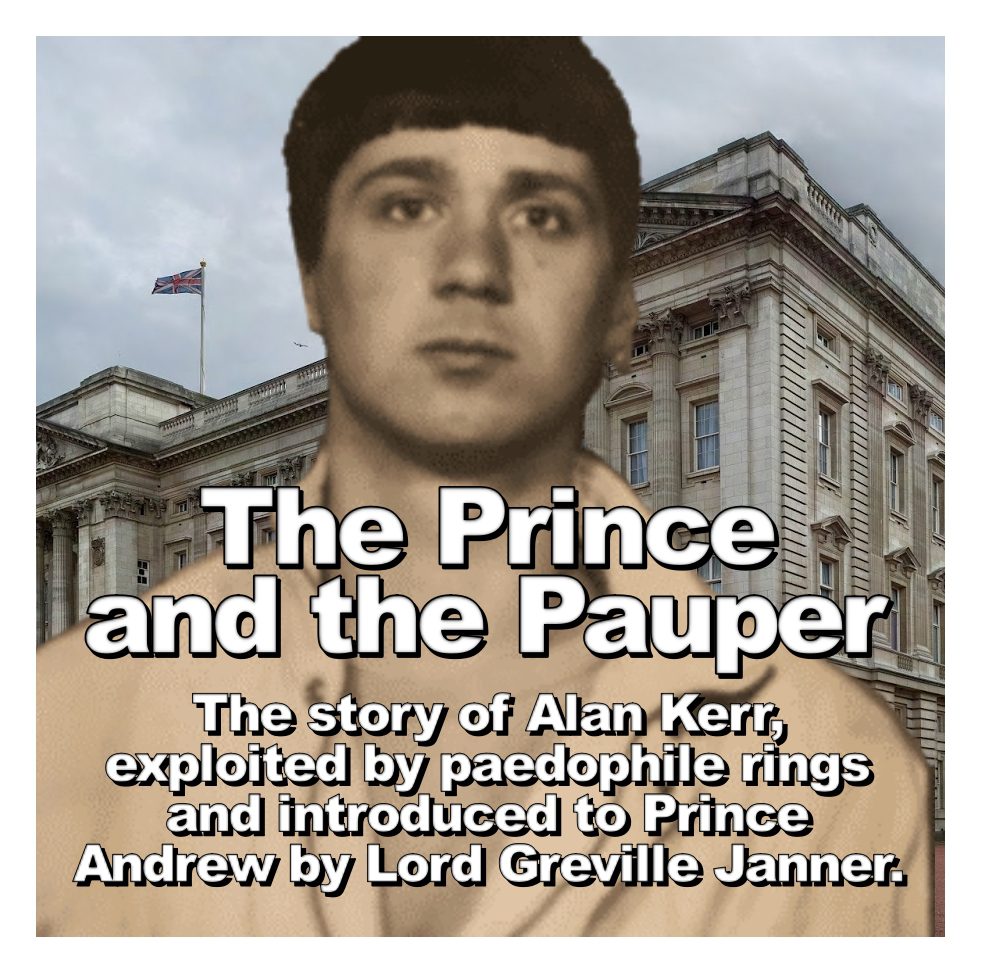
Alan Kerr was sexually abused by three men at Williamson House, a Belfast Corporation Welfare Department care home in Belfast. He was only six years of age when it started. One of his abusers was Eric Witchell, the Officer-in-Charge of the home. Witchell was a friend of both Joe Mains, the infamous paedophile and Warden of Kincora Boys’ Home, and William McGrath, the Housefather at Kincora.
Alan is the younger brother of Richard Kerr, another child abuse victim. Alan did not realise he had a brother until he met Richard at Williamson House when he was six. He also met his sister there, learned that he had another brother and two other sisters, and that both of his parents were still alive.

Later, he was moved to Shore House, where he was abused by two other men, one of whom may have been Witchell’s friend, William McGrath.
Alan eventually fled from institutional care for a life on the streets of Belfast. Still, it was no more than jumping out of the frying pan and into the fire and having been neglected, groomed and abused throughout his childhood, and finding himself desperate for food and shelter. At the same time, on the run, he fell into the hands of a network of calculating paedophiles who abused him. At one point, he was manipulated into working for a while at a brothel off the Lisburn Road, where boys as young as 13 were made available to Belfast’s paedophile community.
Later again, he was trafficked to Birmingham and thence to London by Billy ‘B’, one of his abusers. Out of desperation and, with neither an education nor any sort of a qualification, he ended up being exploited as a ‘rent boy’ at Victoria Station; as a ‘Dilly boy’ on the ‘Meat Rack’ at Piccadilly Circus; and for approximately, at a year in a brothel in Earl’s Court alongside other boys who were younger than him; possibly even as young as 13 or 14.
Alan also had a bizarre encounter with Prince Andrew, which is described in sections 17 and 18 of this Webbook.
1. A FOG OF FEAR AT BREFFNI NURSERY 1969-1974. INCARCERATING TODDLERS WHO CRIED AT NIGHT IN A PITCH-BLACK BOILER ROOM. ALAN AGED 0-6.
Alan Kerr was born on 8 May 1968 and was taken into care at Breffni Nursery when he was only a few months old, sometime in late 1968 or early 1969.

There was a lot of sobbing at night in Breffni, a care home which catered for infants and pre-school children. Alan recalls how, if a child in the dormitory began to cry out loudly at night, some of the more brutal members of the night staff would put the child in a boiler room, well out of earshot. They were often left alone in the pitch black for hours. Alan frequently found himself crying because cold strangers surrounded him; he had ‘no family to love me’; and had to cope with the unrelenting stress of a threatening environment. He, too, ended up in the boiler room on several occasions. He recalls one particular night when two of the night staff marched into the dormitory, hauled him out of bed and carried him to it, then pushed him inside and left him alone in the darkness for hours.

2. RAPE AT WILLIAMSON HOUSE, 1974-1978. ALAN KERR WAS SEXUALLY ASSAULTED ON HIS FIRST NIGHT AT WILLIAMSON HOUSE. HE WAS ONLY 6 YEARS OLD. ALAN AGED 6-9.
A caveat must be entered before we proceed any further: Alan Kerr does not have access to his institutional records from Belfast and therefore cannot provide precise dates. Instead, he has done his best from memory.

Alan left Breffni Nursery when he was about six, sometime in 1974, or thereabouts, and took up residence at Williamson House for the next two or three years. He describes it as being ‘worse’ than Breffni. ‘Things did happen there which I still can’t talk about.’
Alan would be abused by men who were not members of the staff at Williamson House; yet more proof of an organised child abuse ring operating in NI at this time.
Astonishingly, the existence of a network has been dismissed by a series of lightweight inquiries that were no match for the corresponding heavyweight cover-ups organised by the British Establishment, which have lasted for nearly four decades. The most recent example of this was the mistake-riddled Hart Report of January 2017, a document that even contradicts itself.
‘The abuse began on my first night at Williamson House when a man climbed into my bunk bed. I didn’t understand what was happening.’ The event was so traumatic that Alan manages to black it out most of the time and indeed prefers not to talk about it.

Alan’s brother Richard and his sister were at Williamson House. Before his arrival, he had no idea that he had any family. He also discovered he had two other sisters and a brother. Alan, Richard and his sister were together for about a year before Richard was shipped out to Kincora Boys Home, perhaps the most concentrated cesspit of child sex abuse in Ireland at that time. Alan’s sister remained with him at Williamson House. He received his first visit – or at least the first visit he can remember – from his parents at the home.
One of Alan’s abusers at Williamson House was Eric Witchell. He was a friend of Joe Mains, the Warden of Kincora, and William McGrath, the Housefather at Kincora. Although Witchell’s title was that of Officer-in-Charge, his responsibilities were confined to one of the two buildings at the institution, each of which was administered separately. Alan was not a resident on Witchell’s wing. Nonetheless, Witchell managed to lure him across to his attic room, where he groped him sexually.

Witchell, he recalls, ‘always had a grin on his face’.
Alan hated the place from the word go. ‘Sometimes when things went wrong, we were starved for no good reason.’ On more than one occasion, he was sent to bed without having been fed, although he had done nothing wrong, but someone else had – but had not owned up to it – and everyone was punished. ‘It was very hard to be happy at Williamson House. There was no joy there. It was scary in these places’.
The Hart Inquiry did not investigate Williamson House, although several other care homes were.
3. MISERY AND MORE SEXUAL ABUSE AT SHORE HOUSE, 1977-1980. WAS ‘JOE SOAP’, THE ABUSER WHO VISITED SHORE HOUSE, WILLIAM McGRATH FROM KINCORA? ALAN AGED 10 – 11.
Alan left Williamson House around 1977. He was about 10 and took up residence at Shore House, also in Belfast. He stayed there until he was 11, perhaps even 12. ‘It was not a nice place either. One of the staff, [NG], was very physical from the start. He would grab you by the throat, lock grab you; and drill march you up to the dorm and throw you into it. When you were in a lock, you couldn’t breathe properly’.

One lady beat the children with a wooden spoon on their legs and put soap and mustard in their mouths. ‘She was the worst female member of staff. If a child was making noise at night, she came upstairs and pulled the cover off, took your pyjamas down and beat you on the bum or the legs. It was pure physical hitting; hard-hitting. She could get furious.’
‘One thing the staff had to do was to make you afraid of them. This was how they kept control. They couldn’t ever lose control’, Alan emphasises.

Sadly, a lot worse than this lay in store for Alan.
A man Alan refers to as ‘Joe Soap’ abused both him and another boy at Shore House. Alan had known him earlier at Williamson House.
‘Soap’ was a man who ‘smelt and was dirty’. He materialised at Shore House one day out of the blue, a stranger to Alan. Yet, ‘Soap’ knew exactly who he was. At the time, Alan’s parents were both alive. ‘Soap’ knew about them, too. Clearly, someone must have furnished him with the relevant details about Alan, most likely someone with access to his welfare file. ‘Soap’s’ opening gambit involved telling the staff that he was a friend of Alan’s parents. This was accepted at face value. ‘One of them came in and told me that there was someone outside who was a friend of my family, and I was brought outside to meet him. It was as simple as that.’

Many years later, Alan was looking at a picture of William McGrath, the notorious Housefather at Kincora Boys’ Home, when he realised he knew him, and then it came to him: McGrath was ‘Joe Soap’. If his recollection is accurate, this would explain how ‘Soap’ knew so much about his background and where to find him. For a start, McGrath and Witchell were friends. Witchell even had his own nickname for McGrath, ‘Master McGrath’, after a then-popular dog food. Witchell, of course, knew all about Alan’s background from his time at Williamson House. McGrath might also have picked up Alan’s trail from his visits to his brother Richard at Kincora. Richard had entered Kincora in 1975 and stayed there until 1977.

McGrath was also known to abuse very young boys. One of his Kincora victims, James Miller, has described how he had an appetite for boys ‘with no hair between their legs’. Miller told the Hart Inquiry how the staff at Kincora ‘each had their favourites and they kept those boys for themselves. However, McGrath wasn’t that fussy about who he abused. He said himself he ‘liked’ all boys as long as they weren’t too old’.

Miller also stated that the abuse he suffered at Kincora ‘started within the first week. It continued over the entire two years I was there. I have thought about it, and I would say McGrath abused me on 325 occasions, ranging from getting into bed with me to buggery. He used to bring me downstairs behind Mains’ office and down to where the freezers were. It was quieter for him down there. The things he used to do to me were sick. He would try to get me to have an erection but I wasn’t old enough. I wasn’t even developed which was the way McGrath preferred it. He used to say he liked boys with no hair between the legs.’
Alan was about 10 or 11 at the time ‘Soap’, the man he believes was McGrath, began to abuse him.
McGrath occasionally wore glasses, just as ‘Soap’ did, although all the published photographs of him depict him in spectacles. McGrath did not always wear them while he was working at Kincora, according to Richard Kerr, who saw him every day for nearly two years. Similarly, ‘Soap’ did not always wear spectacles inside Shore House.
The defilement perpetrated by ‘Soap’ began after the second or third visit. ‘Soap’ could hardly have acted so confidently unless he knew that Alan had already been abused and had not complained.
‘Soap’ became a frequent visitor to Shore House. The early encounters involved Alan being raped in the upstairs toilets while the staff were downstairs in the living room, unaware of what was going on. ‘I didn’t talk to them. You couldn’t talk to them. I was so scared of them. I thought I would get into trouble if I said anything to them.’
Later, ‘Soap’ took him to a derelict house to defile him.

The second boy was also abused in the upstairs toilets. Alan was instructed by ‘Soap’ to stand guard outside them while it took place. The other child was later rescued from the care system by a relative. Alan has neither seen nor spoken to him since.
One day, ‘Soap’ disappeared, never to turn up again at Shore House. Although Alan cannot be specific about the dates, this may have been early in 1980, when the Kincora scandal erupted and McGrath’s reign of terror came shuddering to a halt.
Whether ‘Soap’ was McGrath or not, the essential point is that a paedophile was provided with confidential details about a boy at Shore House who had been broken and moulded into a sexual plaything at the age of six by Eric Witchell and others at Williamson House. Clearly, a paedophile network was operating in the shadows. Yet every State-sponsored probe into the Kincora scandal has concluded that an organised network of paedophiles did not exist in NI.
Shore House was not investigated by the Hart Inquiry either.
4. AN EMPLOYEE AT SHORE HOUSE IS FOUND NOT GUILTY IN COURT OF MASTURBATING IN FRONT OF ALAN KERR
The staff at Shore House had access to a property in County Down where the children were occasionally taken on what should have been happy and memorable excursions. Alan went on one trip led by ‘G’, the man who was given to grabbing children by the throat. Alan was the only boy on the trip. That night, the girls were shepherded into one of the bedrooms while Alan was instructed by G to join him in another room. When the doors were closed, G ‘took off his clothes and stood in front of me naked with his erection on display and began pleasuring himself’, Alan recalls. ‘Then he got into his own bed and continued. I told another boy about this and we were probably overheard and the story [eventually] leaked back’ to the other staff at Shore House.
Something similar happened during a subsequent visit to Portrush with G. On the second occasion, ‘he got into the shower with me erect. Then he masturbated himself in the bathroom. He was probably about 27-28 at the time’, Alan recalls.

Alan was attending a meeting of the Boys Brigade in a hall near Shore House one day, not long after these events, when a member of staff called him out early and brought him back to see Miss Kavanagh, who ran the institution. She was in her office with the Area Head social worker, who was seated. She quizzed Alan about G’s behaviour. At first, he was afraid to talk, but she persisted. She used hand gestures to depict what she understood had taken place. Alan eventually confirmed what had transpired. The RUC were then called in and took a statement from him. A prosecution was pursued in a court in County Down. The presiding magistrate was male in his 50s or 60s.
Alan, who was 10 or 11, recalls that he was ‘set upon by [G’s] lawyer, and I started crying. The defence tore into me. I was accused of making it up. I denied I had lied. I was accused of being the one who had exposed myself to others on the trip’. That, of course, was a blatant and malicious lie.
On her way out of the court after Alan’s cross-examination, Miss Kavanagh said that she was convinced that G was lying about Alan’s alleged behaviour because she was the person in authority to whom any such misbehaviour would have been reported and not a word of it had reached her ears.

Kerr was the only prosecution witness to testify about what had transpired inside the bedroom. In the event, her colleague was found not guilty by the magistrate. However, he soon lost his job at Shore House.
Alan did not receive any form of counselling after the trial. Shortly afterwards, he was fostered by a family in the community. The arrangement lasted approximately two years before the relationship broke down and he returned to Shore House, albeit for a brief spell only, before he was moved on to Bernardo’s Sharonmore Project.
5. ESCAPE FROM RATHGAEL JUVENILE DETENTION CENTRE FOR A LIFE ON THE STREETS OF BELFAST 1982-85. ALAN AGED 14-16.
Alan stayed at Sharonmore for about two years, 1980-81, where he was not abused sexually. Nonetheless, the trauma of his childhood had caught up with him, and he was now a troubled child. He was transferred to Rathgael Training School in Bangor, Co. Down, which catered for difficult children. So intense was his dislike of it that he absconded at any given opportunity, perhaps up to twenty times. His first breakout occurred shortly after his arrival. This began a pattern of traipsing ‘across fields that took me into Dundonald in East Belfast’. When he was caught and hauled back, he would be put into a lock-up unit for absconders in ‘House 4’, which had shatterproof plastic windows. All told, he spent about a year at Rathgael before his final and permanent break for freedom.

When he was in Belfast, the inevitable happened: he was preyed upon by predators on the lookout for ‘runaways’. ‘Two men – Martin Cassidy and Davey Martin – bumped into me, and it started from there. They hung around the town centre a lot picking up boys, especially boys in school uniforms. They often went to the toilets in the city and other places. Cassidy had a beard in those days and wore an earring. He was dirty and badly dressed. Martin was more into suits, snappy suits’
Alan recalls how Cassidy was ‘a monster’ who asked him to perform grotesque sexual acts on him.
Alan became something for them to show off, to dangle and pass around to other predators. Among those to whom he was circulated was ‘Fanny’, who was a ‘dirty pervert’, as well as Roy, Hugo and Billy B, who all had their own kinks. Roy is still alive and living in Belfast. Billy ‘B’ is dead as, it appears, is Hugo.

‘I slept with men because I had no choice. I needed food and a bed’, Alan explains. Suffice it to say, by this time, his desperation had made him easy prey for Belfast’s calculating paedophiles. He was escorted around the paedophile haunts of the city, such as the Whip & Saddle Bar in the Europa Hotel, while it was run by Harper Brown, a friend of Joe Mains, the Warden of Kincora. The Europa was where Alan’s brother Richard had been abused by Enoch Powell MP while he had ‘worked’ there as a bellhop for Brown; in reality, a flimsy cover for his role as a plaything for pederasts.

While Alan was in the Whip and Saddle, he met some English paedophiles. Some of them knew their depraved NI counterparts who drank in the hotel, while the ‘Northern Ireland paedophiles definitely all knew each other. It was a close-knit group; really close.’ The members met in a series of pubs and often exchanged information about boys, especially new boys, ‘the fresh meat or chickens as they called us’. Alan Kerr was also taken to the Crow’s Nest on Skipper Street. It was quite close to the Albert Memorial, which was then a ‘cruising ground’ for paedophiles. It was later renamed the ‘Custom House’. He also went to ‘The Red Barn’ on Rosemary Street, which was opposite the Royal Avenue Hotel bar, which was also frequented by paedophiles, notably the terrorist and MI5 agent John Dunlop McKeague.
6. THE BOY BROTHEL OFF THE LISBURN ROAD
During another foray from Rathgael, Cassidy and Martin brought Alan to a gay brothel on a street off the Lisburn Road. ‘From the outside it looked just like a house’, Alan recalls. ‘13 and 14-year-old boys were working in it as well as older boys. I knew one of them from Williamson House. He was sitting in the living room on a settee with some other lads when I walked in the first time’.
Despite countless police, local authority and state-sponsored enquiries into child sex abuse in Northern Ireland over the last four decades, no investigation has taken place into this brothel. It was within walking distance of Belfast City Hall, which was a meeting place for the members of the paedophile network.

How did all the enquiries fail to uncover this child brothel?
How many other child brothels were open for business in Northern Ireland at this time?
Alan recalls that the brothel was ‘run by an ugly fat character. I sort of worked a bit in it. I met [name withheld] who was the same age as me. He was a Catholic. I’m Protestant. He lived with his family in the Divis flats.’ Alan disliked the fat man and soon decided to give the brothel a wide berth.
According to Alan, the brothel was frequented by a large number of Belfast’s ‘close-knit’ paedophile community. What are the chances that the men who were involved in the Kincora, Williamson House and Park Avenue Hotel branches of that community never once visited the boy brothel, nor knew of its existence? Did Mains, McGrath, McKeague and Alan Campbell – all British agents – never tell MI5 about it? Did Ian Cameron of MI5, the evil force who protected the ring, and his successors, never learn about it?

At the very least, the brothel enjoyed a measure of shelter from the protective wall built around NI’s paedophile community by the NIO, MI5, MI6 and the RUC Special Branch. For their overarching paedophile exploitation/blackmail operation to thrive, the NI paedophile community as a whole needed to flourish. If one child abuser were ever to be arrested, it was always likely that others would follow, and the deprecations at Kincora, Williamson House and the Park Avenue Hotel would ultimately be exposed.
There is also a deeply disturbing – yet highly likely – possibility, namely that the brothel was a constituent element of the MI5-run operation that also permitted the abuse at Kincora, Williamson House, the Park Avenue Hotel and elsewhere to fester.
7. THE DAY A RUC DETECTIVE AIMED A REVOLVER AT ALAN KERR’S FACE
Alan went to stay with the Catholic boy from the Divis Flats he had befriended at the boy brothel. ‘I stayed with his family on and off. I slept on the floor of his bedroom. It was very small and stuffy. His brothers were very Republican. I don’t think they ever realised I was a Protestant.’

During an escapade with his newfound feral friends from the Divis flats, Alan found himself riding as a passenger in a stolen car one day. Suddenly, two jeeps carrying armed British soldiers tore after them. ‘The soldiers always had these large SLR rifles. Our car stopped and everyone jumped out. I didn’t know where to go. The rest went over a footbridge into Divis and got away. I knocked on the door of a house where an old couple lived. I brushed past them and hid inside. But someone saw me and a few police and soldiers came in. They brought me outside and threw me into the meat wagon and took me to a police station. I can’t really remember what I said but I may have admitted to being in the car. The staff at Rathgael were called and came to take me away. When we were going out, I bolted. I got past the barrier. They chased me but I got away. The police jumped into a car and caught up with me but I kept running backwards and forwards and turning around; they couldn’t get me in a corner as their car wasn’t able to turn as fast as I could. Then one of them pulled out his revolver and pointed it at my face and said he would shoot me. I was scared so I stopped. I was taken back to the police station but the staff from Rathgael had gone. They came back later and brought me back to it. At that stage, I just thought of [Rathgael] as somewhere to eat. I didn’t want to be in the system any more. I escaped again and returned to the Divis.’
8. ROUSING THE SUSPICION OF REPUBLICANS
Alan was not charged with an offence by the RUC, something that roused the suspicion of some of the Republicans in the Divis flats. They were also suspicious at the speed with which he had regained his freedom. ‘They wanted to know if I was an undercover agent’.

Ultimately, they accepted Alan’s friend’s assurance that he was simply an ‘orphan’ and things calmed down.
9. MEANWHILE, 10 YEAR-OLD BOYS WERE BEING ABUSED IN DUBLIN
Alan remembers one particular individual who preyed on him and other urchins in Belfast, a man called Hugo who was fond of displaying his wealth. ‘He was known as the Money Man. He always wanted people to see that he had money. He would never take out a note; always a roll of banknotes. He drank in the pub opposite the Europa Hotel. He had grey hair and was middle-aged.’ Although he was from Northern Ireland, Alan believed he was living in Dublin. All the signs are that he is the same man as the individual who was the subject of a story in the Evening Herald on 6 November 1986. It exposed the vile behaviour of a paedophile from Northern Ireland who was spending a lot of time in Dublin. It reported that:
‘Every weekend an affluent businessman from Northern Ireland travels to Dublin by train to hire young boys for sex.
‘Described as middle-aged and grey-haired, his favourite haunts are the public toilets on O’Connell Street and Burgh Quay, where there is an alarming number of boys often as young as 10 or 11, who are available for sexual services.

‘Nicknamed ‘Moneybags,’ he uses an elderly Dubliner scout on his behalf procuring the boys and acting as a lookout while business is conducted in the cubicles.
‘In one particular case, a 12-year-old boy was paid £3 for 15 minutes with him.
‘In other cases, he will take boys back to Belfast and spent most of his time in a top hotel where he is well-known.
‘The boys, who are usually from a poor background or even homeless, receive as much food and drink as they can consume, sometimes new clothes and are even promised holidays abroad.
‘‘Moneybags’ comes to Dublin every weekend to indulge himself and he rarely uses the same boy twice’’
The ‘top hotel’ was most likely the Europa where Hugo often stayed.
10. HUNGRY, ALONE AND FIGHTING THE BITING COLD
Alan was abused by Billy ‘B’, a man he describes as a ‘toilet creeper’: ‘I met him out of the blue one time [in Belfast] while I was on the run from Rathgael [Training Centre]. He followed me into the toilet and smiled at me’, Alan recalls. B would prove to be one of Alan’s most prolific abusers.

When Alan was 15 or 16, B took him to London via the Belfast-Liverpool car ferry in his silver BMW. At the time, Alan was subject to a care order which was not due to expire until he was 21. Alan stayed in London after B headed back to Belfast because he did not want to return to Ireland, but this proved no more than jumping out of the Belfast frying pan and into a London hellfire. With no support, trade or qualification, he would spend his youth as a ‘rent boy’ at such places as Victoria Station and on the ‘Meat Rack’ at Piccadilly Circus, also known as the ‘Dilly’. Over time, he would get to know boys from all over Ireland who were in the same dire straits as he was. The men who abused the young teenagers referred to them as ‘chickens’; the boys called their abusers ‘punters’. Alan would never return to live in NI again.

Victoria Train Station was an infamous hunting ground for paedophiles. ‘There were pubs inside the station in those days. Some of the men who went to them were only there to have sex with the boys. There was another pub nearby, the Shakespeare, which was similar. Soldiers used to go there a lot. At the weekends there would be a lot of military police outside it’.
The police knew perfectly well what was going on at Victoria Station. Not long after his arrival, Alan was approached by a British Transport Police (BTP) officer who asked him who he was and then went away to make inquiries about him. When he returned, he told Alan that since he wasn’t in trouble in NI, he wasn’t going to do anything about him. Clearly, the officer had been able to make enquiries with Belfast – presumably through the communication facilities in the BTP office at the station- and must surely have discovered that Alan was still under a care order. Nonetheless, he abandoned him to a life as a rent boy.

Finding somewhere to sleep was a priority for Alan, and Victoria Station offered some shelter. ‘In those days, the station was open all night. It is unrecognisable now. I slept on trains that pulled into it for the night’. Sometimes he found himself drenched in sweat, even in winter. Then, as the night and early morning crept in, he would begin to freeze while still damp, if not actually wet. He recalls having to go to the toilets to try and warm himself up by using the hand dryer. ‘In the morning, the police would come onto the trains and turf you off’.
One of the visitors to the toilets at Victoria Station was John Imrie, an MI5 officer named by Ken Livingstone in the House of Commons in connection with the Kincora scandal. Imrie was arrested at the station and convicted of exposing himself.
11. QUEER-BASHING AND SEXUAL ABUSE AT THE HANDS OF THE POLICE
During his early years in London, Alan was assaulted by police officers on a number of occasions. Typically, this happened as he was being escorted towards Vine Street Police Station from the Dilly. ‘They would start pushing and pulling you to make it look like you were causing them trouble. They would use this as an excuse to punch you in the stomach; always in the stomach; up against the wall outside the station. They never bruised your face as you might be going up before the Bow Street magistrates’.

One British Transport Police officer Alan got to know was a pederast, something that would explain how the abuse was able to thrive at the station. He developed a liking for Alan and frequently abused him, even taking him back to his flat. Some of the officer’s colleagues suspected what was afoot and attempted to persuade Alan to talk about it but he refused. The abusive officer has long since died. He operated out of the Transport Police office at Victoria Station. Alan didn’t reveal the nature of the relationship he had with this officer when he was interviewed by his colleagues because he was ‘afraid of the police’.
12. THE EARL’S COURT ‘CLINIC’ ON THE LONGRIDGE ROAD
One night, Alan was approached by an Oriental man called Peter, in his 30s or 40s, at Victoria Station. He escorted him to a house at 51 Longridge in Earl’s Court, which masqueraded as a ‘clinic’. What Alan didn’t realise at first was that he was being sampled to see if he might be suitable to work for the man at his brothel, one that catered for older men who exploited teenage boys. ‘Peter always tested the boys himself to see if they were any good. He gave me a few quid the first time we had sex, but never again. He never felt he had to pay for sex and had sex with the boys whenever he felt the urge. You couldn’t say no to him’.

‘Peter was friends with another Thai man who ran a brothel on Sydney Street. They were always looking for chickens for their places. When I first started working for him, he was in a house in Earl’s Court called the ‘Earl’s Court Clinic’. It was all done up in an Oriental fashion with Oriental statues and flowers. Oriental boys and some Australian boys worked in it. Some of the Oriental boys looked about 13 or 14, but you had no way of knowing their age. Mainly, the boys were around my age. There was one older lad who was in his late 20s, but he was more like Peter’s right-hand man. He would take over running the place when Peter wasn’t there’.
Peter later moved the Clinic to a basement at Nevern Place, also in Earl’s Court.
13. THE LONDON PAEDOPHILE CIRCUIT THAT REVOLVED AROUND ELM GUEST HOUSE, THE EARL’S COURT CLINIC, THE PHILBEACH HOTEL AND THE BROTHEL ON SYDNEY STREET
By the time Alan had arrived in London in the mid-1980s, Elm Guest House, an infamous boy brothel, had been raided and closed down by the police. Until 1982, the Elm was where the likes of Sir Cyril Smith MP abused boys. Once inside the doors, abusers could mingle with each other. There was, for example, a sauna available to all patrons. Cyril Smith once reportedly trapped himself inside it due to his obesity.

The closure of the Elm did not put an end to child abuse in London. It just moved – or intensified at other establishments. One venue where underage boys were exploited was the Philbeach Hotel in Earl’s Court. Both Alan and his older brother Richard were abused at it. Richard had been held in the hotel by two men after arriving in London. Richard had also been exploited at the Elm. A return visit he made to Elm Guesthouse as an adult with a Channel 4 News team is available on YouTube.

Richard Kerr says that Peter, the Thai child pimp, was involved in both the Elm and the Philbeach. Richard recalls a picture of Peter which hung on one of the walls in the Philbeach. It featured him amid a group of men.
On the surface, the Philbeach was nothing more than a raucous party venue for consenting homosexual adults. Suffice it to say, many of those who frequented the hotel had no part in the abuse of underage boys. The LGBT Archive recalls it fondly in the following terms: ‘Philbeach Hotel in Philbeach Gardens, Earl’s Court, was a gay-owned hotel, catering for a gay clientele. Long before Soho became So-Homo, Earl’s Court was the gay capital of London. And if the walls could talk at the Philbeach, London’s most in-your-face gay hotel, they’d have some saucy tales to tell. It’s typically English B&B material, if a bit grubby. But people [didn’t go to it] for the chintz. For the Philbeach had gained a reputation as a cruisy hotel. If you don’t enjoy being propositioned in the bathroom, request a room with ensuite facilities. The Philbeach Hotel was open for 27 years and was one of the largest gay hotels in Europe. The Philbeach hotel was the only gay hotel in London that was owned by homosexuals and run by homosexuals. The hotel closed on January 31, 2008. It had 35 rooms on three floors.’.

14. THE ‘CLINIC’ WAS MORE DISCREET THAN ELM GUEST HOUSE
The ‘Earl’s Court Clinic’, was a far more discreet establishment than the Elm. ‘The punters who visited it came up the steps outside it and through the front door and into a hall. There was a door inside the hall with a bit of glass in it that acted as a one-way mirror because the hall was kept in semi-darkness but the room next to it – where we were – was well lit. The punters would peer through the glass at us – we would be sitting inside – and pick one of us out. In the first building – the house – Peter would walk into the room after the punter had made his choice and call out the name and shout “upstairs”. After we moved to the basement [premises], we would be sent to a room along the corridor. There was also a darkened window in the basement for the punters to look through at the lads. Peter would make recommendations about who was suitable for the punters who didn’t make up their mind immediately’.

15. FOR SALE: ASSAULT AND BATTERY
Peter allowed the ‘punters’ to assault his boys if they were prepared to pay enough. ‘The most I ever got was from a man who wanted to lash me with a leather belt. He paid me £20 per slap. I made a few hundred quid that night’, Alan recalls.
‘We always got a cash payment, but the commission was half. Peter always took half’.
‘The punters were rich. Most of them wore suits. There were no roughs. Most of them were in their 40s and upwards. The oldest was about 70. The older men were the worst. They were dirty down below. Some of them had already got cum in their pants; they were that excited. They made me sick, but you just had to get on with it. You had to be good to stay in the Clinic. If you didn’t make money, Peter got rid of you. I worked for him for about a year. Then I went back on the streets again. I haven’t seen Peter in a long time. The last time I saw him, he was old and had grey hair.
The Independent Statutory Inquiry into Child Sex Abuse (IICSA), led by Professor Alex Jay, was a failure. It could have, but did not look into many high-profile instances of non-recent child sexual abuse. It should trace Peter and ask him searching questions about what he knows about VIP paedophiles. That would have unravelled the VIP network that IICSA failed to detect.
16. GREVILLE JANNER MP AND THE APARTMENT AT DOLPHIN SQUARE

After his time at the Clinic, Alan went to the Meat Rack on the ‘Dilly’ at Piccadilly Circus. One night, Greville Janner, then a Labour MP, ‘came up behind me and started talking to me’. A short while later, he escorted Alan to the bar in Dolphin Square. Alan slept with Janner each night during the week that followed. ‘I was desperate for somewhere to live at the time. I wanted accommodation, food and security’.

Janner would throw him back on the street in the morning and then hook up with him at night. Janner did not attempt to hide who he was or what he did. One morning, Janner warned him he had ‘a late sitting’ that night, but that he was to wait for him. This, presumably, was a reference to a late sitting in the Commons.
17. THE PRINCE AND THE PAUPER

During the course of the week, Janner invited him to go to a show in Earl’s Court, which took place in 1986. Alan was surprised but happy to accept. Janner then told him that he had to submit his – Alan’s – name for security clearance as they would be on Prince Andrew and Sarah Ferguson’s guest list. Alan obliged by providing his full name and his sister’s address. Janner subsequently told him that everything was ‘fine’ with the security people.

Shortly afterwards, they attended The Prince and the Pauper at Earl’s Court‘s Olympia with the Royals. Janner and Alan sat directly behind the Royal couple, who were in the front row, or very close to it. While they were waiting for the show to begin, Alan and Prince Andrew conversed. They also chatted during the intermission. ‘I had a good conversation with him. He had character. He was a cheerful guy. He was not snobby or anything. He told me he was going to open a hospital in Northern Ireland. I didn’t feel I had to bow down to him. I wasn’t nervous. Janner let me do the talking. They seemed to know each other quite well. That’s why I was able to talk to him. Sarah Ferguson didn’t speak much. She really just ignored us.’
The guest list and the vetting records for this performance should still be in an archive somewhere.
18. WHAT WAS JANNER PLAYING AT?
Janner obviously knew Alan was from Belfast and that his name would be run by MI5 and the RUC Special Branch during the security vetting process. It must have occurred to him that Alan could easily have had one or more convictions for male prostitution under his belt. And Alan did indeed have a number of convictions. He believes – but is not certain – that he incurred some of them before he met the Prince. So, why was Janner prepared to submit his name to the officials responsible for protecting the Royals? Had he reason to believe he had nothing to fear from MI5 and the police?

Why did Janner – a married man, politician and author – take a male prostitute in his early 20s to the performance instead of his wife or some other friend? There must have been many influential people who would have been indebted to Janner for just such an invitation.
If the tabloid media in the UK had discovered that Prince Andrew had enjoyed a social interaction – however fleeting and innocuous – with the brother of a Kincora boy, that fact alone could have generated waves of negative publicity for him, especially with the unrelenting reports about Kincora which the heavyweight campaigning journalist Paul Foot was publishing in Private Eye and the Daily Mirror. The true horror of the Kincora scandal has yet to make an impression on the people of England, Scotland and Wales. See Kincora’s darkest secret.
There are other puzzling features about the event. Janner was a great communicator, so much so that he published multiple editions of a book entitled ‘Janner’s Complete Speechmaking’. So why did he sit back – literally – and let Alan dominate the discussion with Prince Andrew?

When did this performance take place? Prince Andrew and Sarah Ferguson were engaged to be married at the time of the performance. Their engagement had taken place on 19 March 1986. Prince Andrew told Alan that he was going to open a hospital in Belfast. Prince Andrew visited the City Hospital and then went to Hillsborough with NI Secretary Tom King on 25 June 1986. He was married on 23 July. This means that Kerr was 17 or had just turned 18 at the time of the performance, as he was born on 8 May 1968.
Janner’s defenders still maintain that he had no interest in young males.
19. MI5’s ‘DOLLY MIXTURES’.

If MI5 had done its homework properly, it would have realised that Alan was Richard Kerr’s younger brother, the courageous boy who had exposed the Kincora scandal. Significantly, it was Richard’s social workers who had informed the Irish Independent about it. The link between the brothers was hardly a secret: when he had lived in Belfast, Alan had occasionally visited Richard at Kincora.

MI5 certainly kept an eye on the sexual antics of VIPs in the 1980s. It had a dedicated unit which monitored the sexual antics of Tory VIPs. It was called the ‘Dolly Mixtures’. In February 1985, Frank Doherty reported in the Phoenix magazine that the ‘Dolly Mixtures’ had been set up on the ‘personal orders’ of Margaret Thatcher to avoid embarrassing Tory sex scandals. It is highly likely that it or a parallel unit also monitored the young Royals. Indeed, the so-called ‘Squidgygate’ tape featuring Charles and Camilla is suspected to have originated from an MI5 leak.

Frank Doherty’s Phoenix article about the ‘Dolly Mixtures’ (published five years before the Squidgygate scandal erupted) revealed that the ‘Iron Lady’ had ordered the establishment of the unit on account of ‘her fear of a repeat’ of the Profumo scandal. ‘Since 1981, on her personal orders, an elite section of MI5, operating from Gordon Street, W1, has kept a discreet eye and an attuned ear on the personal and sexual indiscretions of Tory MPs. This section, known as the ‘Dolly Mixtures’, is composed of tall, blonde males, green-wellied Sloane Rangers, Young Fogie homosexuals, and young blue-chip ‘wets’ who together form a unit superbly equipped to socialise with and report on the morale, morals and mores of Tory MPs’.


MI5 certainly appreciated the real and present danger Richard Kerr posed to the British Establishment. It had done so for years before the performance at the Earl’s Court Olympia, which his younger brother attended.
In the early 1980s, Richard had lived in Preston and later in London. He had become the target of heavy-handed officials at both locations. In 1981, he had been warned by the RUC, who visited him in Preston, not to return to Belfast to give evidence at the Kincora trial. The RUC only wanted boys who had been abused inside the walls of Kincora by the staff to get into the witness box; not those like Richard who had been taken out of the home to places such as the Park Avenue hotel where they were made available to MI5 surveillance targets including at least one senior member of the DUP (the ‘Wife Beater’) and his friend John Dunlop McKeague, the leader of the Red Hand Commando.

Later, a group of police officers assaulted Richard in London to keep him quiet. On one particular occasion, he was attacked by an undercover officer who had been listening to what he was telling his friends about Kincora in a fast-food restaurant in London.
20. JANNER’S FRIENDS ON THE BENCH

Janner knew that Alan occasionally got into trouble with the law. When Alan found himself up before the magistrates at Bow Street on another charge later on, he informed the MP – with whom he had now become quite friendly – about his looming appearance. Janner, who was also a barrister and friendly with several judges, wrote a letter for him. Janner attended the hearing but didn’t have to move from his seat during the hearing. In the event, Alan was found not guilty.

Alan is aware that at least one of the magistrates Janner knew also visited the Dilly to procure sex from the rent boys at it.

Overall, Alan was impressed by Janner. ‘He came across as a very intelligent man’, he says.
Others were impressed with him, too: Janner was later made a member of the House of Lords.
The British Establishment is expert at covering up for the Royal Family. See: The Mountbatten Dossier. [WebBook]
Also Mountbatten exposed, 1990.
21. ALAN NOW.

The only occupation Alan has ever had is that of a male prostitute and a brief moment as a model for a pornographic gay magazine. He now lives in a small flat in London. A report from his counsellor states that his experiences have left ‘him feeling extremely isolated and [he experiences] regular traumatic flashbacks and debilitating bouts of anxiety and depression’. He is a poor sleeper and becomes physically shaky when agitated.

He has attempted suicide by inhaling gas. On another occasion he punched his hand through plate glass resulting in severe injuries. He has engaged in other bouts of self-harm.
He is not in a relationship and has no children.

22. STEPS WHICH SHOULD HAVE BEEN TAKEN BY PROFESSOR ALEXIS JAY AND CAN STILL BE TAKEN BY THE METROPOLITAN POLICE OR A GENUINE INQUIRY INTO VIP SEX ABUSE.
Alan Kerr made a statement to the lamentable London-based Independent Inquiry into Child Sexual Abuse (IICSA). A thorough investigation of his case could have exposed the VIP child abuse network of which Alan Kerr had been a victim. IICSA failed totally in this respect.

IICSA should have:
• Asked MI5 for its files on Alan and Richard Kerr;
• Alan and his brother Richard (who was abused by a string of Westminster MPs and a Tory Cabinet Minister) should have been asked for the names of their VIP abusers;
• It does not appear any attempt was made to ask the department responsible for the security vetting for the Earl’s Court Olympia performance of The Prince and the Pauper, which Alan Kerr attended with Lord Janner, for all of its relevant records;
• It does not appear that the IICSA investigated Peter, the Thai child pimp who ran the Earl’s Court Clinic, and his wealthy clients.