
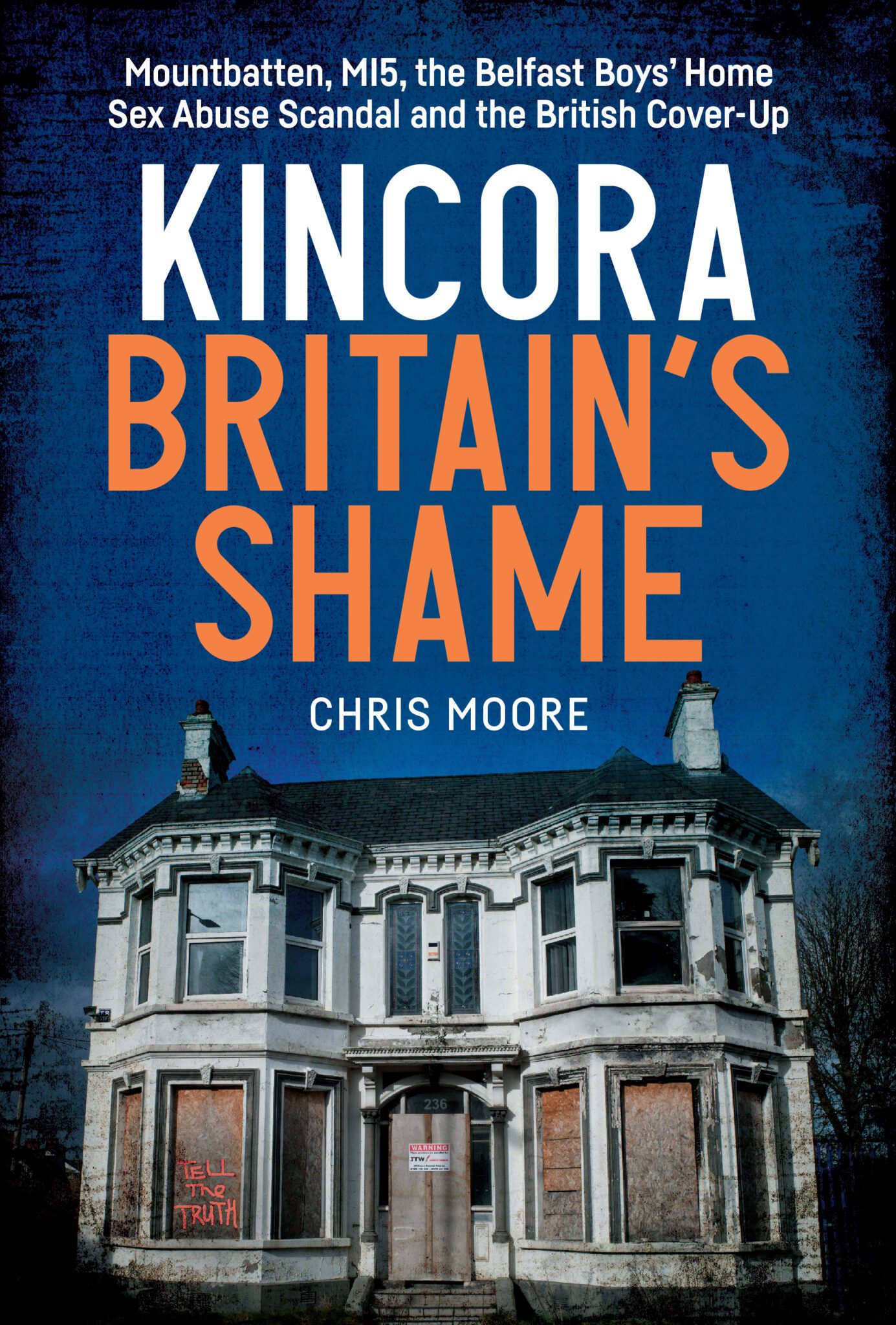
Christopher Stanley reviews “Kincora: Britain’s Shame: Mountbatten, MI5, the Belfast Boys’ Home Sex Abuse Scandal and the British Cover-Up” by Chris Moore. Published by Merrion Press (£17.99 Paperback) 276 pages.
To the memory of Stephen Waring who committed suicide or was murdered.
[1]
In 2020 I published an opinion piece called The Accused and the Accusers: If Not Now, When? (Village Magazine 15 May 2020).
That piece considered the process and progress of the investigation then being undertaken by Independent Inquiry into Child Sexual Abuse (IICSA) in London.

That piece was observational reportage from a lawyer attempting to ventilate the rights of his client, one of the abused who should have been allowed to speak. It focussed on the mechanisms and structures – including the physical exclusion from the site of the proceedings – of limitations to deter engagement by victims/survivors of abuse, to restrict enquiry into the catalogue of institutional failures, and to exclude any sniff – or odour – of the role in safeguarding National Security by the British security services (specifically MI5)) – as an element in all this.
The IICSA – common to all public statutory inquiries established pursuant to Section 1 of the Inquiries Act 2005 (or its manifestations via the legislative processes of the devolved administrations) had no power, authority, jurisdiction, or discretion to attribute criminal or civil liability.

The IICSA was clear in its imposition of its compliance with that restriction on its work.
In the process of adducing, assessing and making conclusions on both witness and documentary evidence (the other restrictions being the exclusion of evidence or the taking evidence in CLOSED via Section 19 Notices and Orders), the aims of the IICSA became one of reputational damage limitation of the institutions under scrutiny and of ‘going through the motions’ in terms of an interminable lawyer-led process.
The ICCSA did not listen with any serious intent to the actual victims-survivors of clerical and non-clerical (political) abuse at the expense of the expansive and extensive defences provided to those clerical and political institutions that enabled and protected the perpetrators of abuse and fostered cultures in which their abuse could be perpetrated with impunity in the surety of silence.

The ICCSA provided victims-survivors with benign forums and safe-spaces to speak softly within but not for too long or too loud in order to account for the beasts who abused them but not for the institutions and systems that protected and enabled those beasts and safe-guarded the abuser and not the abused. The ICCSA perpetuated those processes of systemic institutional failure regarding its treatment of the abused.
However, there is always discretion available to inquiries to arrive at Conclusions, based upon an assessment of the evidence adduced (by compulsion or otherwise or in OPEN or CLOSED session) and to make Recommendations to secure criminal justice or civil-regulatory intervention. The IICSA did not do so.

The IICSA had been suggested as a mechanism to examine the cross-jurisdictional aspects of the systemic and systematic sexual abuse that was inflicted upon those in the ‘care’ of the Kincora Boys’ Home (and other institutions including Williamson House) including the role of senior members of the English Establishment as perpetrators of abuse including Louis Mountbatten and the role of the British Security Service as an element in the counter-insurgency operations throughout the course of the Conflict in Northern Ireland (and indeed before and after). That suggestion of referral to the IICSA was rejected and ‘Kincora’ (as both a real place and a symbol of abuse) became jurisdictionally consigned as a module within the fatally flawed Historical Institutional Abuse Inquiry (HIAI).
The trafficking of victims/survivors of abuse that commenced at Kincora with further sexual exploitation between Belfast and London, was therefore excluded from examination by either mechanism of investigation. If the system of trafficking had been so examined, it would no doubt have been subjected to the restrictions externally imposed internally acquiesced in the name of National Security within the safekeeping of the Security Service (MI5).

The motto of MI5 is ‘Defence of the Realm’ (Regnum Defende) which, as Chris Moore says in conclusion to his book now under review here (I paraphrase), is more important than defending those who could not defend themselves, the victims/survivors of sexual abuse pursued for venal pleasure or political capital (page 254).
Stephen Waring could not defend himself and he committed suicide on his trafficking ordeal. Moore compellingly discusses the friendship between him and Richard Kerr, an important figure throughout the narrative, and the apparent suicide of Stephen in the context of the role of Louis Mountbatten – and the efforts to protect or besmirch Mountbatten’s reputation by the Security Service – through the elimination of Stephen – the murder of Stephen Waring disguised as suicide (Chapter 16 and pages 228 – 229).
[2]
In the earlier I piece I was specifically concerned with the IICSA examination of the allegations of child sexual abuse against deceased senior Labour Party politician Greville Janner. The conclusions of the Janner Module were eventually reported to Parliament as Institutional Responses To Allegations Involving Lord Janner (9 October 2021) (HC729).

As with the Recommendations and Conclusions of the majority of statutory public inquiries established in the UK they are consigned to the Whitehall circular filing cabinet with a dull thud (see my recent comment on the outworkings of the IICSA in light of the Makin Review into the clerical abuse scandal of John Smyth and resultant fall from grace of the senior Anglican leadership ( Covert History 28 June 2025). The IICSA concluded regarding Janner that:
“1. While this report is constrained in what can be publicly reported, based on the evidence we saw and heard, the complainants in two police investigations (Operation Magnolia in 2000 and Operation Dauntless in 2006) into child sexual abuse allegations made against Lord Janner were let down by institutional failings.”
“3. Given that the focus of this investigation is on the institutional response to the allegations, it is not part of our remit, even if it were possible to do so, to determine whether the allegations made against him were true.”
“19. Much has changed in law and practice since the events considered in this investigation, including the practice of the institutions directly involved, such that we do not think it is necessary to make any specific recommendations in this report. However, themes emerging in this investigation have also arisen in others. Such themes include deference to powerful individuals or to superiors, the barriers to reporting faced by children (particularly those in care) and the need for institutions to have clear policies and procedures setting out how to respond to allegations of child sexual abuse.”
I mention the Janner Module of the IICSA because at that time I had worked both with and on behalf of a number of the principal figures who are core to Chris Moore’s book Kincora: Britain’s Shame. These included Richard and Alan Kerr and Fred Holroyd and Colin Wallace. Alan Kerr was a victim of abuse in Belfast and was trafficked to London where he was abused again.
Alan Kerr is Richard Kerr’s younger brother. I assisted him in attempting to engage with the Janner Module of the IICSA. My earlier opinion piece described the resistance met when bringing a witness into the Theatre of Cruelty that can sometimes be a statutory public inquiry.

Richard Kerr and Colin Wallace met similar resistance when attempting to engage with the Historical Institutional Abuse Inquiry (HIAI) which had been established in Northern Ireland and which, despite a legal challenge taken by Gary Hoy (2016 NICA 23), had a Kincora Module which therefore ensured that the London IICSA would not countenance jurisdictional ‘bad form’ by gazing at the Kincora issue.
The Kincora Module of the HIAI has been widely criticised for accepting assurances from the British Security Service (MI5) and the Secret Security Service (MI6) (see page 173), to having no powers to compel sensitive material and to being hostile to those witnesses – including victim/survivors – who engaged with it including Fred Holroyd and Colin Wallace. Moore summaries the criticisms of the HIAI (pages 169 – 177 and 129) (which in fact did make ‘revelations’ by default regarding relevant damning material generated by MI5 (see page 176 for example)).
In conclusion the Kincora Module 15 of the HIA Inquiry Report is Chapters 25 – 29:
“56 Those investigations did not find, and our Inquiry has not found, any credible evidence to show that there is any basis for the allegations that have been made over the years about the involvement of others in sexual abuse of residents in Kincora, or anything to show that the security agencies were complicit in any form of exploitation of sexual abuse in Kincora for any purpose.” (Volume 9 – Kincora Boys’ Home (Part 2) page 15) (see also: UTV | ITV News 2 July 2017).
Despite a wilful complicity in being blindsided regarding Kincora, the HIAI recommended compensation payments of up to £100,000 to victims/survivors of institutional abuse. On 16 June 2025, Kincora Boys’ Home sexual abuse victim Garry Hoy received an undisclosed settlement after claims a paedophile housemaster was protected from being prosecuted due to being an MI5 agent. No admission of liability was made (BBC News 16 June 2025).

How wrong, in retrospect, was the then Lord Chief Justice of Northern Ireland (Sir Declan Morgan) when he concluded his judgment in the challenge to the scope of the HIAI in terms of ECHR Article 3 compliance that:
“[41] This society has been rocked to its core by the shocking disclosure of the abuse of children in this community over many years. Just as shocking has been the manner in which the institutions to which some of the abusers belonged sought to protect the institution rather than the children. There is a suggestion in this case that children in Kincora were abused and prostituted in order to satisfy the interests of national security. If that is true it must be exposed. As a society we must not repeat the errors of the institutions and should remember our obligations to the children. If the suggestion is not true, the rumour and suspicion surrounding this should be allayed. We have decided that the HIA is entitled to proceed along the route mapped out by it. That does not in any way detract from the need to ensure that our obligations to these children are satisfied.”
Sir Declan Morgan is now the Chief Commissioner of the Independent Commission for Reconciliation and Information Recovery (ICRIR). The ICRIR is the mechanism introduced by way of the Northern Ireland Troubles (Legacy and Reconciliation) Act 2023 (the legacy Act) and which is now being challenged in terms of ECHR compliance in litigation before the UK Supreme Court (Re Martina Dillon and Others ).
It is also subject to potential challenge before the European Court of Human Rights ((ECtHR) in extant application lodged by the Irish government against the UK. This hangs over the British government as a sheathed sword between Downing Street and Leinster House in their struggle over securing co-operation regarding the Omagh Bombing Inquiry. Co-Operation which is in fact demanded if that inquiry purports to be ECHR-complaint in its investigation. The ECtHR application is subject to examination following the conclusion of the domestic proceedings of the UKSC. It is lodged 1859/24 and its status was confirmed in correspondence from the Court 11 July 2025.
A submerged legal point in the UKSC challenge to the Legacy Act is the matter of the independence of the ICRIR and the weight of the ‘doctrine’ of National Security whose safekeeping is in the hands of the MI5. This is described by the UKSC (which is yet to hear the appeal) as the ‘controlled the disclosure of material to and by ICRIR’.
[3]
The subtitle of Chris Moore’s book is Mountbatten, MI5, the Belfast Boys’ Home Sex Abuse Scandal and the British Cover-Up. Chris Moore dedicates his book to ‘all survivors of child sexual torture and rape – and not just those in Kincora’ – these include those who were abused such as Richard Kerr’s best friend Stephen Waring, who (apparently) committed suicide in 1977 by jumping from the Liverpool ferry having been trafficked from Northern Ireland to England and been returned to the site of his original abuse by the Merseyside Police (page 86 and 96 – 97). Moore’s book clearly indicates the ‘elimination’ of Stephen Wring (pages 228 – 229).

Some victims/survivors of sexual abuse have always spoken. Some have been enabled to speak. Some speak on behalf of those who were silenced by suicide.
Many of those suicides as a result – direct or indirect – of sexual abuse will never be spoken for.
Chris Moore’s work in part speaks for them and is an important document-testament for that alone.

As Ed Moloney notes in his Preface this ‘journey’ for Chris Moore began 40 years ago and first resulted in extensive reporting – including BBC Northern Ireland Spotlight (11 February 1982) – and the publication of his “The Kincora Scandal: Political Cover-Up and Intrigue in Northern Ireland” (Dublin: Marino Books, 1996) (which is as difficult to source as “The Committee: Political Assassination in Northern Ireland” by Sean McPhilemy (1999).
Moore’s relationship with the BBC regarding Kincora is considered at pages 123 – 124 and pages 203 – 204 and at The BBC & The Kincora Files | The Broken Elbow where he wryly notes that:
“It may yet prove to be another example of the kind I saw on my first day of employment at the BBC where the establishment places the protection of its most honoured and privileged citizens above those with less political clout and who are regarded as disposable. As things stand in the absence of some truthful disclosures from MI5 and the British government it does seem to offer a reasonable explanation for the battle to hide away Britain’s most unwanted child.”
[4]
The Kincora Boys’ Home, a non-clerical residential institution was established in 1958 by the local health authority to provide full-time accommodation for boys of (then) working age (15–18) who faced an abusive or otherwise compromised home life. The Home closed in 1980. The home was demolished in 2022. Moore describes its notorious history as site of systematic child sexual abuse in Chapter 1 of his book.
But Kincora as a word attached to a specific place in East Belfast at 236 Upper Newtownards Road signifies what Moore claims to be the ‘shame of the British Establishment’ and whose ‘odour … still pervades the Northern Ireland psyche’ despite its actual destruction (page 1). Moore deploys the word odour again at page 244 such is his determination to expose the depths that officers charged the protection of National Security will go to in order to satisfy the agenda of their Whitehall Hall masters – the Mandarins and senior career civil servants.

I would have used the word stench of evil corruption and collusion and impunity in which Kincora and other associated institutions – including the Europa Hotel – as sites of violent abuse mark perhaps the darkest point of the elision between the sectarian conflict and the exploitation of child sexual abuse for political purpose where the English accent is as clear at the top of the stairs and behind the closed doors of hostels and hotels in Belfast and London, at the Europa Hotel and at Dolphin Square, the residence of Greville Janner.
What Moore adds to the narrative of Kincora (‘the most enduring child sex scandal in the history of the UK’) is confirmation of the rumours and suspicions that the HIAI should have sought to assuage and account for. But the HIAI had neither the appetite for the work of digging within the pit from whence the stench came or the wherewithal to confront the institutional authority of MI5 and other elements of the British Security Forces, then and now. MI5 saw to it that evidence of its knowledge of abuse of children at Kincora and the exploitation of that knowledge for the aims of counter-insurgency operations was not disclosed to the HIAI (in the same way as it has attempted with its files on Freddie Scappaticci when requested by Operation Kenova) or ensure their destruction or closure of those files with the complicity of its local political master the Northern Ireland Office (pages 127 – 128 and page 198).
Moore connects Kincora and the abuse of its victims – for example Richard Kerr and Arthur Smyth whose voices ring clear now after years of silence and those who cannot speak including Stephen Waring and the Lost Boys – with the still unfolding narrative of collusion within the out-workings of the Legacy of Conflict in Northern Ireland.
But Moore goes beyond this and, with the benefit of the recent research of Andrew Lownie and others, exposes Establishment exploitation of abused children and the exploitation of those Establishment abusers for political advantage. Louis Mountbatten (‘to me he was king of the paedophiles’ says Arthur Smyth) is a case in point and Lownie’s forthcoming biography of his great nephew Andrew Windsor will be fascinating complimentary reading given the narrative provided by Alan Kerr regarding Greville Janner’s connection the House of Windsor.

Andrew Lownie is quoted by Moore: “No one wants to talk about Kincora Boys’ Home … The papers weren’t released. When some of the files were released, they were heavily redacted. So, this goes to the heart of it … And as part of my research, there were links between Kincora- from where one of the boys had been trafficked to Mountbatten in August 1977 – and a wider Anglo-Irish vice ring, which stretched across country houses in Northern Ireland … “So yes, the story has grown since I did my research in 2019. I think there’s more and more evidence about Mountbatten’s bisexuality, his paedophilia, and the fact that it was known about – and has been covered up.”
The work of investigators such as Moore and Lownie contribute to both the history of collusion through the course of the Conflict in Northern Ireland and the hidden history institutional paedophilia within the English Establishment, sacred and profane. They do this work at their at their own expense – personal and financial and professional.
Chris Moore is one of a handful of ‘in for the long-haul’ archivist of the hidden archives. He is an annoyance and an irritant to those who seeking to keep those archives locked and secure from public gaze. That public gaze wants to be able to look at and understand those hidden histories of collusion during a counter-insurgency operation where vulnerable children in ‘care’ were allowed to be violently sexually abused by known paedophiles for political gain through blackmail for power, influence and control. Behind the likes of Chris Moore stand people such as Colin Wallace and Fred Holroyd.
The public gaze wants to see the evidence and it is the gaze of a community which demands explanations incurring transparency and accountability which the institutions charged with Defence of the Realm seek to deny as a mandate of their existence. There lies the rotten core – the stench – of the criminal activities of MI5 and the other British Security Forces – which festers at the heart of the out-working of the Legacy of the Conflict where the most vulnerable were exposed to the lusts of most venal and some, like Stephen Waring, paid with their lost lives, like the Lost Boys who silent voices Chris Moore now help to speak, for their loss to be accounted for and for the cause of their loss to be exposed.
Christopher Stanley is a Freelance Litigation Consultant and was a Legal Aid Practitioner Group/Legal Aid Lawyer of the Year Public Law Lawyer of the Year Nominee 2017 and Times Lawyer of the Week 8 February 2018.
He has worked on the out-workings of the Legacy of the Conflict in Northern Ireland and institutional and non-institutional clerical and non-clerical sexual abuse across the island of Ireland and the UK.

Further reading: The Boy on the Meat Rack
