1. Introduction.
I remember being struck by a passage in the late Kennedy Lindsay’s book, ‘The British Intelligence Services In Action’ (1981). Lindsay, a Unionist politician, alleged that MI6:
‘has numerous agents and informants [in the Republic of Ireland], including many at high levels in the civil service, police, and armed services. The territory had been part of the United Kingdom until 1921, and even today, some citizens do not fully recognize the legitimacy of Irish governments. Feuds stemming from the civil war that followed independence still linger. Political bias in appointments is common, fostering jealousy that undermines loyalty to the regime or even to the state itself. [MI6’s] challenge has never been finding agents, but limiting them to those with the best contacts and greatest potential.‘

Overall, Lindsay’s book suggests he had several reliable sources. Back in 1981, I wondered whether time would bring confirmation of his bold claims about spies operating for Britain inside government departments in the Republic.
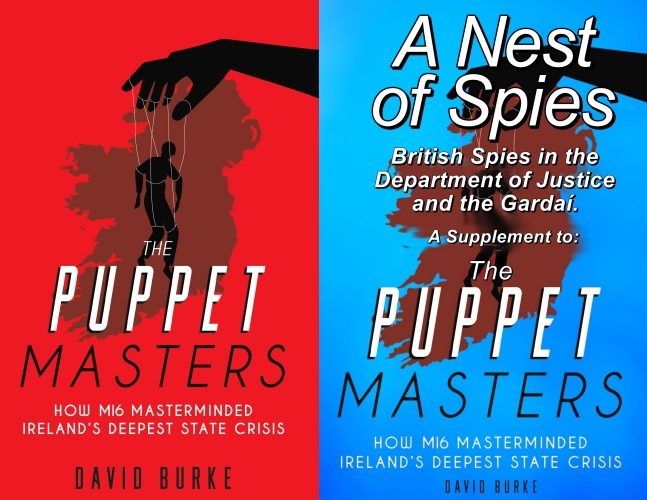
This webbook, a supplement to ‘The Puppet Masters’ (2024), invites you to judge for yourself.
Lindsay also asserted that the Irish media had been infiltrated at a senior level. Time has confirmed this, particularly regarding The Irish Times. Declassified UK Foreign Office files have exposed clandestine links between London and Maj. Thomas McDowell of The Irish Times (see: https://coverthistory.ie/tag/irish-times/).
I spoke to Lindsay once, in 1989, when he quite openly disclosed the name of another legendary media figure whom he said was working with MI6 and the CIA, a story for another day. For the moment, I will say that Lindsay was 100% correct about this individual.

The primary focus of Lindsay’s book was the shooting of William Black, a reserve member of the UDR. Lindsay argued that Black was shot by undercover British forces to preserve the secrecy of a clandestine Mobile Reaction Force (MRF) operation upon which Black had stumbled. Once again, Lindsay’s sources were accurate. In 1990, Archie Hamilton, the UK’s Armed Forces Minister, admitted soldiers had shot Black and compensated him for the near fatal injuries he had suffered.


Part 1: A bloodsoaked start, after which cooperation was achieved.
2. From the elimination of the Cairo Gang to intelligence cooperation.

In 1920, Michael Collins and his ‘Squad’ eliminated the ‘Cairo Gang’, a group of British undercover assassins sent to Ireland. The Squad also executed informants and RIC police officers involved in the harassment of IRA personnel.

These lethal and bloody differences were soon set aside. In 1938, MI5 played a key role in establishing Ireland’s first modern spy agency, G2. This development came about following a secret meeting on 31 August 1938, attended by Guy Liddell of MI5, J.W. Dulanty, the Irish High Commissioner in London, and Joseph Walsh, Secretary of the Department of External Affairs.

At the meeting, Walsh revealed the concern of the Irish premier, Eamon de Valera, over Nazi activities in the South and his desire to create a department similar to MI5 to counteract them. This was welcome news to British ears, and MI5 offered to
‘assist them in every possible way and promised to supply a memorandum on the subject. Walsh said that the new Eire [i.e. Irish] counter-espionage Department would be under the Eire Department of Defence, and it was agreed that an exchange of information would be made between [MI5] and the Eire counter-espionage Department on the activities of Germans in Eire.‘

G2’s cooperation with MI5 reassured London that Ireland could disrupt Nazi-IRA links, which had begun as early as 1935. Additionally, GC&CS (the forerunner to GCHQ) intercepted communications from the German Legation in Dublin to Berlin. On 3 May 1943, Clement Attlee, then Deputy Prime Minister and future Prime Minister, wrote to Winston Churchill, describing how G2 was working ‘with our Security authorities.’
‘The actual information which the German Minister [in Dublin] has so far been able to collect and telegraph [to Berlin] does not suggest that hitherto he has been able to secure any information seriously likely to hamper or injure our operations. The close watch which the Irish Security authorities keep on his movements and contacts, in co-operation with our Security authorities, can go some way to prevent his having much greater success in the future.‘
3. Spying on a Zionist TD for MI5.
This co-operation continued after the war. In the late 1940s, MI5 and the Gardaí placed Robert Briscoe, a Fianna Fáil TD, under surveillance due to his links with militant anti-British Zionists in Palestine.

4. Cooperation during the IRA’s Operation Harvest.
MI5 and MI6 renewed their interest in Ireland after the IRA launched ‘Operation Harvest’ better known as its ‘Border Campaign’, which, as the name suggests, targeted UK security forces stationed along the six northern counties which remained within the UK. The IRA’s campaign began in 1956 and ended in early 1962.

At the outset, the British Ambassador to Dublin, Sir Alexander Clutterbuck, sought to establish a framework for intelligence co-operation between the UK and Ireland. His efforts were likely inspired by the strong relations forged during World War II and joint efforts against Jewish rebels connected to the IRA. However, after making his proposal in Dublin, Clutterbuck was politely rebuffed by Frederick Boland, Secretary of the Department of External Affairs. Boland insisted that liaison between the police forces of both countries:
‘would continue to be of the personal and informal character that he thought at present existed between individuals in the two police forces, and that the more informal it was and the less that was known about it, the better.‘

Despite Boland’s preference for informality, a limited degree of co-operation was achieved at the highest levels when the two governments exchanged aides-memoire on the IRA in January and February 1956.
Charles Haughey, the Irish Minister for Justice in the early 1960s, became a key figure in ending the campaign. He introduced military courts to deal with the IRA.
Haughey impressed the formidable Secretary of his department, Peter Berry, with the decisive nature of his intervention against the IRA.

Haughey became a hate figure in Republican circles. As recently as 2025, Des Long, who joined the IRA in the late 1950s (and subsequently helped set up the Provisionals) was still hostile and scathing in his criticism of Haughey.
Within a decade of the end of the Border Campaign, Berry would try to put Haughey behind bars on false charges backed by perjury and an altered witness statement. I will return to this episode in due course. (Berry’s deceit is also addressed in greater detail in three of my books which deal with these events.)
This webbook will focus on a dark and sinister motive which may have driven Berry to these extremes.
Part 2. An aristocratic spy ring.
5. ‘It was as simple as picking up a phone.‘
Whether Frederick Boland was aware of it or not, a communication channel already existed within the Department of Justice, connected to the British Home Office. There, the Secretary maintained a direct line to his counterpart in London. According to Joe Ainsworth, a future Deputy Garda Commissioner and intelligence supremo who worked alongside Garda Commissioner Daniel Costigan during the Border Campaign, ‘It was as simple as picking up a phone.‘

One of those who picked up the hotline during the Border Campaign was Thomas Coyne. He served as Secretary of the Department of Justice from 1949 to 1961. Born in 1901, Coyne did not participate in the War of Independence as a young man; instead, he joined the Royal Flying Corps (RFC) in 1918. The RFC was the precursor to the RAF and included notable figures such as the superspy Sir William Stephenson, head of British Security Coordination during World War II who later helped establish the CIA. Another member was Oswald Mosley, founder of the British Union of Fascists.

Coyne subsequently worked with MI6—a connection that will be explored later in this webbook. In other words, the most senior official in the Department of Justice (DoJ) during the Border Campaign was an MI6 asset.
Coyne was not the only one.
Coyne was in a position to recruit, place and promote other moles.
He also seeded Garda intelligence with informants.
Who is to say when – if ever – MI6’s infiltration of the Department of Justice came to an end?
6. The Earl of Granard, aristocratic spymaster.
Thomas Coyne was part of an MI6 network which included senior members of the Ascendancy.
Arthur Forbes, the 9th Earl of Granard (10 April 1915 – 19 November 1992), was another British spy who lived and operated in the Free State and, later, the Republic of Ireland.
His father was the 8th Earl, and his mother was an American socialite who was the daughter of Ogden Mills.

The Forbes family belonged to the ruling elite on both sides of the Irish Sea. Upon reaching maturity in 1895, the 8th Earl took his seat in the House of Lords under his junior title, Baron Granard. When the Liberals came to power in 1905 under Sir Henry Campbell-Bannerman, Granard was appointed Lord-in-Waiting to Edward VII (a government whip in the House of Lords) and Assistant Postmaster-General, holding these posts until 1907 and 1909, respectively. In 1907, he was admitted to the Privy Council and appointed Master of the Horse, an office he retained until 1915.

The 8th Earl was also involved in Irish politics. He served on the Irish Food Convention and was Food Controller for Ireland in 1918, the same year he was admitted to the Irish Privy Council. He was a member of the short-lived Senate of Southern Ireland in 1921 and the Senate of the Irish Free State from 1922 to 1934. He again held the post of Master of the Horse between February 1924 and 1936, although by then it was no longer a political office. Granard also served as Vice-Admiral of Connaught and Lord Lieutenant of Longford.

The 9th Earl, the focus of these events, was educated at Eton and Trinity College, Cambridge. Forbes was appointed Air Attaché to Romania on 31 October 1939 and earned the rank of wing commander. He famously transported diplomats and politicians fleeing newly Nazi-occupied Poland from Romania to Greece aboard his personal Percival Q6 aircraft. These included British subjects and other diplomats who had escaped from Poland during the German invasion, travelling from Cernăuți in Northern Romania (now Chernivtsi, Ukraine) to Bucharest and onward to Greece or Turkey.
On 30 October 1940, he was appointed deputy Air Attaché to Greece. Later in the war, his expertise was sought as an adviser to Britain’s Minister of State for the Middle East.
The Earl undoubtedly worked with one or more of Britain’s intelligence agencies, most likely MI6 (the overseas spy agency) and MI9, which operated behind enemy lines to create escape networks.

His decorations included the Air Force Cross, the French Legion of Honour, and America’s Legion of Merit.
Lord Granard was married to Marie-Madeleine Eugénie, Princess of Faucigny-Lucinge (d. 1990). She was the daughter of Jean Maurel and the first wife of Prince Humbert de Faucigny-Lucinge, brother of Prince de Cystria—both descendants of Louis IX of France. Together, Marie and Lord Granard lived at Castleforbes Demesne, the largest estate in County Longford, and had two children.

From 1972 to 1990, Forbes was a director of Texaco, which operated in the Republic of Ireland. He also served as a director for the Nabisco Group Ltd, manufacturer of food goods and confectioneries such as Oreos, and Martini & Rossi, producers of various alcoholic beverages.
Forbes died at his home in Morges, Switzerland, in 1992, aged 77. His nephew Peter inherited the title and remains its holder.
Part 3: Seeding Garda Intelligence with MI6 moles.
7. Thomas Mullen, the second MI6 mole at C3.
Remnants of Britain’s upper class in Ireland helped MI6 steal Irish state secrets. They were part of a network that reached inside An Garda Síochána (the Irish police, also known as the Garda or Gardaí).
Forbes and Coyne were part of a network which enabled Garda moles to pass Irish intelligence secrets to MI6. This sensitive information was held by C3, the nerve centre of Garda intelligence, located at the organisation’s headquarters in Phoenix Park.
Sergeant Thomas Mullen of C3, who lived in Milltown, Co. Dublin, was MI6’s mole inside the unit in the 1950s, i.e. during the Border Campaign. Born around 1902, Mullen was not the first mole at C3: he had at least one predecessor, whose name unfortunately remains unknown.
Mullen assumed the role following the retirement of his predecessor.
8. Patrick Crinnion, the third MI6 mole at C3.

The only Irish official ever convicted of charges related to espionage for Britain in the Republic of Ireland is the late Detective Patrick Crinnion of C3, about whom I have written a book titled The Puppet Masters.

In ‘The Puppet Masters’, I suggested that Crinnion had a deferential attitude towards the Ascendancy—a trait likely stemming from his mother’s role as a housemaid at Powerscourt House, Co. Wicklow.

The family lived in an estate cottage on Boghall Road, Bray. After the book’s publication, a new source came forward with information revealing that Crinnion had also spent a formative part of his youth in Co. Longford, working on the Earl of Granard’s Castleforbes estate.

I was provided a handwritten document by a Department of Justice official—whom I will call ‘Dolan’—who read a secret letter Crinnion wrote to Taoiseach (Prime Minister) Jack Lynch while imprisoned in Mountjoy after his arrest.

Crinnion and his MI6 handler, John Wyman, were both arrested in December 1972. Crinnion wrote to Lynch in 1973. I will refer to this letter as Crinnion’s ‘1973 Mountjoy Letter.’ Dolan, having read it, later disclosed that Crinnion’s
‘father seemed to have been absent from his childhood. Nuancing indicated an ingrained ‘tenantry’ obeisance to the Earl. There was acknowledgment of kindness by the Earl to the family. It was also clear that the [Earl had] British rather than Irish propensities…‘

9. The 9th Earl and Patrick Crinnion.
Crinnion was bright – a fact noted by his co-workers at the Castleforbes estate. He later joined Mensa. Dolan revealed that Crinnion’s 1973 Mountjoy Letter described how one of the ‘estate people’ made ‘a personal approach to the Earl when Crinnion was in early adulthood.’ This,
‘resulted in [Crinnion] going to England, either to join, or be—in some unrecollected way—‘familiarised’ with policing. Without any great lapse of time, advised, I think, either directly or indirectly by the Earl, Crinnion returned to Ireland to join [the part-time Garda reserve] An Taca Síochána, from which he ultimately joined An Garda Síochána.
‘It was conveyed to Crinnion—either when he was associated, in whatever way he was, with policing in England, or when he later joined An Taca Síochána, whether directly or indirectly by the Earl, or someone else—that he should respond cooperatively when, one day, he would be ‘approached’ career-wise.‘
In other words, Crinnion became a ‘sleeper agent,’ awaiting activation.
Having joined An Taca Síochána, Crinnion passed his Garda exams and, on 10 May 1955, officially joined the force. Despite being at the bottom rung of the Garda ladder, he audaciously sued the Garda Commissioner over a sum of money he found while on patrol and handed to his desk sergeant. After no one claimed it within a year, Crinnion put in his claim for the money but was told he was not entitled to it. He took legal action against the Garda Commissioner. This action could have harmed his career, but instead, he was soon assigned to Dublin Castle’s Special Detective Unit (SDU).

Philip McMahon was in charge of the SDU when Crinnion joined its ranks.
10. Crinnion takes his orders from Thomas Coyne.
While working under Philip McMahon, Crinnion received an extraordinary summons to a clandestine meeting with Thomas Coyne.
Coyne was preparing Crinnion to succeed Thomas Mullen as MI6’s mole inside C3.

According to Dolan, ‘Tommy Coyne’ asked Crinnion to meet him at the offices of the Department of Justice on the top floor of Government Buildings. There, Crinnion ‘received instructions from Coyne’ and was
‘informed that he was going to be assigned to duty with whichever Garda division handled security, in the Depot at Phoenix Park. He would start at the clerical bottom, inform himself, be efficient, become valued, and maintain confidentiality about his meetings with Mr Coyne. The Department of Justice did not want direct contact from him. He might hear from the Department, and if so, the expectation was that he would be appropriately productive and cooperative. [Crinnion] did not elaborate further in his [1973] letter to the Taoiseach.‘

Crinnion soon began working with John Wyman of MI6. Dolan further explained:
‘[Crinnion] maintained, when interrogated in 1972, that transactions such as those with [John] Wyman were ‘ordinary’ practice within the Garda. My recollection, such as it is, suggests he implied these activities fell under his understanding with Mr Coyne.‘
Part 4: A Veil of Secrecy.
11. Shock at the Department of Justice but a cover-up ensues.
Dolan then revealed an extraordinary reaction:
‘I clearly remember the shock Crinnion’s [1973 Mountjoy Letter] caused among those in the Department who succeeded Mr Coyne or served with him. By then, Mr Coyne was deceased and his successor, Mr [Peter] Berry, had retired.‘

Dolan also disclosed that Crinnion claimed in his 1973 letter to Taoiseach Jack Lynch:
‘Liaisons such as his with Wyman [of MI6] were known about and not excluded at the level at which he was operating.‘

Crinnion hoped Jack Lynch would conduct a personal investigation to confirm that he had been acting under orders from his superiors. Dolan explained that Crinnion believed a
‘personal investigation by An Taoiseach, if sensitively conducted, person to person at [Garda] Commissioner level, would establish his bona fides and confirm that liaisons such as his with Wyman were known about and accepted at the level at which he was operating, within a sector of mutual concern. Reassured, An Taoiseach could then facilitate an appropriate resolution of his prosecution.‘
My interpretation of this passage is that Crinnion was telling Jack Lynch that his superiors at C3 were aware of his contact with MI6. At the time of his arrest, Larry Wren was heading C3, serving from 1971 to 1979.

Prior to Wren, Patrick Malone led C3. Malone was promoted to Garda Commissioner in January 1973, around the time Crinnion wrote his 1973 Mountjoy Letter.

Additional evidence points to Wren’s awareness of Crinnion’s relationship with MI6 (see ‘The Puppet Masters’ for details; also section 17 below.)
12. Thomas Coyne must have had an accomplice at the Department of Justice (DoJ).
Recall that Thomas Coyne, Secretary to the Department of Justice (DoJ) told Crinnion the DoJ — in reality meaning Coyne’s cabal within the department — ‘did not want to hear from’ Crinnion, although Crinnion ‘might hear from the Department’. Since Crinnion was to go to C3 and ‘start at the clerical bottom,’ it was clearly anticipated that this process would take time. Coyne resigned shortly after his meeting with Crinnion, suggesting that another DoJ official or officials were in place to continue operations. Otherwise, how could Crinnion expect to ‘hear from the Department’?
13. Pointing a finger at Peter Berry.
Peter Berry joined the Department of Justice in 1927 and quickly rose through the ranks. Much of his career focused on security and counter-subversion work, especially after he became Assistant Secretary in charge of State security.
In 1961, Berry succeeded Coyne as Secretary of the DoJ, a position he held until early 1971. Throughout his tenure, he remained deeply involved in security matters. Berry died suddenly of a heart attack on 14 December 1978.

Coyne and Berry were part of a tight-knit unit, or ‘nucleus.’
Dolan suspected that Berry participated in the recruitment of Crinnion. If true, MI6 had the ear not only of Coyne but also of Berry—one of the most important security officials from 1936 to 1971.
Berry worked hand in glove with the top tier of the Gardai. According to Crinnion’s 1973 Mountjoy Letter, senior Gardai knew of his relationship with MI6. If they knew, it raises the possibility Berry was fully aware of it. Recall that Dolan revealed that Crinnion wanted a
‘personal investigation by An Taoiseach, [which] if sensitively conducted, person to person at [Garda] Commissioner level, would establish his bona fides and confirm that liaisons such as his with Wyman were known about and accepted at the level at which he was operating, within a sector of mutual concern. Reassured, An Taoiseach could then facilitate an appropriate resolution of his prosecution.‘
Berry was also a key figure in the 1970 Arms Crisis, an event that plunged Fianna Fáil into turmoil and internecine feuding that lasted for decades.
Berry wrote an account of his career as a security official which was published in Magill magazine in June 1980. It reveals the pivotal role he played in the Department of Justice. It is contained in an appendix to this story.
Part 5: Dirty Tricks
14. Dirty tricks at the Department of Justice
Dolan believed that Coyne’s recruitment of Crinnion should not exclude the ‘possible role of Peter Berry’. In other words, Dolan—who interacted with Berry on a weekly, if not daily, basis—suspected that Berry was part of the same clandestine MI6 apparatus within the DoJ as Coyne.

If Dolan’s suspicions are correct, Berry’s bizarre behaviour during the 1970 Arms Crisis becomes more understandable. MI6 was deeply involved in the affair—details about this can be found in The Puppet Masters. Several ministers, including James Gibbons, Neil Blaney and Charles Haughey, engaged in an attempt to import arms into the Republic. Gibbons, as Minister for Defence, had legal authority to import weapons.

The plan was to stockpile these arms as insurance against a potential ‘doomsday’ scenario unfolding in Northern Ireland. The weapons were to be supplied to Nationalist communities in the event of a breakdown of law and order where lives were under threat. This might happen in circumstances where the British army returned to Britain and Loyalist violence – akin to that of August 1969 – broke out again. It would also lessen pressure on the Irish government to send armed troops across the border.

Contrary to MI6’s black propaganda, the weapons were not intended to arm the Provisional IRA. This type of disinformation was promoted by MI6 assets in the British and Irish media.

Jack Lynch was aware of the machinations to import the arms.
A failed attempt was made to fly arms from the Continent to Dublin Airport in April 1970. The flight was cancelled at the last moment when Military Intelligence discovered the SDU – acting on Berry’s orders – planned to seize the consignment.
Berry approached Jack Lynch a few days later to inform him about the attempted arms importation. Lynch pretended he was unaware of the operation. To Berry’s dismay, Lynch chose to cover up the matter. (The reasons for Lynch’s decision to conceal the existence of the operation are described in ‘The Puppet Masters’ and ‘Deception & Lies’.)

Crinnion demolished the cover-up by delivering a note to Liam Cosgrave of Fine Gael, then leader of the opposition. (See ‘The Puppet Masters’ for details.) Cosgrave successfully challenged Lynch’s cover-up. Political chaos erupted.
Berry propagated the same falsehoods circulated by Crinnion and MI6 —that the arms were destined for the IRA, rather than being part of an Irish military contingency plan.

Berry pushed for the prosecution of ministers Haughey, Blaney, and others, despite Lynch’s Attorney-General advising against it.
Berry altered the witness statement of Col Hefferon of G2, reshaping it to send innocent men to prison. The colonel was urged to commit perjury by Minister Jim Gibbons (who was not being prosecuted for his part in the affair).
Col. Hefferon refused to buckle and told the truth at the Arms Trial. Gibbons was exposed as a perjurer and the Arms Trial defendants – including Haughey – were acquitted.

The Arms Crisis removed three ministers from Lynch’s cabinet: Blaney, Haughey and Kevin Boland. These ministers were perceived as hardliners by London. MI6 would go to great lengths to prevent their return to office.
Viewed through the lens that Berry was Coyne’s successor as MI6’s man at the Department of Justice, his actions gain a somewhat clearer logic.

15. Britain’s delicate source, June 1970
In 1970, G2, Ireland’s military intelligence, was dispatching undercover operatives across the border. British officials were aware but hesitant to confront the Irish government, fearing exposure of their information source within it.
On 17 June 1970, Ronnie Burroughs, the UK Representative to the Stormont government, wrote to the Foreign Office referencing a delicate ‘source’ who had supplied intelligence on G2’s activities in Northern Ireland:
‘If the function of these [Irish military intelligence] officers is as innocent as suggested, their work can be carried out by ordinary political observers openly. If there is a clandestine element, then I do not see how we can tolerate them. We certainly would not do so in any other part of the UK… Due to the delicacy of the source, it would not be possible to reveal to the Irish their own acknowledgement of the presence of these officers.‘
The ‘delicate source’ held a senior position within Irish State security. While one might suspect an officer in the Irish Army or Department of Defence, C3 liaised closely with G2 and was well-informed of their activities. Thus, the source could have been Crinnion or a more senior Garda officer or DoJ official.
16. An ‘authoritative source in the Irish government’ smears Neil Blaney, 1971.
MI6 wanted a government in Dublin that aligned with the interests of the UK. They perceived Haughey, Blaney and Kevin Boland as too hardline for their taste. All three were now on the backbenches thanks to the Arms Crisis. Maurice Oldfield and his colleagues in MI6 did not want them to return to power.

Neil Blaney, dismissed from Cabinet by Jack Lynch in 1970, became the target of an MI6 plot to block his return. He was the victim of a smear campaign aimed at tarnishing his reputation in Washington.
There were two key figures at the American Embassy in 1970, the ambassador, John Moore, and his ‘political officer’ Virgil Randolph III. Moore had been appointed in 1969 by Richard Nixon. Prior to his appointment, he had served as a key adviser to Nixon. Born in 1910, Moore had a legal background and was well versed in the rough-and-tumble of politics in Washington. His grandfather had emigrated from Ireland to America during the famine while his father had been closely associated with John Devoy and Clann na Gael in New York. Moore represented Washington’s interests in Ireland until 1975. Such was his affection for the country, he chose to be buried in Deansgrange Cemetery, Co Dublin, after his death in Manhattan in 1988 from bone cancer. His wife, who predeceased him, was also buried in Ireland.

If Randolph III wasn’t a CIA officer, he was certainly fishing in the same waters as the spooks from Langley. [1] In May 1971, Randolph III was contacted by ‘an authoritative source in the Irish government’ who gave him a very peculiar view of what was allegedly afoot in Ireland. The Irish official claimed – deceitfully – that there were three separate wings of the IRA on the island: the Officials, who were ‘under Communist influence’; the Provisionals; and a 100-strong underground army he called ‘Blaney’s Private IRA’. The notion that ‘Blaney’s Private IRA’ existed is so farcical that it does not merit a rebuttal, but the ‘government’ official was sufficiently convincing at the time to persuade Randolph III of its existence.
On 18 May a rather gullible Randolph III sent an eight-page confidential assessment of the IRA to Washington. It was drawn up in coordination with the US consul general in Belfast. Dealing with the lead-up to the fracture in the IRA, he stated that he understood
‘from an authoritative source in the Irish government that in the autumn of 1969 the Irish Minister for Agriculture, the unreconstructed Donegal man and powerful Fianna Fáil politician Neil Blaney, began beefing up his own political machine in the Republic and in Northern Ireland, ostensibly to further the Fianna Fáil interest but actually to further his own… Prime Minister Lynch, unable to curb Blaney’s free-wheeling activities, which involved the diversion of Irish government and Fianna Fáil party funds to his supporters, waited for an opportunity to quash Blaney and his “Private IRA”.’

Under the sub-heading, ‘the Gun-Running Plot’, Randolph had more bunkum to impart, namely that:
‘it now seems established that during the spring of 1970 Neil Blaney sought to give muscle to his political ambitions by arranging for the illegal importation into Ireland of a substantial quantity of arms and ammunition for delivery to his Republican friends on both sides of the border. Despite the failure of the attempt to smuggle arms to Blaney’s “Private IRA”, a quantity of guns and ammunition as well as money (some apparently from Irish government appropriations for “Northern relief”), seem to have trickled into Northern Ireland during 1970, mostly into the hands of the IRA “Provisionals”.’
For the avoidance of any confusion, Randolph III was claiming that Blaney’s IRA was a wholly separate organisation to that of the Officials and Provisionals. He described how, in January 1971, ‘a responsible Irish government official’ had estimated the
‘combined active membership of both IRA groups [i.e. Officials and Provisionals] in the Republic at about 1300, with an additional half that number operating in Northern Ireland. These figures exclude Neil Blaney’s “Private IRA”, which may number a hundred men or so.’

Randolph III referred to Ruairí O Brádaigh by his English name, Rory Brady. According to the American,
‘Brady’s Provisionals are .. having nothing to do with Neil Blaney’s … current efforts to found a new 32-County Republican Party (whose real aim is to oust Lynch from the leadership of Fianna Fáil) … Since it is doubtful that the new Republican Party will get off the ground, Blaney’s “Private IRA” may eventually drift back into Fianna Fáil.’
Because Blaney’s IRA did not exist, the prediction that it would ‘drift back into Fianna Fáil’ provided a convenient escape hatch through which this source could scarper with his credibility intact when—as was inevitable—this non-existent fantasy wing of the IRA failed to engage in any sort of activity.

Nonetheless, it must have disturbed the recipients of the report in Washington, who were relying upon Randolph III’s ostensible expertise, to hear that a mainstream European political party was prepared to absorb armed terrorists into its ranks.
Randolph III had more poppycock for his readers:
‘In this connection, it should be noted that Fianna Fáil has very carefully avoided any confrontation with the IRA “Provisionals” and the “Officials” as well. In fact, the Lynch government has turned a blind eye at clandestine “Provisional” IRA training activities in the Republic.’
Why would a ‘government’ official pedal these ludicrous yarns to the American Embassy?
What was his real agenda?
The source was likely Crinnion or a senior official in the DoJ. It is hardly fanciful to suggest that the source was handed a script by the two propagandists at the British Embassy, Peter Evans and John Peck, and instructed to relay its content to the U.S. Embassy to blacken Blaney’s name in Washington. Peter Evans was either an MI6 officer or an officer of the Information Research Department (IRD), which ran black propaganda operations. John Peck was Britain’s ambassador and a former Director of the IRD, involved in the lethal MI6-CIA-IRD regime change in Iran in 1953 and a myriad of other murderous dirty tricks around the globe.

Evans and his colleagues were also busy circulating verbal smears (‘sibs’) about Haughey in Dublin, including one that he was friendly with KGB officers sent to Dublin to help the IRA.
Blaney’s star shone brightly after the Arms Crisis and its sequel the Arms Trials but it fizzled out amid bouts of internal feuding which convulsed Fianna Fáil during 1971. He was expelled from the party in the first half of 1972, never to return. On 24 August 1972, David Blatherwick sent a confidential report to the FCO in London and Frank Steele, a senior MI6 officer in Belfast, among others. It stated that while the Arms Crisis was
‘now part of the past and seems likely to be treated as such in the Republic … Mr Blaney’s political career in Fianna Fáil has collapsed. Mr Haughey is still doing good deeds in the political wilderness.’
Henceforth, and with Blaney essentially no longer in contention for a leadership role in Fianna Fail, MI6 and the IRD’s attention would focus on Charles Haughey.
[1] Randolph III joined the US Foreign Service in 1955 and served in Haiti, Brazil, Peru, Venezuela, Ireland, Barbados, Colombia and Washington. He earned the State Department’s ‘Superior Honor Award’ before retiring in 1985. He was killed on 11 September, 1997, following an automobile accident in Brazil.
17. Smearing Jack Lynch in Washington for allegedly turning a blind eye to the IRA.
The allegation made by the Irish official to Randolph III that ‘the Lynch government has turned a blind eye at clandestine “Provisional” IRA training activities in the Republic‘ is also noteworthy – not to mention absurd.

Allan Rowley of MI6 was shortly to engage in an operation to place pressure on Jack Lynch to intensify the Irish government’s crackdown on the IRA by embarrassing him with allegations he was not doing enough to thwart the IRA. (See the details relating to the ‘Border Dossier’ in ‘The Puppet Masters’.) The disinformation being fed to Randolph III was similar in tone to the narrative Rowley would create during the Border Dossier affair.
This adds weight to the likelihood that Randolph’s deceitful source was an MI6 asset.
18. The appointment of a new head of C3, later investigated as an MI6 ‘mole’ by Assistant Garda Commissioner Joseph Ainsworth.
Larry Wren was put in charge of C3 in September 1971. He was not the obvious choice for the post.

There were other candidates, one of whom was Joe Ainsworth. Ainsworth had a long history of working in intelligence, including a number of years serving as an aide to Garda Commissioner Costigan during the Border Campaign.

Ainsworth worked with C3 on numerous occasions, a point which must be stressed as he was later smeared by deceitful Garda sources as someone without any intelligence experience. The smears were circulated after he was appointed as head of C3 in 1979, and appeared, inter alia, in The Irish Times.
Ainsworth was one of those who had been aware that Sean MacStíofáin had been enlisted by Garda Special Branch (SDU) as an informant. Ainsworth had been based in Cork at the time of MacStíofáin’s recruitment, although he was not directly involved in it. Unlike those in the SDU – particularly its chief, Philip McMahon – Ainsworth did not trust MacStíofáin. His assessment of MacStíofáin was prescient as the latter was leading the SDU a merry dance pretending to be a genuine informant. According to Ainsworth, MacStíofáin had ‘a big mouth’ and when he opened it, he would sometimes proceed to ‘spout information’. Yet, he was someone who only talked to the Gardaí when it suited him and was a ‘man who played the violin with two bows’. Later, Ainsworth became suspicious that MacStíofáin was merely engaging with the Gardaí ‘in the hope it would take some of the heat off him’.

According to Ainsworth, MacStíofáin and Philip McMahon enjoyed a good rapport. At one stage ‘all communication was made person to person’. The Gardaí finally realised that MacStíofáin was a false informant in late 1972, by which time their negligence had provided MacStíofáin with sufficient time to establish the Provisional IRA as a formidable force. MacStíofáin managed to direct the Gardaí and their resources away from Provisional IRA activities towards those of his rivals in the Official IRA (led by Cathal Goulding).

Ainsworth led the inquiry into the bombing of St Finbar’s cemetery in Cork the night before President Eamon de Valera was to open a memorial in it in March 1963. That attack was perpetrated by IRA volunteers (acting without the sanction of their superiors including MacStíofáin.)
In the early 1970s, Ainsworth was assigned to work on a project which required him to base himself at C3’s suite of offices in the Phoenix Park. As part of his work, Ainsworth maintained what Patrick Crinnion described as ‘a secret file [which] he had locked in C3’. Crinnion was friendly and welcoming to Ainsworth, a little too friendly for the older man’s taste. Crinnion repeatedly offered to tidy up his papers at the end of the day. Ainsworth declined, somewhat suspicious that Crinnion was being unduly inquisitive. Ainsworth’s ultra-secret file may very well be the only one into which Crinnion failed to break.

Larry Wren, who secured the C3 post, would go on to work very closely with an officer from MI5 who visited Dublin on a regular basis, a story for another day.
Recall also that the DoJ official ‘Dolan’ revealed that Crinnion asserted in his 1973 Mountjoy Letter that
‘Liaisons such as his with Wyman [of MI6] were known about and not excluded at the level at which he was operating.’
Recall (yet again) that Crinnion wanted a
‘personal investigation by An Taoiseach, [which] if sensitively conducted, person to person at [Garda] Commissioner level, would establish his bona fides and confirm that liaisons such as his with Wyman were known about and accepted at the level at which he was operating, within a sector of mutual concern. Reassured, An Taoiseach could then facilitate an appropriate resolution of his prosecution.‘
Put simply, Wren knew that Crinnion was in contact with MI6.
Ainsworth was appointed as head of C3 in the summer of 1979 by Garda Commissioner Patrick McLaughlin. Jack Lynch was Taoiseach at the time. Ainsworth concluded that Wren had been working for British intelligence. In an interview he gave The Irish Times in March 1984, he referred to a ‘mole’ whom he had been hunting while in charge of Garda intelligence. The unnamed ‘mole’ was Wren.
It is not clear how well Wren knew Andy Ward at the time of his appointment as head of C3 in 1971, but the pair became very close. They conducted clandestine meetings while Ainsworth’s ‘mole’ hunt was underway during the early 1980s.

Ainsworth began his investigation into MI6 penetration of C3 in 1979 by asking for the file on Patrick Crinnion. It turned out that Wren had not kept one.
Ainsworth became the victim of a sustained smear campaign led by former Garda Commissioners Ned Garvey and Larry Wren, also a story for another day.

Garret FitzGerald appointed Wren as Garda Commissioner in 1983 after Ainsworth and the then Garda Commissioner, Patrick McLaughlin, were pushed out of office after leaks about the tapping of the phones of two journalists.

During his interview with The Irish Times in March 1984, Ainsworth blamed the ‘mole’ for leaking information about the phone taps to people outside of Garda intelligence.
“Now it never happened before that that type of information got out. The reason it got out has to be chased after. Because I’m inclined to think that whoever got it is a mole who should be rooted out. That person is a danger to the State and continues to be a danger to the State because what happened once could happen again and again in many different ways.“
19. Col. Michael Hefferon of G2 suspected Crinnion as early as 1969.

Col. Michael Hefferon, Director of Irish Military Intelligence, G2, 1958–1970, concluded that Crinnion was working with British intelligence as early as 1969.[1] He believed he was responsible for the provision of information to Britain which had enabled a spy calling himself ‘Capt. Markham-Randall’ to operate in the Republic.

Capt. Kelly of G2 described how:
One aspect of the [Markham-Randall] affair puzzled Colonel Hefferon. How could a British agent be so well acquainted with security details about members of the Irish Government and their attitude to the North, which could not and should not have been officially communicated to the British? For some time, he had a strong suspicion that there was a leak in C3, the security section of the Gardaí at their Dublin Phoenix Park Headquarters. As he saw it, the finger pointed at the chief clerk there, who ‘was always creeping around the place, permitted to listen in to even the most confidential conversations and with apparent unrestricted access to information and files’. The Colonel had nothing concrete to back up his suspicion and as the Garda in question [i.e. Crinnion] was obviously a most trusted individual, probably the most trusted and best informed in Garda intelligence circles, there was little the Director of Military Intelligence could do about it. He would very quickly have been told to mind his own business.[2]

[1] Kelly (1999), p. 24–5.
[2] Ibid.
Part 6: Cover-up becomes the norm.
20. The disappearance of Crinnion’s 1973 Mountjoy Letter.
Patrick Crinnion was apprehended by Special Branch officers in December 1972 during an attempt to rendezvous with his MI6 handler, John Wyman, at the Burlington Hotel in Dublin. He was subsequently taken to Mountjoy Prison, where he composed a secret letter to Taoiseach Jack Lynch. This letter, scrutinized by the Department of Justice official Dolan, consisted of several sheets of A4 stationery, densely written on both sides, spanning four or five pages. (Dolan mistakenly thought Liam Cosgrave was Taoiseach when describing these events many years later. However, Cosgrave did not succeeded Lynch as Taoiseach until after Crinnion’s release from prison.)

The 1973 Mountjoy Letter was sent by Dolan to Lynch after being found in Crinnion’s cell, but it is not clear if Lynch ever received it.
A copy was placed in the Department of Justice’s ‘Security’ archive, and another should have been held by the Department of the Taoiseach. However, it is doubtful either survived. If lost, one must consider whether another MI6 asset within the Department of Justice removed or destroyed it.
21. Andy Ward did nothing about Crinnion’s 1973 letter.
Andy Ward, who succeeded Peter Berry as DoJ Secretary from 1971 to 1986, was aware of the 1973 Mountjoy Letter but seemingly took no action. If any inquiry occurred, it was kept from the public, and no evidence of such has ever surfaced.

Author Dermot Keogh, who accessed Jack Lynch’s archives while researching his biography of Lynch, did not find Crinnion’s letter among the documents, supporting the notion that Lynch never received it.
22. Ned Garvey and Larry Wren did nothing about Thomas Mullen despite his confession.
Assistant Garda Commissioner Ned Garvey, overseeing Garda intelligence’s C Division (which included C3), and Larry Wren, Director of C3, did not debrief Crinnion while he was in custody between December 1972 and February 1973.
They did not send anyone to debrief him either.

In 1979, Joe Ainsworth, who succeeded Wren as head of C3, discovered that no file on the Crinnion affair existed within C3’s archives, let alone one containing Crinnion’s letter to Lynch exposing Coyne.
Thomas Mullen’s role as an MI6 mole was uncovered in 1972-73. Mullen confessed to Special Branch officer Mick Hughes that a retiring C3 officer had recruited him, explaining, ‘There has to be someone to forward [the information].’
Instead of investigating Crinnion and Mullen, the State disseminated falsehoods about them. Crinnion was portrayed merely as a clerk, though he actively engaged in various operations, including the 1972 capture of the Chief of Staff of the Provisional IRA (see ‘The Puppet Masters’ for details.) .

Crinnion wrote to several politicians—including Garret FitzGerald and Conor Cruise O’Brien—claiming responsibility for precipitating the Arms Crisis. Neither disclosed this to the public. (I shall return to this issue in section 29 of this webbook.)
23. No inquiry into the first MI6 mole in C3.
Mullen appears to have provided Mick Hughes with the name of his predecessor as MI6’s mole inside C3. Even if he didn’t, since C3 only had about a dozen members, it would have been easy to detect him. The pre-Mullen mole was probably someone who retired before Mullen began spying for MI6.
There is no evidence that Larry Wren investigated to confirm or establish the identity of this mole.

24. Larry Wren allowed false evidence to be given about Crinnion. It helped disguise his relationship with Thomas Mullen, the other MI6 agent inside C3.
Larry Wren interfered with C3’s records. At Crinnion’s trial in February 1973, the date of Crinnion’s assignment to C3 was falsified by five years, rendering the personnel trail unreliable and obscuring his relationship with Thomas Mullen.
If Wren had opened a file about Mullen, it disappeared from C3 before Joe Ainsworth took over the department in the summer of 1979.

Part 7: The smear campaign continues
25. A deceitful ‘Source close to new Govt’ spreads more fiction about the Arms Crisis.
While Crinnion was found guilty, it appears he was sacrificed to protect a larger MI6 network which reached into the Department of Justice and senior Garda ranks.

In April 1973, US Ambassador John D. Moore became the target of an elaborate confidence trick designed to discredit Charles Haughey. This deception exploited the same fabricated information circulated by Hugh Mooney of the Information Research Department (IRD)—that Haughey was sponsoring a Provisional IRA bombing campaign in Northern Ireland and profiting from it (see ‘The Puppet Masters’ and ‘An Enemy of the State’ for details).

More than fifty years later, making sense of these events remains challenging. However, it is possible to identify the involvement of a senior government official in the deception, likely a mole within the DoJ. It certainly was not Crinnion, who had fled into exile by February 1973.
This official either met Moore personally or relayed information to him. Moore trusted the intelligence due to the high status of the source.

After absorbing the lies of the Irish official, Moore sent a cable to Washington in April 1973. The cable alleged that the new government had learned that senior Fianna Fáil figures were involved in a conspiracy with the IRA to bomb Belfast and subsequently buy the damaged properties at reduced prices. Patrick Cooney, Fine Gael’s Minister for Justice from 1973 to 1977 was mentioned in the cable as having been aware of the Haughey bomb plot. He has dismissed these claims as nonsense.
Crucially, the cable identified the ‘source’ as someone close to the Cosgrave government:
‘Source close to new Govt, however, tells us that Cosgrave expects to make some major announcements and disclosures in the near future… Some of the info is sensitive. Please hold carefully… Senior figures in previous [Fianna Fáil] government had formed a ring to buy bombed-out property in Northern Ireland at low prices, using an American businessman as a front for purchases… Disclosures will inevitably raise suspicions that Dublin-based profiteers were collaborating with IRA bombers… Source says that he has seen some of the files on the case and found them ‘extremely unsavoury.’

Moore could only have accepted these lies if he believed the source had access to highly classified information. Both the Special Branch and Department of Justice had such means of knowledge.
The cable further stated:
‘Government is likely to follow with full disclosure of scandal, though some in Government believe that news should be withheld because it reflects badly upon the entire Irish Nation.’
This statement shows a cunning strategy, since the fictitious events the source predicted were never going to materialize. This caveat offered a way out for the Department of Justice mole to maintain credibility when nothing happened. He could claim that Cosgrave and Minister Cooney were engaged in a cover-up in the national interest.
The cable also alleged that Minister Cooney had:
‘Found much evidence, hitherto undisclosed, implicating members of the previous Fianna Fáil government in the arms-smuggling scandal of 1970.’
Cooney was Minister for Justice, which increases the likelihood that Moore was deceived by a Department of Justice official able to impersonate or cite Cooney’s views. If this analysis is correct, a very senior official was involved, not a Garda.
Cooney, of course, found no such evidence. Nevertheless, the cable insisted:
‘Outgoing government had made off with files on this and similar embarrassing topics, but a few career men kept personal photocopies which have now been turned over to the new government. According to source, Justice Minister [Cooney] believes that evidence is sufficiently incriminating to allow a new arms trial, with formal charges against three previous ministers: Haughey, Lenihan, and one other whom source did not recall. (This is the first time we have heard that Lenihan may have been deeply involved in the arms-smuggling episode).’
No further trial occurred. Again, the reference to ‘career men’ above suggests the source who was misleading Moore was a senior Department of Justice official.
This source could not have been Crinnion, who by this time had served his short prison sentence and fled into exile.
26. Haughey’s alleged ‘shady’ land dealings.
Michael Daly of the IRD arrived in Dublin at some stage in 1973. His cover was that of ‘Head of Chancery’ at the British embassy with responsibility for ‘information’, 1973-76.[1] He must have been central to the ongoing plotting against Haughey, including one designed to disparage the politician in the eyes of the Americans.

A second US Embassy cable was transmitted by US Ambassador Moore on 11 November 1974. Again, it reveals the likely hand of a DoJ mole working with MI6 and the IRD. This cable concerned Haughey’s alleged ‘shady’ land dealings. On this occasion, the mole was probably briefed with a script by his MI6 handler and met in person with the ambassador, relaying the smears directly.

Moore’s resulting cable was entitled ‘Haughey Tries For A Comeback’ and detailed how Haughey
‘has been making a speaking tour that is clearly a bid for a front bench seat. Previously a minister, Haughey fell from power and grace during 1970 arms-trial crisis. (He was involved in misappropriation of public funds for Northern Catholic extremists.) Since then, he has kept quiet and worked hard on back benches. Newspapers have always been fascinated by him, however, since he is one of party’s few talented deputies. Current Fianna Fáil front bench is so weak that journalists love to speculate on “when Charlie will return’”. His reputation for shady real-estate deals does not seem to discourage his fans. Eventually, Haughey would certainly like to be party leader’.
In reality Haughey was surviving on a large overdraft from the AIB but the disinformation in the US cable chimed with rumours that Haughey was involved in all sorts of business transactions.

The cable’s recommendation to Washington was that
‘over long-term, Haughey must be considered a serious challenger for Lynch’s job, if only because the competition is so weak. We can entirely accept Lynch’s judgment that Haughey would be dangerous: nothing is less needed now than Republican opportunism’.
The media remained hostile to Haughey. Tony O’Reilly, who had gained a controlling interest in a string of Irish newspapers including the Irish Independent, between March and September 1973, decided to tog out for the anti-Haughey squad. On 8 January 1975 Michael Daly of the British embassy in Dublin transmitted a cable to London revealing that O’Reilly had
‘instructed his editors at lunch that no support whatsoever was to be given to Haughey’s efforts to return to respectability’. O’Reilly had opined that Lynch was a ‘decent man who was above [reproach] and should be protected from Haughey’s machinations’.[2]
Daly predicted that O’Reilly’s ownership of regional newspapers might counter Haughey’s attempts to secure support among Fianna Fáil’s grassroots throughout the country.

Additionally, Daly felt that O’Reilly’s attitude might influence the political views of the country’s businessmen
‘who have taken the line that “Charlie may be a bit of a villain but he talks good sense of economics”
Daly felt that they would not be
‘so keen to push it if O’Reilly – who was a far more successful businessman than Haughey – takes a critical view of poor Charlie’. [3]
Daly noted that this was the first occasion of which he was aware that O’Reilly had given his editors a directive ‘on the handling of a political subject’, adding that ‘if he intends to make a habit of this, at least he has started sensibly’.
[1] Daly later went to serve in Nicaragua (during the Contra era), Chad, Costa Rica and Bolivia.
[2] Sunday Business Post, 1 January, 2006.
[3] Ibid. In 1984 O’Reilly acknowledged that: “in many cases we [in Independent Newspapers] try to lead public opinion, not follow it. See Matt Cooper, The Maximalist: The Rise and Fall of Tony O’Reilly (Gill & Macmillan, Dublin 2015) p., 159.
Part 8: Unsanctioned and disavowed high-level MI6-Garda cooperation.
27. Garvey hands over files to MI6, 1975.
In the early 1970s, the British Secret Service, MI6, established a station at Thiepval Barracks in Lisburn, near Belfast. By 1973, the station was headed by Craig Connell Smellie, a fifty-year-old Scot who bore a resemblance to the actor Robert Morley. Smellie’s extensive career included postings in volatile regions such as Alexandria, Baghdad, and Khartoum, experiences that seemingly prepared him well for his role in the rain-swept landscape of Ulster. His last African posting before taking charge at Lisburn was in Tripoli in 1966.

Craig Smellie’s influence reached into the heart of An Garda Síochána’s intelligence unit at their headquarters in Phoenix Park, Dublin. His most senior known contact within the Garda was Ned Garvey, the Assistant Commissioner responsible for overseeing intelligence activities in the Republic of Ireland. MI6 operatives regularly met with Garvey at Phoenix Park. Initially, MI6 was represented by Bernard Dearsley, attached to the British Army’s Special Military Intelligence Unit (SMIU). Later, Captain Fred Holroyd, also of the SMIU, succeeded Dearsley in this role.

Captain Holroyd recalled having six to eight meetings with Garvey and another man who can only be identified as Larry Wren. Holroyd’s predecessor, Bernard ‘Bunny’ Dearsley, had enjoyed a similar working relationship with the pair.
In April 1975, Holroyd was accompanied to one of his meetings with Garvey by Frank Murray of the Royal Ulster Constabulary (RUC). A significant portion of this meeting took place in Garvey’s office at Garda Headquarters in Phoenix Park.

In later years, Ned Garvey claimed to have no recollection of this April 1975 meeting. However, Judge Barron, in his report on the 1974 Dublin bombings, confirmed that:
‘The visit by Holroyd to Garda Headquarters unquestionably did take place, notwithstanding former Commissioner Garvey’s inability to recall it. [..] On the Northern side, there is conflicting evidence as to how, why, and by whom the visit was arranged. Regrettably, Garda investigations have failed to uncover any documentary evidence of the visit, or to identify any of the officers involved in arranging it from the Southern side.‘

Part 9: MI6’s friends in Dail Eireann.
28. Conor Cruise O’Brien passes Irish military intelligence secrets to Britain.
Politicians were also passing information to Britain, primarily through the British Embassy.

In 1969, Ambassador Gilchrist was seeking information to flesh out reports which were reaching his ears ‘linking [Haughey] with an organisation in Monaghan devoted to trans-border activities’. Conor Cruise O’Brien made a timely intervention. O’Brien was a former Irish diplomat who was now an Irish Labour Party TD.[1] He shared information from a document about G2’s activities with Gilchrist. It was compiled by John Devine, the public relations officer of the Irish Labour Party. The memorandum was entitled Aspects of the Six County Situation. An over-arching flaw contained in it was Devine’s erroneous assumption that the operation in Monaghan was a
“‘front organisation for Fianna Fáil” which, he believed, was trying to take over the NICRA and establish a political footing in Northern Ireland.‘
There were, however, some valuable nuggets about G2 among the hodgepodge. Devine described how:

‘In the first (and current) issue of the magazine ‘This Week’, it is reported that Irish Army intelligence officers and British Army intelligence have exchanged visits into each other’s territory. Whatever about the British, the Irish certainly have been visiting the North regularly since October 5 last (1968).’
He proceeded to relay how an ‘agent’ of
‘Messrs Haughey, Blaney and Boland, has been conducting .. military intelligence personnel (Captains Doolan and Duggan) on trips behind the barricades’.

Devine believed that the officers were co-operating with ‘the Republican element in the North’, and that ‘ammunition and money has been distributed’ to them. Although not named, the ‘agent’ was Seamus Brady. The Republicans who had jumped into bed with Fianna Fáil – according to Devine – were those whom had
‘more or less broken with the Dublin HQ of the IRA… The [Goulding faction of the] IRA is highly worried and indignant at the influence which these Fianna Fáil people are having among Northern Republicans; the possibility of retaliation is likely from the Dublin end. Fianna Fáil have now established a chain of links from Belfast and Derry, including places like Dungannon, Newry, Armagh, Coalisland, Omagh and in other places where their sphere of contacts up to now has been negligible. Their aid is being accepted’.

In reality, G2 was in contact with various Citizen Defence Committees (CDC) representatives in these areas, not the IRA. In Belfast Capt. Kelly of G2 was talking to Tom Conaty (Chairman of the Central CDC and a future adviser to the Secretary of State for Northern Ireland, William Whitelaw); Jim Sullivan (an ally of Goulding who also served as Chairman of the Central CDC); and Paddy Devlin (secretary of the Central CDC and a future SDLP minister). It would be difficult to conceive of a group more hostile to the anti-Goulding faction that transformed into the Provisional IRA than the hierarchy of the Central CDC.


***
On 10 November 1969, Gilchrist sent a confidential telegram to the FCO, describing the mysterious manoeuvrings in Monaghan. He identified O’Brien as his informant. The communication closely mirrored the content of the flawed Devine Memorandum. It described an ‘organisation in Monaghan’ which was ‘quite a small one’ and that it had been ‘set up by Haughey with party funds’. In reality, the Monaghan operation was being financed in the normal way by funds allocated to G2 by the Secret Vote.
On a more accurate level, O’Brien or Gilchrist, or perhaps both of them, had deduced that:
‘It contains an Intelligence Unit, where Irish Army Intelligence Officers brief and debrief visitors to and from the North.’

Gilchrist’s interest focused on the allegation that Haughey and his associates had prepared lists of civil rights ‘Defence Units’ (sic) in Northern Ireland and of their requirements ‘for self-defence’ should ‘further disorders break out’. This was a fair stab at what G2 was up to, save that G2’s tendrils were reaching out to the CDCs, not civil rights groups, albeit there was an overlap between the two.
Gilchrist proceeded to explain how, according to O’Brien, the Monaghan organisation was hoping to provide support to the defence units ‘by way of weapons, radio sets and personnel’. O’Brien also reported that, ‘numerous weapons have already been supplied, not on the responsibility of the [Monaghan] organisation itself but by people who have been given access to its lists.’ This however, was unconfirmed, ‘being only my own attempt to reconcile conflicting rumours and reports’.

Gilchrist relayed O’Brien’s analysis of what was afoot to the FCO. According to the ambassador, O’Brien felt the enterprise was a political stunt which would be brought to ‘public knowledge’ so it could ‘bolster the image of Fianna Fáil as the patriotic party, still fighting for Irish unity’.
But what did Gilchrist himself think? He wrote that O’Brien ‘may be right but we should keep our eyes open to this threat on our flanks’.

On 4 November 1969, he advised London that there ‘has certainly been some very considerable gun-running for the benefit of the Catholics in the North, but it is by no means sure that the IRA as an organisation is responsible for it’. This was an accurate assessment. According to John Kelly, an IRA veteran who would later stand trial with Charles Haughey and Captain Kelly at the Arms Trials:
‘people all around the Twenty-six Counties contributed weapons at this period, and it was not just Fianna Fáil supporters – people aligned to Fine Gael, traditionally seen as strongly anti-IRA, also helped out. Whatever they had, shotguns, old rifles, Mausers going back to the First World War, were handed over’. [2]
[1] O’Brien was the Labour Party’s then spokesman on Northern Ireland, and later, a government minister in the FG-Labour coalition, 1973–77.
[2] Boyne, Sean, Gunrunners (O’Brien Press, Dublin, 2006), p. 56.
29. Garret FitzGerald passes Public Accounts Committee Inquiry (PAC) secrets to Britain.
Garret FitzGerald of Fine Gael maintained a close relationship with the British Embassy in Dublin. In 1970, he was appointed to the Public Accounts Committee, which was tasked with investigating how the Irish Government had spent approximately £100,000 allocated in 1969 for relief of distress in Northern Ireland. A portion of these funds had been used to support the G2 operation that ultimately precipitated the Arms Crisis.

FitzGerald kept the British Embassy informed about some of the committee’s private deliberations, without the knowledge of his colleagues on the committee. On 18 December 1970, after speaking with FitzGerald, Ambassador John Peck was able to report to London that:
‘Deputy Garret FitzGerald, a member of the [Public Accounts] Committee, told us last night that the Committee intends to question all those involved in the arms trial and to publish the proceedings in full. Evidence will be taken from people in the North, whose identities will, however, be protected. He said that of the £100,000 or so expended, it appeared that perhaps half had been spent on genuine relief works.
‘It looks increasingly as if the proceedings of the committee could be a re-run of the arms trial and be awkward for Messrs. Haughey and Blaney.‘
30. O’Brien and FitzGerald cover-up MI6’s role in the Arms Crisis.
Both Conor Cruise O’Brien and FitzGerald were aware that Patrick Crinnion had sent the note which sparked the Arms Crisis to Liam Cosgrave but chose not to disclose this information publicly.

On 12 June 1973, Crinnion wrote directly to Garret FitzGerald and Conor Cruise O’Brien, who were then ministers in the new government. In his letter, he asserted:
‘… I recklessly crusaded against the IRA and subversives without regard to the double-edged political weapon the IRA is and my personal efforts resulted in a toll which included precipitating the Fianna Fáil Arms Crisis …’
31. The Tánaiste (and future President of Ireland) smears Gerry Jones by passing an untruthful statement to the British Embassy.

The Tánaiste (deputy prime minister) and future President of Ireland, Erskine Childers, was one of the embassy’s established contacts. As Gilchrist recorded the
‘three Irishmen with whom I can talk most freely and frankly about Irish politics are moderate men, and they know very well what side they are on. They are General Collins-Powell, Mr David Neligan, & Mr Erskine Childers’.
David Neligan had set up the Special Branch but was at that point enjoying his retirement.

General Sean Collins-Powell, also retired, understood the thinking of the Irish Army.

Childers, who served as Tánaiste in Jack Lynch’s first Cabinet, was born in London in 1905, educated at the University of Cambridge and became an Irish citizen in 1938.

His father – once a British naval intelligence officer – was executed in November 1924 by the Free State Government. Such was the son’s abiding resentment of the Irish Army, when he became president in 1973, he attempted to dismiss his military aide. This antipathy may account for the hostility he displayed towards Haughey whose father Sean had been an officer in the army which had executed his parent. Childers had once offered cigarettes from an open package to each one of his Cabinet colleagues while clutching it firmly in his hand as he went from one to another. He pointedly ignored Haughey when he reached him.
Childers enjoyed a cordial relationship with the British embassy, not merely by virtue of his birth, but on account of his second marriage to Rita Dudley. She met him in 1952 while he was Minister for Posts and Telegraphs. They married in Paris later that year.

Taoiseach Eamon de Valera was uneasy about the fact that she worked at the British Embassy. She was obliged to step down from her post. She had worked in a number of secretarial positions for Britain. Her abilities had drawn her to the attention of Sir John Maffey who ran the legation. She became the assistant press attaché in 1942. Impressed, Maffey had recommended her for a position at the Irish Desk in the Ministry of Information in London in 1943, an appointment she duly accepted. From there, she moved to the Foreign Office for a spell.
During her interlude in London, Rita Dudley was permitted sight of classified intelligence files about the Holocaust which troubled her greatly. This raises the possibility that she was now a part of British intelligence.

She returned to Dublin in 1942 to resume her role as assistant press attaché. John Betjeman held the role of senior press attaché, but this was cover for his assignment as a propagandist on behalf of the Ministry of Information. His work was performed in coordination with SOE, MI6 and MI5. It is not known what Rita Dudley knew of her superior’s clandestine activities.
Some of the information Erskine Childers passed to the embassy was of a dubious quality. He appears to have been motivated, in part at least, by personal enmity. After Haughey and the other defendants were acquitted, Childers fed Ambassador Peck a story which the ambassador relayed to London. The memorandum stated that:
‘There is a Dublin businessman called Gerry Jones who is a close friend of [former government minister] Mr [Neil] Blaney and an associate of Mr Haughey in the various property deals and other transactions in which he specialises. The Deputy Prime Minister [Erskine Childers] told me that to his certain knowledge Mr Jones had tracked down and ‘got in touch with’ all 12 jurors in the trial.’ [PRO FCO 33 1207. See also The Arms Conspiracy Trial by Angela Clifford, p. 683.]
Since Childers was asserting that each member of the jury – without exception – had been approached ‘to his certain knowledge’, we can conclude that he was, at best, fantasising; at worst, lying. The claim that the entire jury was suborned by anyone, let alone Jones, is manifestly untrue. Some of the jury had sided with the defendants before the trial had ended. After John Kelly wound up his speech from the dock, he received the applause of at least one member of the jury.

In his 2020 book, The Arms Crisis, The Plot That Never Was, the former RTÉ broadcaster and producer, Michael Heney, quoted two former jurors he had interviewed in 2001. They were responding to a claim by Garret FitzGerald that they had been intimidated. They wanted to tell a completely different story. One of them described how, after Gibbons had admitted some knowledge of the arms importation:
‘You could actually sense the reaction in the jury box, because that was a turning point for the whole thing. A complete denial on the one hand, and then an admission [by Gibbons] that he was aware of it … There was another lad on the jury and when we both – when we went in – we were saying, ‘that’s a revelation’, and another few of the jury were in the vicinity and also of the same opinion. That, that was absolutely – I suggested myself that the four lads [Haughey, Capt. James Kelly, John Kelly and Albert Luykx] shouldn’t be up on trial, that it was Jim Gibbons should have been up for perjury.’ Michael Heney, The Arms Crisis, The Plot That Never Was, page 320.]

Furthermore, the acquittal was reached quickly and unanimously. After the verdict, a number of the jurors rushed to shake hands with the defendants, again, hardly the act of people who had been intimidated.
Gerry Jones, the man maligned by Childers, was a charmer, not a thug. He was involved in shipping and engineering enterprises.

Serious consequences would flow from Childers’ deception: during the 1970s the IRD would provide a series of briefings to media figures during which Gerry Jones was named as a member of a group which was assisting ‘US suppliers of firearms to the PIRA’. This was a lie and placed his life in danger.

The Childers memorandum also reveals that the Tánaiste was furnishing the embassy with information about Haughey’s ‘various property deals and other transactions’. If Childers felt Haughey was engaged in wrongdoing, he should have gone to the Gardai. Haughey had little or no influence over the police at this stage. They had just prosecuted him for alleged arms smuggling. He was also on the backbenches. If, however, as was to happen in 1977, Haughey was to return to government, the information – if true – could have been used by MI6 to blackmail Haughey to bend to the will of London.
Ambassador Peck described Childers in his memoirs as
‘a very remarkable man .. when I knew him he was Minister of Health and a very steadfast supporter of Jack Lynch’; [moreover,] ‘a very wise and experienced man, who had always been friendly and helpful’ to the Embassy and a welcome dinner party guest at the Ambassador’s residence.’ [Peck pp. 120/1 and 151]
Peck recalls that at one of the last parties he hosted:
‘without warning Erskine Childers rose made a speech, very warm and simple and obviously straight from the heart, not about our guests of honour [the Canadian ambassador and his wife] but about Mariska [Peck’s wife] and me and our time in Dublin. There is, of course, no text or record of it, but one of the points that he stressed went something like this: “We in the Irish government soon discovered that the British ambassador interpreted our position and our problems faithfully and fairly to his government. But we also learned that he was a lucid and outspoken ambassador, and I would like people on both sides of the water to know that when, as often happens, there were differences between us, we were never left in any doubt what the British felt and why.’ [Peck page 152]
As an experienced diplomat, Peck would have been in dereliction of his duties had he not tried to absorb as much confidential information as he could from the gushing Tánaiste. Gilchrist had probably milked Childers’ political udders as hard as he could for years before Peck’s arrival.

Yet, behind Childers’ back, the embassy was scathing of the faction of which Childers, Lynch and Gibbons were members. On 24 August 1972 David Blatherwick, sent a confidential report to FCO in London, Frank Steele, the senior MI6 officer in Belfast, and others, stating of the Arms Crisis and Arms Trial that Capt. Kelly was:
‘the fall guy, and Gibbons, by means of lying and eventually perjury preserved his head .. Mr Lynch and Mr Gibbons, the villains of the piece, continue to enjoy the fruits of a very dirty victory’.

The allegation about jury intimidation later appeared as part of a series of smears in Private Eye magazine. Many of the stories printed by Private Eye were based on smears concocted by black propagandists at Stormont Castle in the 1972 (further details of which can be found in ‘An Enemy of the Crown’).
[1] PRO FCO 33 1207. See also The Arms Conspiracy Trial by Angela Clifford, p. 683.
[2] Michael Heney, The Arms Crisis, The Plot That Never Was, (Head of Zeus, London, 2020), p. 320.
32. The Ambassador’s puppets in the Dail.
Ambassador Gilchrist had a few other tricks up his sleeve: he was able to direct certain TDs to ask questions for him in the Dáil.
A Fianna Fáil campaign was launched after the eruption of violence in August 1969. George Colley, with full Cabinet approval, supervised a team of press secretaries which was dispatched around the globe with briefs which were critical of British policy in Ireland.

Gilchrist’s view of George Colley, as expressed at the end of September 1969, was that he was part of a group of ‘hawkish’ ministers which included Blaney and Boland. [1]
Gilchrist described the propaganda offensive to Oliver Wright, a British diplomat stationed in Belfast, as a process of ‘emitting poisonous propaganda’.
On 7 November, 1969, Gilchrist boasted, that:
‘There is a general tendency in Dublin to regard the whole thing as a mistake, a concession made at the time to hot-heads, something best forgotten. The newspapers on the whole have been critical, sometimes scathing; and there have been questions in the Dáil (some of them stimulated by your humble servant – tell it not in Gath, publish it not on the streets of Belfast) which have made the Government decidedly uncomfortable.’[2]
Gilchrist was referring here to questions which had been raised in the Dáil on 22 October, 1969, by Gerry L’Estrange TD of Fine Gael who had asked why there was a need for the new government information service.

Later, Conor Cruise O’Brien and Garret FitzGerald would pose further questions.[3]
[1] Angela Clifford, The Arms Conspiracy Trial (A Belfast Magazine, ISBN 1 874157202)(2009), p. 660.
[2] Angela Clifford (2009), p. 665
[3] Angela Clifford (2009), p. 665
33. Jack Lynch conspires with Ambassador Peck to outfox Dáil Eireann.
On 25 April 1972, British Prime Minister, Edward Heath, wrote to Jack Lynch urging the immediate creation of a system of security co-operation along the Border. When questions were raised in the Dáil about the discussions between Dublin and London, Lynch denied that co-operation had been broached. However, behind closed doors, a rather wily Lynch was telling Ambassador Peck that he agreed that ‘discreet collaboration was clearly called for’.

In what must have been music to London’s ears, that same month, Lynch gave Peck what the ambassador interpreted as ‘carte blanche’ to pursue the establishment of security co-operation directly with the Department of Defence in Dublin. Peck sent a telegram to London stating that the co-operation would be ‘mutual and discreet, bearing in mind that it has to be deniable in the Dáil’. Afterwards, there was a meeting to kick start the co-operation between the chief-of-staff of the Irish army and the military attaché at the British embassy.

The point of contact for Peck at the DoJ was Andy Ward.
Later, Peck had meetings with Larry Wren of C3.
34. Lynch and the judiciary.
Jack Lynch told the ambassador on another occasion that he had shunted Cearbhall Ó Dálaigh, the Chief Justice of Ireland, to the European Court of Justice as he did not like the decisions that the Supreme Court was handing down. Some of them related to rulings about Garda special powers. The UK also disliked these rulings. At the time of his appointment, Ó Dálaigh thought he was being honoured.

The appointment of Ó Dálaigh to Europe for such an underhand motive was tantamount to improper interference with the judiciary.

It also shows that Lynch saw the European Court of Justice as a dumping ground for unwanted judges, a body to be treated with contempt.
Part 10: More Garda agents.
35. Det. Sgt. Colm Brown, an asset of MI6.
Fred Holroyd enjoyed the assistance of three other gardai: Det John McCoy (‘The Badger’) who was stationed at Monaghan, Det Vincent Heavin (stationed at Castleblaney) and Det. Sgt. Colm Browne who was attached to the Technical Bureau Investigation Unit in Dublin but was assigned to the border most of the time.
Browne led the investigation into the Monaghan bombing of 1974.
McCoy was also a central figure in the Monaghan investigation.
At the time of the Monaghan attack, Fred Holroyd was attached to the Special Military Intelligence Unit (SMIU) of the British Army, in its 3 Brigade area, which included Portadown. The UVF bomb gang responsible for the Monaghan bombing had a heavy presence in Portadown.

Holroyd also worked for Craig Smellie, the MI6 head of station, based at Lisburn. It was MI6 which put Holroyd in touch with this network of gardaí stationed along the Border.
Holroyd got on well with Browne. On one occasion he crossed the Border into Monaghan where he was picked up in a car by Browne. Shortly afterwards, they spotted an IRA man who was wanted in the north, but not in the Republic. Holroyd climbed of the vehicle, crept up behind the IRA man and whispered into his ear: ‘I am an SAS man and I am going to kill you.’ Holroyd was amused by the prank and returned to the car in high spirits. Browne was puzzled and asked: ‘What did you say to him; he is terrified’.
On the Northern side of the Border, Holroyd monitored the UVF and owed Browne a lot of favours. Holroyd was in fact the perfect resource for Browne to progress his inquiry into the Monaghan attack. Yet, Holroyd has no recollection whatsoever of Browne ever asking him whom he suspected of the Monaghan bombing, even informally.

Holroyd could have told him that Robin ‘The Jackal’ Jackson, the chief suspect, was one of the leaders of the operation, who was ‘known by myself and other Army Intelligence persons’ but ‘Army personnel were not allowed to touch him. The reason we were given was that he was working on behalf of the RUC Special Branch.’ Holroyd believes that Jackson ‘was a paid informer and agent of the RUC, personally run by a Sergeant of my acquaintance in Portadown Special Branch office’.
36. The Badger, Det. John McCoy, an asset of MI5 and MI6.
Fred Holroyd spoke to the press in the 1980s about his relationship with Browne, McCoy and Heavin.

By 1987, John McCoy, the ‘Badger’ was feeling some heat. He protected himself by granting two interviews in which he warned his superiors not to expose him. The interviews were blatant threats. Larry Wren was garda commissioner at the time.
In an interview that year with Liam Clarke, McCoy said that he and other gardaí gave their British contacts ‘more or less any intelligence they asked for, though of course you would never play your full hand’ [3 May 1987, Sunday World].

Some of the information supplied by these gardai was used to help British undercover forces kidnap and murder people in the Republic.
That same year journalist Brendan O’Brien, asked McCoy if he was aware that some of the intelligence he had supplied had been used for cross-border kidnappings and possibly assassination. McCoy replied:
‘I wouldn’t lose any sleep over retaliation or tit-for-tat in some cases but I would if innocent people got killed’.
Brendan O’Brien’s interview with the Badger was published in the Irish Independent on 20 January 1987. In it, the Badger told O’Brien that between 1972 and 1983, he had maintained contacts with six British military officers including Bernard Dearsley, Fred Holroyd, David Delius of MI5 and Peter Maynard.

During his interview with Liam Clarke (for the Sunday World) he indicated he had received authority from higher up the Garda chain of command for his actions. He did not name names but obviously had Ned Garvey in mind and probably Larry Wren as well as Deputy Commissioner John Paul McMahon.

McCoy was not disciplined despite Holroyd’s revelations in the media and his own admissions to Clarke and O’Brien.
McMahon had been McCoy’s boss in Monaghan in the 1970s when he had been a chief superintendent. As Holroyd notes in his biography, McMahon had interviewed him in 1987 as part of a less than rigorous investigation into the Badger. McMahon certainly did nothing after the O’Brien and Clarke reports appeared in print.
Det. Vincent Heavin also escaped scrutiny.
37. The central Monaghan bomb file that disappeared.
The central Monaghan file into the 1974 bombing was kept at Monaghan Garda station. It was in the control of a senior officer. He was noted for working closely with a particular subordinate, one of Holroyd’s contacts. This senior officer was assigned to liaise with security and intelligence services on the other side of the border. Wary of the task, he delegated it to his subordinate. On the surface, this cooperation with the RUC and British Army was legitimate within certain parameters. However, the liaison far exceeded what could be considered legitimate, indicating that the senior officer knew what was going on behind the scenes and sought plausible deniability. The senior officer passed away more than a decade ago.

Later, when the senior officer was reassigned to Dublin, he took the Monaghan file with him. It was the one which contained all the known information along with the original copies of statements. This was an unusual step as the original file should have been kept in Monaghan.
Senior retired Gardai believe records were removed from the Monaghan central file by officers sympathetic to Britain after it was taken from Monaghan.
The senior officer achieved a very high rank in the force.
The subordinate was involved in setting up assassinations of INLA members as late as the early 1980s.
38. Gardai helped MI5 spy – illegally – on John Hume of the SDLP, in Dublin, in the 1980s.
Details about this transgression during Larry Wren’s tenure as Garda Commissioner can be found on this website via the link below:
39. Only a single prosecution in the history of the State.

Patrick Crinnion remains the only individual working in security, intelligence or as an official of the Irish government to face charges connected to the activities of British intelligence in Ireland.
David Burke is the author of four books published by Mercier Press.

These books can be purchased here:
APPENDIX: PETER BERRY DESCRIBES HIS ROLE AT THE DEPARTMENT OF JUSTICE:
‘In 1936 when I was appointed Private Secretary to the Secretary of the Department and thus became one of a nucleus who had access to police reports dealing with subversive organisations. Part of my job was researching the history and activities of the IRA and the Communist movement with a view to keeping records in printed books for easy reference by the Minister and Government.
‘On this account I got an encyclopaedic knowledge of subversive elements and the process of writing and rewriting in preparation for the printed volumes imprinted in my memory a great deal of information which was to prove very useful to Ministers in the course of Dail debates and so on.
‘In 1938 I became Private Secretary to the Minister, Mr. Ruttledge, and in September 1939 to his successor, Mr. Gerald Boland.

‘In June 1940 the Minister signed warrants for the detention of 500 alleged members of the IRA (the fall of France had occurred in May) and an Intelligence Division, consisting of a Principal Officer and a Higher Executive Officer – formerly Mr. Ruttledge’s private secretary – was established to advise the Minister and to sift the value of police recommendations. Mr. Boland had a very healthy question mark placed over every recommendation for a detention order and he was not satisfied to keep a person in detention without trial on police recommendations alone.
‘In the next eight months he became increasingly dissatisfied with the lack of independence from the police of the Departmental advice and he insisted on a change of personnel. On the Secretary’s advice the Minister assigned me to the job.

‘I had daily, sometimes hourly, contact with the Minister during the War years and attended him in the Dail debates on political matters and when he was receiving deputations. I signed all correspondence in connection with matters such as parole and came to be recognised in political circles as the Minister’s eminence grise.
‘When things got slack I carried on with my research with a result that a second printed volume was produced for the years 1941/47 to supplement the volume for the years ending in 1940 in relation to the IRA. I also produced a dossier in manuscript form in relation to communist activities for the same period. The period 1948/51 of a Coalition Government, the period 51/54 of Fianna Fail and another period of 54/57 of Coalition Government were quiet years, politically, but on 12th December 1956 the Border Campaign erupted and it was to continue until February 1962.
‘From February ’48, on the change of Government, until March ’57 when Fianna Fail took over once again I retained custody of the confidential papers although I was in higher ranks and dealing with broader Departmental matters: it suited everybody, in particular the new Secretary and Asst. Secretary, to have somebody around who could reel off facts and figures or turn up precedents from memory.
‘During the Border Campaign of 1956/’62 I was one of a team of three, the others being the Attorney General (Andrias O Caoimh) and the Legal Adviser of the Department of External Affairs, who prepared the case against Lawless which came before the Human Rights Commission and the International Court of Justice at Strasbourg. I attended the hearings. My part was to make up the dossier of facts, theirs to deal with the legal aspects. Again the writing and re-writing of the history of IRA activities to justify the Government’s use of the powers of detention without trial imprinted on my mind details which time has not erased.‘
‘In the course of the Strasbourg hearings I got to know the Head of “S Branch” (Phil McMahon) very well as he had been subpoenaed as a witness before the Commission of Human Rights and I formed a great respect for his integrity and knowledge of his subject: at the time he was being described in Tim Pat Coogan’s book, “Ireland since the Rising” as “the Nemesis of the IRA”. And so he was.
‘Through experience I found, at times, that information emanating from the field workers in the “S Branch’ had taken on a different emphasis after it had passed through Garda HQ and I was not happy with some of the HQ interpretations which tended to make mountains out of molehills.
‘My direct contact with the Head of the “S Branch an my general knowledge of the subject stood me in good, stead for instance when I found that, without the Minister’s knowledge, a radio network was being strung along the Border in anticipation of an outbreak of IRA violence on the occasion of the 1966 Commemoration Ceremonies of the Rising of 1916: Garda HQ went off at half cock and were taking preventive measures just in case … while in my judgement the installation on Garda barracks along the Border of a radio network might prove to be a provocation. I took the responsibility of cancelling the installation Waterford City and other centres had been stripped for the purpose — and I was proved right, in the event.
‘Indeed, the Garda action might have had more far flung results as I had a personal letter from the Secretary of the Ministry of Home Affairs in Northern Ireland (Greaves) asking for a meeting between our respective Ministers for a joint plan against anticipated IRA violence. The meeting was avoided but the projected action from Garda HQ might have led to acute embarrassment for Government. This was only one of several occasions on which Garda HQ, always kicking for touch, gave advice in policy matters which was not justified by the facts.
‘In later years, early in 1970 for instance, I found that information communicated to me verbally on a Thursday, simultaneously with communication to Garda HQ, had not been reported to the Minister in writing by the following Tuesday when he intended to bring the matter to the notice of a Government meeting. On the Tuesday the Commissioner denied any knowledge of the serious matter as did his senior officers but when a search was made it was found that the report had been received in Garda HQ on the Friday and had not been dealt with because the officer concerned was “house-hunting”. These are some of the reasons why I felt that Government would be best served by a continuation of my personal supervision in policy matters of a political nature.
‘In my time as eminence grise to Gerry Boland and, later, when in positions of additional paper authority as Assistant Secretary and Secretary of the Department for a span of over 13 years I ran foul of Minister after Minister and quite a number of Members of the Oireachtas in refusing to accept their nods and winks to turn a blind eye to irregularities.‘