
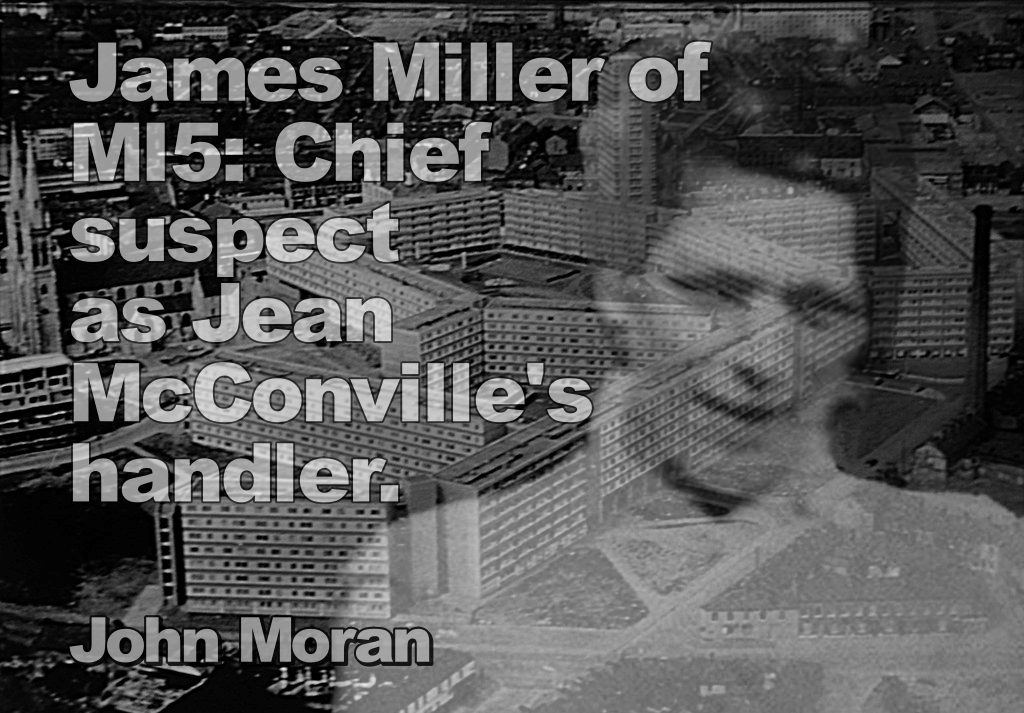
‘It is like peeling an onion, and the more you peel them away, the more you feel like crying. There are two laws running this country: one for them (the intelligence services) and one for the rest of us,’ Miller told Paul Foot in ‘Who Framed Colin Wallace‘, p246.
The chief suspect for the role of Jean McConville’s handler was a British intel agent called James Miller. Miller, an Englishman, was a prolific operator who was also centrally involved in the Bloody Sunday Massacre AND the Northern Ireland operation of Clockwork Orange, the plot to bring down the Labour government of Harold Wilson.

Miller even infiltrated William McGrath’s Tara Brigade and his Kincora paedophile operation. But his warnings about McGrath being a risk to any child in his care were abruptly silenced.
On yet another occasion Ivor Bell, a leading Provo, gave Miller protective shelter in his home.

Miller was an MI5 agent and a former Parachute regiment sergeant-major who had infiltrated the Nationalist community in Belfast and Derry, in the early 1970s, to work as a lift engineer, in Divis St Flats and Rosville Flats respectively. He was married to a Protestant Belfast woman and lived in Monkstown, Belfast.
Because of Miller’s extraordinary involvement in the Bloody Sunday massacre – as revealed by David Burke in his book Kitson’s Irish War – and because he had worked in Divis Flats at the time of Jean McConville’s murder in 1972, the worst year of the Troubles, he is now of particular interest.

In his book, Burke revealed that Miller was the likely instigator of the Bloody Sunday massacre which resulted in the deaths of 14 civilians. As ‘Observer B’, Miller had falsely claimed to have seen IRA men practicing to attack the British army near the Rossville Flats. He passed on the concoted information to the British army and MI5.
McConville’s appalling murder and grotesque ‘disappearance’ by the Provisional IRA was quickly forgotten in the maelstrom of violence of 1972 when there were close to 500 killings. Her case was neglected until it was revived by the release of the Boston Tapes, a collection of secret admissions by various paramilitaries, given on the condition of anonymity.

A bestselling book by Patrick Radden Keefe, ‘Say Nothing: A true story of murder and memory in Northern Ireland’, which was awarded the 2019 Orwell Prize for Political Writing, covered some of the history of the McConville murder, but the book failed to mention James Miller.
Had Miller’s role in the McConville case been available, the book’s narrative might have been different.

Author Ed Moloney was critical of the exploitation of Jean McConville, a vulnerable woman with ten children. In his book, ‘A Secret History of the IRA’, he wrote:
‘The background to the tragedy of Jean McConville was set in Divis Flats, then a large sprawling complex of apartments in tower blocks whose stairways and corridors provide the perfect stage for snipers and bomb throwers. In the early 1970s the IRA operated virtually openly in Divis. “Everyone knew who the IRA in Divis Flats were; they walked around with guns and so on,” remembered one of their number. For the British army it soon became a priority to place a reliable spotter in the flats who could warn them of IRA activity and planned ambushes. Jean McConville agreed to be one of those spotters, but by all accounts she was not very good at her job and showed a too obvious interest in the IRA’s affairs. It was not long before the local unit tired of her unending questions and began to suspect her. Her apartment was raided, and sure enough the IRA found a radio transmitter that she had been using to communicate with the British army. “It was taken off her, and she was warned never to do that again; she was a woman and the mother of a large family, and so we let her off,” explained one IRA member familiar with the events. But it was just a warning. Next time, she was told, there would be no warning.

‘Inexplicably McConville went back to spying on the IRA, this time with fateful consequences. Although by this stage British army must have been aware that the IRA knew all about her activities and that she was now in terrible danger, her handlers carried on regardless and supplied her with a second transmitter. Her spying recommenced, and it did not take long before the IRA worked out that she was back in business, once more betraying IRA volunteers and operations. The Belfast Brigade decided that this time she had to die, but its senior members disagreed violently about what to do with her body. The question bitterly divided the Belfast Brigade staff. Some argued that her body should be dumped in the street so that her fate would act as a deterrent to other would-be informers in accordance with IRA custom and practice. But one figure disagreed, arguing that the publicity attached to her death, the fact that she was a widowed mother of 10, would work strongly against the IRA, and he urged that she be buried in secret, effectively disappeared.‘

There were those who tried to cast doubt on the revelation that British Intelligence had a radio of the type described by Moloney. This was debunked in an article Moloney posted on his website which can be read here:

The Police Ombudsman Northern Ireland was unable to find records that confirmed McConville’s espionage activities. This was seized upon by those who resist the idea McConville had been suborned by British intelligence. This presupposes that MI5 and other services can be relied upon to tell the truth and surrender their files. Unfortunately, MI5 rarely does this.

The Stalker affair is a damning example of obsessive secrecy. See Shooting to kill? [WebBook]
MI5 has decided to withhold files on Kincora for decades yet to come. Details about Kincora can be found here: https://coverthistory.ie/tag/kincora/

It only recently emerged that Operation Denton (looking at Freddie Scappaticci) was told it had received all the relevant files it required. It proceeded to produce its report only to find MI5 had withheld crucial documents.
The British government still refuses to open it files on the Dublin-Monaghan bombings of 1974. The Irish government has been asking to see them for decades. Miller was involved in the Ulster Workers Strike which opposed the 1974 Power Sharing Executive. The Dublin-Monaghan bombs exploded during the UWC strike and helped topple the Executive. See RETURNING THE SERVE
Against this background, a series of questions arise:
{i} What secrets are concealed in Jean McConville’s file that the British government is so desperate that it intends to conceal them for 90 years?;
{ii} If Jean McConville was not an informer, why not release her records now?;
{iii} If she was an informer, who spotted, approached and recruited her?
{iv} Who supplied her with a radio device?;
{v} Who decided to maintain her as a spy after she had received a severe warning from the IRA?;
{vi} Who reopened contact with her after the IRA confiscated her radio device?
{vii} Was her transmitter replaced or were all of her reports delivered person to person?;
{viii} Were the secrets contained in the top secret documents which are being withheld for 90 years, revealed to the Police Ombudsman?
{ix} If they were released to the Ombudsman, why is it necessary to suppress them for 90 years?
The fact that Miller was one of a tiny number of British intel operatives with access to the Divis complex, renders him the most likely candidate for the role of Jean McConville’s handler. If the truth about his activities as a spy in the complex was acknowledged, pressure would mount to examine his other activities. In turn, that would open a Pandora’s Box and expose secrets about Bloody Sunday, Kincora, Tara, collusion and Operation Clockwork Orange.
Miller was exposed as an MI5 agent after yet another audacious success – his penetration of the UDA. He fled to live in England where he became unhappy about his financial health. This led him to provide a few tantalising clues about his involvement in some of these operations to reporters before he went back into hiding. He died a long time ago.
James Miller’s role in these nefarious operations offers an explanation as to why the poisoned chalice that is the Jean McConville file is being buried by the British state for the extraordinarily long period of 90 years.

From ‘A Conspiracy of Silence from Downing St to Tara St‘, by John Moran, an e-book planned for publication late next year. John Moran worked as a Foreign Desk editor at the Irish Press and as a sub editor in the Features Department of The Irish Times.