
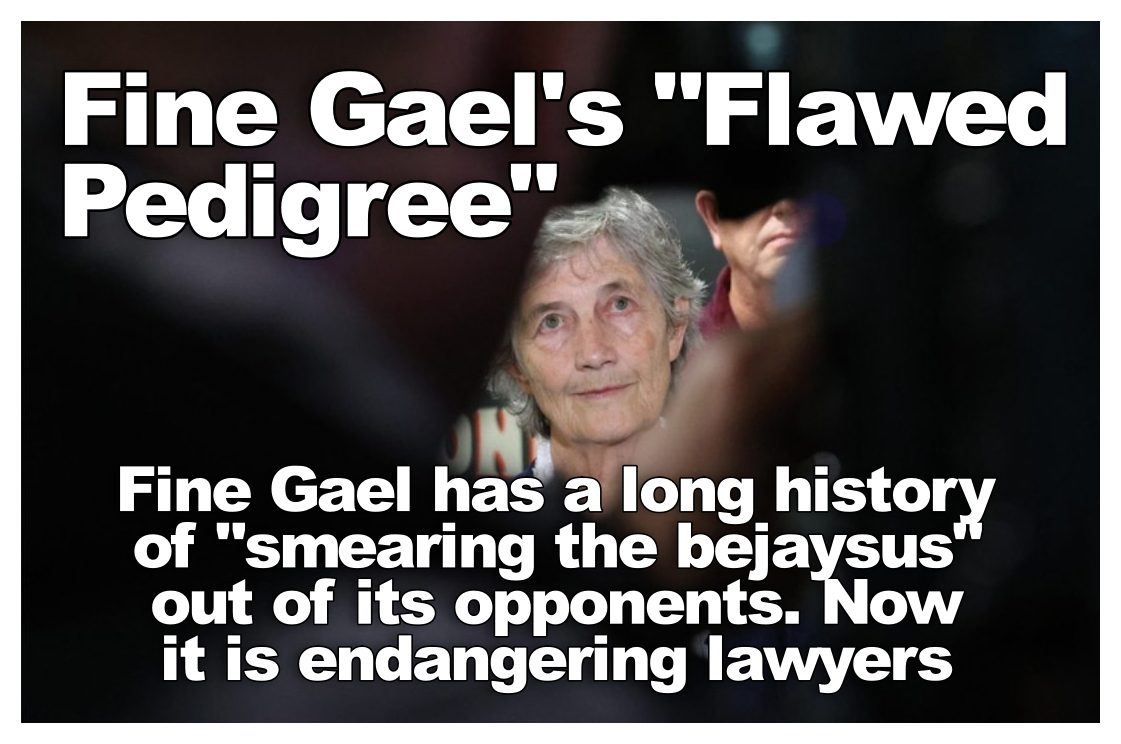
1. Smearing ‘the bejaysus’ out of Catherine Connolly.
When Ivan Yates spoke about ‘smearing the bejaysus’ out of Catherine Connolly, he was merely saying out loud what members of his party have whispered from the shadows for decades.

Yates made remark on his Newstalk podcast ‘Calling It’. He outlined what he would do if his old party, Fine Gael, were to contact him and ask him for advice on how to improve Humphreys’ campaign. His recommendation was as follows:
‘You’re going to be shocked about this now… I would go bullheaded: “Do you want a Provo in the park? Is she a Russian asset?” I would smear the bejaysus out of her, simply because you’ve nothing to lose.‘
2. Boomerang.
Whatever chance FG had of landing a blow on Catherine Connolly by portraying her as a potential Provo in the Park, a modern Captain Boycott, or the pal of despots, it evaporated after Yates said Fine Gael needed to vilify Connolly to get back in the race.
There is nothing the average voter resents more than the feeling someone is manipulating them.
It looks very much like the slurs hurled at Connolly have backfired disastrously on those firing them.
3. Fine Gael’s foremost smearmeister
The smear tactic was the weapon du jour in FG’s arsenal when Yates joined the party. Its foremost exponent was Garret FitzGerald, a man the young Ivan Yates admired greatly. ‘I was in Young Gael because of Garret FitzGerald. He was a truly inspirational figure,’ Yates said after FitzGerald’s death.

In 1978, at the age of 18, Yates was elected to Enniscorthy Urban Council for FG. The following year, FitzGerald denounced Charles Haughey as a man with a ‘flawed pedigree’. The modern era of negative politics and vilification was off with a bang.

Yates began knocking on the door of FitzGerald’s home at Palmerston Road in Dublin. As someone privately educated at St Columbas, he cut the mustard with the FitzGeralds and became a regular visitor.
4. Latent snobbery.
A successful smear is one that triggers fear, shock or disdain.
The ‘flawed pedigree’ remark delighted the well-heeled residents of leafy South County Dublin but angered many further afield. FitzGerald was soon on the backfoot.
FitzGerald’s exact words were that:
‘Deputy Haughey presents himself here, seeking to be invested in office as the seventh in this line, but he comes with a flawed pedigree.’
The public sensed a latent snobbery in the remark. FitzGerald was privately educated at Belvedere College whereas Haughey was a Christian brother boy who scraped his way to UCD with the benefit of grants and scholarships.

To South County Dublin (and those of a better class elsewhere in the country), Haughey was an upstart. It was not right that a working class individual like him was riding horses, living in a mansion and enjoying fine wines. To a Southside family, this was almost as bad as having someone with a Dublin accent move in next door.
FitzGerald denied the latent snobbery in his ‘flawed pedigree’ remark but never provided an explanation of what he really meant by it. He gave at least two different explanations, neither of which conceded social condescension on his part. At least one of the explanations must have been disingenuous.

FitzGerald made the remark on the day Haughey first became Taoiseach. That morning FitzGerald told one of his TDs that he ‘didn’t wish Haughey well’. Later that day in the Dail chamber, where the laws of defamation do not apply, he proceeded to describe Haughey as having a ‘flawed pedigree’.
He didn’t explain what he meant by the insult. During a distinctly separate part of his speech, FitzGerald spoke about the Arms Trial of 1970 of which Haughey had been a defendant. The ‘flawed pedigree’ slur was hardly therefore a reference to that event.
5. Late night phone call.

FitzGerald was concerned by the negative reaction to the remark. When the Sunday Independent reported, wrongly as it happened, in a tiny back-page gossip item, that Fine Gael backbench Deputy Michael Keating had disassociated himself from the slur in a conversation with Haughey, FitzGerald awoke Keating at 1.30 a.m., on Sunday morning, by telephone, to ask if the report was true.
Keating assured him that it was not. Keating’s political star was destined never to shine under FitzGerald ever after.
6. Disingenuous reasoning.
Media reaction to FitzGerald’s attack on Haughey was hostile. He continued to backtrack. In time he would tell the Sunday Times that the statement was ‘unfortunate’ and that he ‘regretted it‘.
In April 1981 he told Vincent Browne of Magill magazine what he had allegedly meant by the remark by saying:
‘Most politicians come up through the process – TDs or Senators, Junior Ministers, Senior Ministers by a more or less steady process. In his case that whole process halted in May 1970 and [Haughey’s] political progress and pedigree was flawed at that particular point.‘
In other words, Haughey was alleged to lack the necessary uninterrupted experience, due to an absence from power in the 1970s while on the backbenches, to become a good Taoiseach.

But this explanation is not satisfactory. In 1981, FitzGerald appointed a number of ministers who had not ‘come up through the process’. His Minister for Foreign Affairs, the most prestigious Cabinet ministry, was given to James Dooge who had no political experience. He had never been a councillor, senator or TD, he hadn’t even stood in an election. Prof. Dooge was brought into the Cabinet through the Senate as one of the Taoiseach’s 11 nominees.

Alan Dukes was made Minister for Agriculture on his first day in the Dail. Dukes had never been a councillor TD or Senator either.
Ironically, back in December 1972, when FitzGerald had tried to topple Liam Cosgrave and fancied himself as his successor, he had been in the Dail for three years and had no junior or senior ministerial experience.
7. An alternative explanation presented to the Sunday Times.
There is further reason to doubt the accuracy of FitzGerald’s explanation to Vincent Browne. In an interview with the Sunday Times in 1984 he claimed that ‘flawed pedigree’ was a reference to Haughey’s ‘involvement at the time of the arms trial‘.

While the political smear is as old as politics, FitzGerald reshaped it for the modern era of mass communication. His rivalry with Fianna Fail was dominated by reliance on the so-called ‘Haughey Factor’, i.e., vote FG because it is not FF led by Haughey.
The tribunals that shred Haughey’s reputation decades later, comforted South County Dublin and justified their underlying disdain of the man which was always class based. If the tribunals had given him a clean bill of health, he would have remained in bad odour irrespective.
8. Presidential Punch and Judy shows.
FitzGerald’s example spread to all parties, and even became the norm in presidential elections – sometimes with negative results.

FF lost countless votes in the 1990 Presidential election after Padraig Flynn sneered at the status of Mary Robinson’s marriage.
Mary McAleese was accused of being a ‘tribal timebomb’ when in reality she was quite the opposite.

Des O’Malley sneered that Michael D Higgins would ‘go mad’ in the Park. He didn’t.
Some in Fine Gael resorted to hurling smears at their own. Leo Varadkar tried to unseat Enda Kenny by falsely linking him to the dirty tricks campaign against Garda Gerry McCabe.

Perhaps now, in the era of President Donald Trump, people are sick of gutter politics. Nonetheless, there is little prospect that Irish politicians will ever abandon dirty tricks, smears and vilification. The sleazy smear genie has long since oozed out of the bottle.
10. The party of law and order exposes lawyers to danger.
Fine Gael recently released a video accusing Catherine Connolly of hypocrisy due to her work as a barrister, specifically her representation of financial institutions involved in home repossessions.
In doing so, Fine Gael is encouraging the public to associate lawyers directly with the actions of their clients.
However, barristers and solicitors should not be judged based on the clients they represent. If this logic were taken to its extreme, lawyers might refuse to represent certain defendants altogether. In the most extreme cases, criminal defendants could be left without legal representation, making it impossible for trials to proceed in the absence of a defence team. This is precisely why the ‘cab rank’ rule exists—mandating that lawyers must represent clients regardless of personal feelings or opinions. Without this principle, the legal system would collapse.
While it is unthinkable that the ‘cab rank’ rule will be abandoned, Fine Gael’s approach nonetheless opens a dangerous Pandora’s box. If the public begins to adopt Fine Gael’s implicit policy of equating lawyers with their clients, solicitors and barristers could become targets of hostility and even violence.
David Burke.
For those who are on X, Fine Gael’s video can be found by clicking the link below: