Introduction.
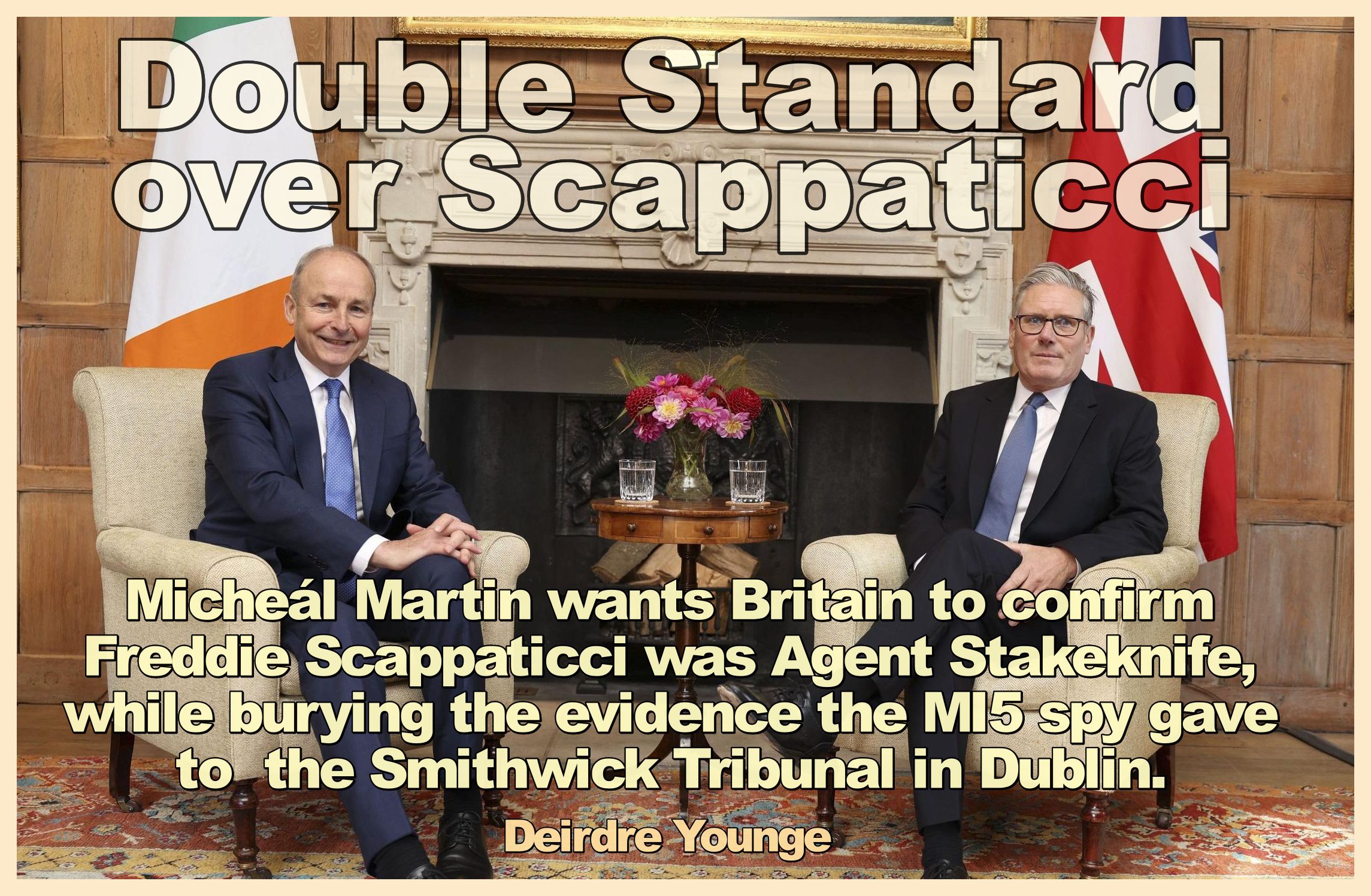
In Dáil Éireann, Taoiseach Micheál Martin called on the British Government to name Agent Stakeknife, who he says is known to be Freddie Scappaticci. This transparency and openness, Martin believes, will help relatives of those killed by the IRA’s brutal Internal Security Unit, led by agent Stakeknife, among others. His appeal followed calls by Operation Kenova head Iain Livingston and former head and present Chief Constable of the PSNI, Jon Boutcher, who recently described the inability to name Stakeknife as a pantomime.
The crunch point of Operation Kenova was inevitable. There was no indication that the British Government, guided by MI5, were going to resile from the default use of the “Neither Confirm Nor Deny” policy in relation to agents to allow agent Stakeknife be named. In response to (the then head of Kenova) Jon Boutcher’s published ‘protocols’, the Cabinet Office, acting for the intelligence service(s), reminded Boutcher that the NCND policy was at the discretion of Ministers, not policemen.

From @coverthistory.ie Has Jon Boutcher head of Operation Kenova escaped the shark infested waters of British intelligence.
It’s now clear that Scappaticci/Stakeknife -for it is he – brazenly fronted up a blanket denial that he was the agent, and for a time, that he even was an agent. A brave volunteer had been set up to be murdered by sensationalist journalists and washed-up informers. But it was not only senior Judges in Northern Ireland who played along with this legal charade. Judge Smithwick of the Smithwick entertained Scappaticci from 2006 as he privately and his lawyers publicly and expensively proclaimed that assertions that Scappaticci was Agent Stakenife were lies.
1. Tribunal

The Tribunal, set up in 2006, was still in private session until spring 2011.
When the then Minister for Justice Alan Shatter gave Smithwick a timeline to complete the Tribunal, concerned about the fact that a public tribunal had been in private session for years:
‘The Tribunal has since 2006 been conducting its inquiries in private. Given the importance that has been attached to the subject matter of these inquiries, The Government considers it appropriate that the Oireachtas and the public should have an indication of where the Tribunal is currently placed in relation to carrying out its mandate the Oireachtas has given it…I doubt very much that the house in 2005 would have envisaged at the time that this would hear nothing from the Tribunal for six years.‘ [The Minister for Justice, Alan Shatter, 1 July, 2011].
Micheál Martin, by now the newly elected Leader of Fianna Fáil, subsequently attacked Shatter in the Dáil for his ‘high handed’ approach claiming he had put pressure on the judge to finish the Tribunal early.
According to reliable sources, legal officers and civil servants were concerned about the operation of the Tribunal. Agents and informants working for the UK intelligence services played a significant role in shaping the Tribunal’s direction.
2. Unmasked
Scappaticci was unmasked in 2003. Séamus Kearney’s young brother Michael was one of Scappaticci’s first victims. Shot dead in 1979 after being falsely accused of being an informer to protect an informer; his body was dumped on the Cavan-Fermanagh border. In a recent book and a series published online, Seamus Kearney described Scappaticci’s reaction when confronted by journalist Greg Harkin and others at his home in Belfast:
‘The day after the rap at the door from the journalist Greg Harkin 1oth May 2003, Scappaticci was summoned to a clandestine meeting with his military handlers at his holiday home in Portaferry, Co Down..they suggested that a furniture removal can be sent to the family home to remove him, his wife and children into the safety of protective custody. But stakeknife was having none of it. Instead he told his handlers he could “brass it out”.‘
Scappaticci approached the IRA denying everything, a strategy which could be managed by both parties:
‘On the 14th of May 2003, a meeting took place attended by renowned journalist Brian Rowan, with the IRA’s Director of Intelligence and the adjutant of Northern Command monitoring proceedings in a building opposite. As pre-arranged Scappaticci issued a public statement in which he denied that he was a British agent and with that approach expected the latest piece of theatre to bring down the curtain on the press who had hounded him thus far. To copper fasten the dual arrangement between Stakeknife and the IRA leadership a number of statements slamming the press for being so gullible in accepting British intelligence propaganda, and other Republicans muddying the waters by claiming the allegations were “”bizarre and without proof””. [Seamus Kearney February, 2026].
Scappaticci responded with the cool calculation that would continue until his death, including in his dealings with Judge Smithwick at the Tribunal set up in Dublin in 2005 to investigate collusion by Gardai in the murders of Chief Superintendent Harry Breen and Superintendent Bob Buchanan in March 1989.
Scappaticci worked his way through the courts, denying he was Stakeknife, with MI5’s collusion and the knowledge of senior judges who were privately advised by Treasury Counsel. In 2003, he brazenly sought a judicial review against the refusal of a Northern Ireland Minister to deny that he was the agent Stakeknife. The Minister did not budge, and Justice Carswell refused his application in a choreographed process.
3. Judicial collusion
Jon Boutcher, now PSNI Chief Constable, former head of Operation Kenova, revealed that a former UK Treasury Counsel, Philip Sales, now an English Supreme Court Judge, gave a secret briefing to the Lord Chief Justice of Northern Ireland, Lord Carswell, who presided over Scappaticci’s Judicial Review application in 2003 that Scappaticci, was in fact, the agent called Stakeknife. This, while Carswell presided over an attempt by Scappaticci to force a Northern Ireland minister to deny he was Stakeknife.

Lord Sales was one of five judges who recently presided over the Paul ‘Topper’ Thompson case* in which the final judgement essentially reiterated the MI5 position that only Ministers or the Secretary of State Northern Ireland, could be the final arbiters in what intelligence be handed over to Courts or, as in the Thompson case, the Coroner. The primacy of National Interest as interpreted by MI5 was reasserted. This reinforced the Government’s ‘Neither Confirm Nor Deny ‘ position in relation to Stakeknife and the final unpublished Operation Denton report.
In the matter of an application by the Secretary of State for Northern Ireland for Judicial Review (Appellant) – UK Supreme Court https://share.google/0Vyq6UopiNJUqXlfG
[See report by Daniel De Simone:
Murder and MI5: How an extraordinary battle erupted over what the state keeps secret. 25 January, 2026. BBC News website.

[*Paul Thompson was shot dead in 1994 in Belfast by Loyalist paramilitaries. His inquest triggered the recent Supreme Court appeal.]
4. Denials.
The Scappaticci charade continued in 2006, when Scappaticci began his long relationship with Judge Smithwick and his legal team after the formal establishment of the Smithwick Tribunal in Dublin in 2005. He was seeking legal representation, believing he would be named in the Tribunal following the publication of the book ‘Stakeknife’ by Ian and Greg Hurst. Peter Keeley, who had operated in the Internal Security Unit in South Down and Louth with Scappaticci, had made allegations against Scappaticci which appeared on the Cryptome website.
Ian Hurst, aka Martin Ingram, and Peter Keeley, aka Kevin Fulton, one a former FRU operative and the other a CHIS, were among a group of ‘whistleblowers’ who met Judge Smithwick in 2006 and onwards and were determined to bring Scappaticci into proceedings, according to sources.

Michael Flanagan, Scappaticci’s solicitor from his first appearance in Flanagan’s office on the Falls Road in 2003, applied for and was given the right to represent Scappaticci at the Smithwick Tribunal from June 2011.
Scappaticci was subsequently given full representation by Senior and Junior Counsel later that year. Judge Smithwick believed wrongly that Scappaticci would give evidence to the Tribunal in public or private sessions.
In a final legal submission to the Tribunal in 2013, made on his behalf by his lawyers,he gave reasons for his legal representation:
2.6 It is submitted that the allegations that Mr Scappaticci is ‘Stakeknife’ has, without any foundation whatsoever, taken on a life of its own ..
2.7 ‘The allegations have resulted in grave consequences for Mr Scappaticci. He has been forced to leave his home and family. The IRA has publicly made it clear as to how they deal with those within its ranks who are suspected of being informers and it is submitted that it is indisputable that the “Stakeknife” allegation has put Mr Scappaticci’s life at risk. The threat to his life was emphasised in 2009 following the murder of Denis Donaldson ..‘
7.1 It is submitted that the sole matter in issue with regard to Mr Scappaticci is the allegation that he is the agent Stakeknife. This was expressly acknowledged by the Honourable Chairman when he said:
“Mr Scappaticci is represented because he made the point that he – that there was an allegation, which he denies, that he is a person under the sobriquet of ‘Stakeknife’. He denies that is so and its been said by various people that he is and denies it and he wanted to make sure that his interest in denying he was ‘Stakeknife’ would be – that he would be represented before the Tribunal and he was given representation for that purpose alone. [Scappaticci’s final legal submission to the Smithwick Tribunal, 2023].
There was no indication or information given about Scappaticci’s meetings with the Judge, or any information given as to what intelligence Scappaticci gave or withheld.
The Smithwick report was published in 2013 with findings of collusion by Garda with no smoking gun, no actual evidence to implicate an individual.

In 2015, prior to a Judicial review brought by Sergeant Owen Corrigan, the Tribunal Solicitor, now working for the Chief States Solicitor in loco Smithwick, who had submitted his report, denied Scappaticci had ever given ‘evidence’.
Letter from the Chief State Solicitors office 4th November 2015:
‘We refer to the above matters and to the letter of the 11 September, 2015.
‘In the first instance, we fail to see how the query raised in the said correspondence is in any way relevant to your client’s application for judicial review, which, as you are aware, is listed for hearing on the 19th of November next. Moreover your correspondence does not identify the relevance of the query.
‘Strictly without prejudice to the question of relevance however, we can confirm that Mr Scappaticci did not provide evidence to the Smithwick Tribunal.
‘Mr Scappaticci (who is outside the jurisdiction) would not cooperate with providing evidence to the Smithwick Tribunal. He declined to provide a signed statement to the Tribunal and declined to give oral evidence.‘
This Jesuitically phrased letter depends on a strict adherence to the legal definition of evidence as it relates to a tribunal – that is, ‘evidence’ is sworn statements, both written and oral. Judge Smithwick himself, however, often referred to unsworn statements and hearsay as evidence.
The letter, extraordinarily, asked what the relevance of the evidence of a high-level agent in the IRA who had been variously accused of being a handler of Garda Corrigan and involved in the murder of Louth man Tom Oliver, as well as being the agent Stakeknife, was. Scappaticci’s long-time handler, Witness 82, gave evidence in 2012 that Scappaticci never gave him any information or intelligence on Garda collusion involving Corrigan or any other guard. It seems clear that Scappaticci did not support Smithwick’s driving hypothesis of Garda collusion.
Operation Kenova found no evidence that Scappaticci was involved in the murder of Tom Oliver who was abducted and murdered in Cooley, Co Louth in 1991. His battered body was found outside Belleeks Village in Co Armagh. There were at least two other agents involved in the ISU who brutally interrogated and murdered Tom – Peter Keeley and a Special Branch informant who has not been named by Kenova. The Oliver case came in and out of evidence throughout the Tribunal. No one has ever been arrested for his murder.
Drew Harris, the former Garda Commissioner as Head of Legacy PSNI was the liaison between MI5,and the Tribunal. He gave evidence in October 2012 and when questioned by Counsel for the Tribunal said he had talked to MI5 that morning just before his evidence.
Lt Colonel Paul Hockley, the senior lawyer in the British Army Intelligence Corps was also in attendance at the Tribunal.
How did they advise Judge Smithwick?
According to senior legal sources, Scappaticci spent three days in Dublin meeting Smithwick and his legal team. No information about these and other meetings was released to other lawyers. In 2013, Judge Smithwick awarded Scappaticci 385,000 euros in legal costs. They were paid in 2015 after being agreed by the Secretary General of the Department of Justice and Public Expenditure.
5. Open the files
Micheál Martin needs to summon the unredacted Smithwick files held by the State Claims Agency, the Chief State Solicitor’s office, and the Department of Justice.

6. Owned
In his final report published in 2013, Judge Smithwick wrote of the ‘novel and unprecedented’ co-operation and assistance he had received from ‘all the security agencies of the United Kingdom’. He then went on to comment on ‘co-operation with the British Security Service'[MI5]:
‘While the Tribunal’s legal team was not given access to underlying Security Service intelligence the Tribunal’s legal team met members of the Security Service on a number of occasions. At the Tribunal’s request the Security Service conducted various searches and informed the Tribunal of the outcome of these searches. Furthermore, some of the intelligence documentation provided by the Northern Ireland office to the Tribunal in a redacted form originated from the Security Service. ..While I acknowledge that a process that a process which does not allow the Tribunal to verify, by checking the underlying information, that what is being told by the Security Service in response to to our various requests is accurate, is not a perfect process, I am nonetheless of the view that the Tribunal has done well to secure an unprecedented level of co-operation from the Security Service of another country.’
Judge Smithwick’s awed tribute is a measure of MI5’s successful orchestration of the Tribunal. Like all the other events Scappaticci had been part of, it was more Kabuki theatre than judicial process. A drama conducted through the participation of its ‘made men’, agents and assets like Scappaticci and Keeley. It had a ‘signature’ dramatic turn of events – the last-minute MI5 revelations, ‘live and of the moment’ delivered by the man from the North, Drew Harris, which essentially pulled the rug from under Smithwick’s final dénouement, despite all his effusive tributes.

© Deirdre Younge 2026.
See also: Drew Harris
Covert History’s Scappaticci archive can be read here: https://coverthistory.ie/category/scappaticci-freddie/
