
Introduction.
King Charles III has recieved briefings from two British Secret Service (MI6) chiefs, Sir Richard Moore and Blaize Metriwell, thus far into his reign.
Prince William has been courted by the intelligence community, notably making a high-profile visit to the HQ of GCHQ, where British cyber espionage takes place.
Queen Elizabeth II received briefings from fifteen chiefs of the British Secret Service during her 70-year reign.

The Royal family has also been the target of their own spies for centuries, for all sorts of reasons, mainly to protect them from reputational harm. King George V had his son Edward placed under intense scrutiny while he was dating Wallis Simpson.
Prince Philip, the father of King Charles, was monitored by the spies of the Soviet Union, such as Stephen Ward and a cell of traitors inside MI5. These operations helped explode the Profumo scandal. Stephen Ward was once a friend of Prince Philip. See Prince Philip’s illicit sex life was monitored by Soviet spies. [WebBook]

One shudders to think what the files about Lord Louis Mountbatten reveal. See: The Mountbatten Dossier. [WebBook]

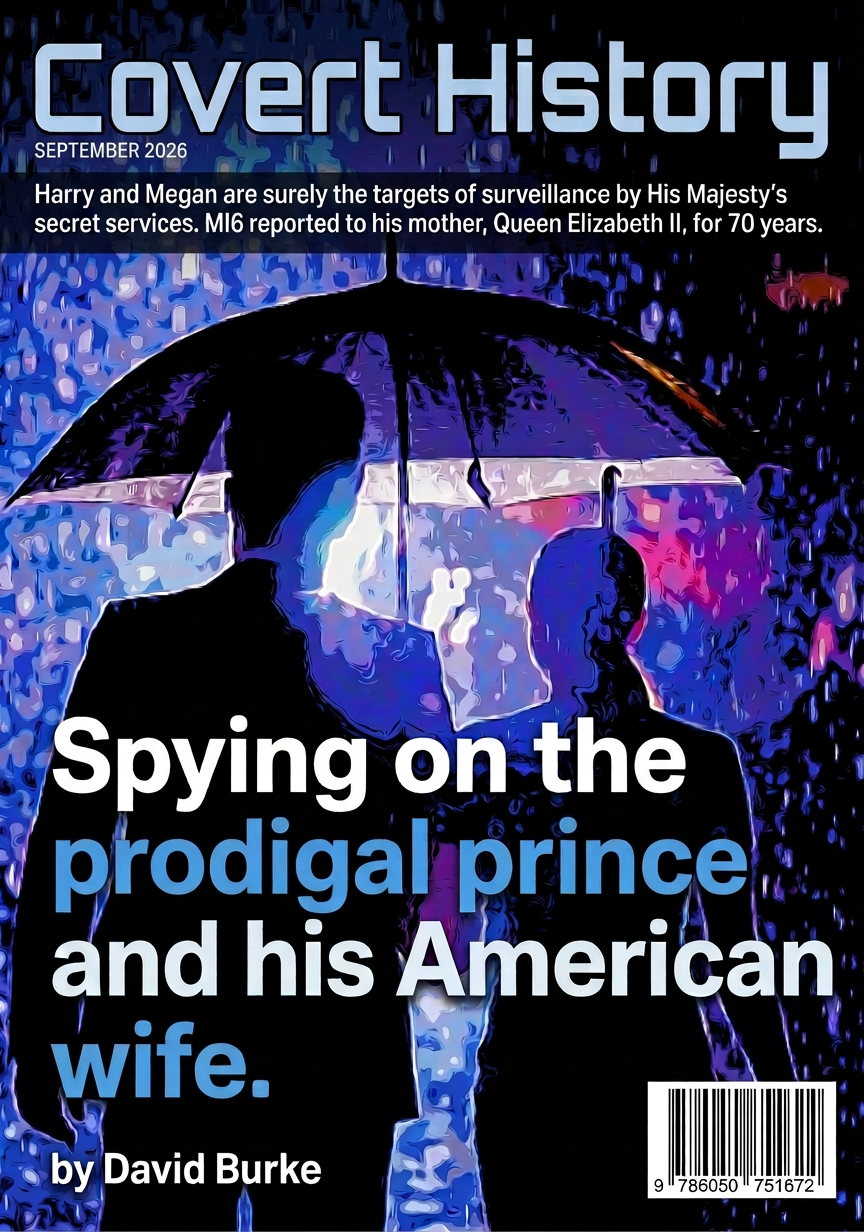
The activities of Prince Harry and his American wife are surely being monitored by Britain’s vast espionage network, in particular, GCHQ.
How much information flows to King Charles is a state secret.
One imagines Prince William will exploit the briefings to the hilt when he ascends to the throne. There will be a lot to monitor, especially the activities of Prince Harry and Andrew Mountbatten-Windsor.

1. Royal briefings.
Richard Moore, the Chief of the British Secret Service (MI6/SIS), 2020-2025, offered his ‘deepest sympathy and condolences to the Royal Family’, after Queen Elizabeth passed away, adding that:
‘Fifteen Chiefs of SIS held office during her long reign. Each of us were honoured to oversee the provision of intelligence to the longest running reader of intelligence reports. In my meetings with The Queen, I was always struck by her candour, wit and burning sense of duty.‘

MI6 is Britain’s overseas intelligence service. It is part of the Foreign Office. (MI5 operates inside the UK and Britain’s colonies.)
2. Reports about the Provisional IRA.
The information furnished to Buckingham Palace in 1979 must have made for sombre reading. Did Martin McGuinness’ name crop up in the briefing about the murder of Lord Louis Mountbatten? If MI6 was any good, it should have. In later years, both parties shook hands as part of the peace process.

3. MI6 and damage to Anglo-Irish affairs.
How much damage did MI6 chiefs such as Sir John Rennie, 1968-73; Sir Maurice Oldfield, 1973-78; and Sir Arthur Franks, 1978-82, cause to Anglo-Irish affairs by briefing Queen Elizabeth with faulty and paranoid information about Ireland?

A file released by Britain’s National Archive in London in 2009 revealed Queen Elizabeth’s ‘alleged dislike of the Irish’. The comment was made by a Foreign Office official in 1979. This (and other factors) shut down the possibility of a state visit to London by Irish President Patrick Hillery. A more extensive analysis of the Queen’s hostility towards Ireland was not released.
The effect of a state visit by the late President Hillery to London and a reciprocal one by Queen Elizabeth in 1979/80 is now difficult, if not impossible, to gauge, save to say that it could only have improved relations.

In 1979, during a trip to Chicago, Princess Margaret commented at a reception hosted by the city’s mayor, Jane Byrne, that: “The Irish, they’re pigs.” (A claim was later made that she had uttered the word ‘jigs’ not ‘pigs’.)
4. A regular visitor to Ireland.
At present, Blaise Metreweli reports to King Charles III. The new monarch presumably uses these opportunities to learn as much as he can about the foreign dignitaries he has met and those he has yet to meet.
Those who have met King Charles on his many visits to Ireland, such as former President Michael D. Higgins, have praised him for the depth of his knowledge about the island. The former President has even opined that he knows more about this country than ‘some’ British politicians. In private, senior Irish diplomats have often voiced alarm not merely about the profound ignorance of senior UK politicians about Ireland, but also their advisers at the Foreign Office.

5. On His Majesty’s secret service.
MI5 (Home Office) and GCHQ also report to the monarch. GCHQ monitors global communications, including those of Ireland.
King Charles has already established an excellent relationship with the intelligence community. As a prince, he was patron of GCHQ, MI6 and MI5. On one visit to GCHQ, he told his hosts that:
‘Few people in this country will ever know just how great a debt we all owe you. But for those privileged enough to understand something of what you do, the difference you make to our security, our prosperity, and to the defence of our values is both clear and invaluable.‘

6. Monitoring Prince Harry and Megan Markle.
In the 1980s, MI5 deployed units such as the ‘Dolly Mixtures’ to monitor the social shenanigans of political VIPs and members of the aristocracy. MI5 and the special branch routinely vetted proposed guest lists of people invited by members of the Royal Family to theatrical events and the like. The purpose of these operations was, where possible, to prevent scandals before they erupted.
See also: The Prince and the Pauper (Webbook).

One scandal the security and intelligence services failed miserably to thwart was that involving Prince Andrew and Jeffrey Epstein.
Megan Markle has caused considerable trouble for the Royals. It would be astonishing if they were not keeping an eye on her, as they once did when Lady Diana Spencer and Wallis Simpson were causes of concern.

In 2026, Prince Harry and his wife are reaching for the olive branch extended by Buckingham Palace after their return to live in the UK. MI6 and GCHQ are undoubtedly monitoring the communications between the couple and their advisers. As monarch, King Charles is surely in receipt of briefings about them, especially any broadsides the prodigal prince and his mercurial wife may yet decide to fire at him.

Harry’s 2023 autobiography was printed at Clays in Bungay, Suffolk, under conditions of great secrecy. Security guards checked the printing staff as they left the factory premises to ensure they didn’t smuggle out copies. It is laughable, however, to think the British Establishment did not acquire a copy well in advance of its publication.
The Establishment has a long tradition of acquiring manuscripts of interest to it. In 1971, a Foreign Office official, A. C. Thorpe, was assigned the task of obtaining the galley proofs of a book about Charles Haughey and the Arms Crisis of 1970. It was written by an Irish military intelligence officer called Captain James Kelly. MI6 and the Foreign Office wanted to suppress the book. They failed. The book, titled ‘Orders for the Captain’, became a bestseller in Ireland.
7. A work placement at MI5, MI6 and GCHQ.
The future relationship between Buckingham Palace and His Majesty’s spies looks positive. In 2019 Prince William spent three weeks on work placements with MI5, MI6 and GCHQ.

David Burke is the author of Kitson’s Irish War, Mastermind of the Dirty War in Ireland. It examines the role of counter-insurgency dirty tricks in Northern Ireland in the early 1970s and the template it set for the Troubles. His next book, An Enemy of the Crown, the British Secret Service Campaign against Charles Haughey, will be released at the end of September 2022. Both books can be ordered/purchased here:

