
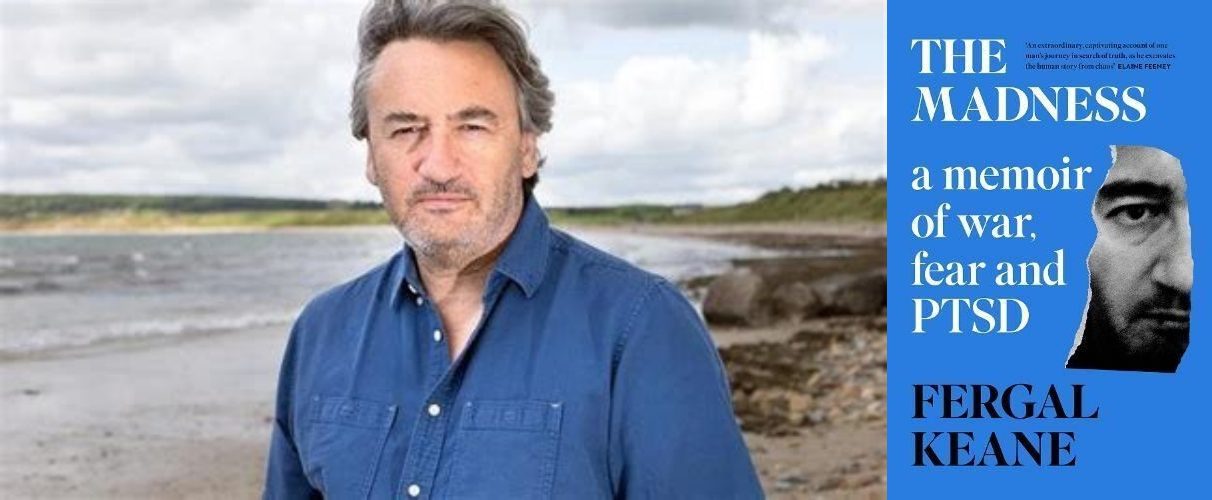
Fergal Keane was born in London, grew up in Dublin and Cork. He went into journalism and became the BBC’s foreign correspondent. His work earned him numerous awards, but at a cost to him personally. He was the overall winner of the Amnesty International Press Awards in 1993 and won an Amnesty television prize in 1994 for his investigation of the Rwandan genocide, Journey into Darkness. He also won the Royal Television Society Journalist of the Year award and the Sony Radio Reporter of the Year.
Here, Kevin O’Connor, the distinguished Irish journalist, author and broadcaster, reviews Keane’s latest book, The Madness.
Fergal Keane’s ‘The Madness’ is a punishing read as it details the breakdown of an Irish journalist, esteemed in the public eye, for his work over many years from many global trouble spots for the BBC. He volunteered for those assignments because he was driven by some internal upset that he needed to express through this hazardous type of work. The book is an interrogation of this symbiotic connection.
The country is Ireland the town is Listowel, Co Kerry, the parentage is father Eamo Keane, a talented alcoholic actor. The boy Fergal has an unfortunate facial tick which provoked bullying at school, incurring strong feelings of victimisation, injustice and impotent desire for revenge. Ingredients, you might deduce, for what later became a sterling career in broadcast, reporting from such cauldrons as Ulster, Rwanda, Ukraine to-day – where he sought and reported on political killings.

He believes the unconscious layers of his Irish upbringing, one imbued with an inheritance of the violence of Revolution and Civil War, churned underneath his professional pursuits. The experience of aunts in the Revolution in Ireland who were involved in spotting targets to be murdered, he believes, gave him an inheritance which surfaced in trauma and obsessed while covering the communal machete breakouts in Rwanda. This was a conflict where the inter neighbour hostilities and betrayals replicated on a larger, more murderous, scale, the trauma of a buried family inheritance of Listowel during the War of Independence.
How he excavates those subconscious influences is the scope of the book, told with his characteristic flair of insightful detail. When his alcohol dependence logs him into rehab, it is with his father’s ghost:
I never believed I belonged in rehab, a headcase drunk washed up in some of those places where I had seen my father – marooned among the shamefaced and scared while his son mingled with the visitors – the angry frightened husbands and wives, the embarrassed children and me wanting to run out the gate to the world of normal people. There always seemed to be an intrusive counsellor urging me to get more involved in my father’s recovery as if that was all that was needed, for me to sit down recite his feelings in one of those brutal family groups where everybody ended up crying and shouting. All in the name of breaking the drunkard denial it was shock therapy, the alcoholic boot camp. I always left feeling my father had been somehow reduced.
He would enter the same cycle: needing help but rejecting it, until a mind-shredding collapse. ‘I Know I should not have not gone back to Khartoum after the massacre. I had not stopped to think about the risks to my mind’.

Here it is worth saying that regular, prolonged journalist work on atrocities, takes its toll on reporters. This was recognised by the BBC which gave him leave of absence from his beat. Keane’s status as someone who volunteered for these harrowing assignments, encouraged his bosses to accommodate his illness as work-induced breakdown. His experience at a psychiatric hospital did not deliver release:
It didn’t save him – how could it save me?
How he tries to save himself becomes a narrative of descent and redemption. Descent into further medication via alcohol: sliding off to secretly drink when in company and stuffing his face with peppermint as disguise. Family and colleagues are not deceived.
Rock Bottom in rehab is provoked by wild ravings, feelings of hopelessness: You are just a piece of shit.. Whoever cared about you ..? and so on. That is how PTSD asserts itself in sickness as he traces with journalistic skills to childhood, the embedded, inherited trauma of Ireland and the Freudian blow of his immediate family – the baby who grew to be boy believing himself to be unlovable because if he was lovable, then surely his father would not be so unhappy or his mother either.
He does learn to love himself, something that delivers a giant step from which he rebuilds his life. It is worth the cost of the book to follow how he does it, personally and professionally…
THE MADNESS BY FERGAL KEANE, published by COLLINS, Dublin and London
