
Introduction.
The Democratic Unionist Party (DUP) was founded by Ian Paisley in 1971. It became – and remains – the most popular and successful Unionist party in Northern Ireland.

In the 1960s and 1970s Paisley preached that the Pope was spearheading a conspiracy against the Protestants of Ulster. In his mind, the Pope was the Antichrist, and was acting in league with Moscow, Fianna Fail and the IRA against the descendents of the Tribe of Dan of Caanan, one of the Lost Tribes of Israel, i.e., the Protestants of Northern Ireland.

Paisley’s bizarre views drove him to forge multiple, deeply disturbing connections with Loyalist paramilitary organisations. Some of the key individuals involved in these groups were also members of a network of paedophiles.

The Loyalist groups included the Ulster Volunteer Force (UVF), Ulster Protestant Volunteers (UPV), Tara, Red Hand Commando and Shankill Defence Association (SDA).
Paisley set up the Democratic Unionist Party in the early 1970s. The view from London was that it was sectarian. ‘Its early days as a crypto-fascist splinter group and its association with some of the wilder men on the Protestant side’ became an embarrassment it tried to shed in later decades.

In the 1980s, Paisley and other figures in the DUP, led Ulster Resistance, an organisation that was involved in the smuggling of arms.


Thuggery and violence had been part of Loyalism since the foundation of the Northern Irish statlet. The DUP tapped into that history when it created Ulster Resistance.
Paisley was also a conspirator in the cover-up of the child sex abuse scandal that swirled around Kincora Boys’ Home. Had Paisley wanted to expose it – and there is no reason to suppose that he did – his hands were firmly tied behind his back because he was compromised by his association with the paedophile and ‘housefather’ at Kincora Boys’ Home, William McGrath. McGrath was involved in some of the groups mentioned above. McGrath knew Paisley had financed at least one Loyalist bombing episode in 1969.
John Dunlop McKeague was the most important Loyalist terrorist of the 1960s and early 1970s. He was close to Paisley during the 1960s.


Have things changed since the Paisley era?

Contents
01. SIR JEFFREY DONALDSON MP, LEADER OF THE DUP, 2021-24.

Little has changed.
In some respects, the DUP has deteriorated even further since Paisley was pushed aside as its leader by his party.
Sir Jeffrey Donaldson led the DUP, 2021-24.

Donaldson was originally a member of the Ulster Unionist Party (UUP). It was led by James Molyneaux MP, 1979-95, and David Trimble, 1995-2005. Donaldson inherited Molyneaux’s Westminster seat when the older man resigned in 1997.

Donaldson switched to the DUP at the invitation of Peter Robinson in 2003. At the time of his move, Ian Paisley was still leader of the DUP.
He received a knighthood in 2016 and was appointed as a member of the Privy Council.

Donaldson always presented himself as one of God’s most ardent, sincere and pious front-line soldiers. He highlighted his religious beliefs during multiple TV and press interviews and public appearances.
He prayed with victims of sex abuse.
He gave sex education lessons to teenagers at his church’s Sunday School, warning them to avoid sin.

He opposed gay marriage.
Below is an interview clip from GB News during which Donaldson extols his Christian beliefs. The broadcast was hosted by an appreciative Arlene Foster, who led the DUP from December 2015 to May 2021. He spoke of the positive impact of a ‘faith approach to politics’, and why the Church should not be afraid to ‘raise its voice’ on political issues. ‘I find increasingly the Christian Church is reluctant to get involved in debate in the public square’, he bemoaned.
In reality, he was a sex pest, rapist, adulterer, liar and child abuser.
He was also a drunkard who projectile vomited over the Mayor of Beijing during a trade trip to China.

During a trip to Washington, a drunk Donaldson sat on top of a female Member of the Legislative Assembly (MLA). Ian Paisley Jnr told BBC NI’s Spotlight that he had witnessed Donaldson, blind drunk, trying to kiss her in a restaurant in a hotel. She was disgusted and slipped his clutches.
This fact alone establishes that his colleagues knew he was a sex pest.

Jim Allister MP, formerly of the DUP, and currently leader of Traditional Unionist Voice (TUV), has spoken of rumours about Donaldson’s ‘proclivities’ and ‘risky lifestyle’ which predated his arrest in 2024.

Publicly, he described homosexuality as ‘sinful’. Yet he frequented at least one gay sauna, called Chariots, in London.

Two PSNI officers watched him enter the premises: Tim Hanley, former head of the PSNI’s Serious Crime Branch and a colleague, a detective inspector. Both were in London working with MI5, whose HQ was very close to Chariots. Hanley disclosed this incident to Mandy McAuley of Spotlight.

Chariots was a sex club. 300 naked or semi-naked men would attend at peak hours. Customers went seeking sexual encounters. Sexual acts took place in open spaces and semi-private rooms.
If rumours are true, Donaldson availed of the services of male and female prostitutes in London.
There were rumours in Dublin for years that he did not want to become First Minister of Northern Ireland because he had a male lover in London whom he would miss if he gave up his seat in the Houae of Commons.

Yet, he defended the right of a bakery shop in Belfast to refuse to provide a cake to a gay couple. He likened the couple to the Shankill Butchers. See the next clip.
He featured in the 2009 Westminster expenses scandal. He had to apologise for seeking and receiving reimbursement of £660 for pay-per-view movies on his parliamentary expense account. He repaid the money. There was speculation that the movies he watched were pornographic. He denied this was so.
Donaldson’s political mentors were Enoch Powell MP and Jim Molyneaux MP.
Donaldson proclaimed his high regard for Powell and Molyneaux throughout his career.

During his trial, it emerged that in 2018 he had an affair with a divorcee in London in 2008 and a suspected affair with an adult female constituent in 2021.
Lady Eleanor was alleged to have bugged his car to see if he was having an affair with an adult female.
Donaldson was Molyneaux’s electoral agent. Molyneaux was a homosexual who was interested in young males and a friend of William McGrath, the housefather of Kincora Boys’ Home. McGrath and others ran Kincora as a ‘honey pot’ for Loyalist paedophiles, for MI5.
Another of Donaldson’s mentors was Enoch Powell MP, a sadistic paedophile who abused at least one boy from Kincora. See Jeffrey Donaldson Mentor
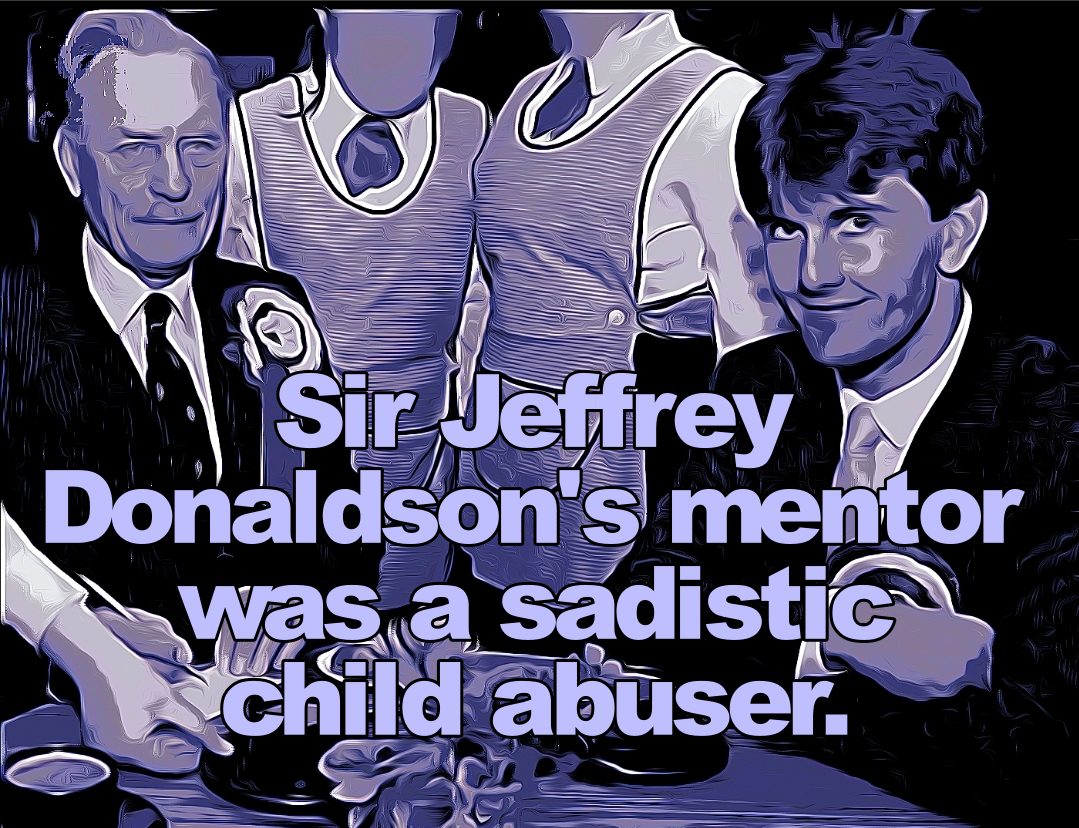

Donaldson probably knows some of the sordid secrets of Kincora.
Perhaps one day, Donaldson will reveal whether or not his relationship with Powell and Molyneaux was purely political. He may reveal other details about the sexuality of his colleagues, too.
See also Donaldson and Molyneaux.


Donaldson is also a member of the Orange Order. The Rev. Martin Smyth was Grand Master of the Orange Order from 1972 to 1998. According to a 1973 press release issued by Colin Wallace, a PsyOp officer at Lisburn British Army HQ, concerning William McGrath, Smyth and Molyneaux were aware of what was taking place at Kincora. MI5 destroyed Wallace’s career after he persisted in attempting to expose the abuse at Kincora. See our Operation Clockwork Orange series
The Orange Order has a sordid history of paedophilia.


MI5’s file on Donaldson must be voluminous.

In what must amount to one of the most important statements made about the reality of politics in Northern Ireland, Norman Baxter, the former Operational Director of Intelligence of the PSNI Special Branch, told Mandy McAuley of BBC NI’s Spotlight that the government, i.e. MI5, guided figures like Donaldson, who had compromised backgrounds, in the direction they wished politics to travel. Baxter told Spotlight:
‘Well, I’d be convinced that the Northern Ireland Office or an element of the government would have known of that behaviour [Donaldson’s sexual activities] because it’s their role to know. Part of managing the peace process is to understand the political actors – to profile and to understand where there is political leverage, and then you apply mechanisms to guide them to where you want the political position to be. I mean, the government would have been failing in their responsibility not to deep-dive into the activities of MPs or other politicians.‘ (Broadcast by Spotlight 26 June 2026.)

Baxter told Spotlight that in mid-July 2000, he observed Donaldson drunk, carrying two bottles of wine in Westminster and that he moved out to the Westminster Terrace, where he had his arms wrapped around two ladies. He believes the women were in their early twenties.

Donaldson is the man who represented Loyalism during Brexit.
Jim Allister, leader of the TUV, raised the possibility during an interview on Spotlight that MI5 may have forced Donaldson to comply with the wishes of the British government.

Many of his colleagues came to despise him. David Trimble MP, leader of the UUP, felt he was a manipulative back-stabber.
Donaldson’s actions eventually caught up with him. On 22 June 2026, Sir Jeffrey was found guilty of eighteen historical sexual offences, including one count of rape and thirteen counts of indecent assault against two women when they were children. The abuse spanned twenty-three years.

His wife, Lady Eleanor Donaldson, was found guilty of aiding and abetting him in connection with five of these offences.
The abuse included kissing ‘Complainant A’ and forcing his tongue into her mouth when she was in primary school. He also put his hands up her top to grope her.

His second victim, Complainant B, was also in primary school when he raped her. He indecently assaulted her on nine occasions, including once in front of Lady Eleanor.
Instead of intervening, Lady Eleanor turned, walked away and pulled the door behind her.

On another occasion, he shone a light on the genitalia of one of the children.
The public would be profoundly shocked if Donaldson’s unfortunate victims allowed their identities to emerge.
Donaldson showed no remorse and called his victims liars.

The worst-case scenario for the DUP is that Donaldson was the victim of blackmail, or so afraid that MI5 knew of his sordid activities, that he did what the British government wanted him to do anyway.
Jim Allister MP of the TUV told the Irish News that information about Donaldson’s paedophilia and his known ‘risky lifestyle’ in London may have been used as leverage during negotiations ahead of the signing of the Northern Ireland Protocol.

Allister has revealed that allegations that Donaldson abused children were in the ‘ether’ from March 2023, a full year before the former DUP leader was arrested.
Allister suggested that the intelligence services and ‘the very top of government would have been aware of that’.
‘And when you set that along the timeline of how Sir Jeffrey somersaulted from his opposition to the Protocol to (its) implementation of the Protocol, then it does beg questions,’ the TUV leader insists.

There is a precedent for this sort of machination: the Kincora Boys’ Home ‘honey trap’ operation run by MI5 and MI6.

An extended version of this section can be found at: Donaldson Dossier

Unfortunately for the DUP, if it thought it had put it’s troubles in the arena of sexual misconduct behind after the resignation of Jeffrey. Donaldson, it was sorely mistaken. An ele ted DUP politician was reported by the media, in September 2026, as having impregnated a party worker. The man’s name and status has not yet been a reported.

02. THE DUP WIFE BEATER
John McKeague exercised a malign influence over another extremely senior DUP figure, the ‘Wife Beater’. This individual is well known – especially among the police – for beating up his spouse.

On one occasion, the RUC were called out to the couple’s house, where they found blood all over the lady’s mouth. Paisley was furious when he was told about the assault.
He has a conviction for violent and thuggish misbehaviour and once teetered on the brink of going to prison, not in Northern Ireland, but elsewhere.
He was involved with Ulster Resistance.

He was once the victim of a black propaganda operation linking him to sexual misbehaviour and John McKeague.
He once threatened to sue a magazine which linked him to the sexual abuse of underage boys.
He is a Zionist.
The Wife Beater is still involved with the DUP.
Politically, he is still a household name.
03. BALANCE OF POWER AT WESTMINSTER

The high point for the DUP – in terms of exercising power – came in 2017, the year it held the balance of power at Westminster. This happened in the wake of the UK general election of that year. The then prime minister of the UK, Theresa May, had to go to the DUP, cap in hand, to beg them to keep her in power.

One of the benefit which accrued to the DUP, due to its hold over the Tories, was the elevation of the Rev. Dr. Willie McCrea, the former co-chair of the Shankill Defence Association, to the House of Lords. He became the Rev. Dr the Lord McCrea of Magherafelt and Cookstown.

McCrea was not always so esteemed. He was convicted in 1971 for riotous behaviour in Dungiven. On that occasion, he was sentenced to six months’ imprisonment.

McCrea was also an admirer of the Ulster Defence Association (UDA) and other Loyalist groups. In 1972, McCrea issued a press release, saying:
‘We call on all Loyalists to give their continued support to the Ulster Defence Association as it seeks to ensure the safety of all law-abiding citizens against the bombs and bullets of the IRA. As the Catholic population have given their support to the IRA throughout this campaign of terror so must Loyalists grant unswerving support to those engaged in the cause of truth.‘

In April 1986, McCrea called for the RAF to bomb the Republic of Ireland. He wanted ‘Libyan-type strikes’ against Dundalk, Drogheda, Crossmaglen and Carrickmore.

McCrea advocated the bombing of Dublin.

04. NOEL LITTLE, FATHER OF THE DEPUTY FIRST MINISTER, EMMA LITTLE-PENGELLY OF THE DUP

The DUP is still haunted by ghosts from the past. Noel Little was close to Paisley and Peter Robinson. Little was a key figure in Ulster Resistance. He helped import a consignment of arms in 1988 which was distributed to Loyalist terror groups.

Little is the ‘Mr D’ referred to in the report on the incident published by the Police Ombudsman of Northern Ireland. He was not charged with an offence.

Little was arrested in Paris in April 1989 – by French authorities – along with two other men. He was convicted of terrorism-related conspiracy – by the French – for trying to trade stolen British missile plans to the apartheid South African government in return for weapons. He was fined and sentenced to two years (which he had served by the time of his sentencing).

Noel Little is the father of the present Deputy First Minister of Northern Ireland, Emma Little-Pengelly of the DUP. Unlike her father, she is making a concerted effort to build bridges with the Nationalist community. She has won praise for attending a GAA camogie event with Michelle O’Neill.

Little-Pengelly was elected to Westminster in 2017 but lost her seat in 2019. After Sir Jeffrey Donaldson decided to take his seat at Westminster but not at Stormont as a Member of the Legislative Assembly (MLA), Little-Pengelly was co-opted to Stormont as an MLA.

The ‘Wife Beater’ was also involved in Ulster Resistance.
05. THE DUP AND THE UVF’s GLENANNE GANG.
William ‘Billy’ McCaughey, a member of the RUC Special Patrol Group, was also a member of the UVF’s Glenanne Gang.

The Glenanne Gang was responsible for the murder of well over 100 innocent victims, including those massacred during the 1974 Dublin and Monaghan bombings. See Returning the Serve: ‘The Jackal’, Collusion, MI5, Nairac, and the Dublin and Monaghan bombings. By David Burke.
In 1980 McCaughey was convicted of the 1977 murder of a Catholic chemist called William Strathern. He perpetrated the murder with Robin ‘The Jackal’ Jackson. At the time, McCaughey was an active member of the DUP.
McCaughey once told Roy Garland:
‘When I went to prison I was an officer of the DUP in my area. My politics were DUP since I joined the Ulster Young Unionists about 1967.’
McCaughey was involved in a string of other murders while a member of the Glenanne Gang.
06. PAISLEY AND THE ‘BEAST’.

Paisley, born on 6 April 1926, first met the sexually insatiable and lecherous deviant William McGrath when he – Paisley – was 22 or 23, in 1949, through their mutual involvement in the Unionist Association in the Shore Road area of Belfast. Paisley had moved into the locality to study at a bible college.

McGrath, born on 11 December 1916, perceived the Catholic Church as the instrument of the Antichrist and was determined to expunge it from Ireland so that the Protestant community – which he believed was descended from the Tribe of Dan of Caanan – could prevail.
McGrath perceived himself as a soldier in what he called the ‘battles of the Lord’. His self-anointed duty was to prevent the Pope ‘enslaving the people of God’, not just in Northern Ireland but throughout Britain.

Paisley, who was ten years younger than McGrath, came to share McGrath’s bizarre views.
McGrath became known as the ‘Beast’ by the RUC officers who investigated his sexual crimes.
He tried to use the bible to convince boys and men that sex between males of all ages was in accord with the Bible. If McGrath did not make a pass at the young Paisley, it would represent something deeply out of character for him. A 1973 British intelligence document recorded how he manipulated younger men. It described him as the commander of the paramilitary organisation Tara, and stated that he was
‘.. a known homosexual who has conned many people into membership [of Tara] by threatening them with revealing homosexual activities which he himself initiated. He is a prominent figure in Unionist Party politics and in the Orange Order.‘

A 1971 tape of McGrath preaching his views was published by the Belfast Telegraph in September 2026. Read Sam Miller’s report on it below:


Listen to the entire recording: tinyurl.com/vdzefazn
07. THE DAY PAISLEY WAS ASKED BY THE RUC IF HE WAS GAY.
In 1980, McGrath was arrested for sex abuse committed at Kincora Boys’ Home.
Paisley was interviewed by the RUC because of his association with McGrath.
At an interview with the RUC, Paisley was asked: ‘Are you a homosexual?’ According to one of the investigating RUC officers:
‘The boys were ready to bolt for the door expecting an explosion of anger from Dr Paisley but he just erupted into that huge belly laugh he had and that was taken as an emphatic no response.’
08. ‘SAVE ULSTER FROM SODOMY’
The questions posed by the RUC to Paisley about his sexuality were certainly at odds with the man’s public image. Paisley supported laws which criminalised homosexuality.

In 1977 he launched a campaign to prevent a change in the law to permit consenting males over the age of 21 from engaging in homosexual sex. He rallied support against this reform under the banner: ‘Save Ulster from Sodomy’.
He led pickets at gay rights events.

He denounced homosexuality as ‘a crime against God and man and its practice is a terrible step to the total demoralisation of any country’.
Despite his efforts, the law was changed in 1982 to decriminalised homosexuality.
Paisley never led a campaign to protect children against paedophilia although he knew the abuse of children was taking place all around him.


09. THE MOST POPULAR UNIONIST OF HIS GENERATION
Paisley led the DUP from 1971 to 2008.
He became First Minister of Northern Ireland in 2007. He retired in 2008.

How did Paisley attract so much support during his marathon political career?
Why did so many people vote for the DUP?
Why did so many join the DUP (and its predecessor, the Protestant Unionist Party (PUP)) and devote to it so much time, energy and money?

Most of the present leadership of the DUP joined the party while Paisley was in charge of it and openly promoting his extreme views.
How did he survive the fact that he knew about the Kincora Boys’ Home sex abuse scandal? In particular, how did he survive the revelations of a woman called Valerie Shaw (see below for details)?

After he stepped down as First Minister, he became a member of the House of Lords, calling himself Lord Bannside.
10. CATHOLICS WHO ‘BREED LIKE RABBITS AND MULTIPLY LIKE VERMIN’.
Paisley bounded onto the political stage in the 1950s eager to launch a broadside at any Protestant who dared offer the hand of friendship to the Catholic Church. In 1958, when the Queen Mother and Princess Margaret visited Pope John, he accused them of ‘committing spiritual fornication and adultery with the Anti-Christ’.

On another occasion he spoke of how Catholics were prone to ‘breed like rabbits and multiply like vermin’.
11. ‘THE SCENE WAS BEING SET FOR THE REINTRODUCTION OF ARMED MILITIAS.’
Roy Garland, who later became the deputy leader of Tara, the paramilitary organisation commanded by William McGrath, attended Paisley’s church in the early 1960s, an institution he discovered was obsessed with ‘Romanism’ and ‘Romish conspiracies’. Worshippers were led to believe the Catholic Church was plotting an Ireland ‘Romanised from end to end as a springboard’ from which to seize control of England. Fingers were pointed at the Republic where the Catholic Church had been elevated to ‘a special position’. The overriding fear was that if Rome gained control of Ulster, Protestants ‘would lose everything’. Catholicism ‘tended towards tyranny, whereas Protestantism fostered freedom and democracy’, and any threat to the Northern state would be met with ‘determined resistance’.

Garland first met William McGrath at the Jack Schuler Crusade in Belfast in the 1960s. Schuler was an evangelical scaremonger who claimed that the Red Army could soon be marching through the streets of Belfast. Garland recalls viewing a film which depicted the massacre of Christians by communists. The film was probably produced by British intelligence or CIA propagandists. It was at one of Schuler’s meetings that McGrath:
‘spoke about Ireland: land of a dying faith. He claimed that Protestantism was dying in Ireland and even in Ulster. Protestants now only formed a majority within a 30-mile radius of Belfast and the streets would soon flow with blood.‘

William McGrath also made the ‘astonishing claim’ that the IRA had become communist and was now ‘a major threat directed by Moscow’.
Put simply, Paisley and McGrath believed that Satan was in control of the Vatican, the Kremlin, Fianna Fail and the IRA, all at once, whom he was directing in a co-ordinated plot against the Protestants of Northern Ireland, one of the Lost Tribes of Israel.
Garland later fell out with McGrath on account of his – McGrath’s – sexual abuse of boys. He also came to realise that McGrath was a fraud: in reality the streets of Belfast had actually been ‘relatively quiet’ and relations between Catholics and Protestants had been ‘generally good’ with some Shankill Road Protestants and Falls Road Catholics even managing to frequent ‘each other’s public houses’.

According to Garland, McGrath was ‘fermenting an atmosphere of suspicion’ with allegations of ‘deeply laid plots to destabilise and overthrow’ the Northern State. ‘For at least a decade he had been predicting that blood would be flowing in the streets of Belfast. The scene was being set for the reintroduction of armed militias.’
12. THE IGNITION OF THE TROUBLES
Paisley and McGrath became involved in Loyalist terrorism in the 1960s.
Gusty Spence of the UVF, McGrath, John McKeague (another paedophile who was involved in the Kincora scandal) and Paisley, among many others, instigated the violence that lit the sectarian firestorm that became the Troubles.
Paisley and Desmond Boal served as advisers to Gusty Spence of the UVF. Paisley fell out with Spence in 1965.

Spence and his associates murdered Peter Ward, a teenage barman in 1966 for no reason other than that he was a Catholic. Spence’s UVF unit burned, Matilda Gould, a 74 year old Protestant lady, alive in a petrol bomb attack on a pub owned by a Catholic next door to her house. After Spence died in 2011, Gould’s granddaughter said
‘My granny was crippled with arthritis. She lived next door to a Catholic man who owned a pub next door. Her house was painted the same as the man’s so my granny was in the house, my mummy was there and she left just an hour before the petrol bomb. They just threw it in through the window and that was it. She was just really burnt to a cinder. My mummy was just away an hour and she would have got it too.’
Another of Spence’s victims was John Scullion, a random Catholic.
Spence was convicted and sent to prison. In 1967 an Orange parade halted outside the goal and paid tribute to him although he had been expelled from the organisation. Paisley, however, condemned him.

Despite his public criticism of Spence, Paisley became involved in planning bomb attacks (described shortly).
Throughout his career Paisley was involved with a bewildering array of Loyalist organisations. The names – which are often quite similar – can be confusing. The paramilitaries who ran them included:
• William McGrath, paedophile, member of Orange Order, Commander of Tara, UCDC; British agent and ‘housefather’ at Kincora;
• John Dunlop McKeague, paedophile, sadistic torturer, serial killer, member of UCDC, UPA, UVF and Red Hand Commandos;
• Gusty Spence, Leader of the UVF; imprisoned in 1966 for the murder of Peter Ward, a Catholic barman in 1966. Forged an alliance with McKeague’s Red Hand Commandos in the 1970s;
• Billy and Eddie Spence (brothers of Gusty Spence);
• Noel Doherty, member of Orange Order, UPA, UVF, Orange Defence Committee and editor of Paisley’s Protestant Telegraph. He used to refer to Paisley as ‘our Moses’;
• Billy Mitchell, UPV, Tara and UVF.
13. PAISLEY AND NOEL DOHERTY
In 1966 Paisley and Noel Doherty established the Ulster Constitution Defence Committee (UCDC). Concealed inside it, they organised a paramilitary branch, the Ulster Protestant Volunteers (UPV) which included former B Specials, McKeague, McGrath and Mitchell.
Doherty became leader of the UPV. Under Paisley’s instructions, he was charged with setting up ‘cells’ throughout the Province, and acquiring arms.

A printer by trade, Doherty also oversaw the establishment of Paisley’s Puritan Printing Press, which produced Paisley’s literature, including his newspaper, The Protestant Telegraph.
Paisley and his associates engaged in these activities in the mistaken belief that the IRA was about to mount a fresh campaign to end partition. In reality, the IRA had gone into hibernation. Cathal Goulding, the chief-of-staff of the IRA, was taking the gun out of Republican politics. He wanted the IRA to lay down its arms completely and become a largely political organisation. Goulding might have succeeded but for the actions of Paisley, McGrath, McKeague and other militant Loyalist extremists.
14. PAISLEY AND McKEAGUE
John McKeague was born in 1930, and originally hailed from Bushmills, County Antrim. He came to Belfast after his parents, Isabella and Thomas, moved him and his sisters there from Portrush where they had run a guesthouse.
McKeague became a member of Ian Paisley’s Free Presbyterian Church in 1966.
McKeague moved to east Belfast in 1968, where he became a regular at Paisley’s own Martyrs’ Memorial Church on the Ravenhill Road.

He also joined the Willowfield branch of the Ulster Protestant Volunteers.
McKeague served as Paisley’s bodyguard for a while.
Before coming to Belfast, he had already been questioned by the RUC about a sexual assault on two young boys. The charges were dropped after the intervention of some friends who held prominent positions in Northern Irish society.
McKeague was greatly admired by The Wife Beater. The pair became friends and socialised together.
15. PAISLEY’S PLOT AGAINST BRIDGE BUILDING NI PRIME MINISTER CAPT. TERENCE O’NEILL
In 1968 the prime minister of Northern Ireland, Capt. Terence O’Neill, tried to persuade his fellow Unionists that if Catholics were given houses, jobs, cars and televisions, they might accept Stormont, and Partition would become permanent. ‘He is a bridge builder, he tells us. A traitor and a bridge are very much alike for they both go over to the other side’, Paisley thundered in response.

The animosity between Paisley and Capt. O’Neill dated back to the start of O’Neill’s premiership in 1963. He had sinned grievously in his eyes by seeking a rapprochement with the Republic. Paisley, Noel Doherty, the Spence brothers, McGrath and McKeague would become the protagonists in a clandestine plot to topple O’Neill.
16. PAISLEY, THE UPV AND UVF
On 21 April 1966, Paisley took Doherty and Billy Mitchell to meet a Loughgall farmer, James Murdock. It was later alleged that Paisley left that meeting to attend another one in Armagh and that during his absence the three others discussed the supply of arms and explosives to the UPV. Even if Paisley was absent, he obviously knew what was being discussed.

In 1968 Noel Doherty was tried on bombing charges, convicted and sentenced to two years. On the day of his imprisonment, Paisley made a speech outside the prison in which he denied all knowledge of Doherty’s offences before announcing that he was forthwith expelled from the UPV and the UCDC.
The UVF also publicly denied that Noel Doherty was one of its members.
17. CRUMLIN ROAD PRISON
Paisley was convicted for unlawful assembly in 1968 and served a six weeks prison sentence.
He used some of his time behind bars to write a book on the Epistle to the Romans. He did so by hand.

18. PAISLEY AND THE EXPLOSIVES AT LURGAN
But Paisley was playing a game with the public. He was deeply involved in UPV terrorism.
Before his imprisonment, Noel Doherty and Billy Mitchell had been introduced to James Marshall, and a supply of explosives from quarries in Lurgan had been secured. The explosives would be used to cause explosions at a Castlereagh electricity station, Silent Valley Reservoir and another electricity station at Ballyshannon in County Donegal. The most intense period of UVF/UPV violence took place between 30 March and 23 April 1969. McKeague was deeply involved too.

David Hancock, a former British army officer, served as a major in Northern Ireland from 1968 to 1970. He told the BBC that an RUC District Inspector in Kilkeel, Co Down, advised him that Paisley had supplied money for the infamous Silent Valley bombings. This raises the likelihood that Paisley was involved in the other Loyalist bombings of this time including a series of attacks on the Republic of Ireland. See the footage embedded in the tweet below:
The objective of the bombing campaign was to make it look as if the IRA was responsible for it and thereby undermine O’Neill’s authority. The bomb plotters wanted the public to believe that the IRA had smelt blood in the weakness of O’Neill’s moderation. O’Neill resigned on 1 May, 1969. ‘Either we live in peace or we have no life worth living’, he told his party. These were prophetic words.
19. McGRATH AND PAISLEY MEET THE NEW PRIME MINISTER
Paisley’s oratorical gifts saw him rise higher in the militant Loyalist firmament than McGrath. The pair, however, remained close.

An indication of McGrath’s importance to Paisley, at the close of the 1960s, can be demonstrated by the fact he was at Paisley’s side during the early hours of 14 August, 1969, after the eruption of the Battle of the Bogside in Derry that in turn begat the Troubles.

Paisley led a delegation to see the new prime minister of Northern Ireland, Major James Chichester-Clark, who was monitoring events at the RUC’S HQ at Knock in Belfast.

One of the delegation, Roy Garland, commented in 1982 that it was surprising that ‘at the height of this violence McGrath, Paisley, myself and a man called Black from Armagh were talking to the Prime Minister, Major James Chichester-Clark about it…We were demanding that the B Specials be mobilised and a ‘People’s Militia’ be formed’. Chichester-Clark, however, was not interested.

Meanwhile, John McKeague was leading rioters, arsonists and looters in a hate-filled rampage against Catholic homes in Belfast.
20. PAISLEY ASKS THE BOMBER: ‘DID YOU TALK?’
On 10 November 1969, John McKeague, Samuel Stevenson and others were charged with a bomb attack at Dunadry on 24 April 1969. Stevenson confessed and was charged with the unlawful possession of gelignite.
McKeague’s trial took place before a jury in Belfast in February 1970. Stevenson, who had already been sentenced, was called as a Crown witness. He told the court that when he had been in the police station, Paisley had visited him and whispered: ‘Did you talk?’

Meanwhile McGrath had circulated a document about the affair which the trial judge had to instruct the McKeague jury to ignore.
McKeague and his co-defendants were acquitted.
21. ALAN CAMPBELL
Paisley and others set up the Protestant Unionist Party (PUP) in 1966. It disbanded in 1971 to be replaced by the DUP in October 1971.
PUP councillor Margaret Miskimmin represented the Shankill Road. She was friendly with another associate of Paisley, a paedophile and child killer called Alan Campbell.
Campbell worshipped at his Martyrs Memorial Church.
In the early 1970s Campbell was charged with abusing two boys at a flat at Mount Vernon Avenue, Belfast. He required someone who was prepared to commit perjury on his behalf. Miskimmin agreed to provide Campbell with a false alibi. Miskimmin, having sworn on the bible, testified before the Crown Court in Belfast in 1972. She lied stating that Campbell had attended a meeting with her at exactly the same time as the police alleged he had molested two boys. Campbell was acquitted.

When Paisley got wind of the perjury plan to save Campbell’s skin, both Miskimmin and Campbell were denied membership of the newly-formed DUP.
Paisley, however, maintained contact with William McGrath who was a friend of Campbell.
Campbell proceeded to molest other children. He is the chief suspect in the disappearance and murder of four boys. See Kincora’s Darkest Secret.
22. COLIN WALLACE
Colin Wallace, a former British Army PSYOPS officer, has provided a shrewd insight into the type of lethal information McGrath and McKeague acquired about Paisley during the 1960s. The same information made its way to British military intelligence in the early 1970s.
Wallace served as the Senior Information Officer in the Army’s Information Policy Unit (IPU), a psychological operations department of Army Intelligence, based at Thiepval Barrack in Lisburn. While working there, he learned that Paisley and Desmond Boal had been ‘closely involved in the reformation of UVF in mid-1960s with Gusty Spence’.

Paisley and Boal later went on to form the DUP.
British military intelligence knew a lot about the activities of Paisley’s associates. They received information that Paisley had been present when Noel Doherty and Billy Mitchell had collected explosives in Lurgan.
Unfortunately for Paisley, McGrath knew about the events at Lurgan, something that undoubtedly gave him a hold over Paisley in later years when he desperately needed help, i.e., after the eruption of the Kincora sex abuse scandal.
23. THE REASONS FOR THE UVF SPLIT WITH TARA
McGrath ran his own Loyalist paramilitary organisation called Tara. Roy Garland served as his deputy for a while. Tara had enjoyed strong links with the UVF whose members then began to lose faith in McGrath in the early 1970s.
UVF inquiries led them to conclude McGrath was connected to one of Britain’s intelligence services. McGrath’s homosexual relationship with a British diplomat in Dublin in the 1950s may have served as his introduction to MI6 and kickstarted an arrangement wherein McGrath helped MI6 convey anti-Communist propaganda pamphlets behind the Iron Curtain.

The UVF decided to undermine McGrath by highlighting his homosexuality instead of denouncing him as a British agent. He was challenged by the UVF leader, Samuel ‘Bo’ McClelland, at a Tara gathering in 1971. According to Chris Moore, author of the ‘Kincora Scandal’:
‘McClelland’s questions were aimed at pressing McGrath into revealing whether or not he was homosexual. McGrath became embarrassed and responded by calling for McClelland to be ‘drummed out’. The UVF leader stood up and called for his men to leave. They left, never to return’.
McGrath had been very close to the groups which coalesced to form the Ulster Defence Association (UDA). He was the author of a document which recommended that the various Loyalist vigilante groups coalesce under one banner. This led to the creation of the UDA.
The UDA later distanced themselves from McGrath when they too learned of his abuse of boys.
Paisley maintained his association with McGrath while all of this was taking place.
24. PAEDOPHILE SPIES IN THE ORANGE CAMP
By June of 1971, McGrath was working at Kincora, a care home for teenage boys.
McGrath secured the position without any type of welfare training or experience. His only qualification was as a hairdresser.
John McKeague, who had become an Army informant in the early 1970s, was almost certainly blackmailed into becoming a full-blown agent of MI5 in 1976. (There is a significant difference between an informer and an agent. An informer is someone who maintains a lot of control over what he does, whereas an agent normally acts in accordance with commands from above.)

As the 1970s dragged on, McGrath and McKeague would become increasingly sharp thorns in Paisley’s side because of their links to MI5 and MI6, not to mention their addiction to the abuse of children.
McGrath undoubtedly passed on the information about Paisley’s involvement in the bombings of 1969 to the British. It certainly came to the attention of military intelligence as Colin Wallace indicates; and the RUC as Hancock has revealed.
25. MI6: ‘WE RAN AT LEAST ONE AGENT WHO WAS AWARE OF SEXUAL MALPRACTICE AT THE HOME.’
Both MI6 (attached to the Foreign Office) and MI5 (attached to the Home Office) ran sexual blackmail operations in Northern Ireland, including the paedophile ‘honeytrap’ operation at Kincora.
One MI6 file that slipped out of the usually airtight archives in London was furnished to the Hart Inquiry. It addressed ‘various allegations surrounding the Kincora Boys’ Home’ and stated that: ‘We certainly ran at least one agent who was aware of sexual malpractice at the home and who may have mentioned this to his SIS (i.e. MI6) or Security Service [i.e. MI5) case officer’.
26. THE INTEREST OF THE BRITISH ARMY’S INFORMATION POLICY UNIT (IPU) IN TARA
McGrath was not a British military intelligence asset. Military intelligence and the civilian services (MI5 and MI6) kept secrets from each other. The military did not know how close McGrath was to MI6 (and later MI5).

McGrath became a target of a British Army operation designed to destabilise Tara.
Colin Wallace believes he:
‘first became aware of Tara in 1971…From a military perspective, Tara posed no real threat to the Security Forces at that time. My initial interest in Tara was that some former members of the Ulster Protestant Volunteers were allegedly attending its meetings.’
Wallace was told to ignore Kincora because it was already the subject of consideration by ‘other people.’
Wallace believes he first learnt that McGrath was a child molester in early 1972 after he met a social worker who told him ‘that she had a young boy in her charge who had claimed that he had been ‘sexually assaulted’ at Kincora. Accordubg to Wallace, she went on to say that:
‘There had been other similar claims involving other inmates and that, although the matter had been reported to the police, no action had been taken. She asked if I could, through Army channels, get the police to investigate. She appeared to be very distressed about the situation and asked that her identity should not be disclosed. I was given to believe that she was particularly worried because key members of the welfare department which ran Kincora were involved and “might take reprisals against her”. She also explained that one of the staff at Kincora “was a prominent figure in Ulster politics. This man she identified as William McGrath”.’
Wallace reported the conversation to one of the intelligence staff at Lisburn after he returned to his office. He asked ‘if the matter could be raised with the RUC through our liaison channels. Some days later the officer to whom I had given the information came to my office and said that I should leave the matter alone because it was already the subject of consideration by ‘other people’. I did not regard this as unusual because similar situations arose quite frequently when interest by one intelligence group could quite easily damage an operation which was already in progress. Also, at that time the information was of more significance to the police than it was to the Army.’
27. ARMY BRIEFS AGAINST McGRATH
However, the British Army, did ultimately target McGrath.
During the summer of 1973 Wallace was instructed ‘to brief the press unattributably about [William] McGrath’s sexual preferences, his use of blackmail to force young people into homosexual practices, and the fact that he ‘runs a home for children on the Upper Newtownards Road’.
A detailed account of this manoeuvre (which failed in its aim) can be found here: ONE OF THE ‘GREATEST’. Jeffrey Donaldson was Jim Molyneaux’s personal assistant. Molyneaux was linked to a convicted Kincora child rapist, in a British Army document. Molyneaux led the Unionist Party, 1979-95. – Covert History Ireland & UK Magazine. [Home]
28. A LOYALIST SPIDER AND HIS WEB OF INTRIGUE
Colin Wallace adds that by 1973: ‘The PSYOPS unit had acquired a significant amount of additional information about Tara.’ They were ‘aware that a number of prominent Tara members were closely linked with the Rev Ian Paisley’. These included James Heyburn, Secretary of Paisley’s church; Hubert Nesbitt, who provided the land on which Paisley’s church was built; and David Brown, Deputy Editor of Paisley’s Protestant Telegraph.
‘We also had information alleging that serving members of the RUC not only attended Tara meetings, but also were involved in the running of the organisation. There were indications that McGrath was obtaining Intelligence information from the RUC on Republicans and there were even claims that RUC stations in East Belfast had supplied Tara with firearms which had been surrendered to the police by members of the public. I do not know how reliable the latter information was, but it was sufficient to make the Army very wary of the RUC when dealing with Tara-related information’.
29. CONFIRMATION OF WALLACE’S CLAIMS
Kevin Dowling of the Sunday Mirror and David McKittrick of the Irish Times confirmed they received briefings on Tara from Wallace.
Furthermore, on 13 March 1977, the Sunday Times published an article entitled: ‘The Army’s Secret War in Northern Ireland’ by David Blundy. It reported that at a British Army briefing in 1974:
‘at which a Sunday Times reporter was present attempts were made to link Paisley with the Protestant para-military group called Tara, a small, obscure and ineffective group as Ulster’s para-military organisations go. The Sunday Times has a copy of an army intelligence summary on Tara which contains accurate details about its organisation…One member, which the summary names, is called a ‘homosexual’ and has conned many people into membership by threatening them with revealing homosexual activities which he had initiated’.
The paper believed the purpose of the briefing was ‘to link Paisley with homosexuals and Communist sympathisers… Our sources say that the army has produced three anonymous documents on this theme which circulated in Belfast.’
30. VALERIE SHAW
There is no doubt that Paisley knew about McGrath’s abuse of children.
He did nothing about it.

Children continued to suffer the most horrible terror – not to mention extreme physical pain – because of Paisley’s inaction.
A woman called Valerie Shaw told Paisley that McGrath was a paedophile in 1973. Shaw served as secretary of the ‘missionary council’ of Paisley’s church. She informed him on 28 October 1973 that McGrath was abusing children at Kincora. Paisley fobbed her off with empty promises to do something about it but failed to act.
Shaw denounced Paisley at a press conference in 1982:
‘I approached Dr Paisley on at least seven occasions’, she said. ‘I asked him time and time again what he intended to do about this. My concern all along was very much for the fact that there were young boys under the threat of this man’s corruption’.
Paisley conceded that Valerie Shaw had informed him about McGrath’s reign of terror, although not that he worked at Kincora.
‘Yes, she did say – she made accusations against Mr McGrath – and she based these on the evidence of Mr ‘X’. When I met Mr ‘X’, he would not meet Mr McGrath and I of course did the only thing I could do: I put (sic) Mr McGrath from taking part in an Orange [Order] service in my church. He wasn’t a member of my church but I took that discipline immediately; and I regret Miss Shaw didn’t go to police’.
Shaw, however, had gone to the RUC but had received no help.
Shaw also informed two senior figures at the Church who warned her Paisley would ‘destroy’ her if she persisted in her efforts to halt the rape of the children by McGrath and his associates.
Shaw’s efforts to engage Paisley lasted a year and a half, after which she left his church in disgust.
Yet, after the eruption of the Kincora scandal in 1980, Paisley would pretend to have difficulty even remembering who McGrath was.
Some of Shaw’s 1982 press conference can be viewed here: https://www.youtube.com/watch?v=UDgqafJU1CY
Nonetheless, through a combination of bluster and compromised inquiries, Paisley weathered the Kincora storm.
There were probably others who alerted Paisley but it was all to no avail. From this point on – if not long before – Paisley had to live with the fact that a witness – if not a congregation of them – existed who could reveal that he knew about Kincora.
31. MR. ‘X’

Mr. ‘X’ was Roy Garland, who had served in Tara, a paramilitary organisation led by McGrath. As part of his mission to expose McGrath, Roy Garland also informed Brian Gemmell, a conscientious British military intelligence officer about Kincora. The information was passed along the line to Ian Cameron of MI5 who ordered Gemmell to abandon his inquiries. Cameron gave this order because MI5 was blackmailing some of the Kincora abusers and exploiting the heinous activities taking place there in other ways.

32. JAMES MILLER
One of the former residents at Kincora, James Miller, who was at Kincora between 1976 and 1978, told the Hart Inquiry on 8 June, 2016, about visits Paisley made to Kincora.
Miller thought it ‘just seemed strange that he was so friendly with Mr McGrath, you know’. [Day 210 page 75.]
After the Kincora scandal erupted, Paisley said he knew nothing about Kincora.

33. THE FAILURE OF THE RUC.
As noted above, Valerie Shaw, went to the RUC who did nothing to help McGrath’s victims.
The Police Ombudsman of Northern Ireland (PONI) carried out an investigation into the RUC’s role in the Kincora scandal. It spent seven years on the investigation, 2015 – 2022. It was responding to complaints made by seven former residents about RUC inaction. The victims had made complaints which had not been relayed to the RUC, or had been ignored by the force. The PONI report confirmed that former RUC ‘officers failed in their duty to the victims of Kincora because they did not act on the information provided to them during the 1973-1976 period’. (There are serious problems with the PONI report but it did at least confirm RUC inaction.)
34. ‘SYSTEMIC FAILINGS’
The PONI report also described how it ‘also identified systemic failings which prevented police from being aware of complaints of sexual abuse at Kincora Boys’ Home which had been made to the Belfast Welfare Authority and the former Eastern Health and Social Services Board (EHSSB)’.
However, ‘systemic failings’ were not the root cause of this failure. Councillor Joshua Cardwell, a former Stormont MP, was chairman of the welfare committee responsible for Kincora. He is not mentioned anywhere in the PONI report. Cardwell’s committee directed the management of Kincora and other homes. Cardwell was himself a key member of the vice ring. He organised trips by residents by car ferry to Liverpool and thence to London by train for abuse by Tory MPs and other VIPs including one TV celebrity now in his 70s who has managed to get himself out of the jungle of public scrutiny. Cardwell committed suicide in 1983 by gassing himself after he was interviewed by the RUC about Kincora.
35. THE JOURNALISTS AT THE SUNDAY TIMES AND THE IRISH TIMES.
For decades a number of journalists have conspired to conceal the true role played by the RUC, NIO, MI6 and MI5, in the Kincora cover-up. One of these journalists held a very senior position at The Sunday Times in London. Another worked for the Irish Times. There were others. They will all be named in due course. Their lies, deflections and omissions about the role of the RUC were undermined in 2022 after the PONI report.
36. THE IPU ATTEMPTS TO STRIKES A BLOW AGAINST PAISLEY
According to Wallace his PsyOps unit attempted to discredit Paisley again by linking him with McGrath in 1974.
This operation is not to be confused with the operation to expose McGrath which took place in 1973 (and is described above in the link relating to Jim Molyneaux). The 1973 operation – also involved a press briefing.

The 1974 operation was designed to reveal the links between Paisley and McGrath in a more determined and detailed manner.
According to Wallace, the 1974 operation ‘was an attempt by the Army to weaken the power of the Loyalist paramilitaries’ during the Ulster Workers Strike (UWC) which was aimed at toppling the Sunningdale-inspired Power Sharing Government. However, the Army ‘plan was not put into action during the strike because of the adverse reaction of the RUC to the Army operation’.
There were subsequent operations against McGrath and Tara. Wallace believes they ‘were initiated by the Army because of the threat he posed to the political process and to the discussions between Loyalist and Republican paramilitaries. I think Paisley was a target at times because he kept changing his stance on key issues’.
37. TARA STRUGGLES ON
The UDA, UVF and others distanced themselves from Tara but McGrath struggled on. Paisley played a double game. He told some of his associates he had turned against McGrath, yet, continued to maintain contact with him.
A declassified British file dated 13 February 1976, which was furnished to the Hart Inquiry, revealed that a ‘source’ had alleged that Tara:
‘Had been destroyed in 1972 by a smear campaign. They had then been 300 strong and included a number of UVF members. Now they were much smaller and of a higher calibre and were UVF’s main rivals… McGrath (according to source) has long made a practice of exploiting other people’s sexual deviations and Tara is vulnerable on this account. Paisley has expressed strong animosity towards McGrath’.
38. THE ANTI-PAISLEY SMEARS COLIN WALLACE REFUSED TO CIRCULATE
Colin Wallace was supplied with forged share certificates and a bank account in Paisley’s name which indicated he had made a substantial purchase of shares in Canada with misappropriated funds. Wallace believes the fabrications were manufactured in London.
Unfortunately for the smearmeisters in London, Wallace was:
‘unhappy about the political nature of the material I was being given and did not show those items – or any of the other political material – to journalists at that time. Clearly, someone else was circulating them. I did send copies to Mrs. Thatcher in 1990 in the hope that she would initiate a proper investigation’.
However, no one from the British Government ever contacted him as a result.
In 1990 Michael Taylor, who also worked at Lisburn, confirmed the existence of the forgeries: ‘I saw forged documents, for instance that the Reverend Ian Paisley had a bank account in Canada.’
39. AN ABYSS OF TREACHERY
MI6 held the upper hand in the intelligence bear pit in Northern Ireland until 1974 when MI5 assumed the dominant role. From this point on, there was a concerted effort to protect McGrath and the operation at Kincora from the threat posed by British Army/IPU destabilisation operations. Paisley would become entangled in the crossfire.
Dark clouds were now hanging over Lisburn. Wallace began to receive propaganda briefs from NIO Intelligence officers in 1973 and into 1974. The new targets included British MPs such as Harold Wilson. In September 1974 Wallace refused to descend into this abyss of treachery.

Shortly afterwards he was informed that his life was in danger – a lie – and that it was going to be necessary to transfer him to England for his own safety. However, he was soon pushed out of the British Army altogether by means of a dirty-tricks operation mounted against him by MI5 (for which he was later compensated). It was alleged behind his back that he was working for the UVF, an atrocious slander, one of many deployed against him.
Ultimately, he would be framed for killing a man in England. He would spend over six years in prison before his conviction was overturned because of the exposure of perjury at his trial by Dr Ian West, a corrupt Home Office official. Wallace was eventually compensated for this.

When the Lord Chief Justice, Lord Bingham, quashed Wallace’s manslaughter conviction and sentence in 1996, he said that if the trial jury had relied on the forensic evidence provided by West in the decision to convict Wallace, then they had been ‘seriously misled’.
West should have been prosecuted, but he was terminally ill at that time and no action was taken.
The urgency to destroy Wallace almost certainly sprang from the fact that he was engaged in – and was personally committed to – the attempts to end the Kincora child abuse scandal by exposing McGrath. Once Wallace had received authority from his military superiors to turn the anti-McGrath propaganda tap on again, MI5 had little choice but to destroy him or watch the Kincora operation unravel. They also wanted to replace him with compliant individuals who would engage in treachery against Westminster MPs.
A detailed 60,000 word account of the plot against Wallace can be read on this website starting here: Operation Clockwork Orange Vol 1 of Covert History Ireland’s new ebook. – Covert History Ireland & UK Magazine. [Home]
This account includes a description of the involvement of Sir Michael Hanley, the Director-General of MI5 in the plot. Hanley was directly involved in rigging Wallace’s appeal against his dismissal.
40. AN MI5 PLOT TO MURDER PAISLEY
On 28 April 1987, The Guardian newspaper reported that MI5 had contemplated murdering Paisley in the early 1970s as part of its campaign to break up and discredit the Loyalist powerbase, ‘according to a former civilian intelligence operative who worked in Northern Ireland at the time’.
The Guardian also reported that the ‘allegation was supported yesterday by Mr Paisley who told the Guardian that he had been tipped off about the plot by an army intelligence officer’. I am aware of who this intelligence officer was.

Colin Wallace also spoke to The Guardian in 1987 and was able to point to a letter he had written to Thatcher in November 1984 which had included an account of how an MI5 officer had asked him to produce an analysis of the likely reaction in Northern Ireland to the assassination of certain ‘prominent leaders in various scenarios’. While this was not particularly unusual, Wallace told the paper, this ‘project was, however, significant (with hindsight) in that it put forward inter alia, the hypothesis that the Rev Paisley might be killed in a Loyalist internal feud involving a homosexual vice ring and the misappropriation of Loyalists’ funds’.
41. THE LETTER WHICH DESCRIBED ‘HOMOSEXUAL PROSTITUTION AT A CHILDREN’S HOME IN BELFAST’ FIVE YEARS BEFORE THE KINCORA SCANDAL ERUPTED
After Wallace was shunted out of Lisburn, he engaged in a correspondence with the Ministry of Defence (MoD). One letter from 1975 refers to the attempts ‘made by the Security Service [i.e. MI5] to discredit various Loyalist politicians, including the Rev Ian Paisley, by the use of forged documents and by linking the MPs with Loyalist paramilitary figures involved in homosexual prostitution at a children’s home in Belfast’.

42. PAISLEY MEETS COLIN WALLACE IN LONDON
In early 1976 Paisley had become convinced that the NIO – which acted as a front for MI5 and MI6 – was plotting against him.
Wallace has revealed that:
‘In 1976, a member of Ian Paisley’s church contacted a member of my family and said that IRKP (i.e. Ian Kyle Richard Paisley) wanted to get in touch with me because the press had told him that the Army had been attempting to discredit him and that I had been identified as being involved in that activity. In 1976 I was living in London, having left Northern Ireland in February 1975’.
Wallace and Paisley ‘met briefly near Parliament’. Wallace recalls that Paisley ‘began by clearly referring to the material that I had given to the press in 1973/74 relating to William McGrath and Tara. I confirmed that I had briefed the press about McGrath and Tara, but that he and a few other individuals we referred to, such as the Rev Martin Smith [the Head of the Orange Order], were simply mentioned as being people whom we believed were aware of the sexual abuse allegations relating to McGrath’.
Paisley then proceeded to tell Wallace that ‘he had it on good authority from a source at the NIO that a Foreign Office psychological warfare team at Stormont was engaged in a project to discredit him and key members of the DUP’. Paisley then ‘asked me what I knew about such a Committee and I told him that I didn’t know anything because I had been away from Northern Ireland for more than a year.’
The meeting ‘lasted only a few minutes and I never heard from him again’, Wallace has explained.
43. PAISLEY WAS ‘VERY WORRIED’ ABOUT THE HOUSEFATHER AT KINCORA
Wallace also says that:
‘Looking back on it, I find it interesting that Paisley was clearly aware of the potential danger of his association with McGrath. He didn’t discuss the matter with me in any way, or volunteer any information, he just asked me questions about the briefings I had given to the Press about McGrath and about the [NIO] Information Coordinating Committee’.
Wallace ‘got the distinct feeling that Paisley was almost frightened of McGrath, or the extent to which McGrath could damage him’.
In February 1976 Paisley told the House of Commons that a smear campaign against him and other Loyalists was afoot. He specifically referred to the Jeremy Thorpe affair, a scandal which had involved an allegation that Thorpe, the Leader of the Liberal Party, had hired a hitman to kill Norman Scott, his former – and much younger – lover. This indicates that Paisley anticipated smears of a sexual nature.

His outburst must have disturbed the members of the VIP paedophile ring at Westminster which then included: Ted Heath; Peter Morrison; Cyril Smith; William van Straubenzee; Greville Janner and others including one. the ‘Sadist’ who took Richard Kerr to dine at Septembers Restaurant in London. He is still alive today and busy denying the existence of a VIP abuse network. He abused Kerr twice – once when Kerr was brought to London from Kincora aged 15 or 16, and later when he was living in London.
44. THE DUP EXPELS MEMBERS OF TARA
Paisley would pretend that he severed all links with McGrath after 1973 on account of what Valerie Shaw had told him about McGrath’s proclivities. This, however, is belied by the fact Paisley officiated at the wedding of McGrath’s daughter, Elizabeth, on 22 January 1976.

Irrespective of whatever charades were being played in early 1976, actual steps were taken to place a distance between Paisley’s DUP and Tara later in the year. According to a declassified NIO cable dated 7 December 1976, ‘the DUP had decided that members of the paramilitary organisation, Tara, who were also members of the DUP should be forced to resign from the party’ and that ‘Peter Robinson (Secretary of the DUP) would produce a list of other [DUP] members who are members of Tara. These persons will be dismissed in due course.’
Other declassified UK files demonstrate that Paisley’s DUP was being monitored by British spies.
45. McGRATH’S EX-LOVER, A MEMBER OF THE DUP, WAS AN MI5 AGENT
One member of Tara who was expelled from the DUP had once been McGrath’s homosexual lover. According to declassified British files, this individual informed McGrath that he was an MI5 agent. It is hardly surprisingly that McGrath took no steps against him as McGrath was also an agent, not to mention the man’s former lover.
MI5 kept this second Tara agent on their books after McGrath was arrested in 1980. The mind boggles at why.
46. THE ‘UNDER SECRETARY’ FROM THE NIO
In 1977 McGrath sent a member of Tara called Jay Wyatt (now deceased) to Holland to procure guns for Tara. Wyatt returned home and was debriefed in McGrath’s house by someone McGrath introduced to him as an Under Secretary from the NIO. It is far more likely that the individual was an intelligence officer.
47. THE 1977 FOLIO PLOT
In 1977 Paisley and the DUP attempted to mount a strike to emulate the success of the UWC strike of 1974 which toppled the 1974 Power Sharing administration at Stormont.
The 1977 strike was a failure.
One of the reasons it failed was because of the circulation of the ‘Folio’ document which alleged John McKeague was the real power behind the proposed strike. McKeague was portrayed in it as having compromised male members of the DUP whom he then blackmailed into supporting him.
The Folio document had the effect of alienating many of those who might otherwise have supported the 1977 strike.
48. RICHARD KERR, THE WITNESS WHO JOINS ALL THE DOTS
Richard Kerr is the key figure in appreciating the full extent of the Anglo-Irish Vice Ring (A-IVR) scandal.
Kerr had an ugly encounter with Paisley after the Kincora scandal erupted. As shall be described, Paisley wanted Kerr to keep his mouth shut about any abuse he suffered at the hands of ‘Englishmen’. Kerr was abused by a large number of Englishman, including a senior Foreign Office and MI6 officer, Peter Hayman. (See below for details.)

Kerr was born on 12 May 1961, and lived with his family off the Botanic Gardens in Belfast until he was placed into care at Williamson House in North Belfast on 16 December, 1966. Williamson House catered for Catholic and Protestant children. Kerr was abused by Eric Witchell from the age of eight, starting one night after Witchell visited his bed.
‘I was on my side, I had a teddy bear. I was biting into that while he had his hand down my backside and fumbled around’. Full rape commenced later. Years later, Witchell was jailed for abusing other boys at Williamson House.
Witchell became the head of Williamson House ‘for the Catholics’ side in early 1975 while I was there. Before that he was visiting it and from my memory he was working part-time. He was living in Liverpool at a church, but had his own place in Belfast that he would go to when he would visit Williamson House.’ Witchell, he adds, arranged ‘for me to meet him in the Liverpool at a church; then he abused me there. I was still in care, living in Belfast. But please realise there were others who came to Williamson House who abused us.’
Alan Campbell, the chief suspect in the murder of four boys, was part of this circle. Witchell, who now lives in London, professes regret at his violent and sadistic past. But he is a deceitful, sinister and deeply manipulative liar. If he was truly remorseful, he would reveal how he made boys from Williamson House available to his paedophile friends. He knew Alan Campbell and undoubtedly has information about his activities.

One of the ‘others’ who abused the children at Williamson House was Dr Morris Fraser.
‘My school records from Mount Vernon’, Kerr has also disclosed, ‘were destroyed because it contained information indicating that I was being abused at Williamson House. The staff at the school suspected I was being abused but, when asked, I would not answer their questions because I was afraid of my abusers’.
49. KERR AND KINCORA
In 1975 Richard Kerr was sent to Kincora. He was only 14 and became its youngest resident. He was forced to have sex with Joseph Mains, the Warden of Kincora, in the shed at the back of the home which ‘had a chair and a mattress in it, that’s about all’, and in a hotel and a guesthouse. Witchell continued to abuse him. ‘Eric [Witchell] was a good friend of Mains’ and they were often on the phone together. ‘Eric would call Mains and I would speak to him on the phone when I was in Kincora and [he would ask] me to come over to Williamson House; then he would abuse me. His room was on the top floor.’ Kerr had no choice but to submit to Witchell if he wanted to see his sister at Williamson House.
At the age of 15 Kerr was taken to the Whip and Saddle bar at the Europa Hotel by Mains and others who supplied him to men staying at the hotel.
The deeply flawed conclusion of the 2017 Hart Report was that abuse at Kincora was an isolated aberration limited to a handful of miscreants on its staff. Significantly, while Kerr was at Kincora, he was spirited out of Ireland to Manchester, London, Venice and elsewhere. See: Judge a king by his courtiers. Jeffrey Epstein was a sexual blackmailer. Roy Cohn was one too. Both men raped children. Cohn was Donald Trump’s mentor. Trump still sings his praises. Epstein was also a friend of Trump. Cohn and Epstein may have been part of the same blackmail network. By David Burke. – Covert History Ireland & UK Magazine. [Home]

Witchell introduced him to two men who exploited him in Manchester. Abuse took place at the Rembrandt Hotel and elsewhere. The two men ‘had other boys living with them. They took photographs of us tied up with our clothes off to put in boys’ magazines. They said they were sending some to Amsterdam’.
50. THE WHIP AND SADDLE BAR AT THE EUROPA HOTEL
In June 1977, when he was 16, Joe Mains secured a job for Kerr at the Europa Hotel. He was rostered to work in the ‘late evening’. This was an excuse to make him available to abusers, many of whom congregated at the Whip and Saddle bar.
Harper Brown, the manager of the Europa Hotel, 1971-84, was a ‘very, very good friend’ of Mains’ and Kerr has no doubt he ‘knew what was going on there’. Kerr’s employment lasted until October 1977.
‘I met Englishmen and Americans at the Europa Hotel where I was abused. Some of these men arranged for me to meet them in England. I was also taken to Larne many times where I was abused at the Harbour Inn Hotel. I was also transported to Scotland from Larne and taken to the North of England and London. This happened quite a bit. I was taken there many times by men who were in the Orange Order. They would come up to Kincora. Two of these men did not abuse me but would take me to meet men that did’. Kerr knew they were Orangemen from discussions with Mains. ‘When I was in Mains’ room in the late evening and he was drinking he would tell me about his membership in the B Specials, and also about the men he knew in the Orange Order. I met one of these men before Kincora and I met the other two when they came to Kincora. They would take me out to places and they would become intoxicated and would have conversations about the Orange Order. I remember one of them said that he was a member of the club behind the West Circular Road. Mains would write down a false address of where I had been to cover-up where they would take me’.
51. THE ANGLO-IRISH VICE RING

The notorious paedophile, Sir Cyril Smith MP, was one of those who abused Kerr in Manchester. In London he was abused at the Philbeach Hotel in Earl’s Court; raped at Dolphin Square; and brought to Elm Guest House (EGH) which was frequented by Cyril Smith, Jimmy Savile and others. He was abused by a barrister at EGH. Hilton Tims, Editor of the Surrey Comet, 1980- 1988, has revealed that in the 1980s one of his journalists made inquiries about EGH only to receive a national security D-Notice injunction which shut his probe down. What possible ‘national security’ threat was there in a story exposing a child brothel? Why did a judge issue the D-Notice? Alternatively, the D-Notice produced by the police was a forgery, a crime in itself.
See also: The Mountbatten dossier, an ebook by David Burke.
52. SIR PETER HAYMAN, THE DEPUTY CHIEF OF MI6
Sir Peter Hayman, KCMG, CVO, MBE was another of Richard Kerr’s abusers. Hayman rose to become High Commissioner to Canada and also worked for MI6. According to a slew of reports, he served as MI6’s Deputy Chief for a spell. He was also a member of the notorious Paedophile Information Network.

In October 1978 London detectives discovered his collection of child pornography: 45 of his diaries describing six years of ‘sexual fantasies’ about children; and that he was a member of a group which swapped photographs. One of them shared fantasies about torturing children to death, with yet another paedophile. The police prosecuted two of them while Hayman was given a warning not to send obscene material through the post. In March 1981, Geoffrey Dickens, a Tory MP, named him in the House of Commons. Margaret Thatcher’s Attorney-General, Sir Michael Havers, argued that Hayman’s collection was not of an extreme nature and hence he had not warranted prosecution.
Despite all the chances he was given, Hayman failed to curb his impulses and was arrested in a public lavatory in London in 1984 with a boy and convicted of gross indecency – but let off with a caution.
53. RICHARD KERR BLOWS THE WHISTLE
In the late 1970s, Richard Kerr’s social workers – who are still alive – furnished details about the abuse at Kincora to Peter McKenna of The Irish Independent. It took a while but he eventually exposed the scandal in January 1980. By this time, Kerr had been trafficked to England by Eric Witchell.
Kerr was no longer in care and living in England at the time the scandal erupted.
54. A BELL HOP WHO WAS ABLE TO LIVE BEYOND HIS MEANS
In London, Kerr secured work as a ‘bell hop’ at the Cumberland Hotel near Marble Arch in London. As the pressure built up around the Kincora scandal in the early 1980s, the people behind the cover-up adopted a policy of carrot and stick to contain Kerr. By way of carrot, his financial security was assured: he was able to afford to live in Flat Number 1, 44 Baker St, around the corner from Oxford Street. Kerr has documentation which confirms he lived there. There was no conceivable way a teenage ‘bell hop’ from Belfast could have afforded such a desirable residence without considerable financial assistance.

By way of stick, the intimidation continued: a group of men came to his flat at 44 Baker St. Some were in police uniform, others in civilian clothing. They knocked him to the ground, told him that they were from the British ‘Secret Service’ and that he was to keep quiet about what he knew about Kincora or they would arrest him as a ‘terrorist’.
The hard-cop-soft-cop routine was also deployed: the next day he received an apology for the rough treatment he had experienced.
55. PAISLEY THROWS HIS WEIGHT ABOUT AT THE CUMBERLAND HOTEL
One evening Kerr was at the bell hops’ station at the Cumberland Hotel when a colleague from the hotel’s café strolled across and told him someone was looking for him. The visitor turned out to be Ian Paisley. Kerr’s recollection of what would unfold is vivid and sharp: Paisley was seated on his own at a table ‘near a glass area’ and was ‘wearing a suit with a hat that was placed on the table’. He also ‘carried a newspaper’ which he ‘placed on the table’. A pair of men sat adjacent to him ‘in professional dress’. While Kerr recognised Paisley, he did not know the others. They would not address him at any stage during the encounter that ensued. ‘They created space between themselves and others.’ As Kerr recalls it: ‘Paisley spoke with them; they were in earshot of our conversation. I was unable to discern if they spoke in an English accent. I do know that they were accompanying Paisley because they joined him after our conversation was complete.’

Paisley asked Kerr ‘to be seated after I was speaking with him standing up’. At the start ‘of the conversation I did not feel intimidated, yet as the meeting continued, I did begin to feel uneasy’, Kerr recalls.
Paisley knew he had been at Kincora and instructed him that if he was questioned by the police, he was not to ‘mention anything about Englishmen at Kincora’. Kerr was dumbfounded and responded: ‘What?’ Paisley repeated the instruction and added that he was ‘not [to] speak of other events that occurred in Belfast’.
‘I nodded my head. No verbal communication was made.’ The encounter only lasted about ten minutes. Paisley left with the two men. ‘I then went back to the bell station slightly disturbed and I did not respond to another bell boy’s question of the encounter.’
Kerr’s impression of the other men was that they had behaved ‘normally [and] they didn’t appear to be threatening’. Initially he had not been frightened by them as ‘they did not speak to me. It wasn’t until later that evening after the meeting [had ended] did I begin to feel concerned as to their intentions.’
- How did Paisley know that Kerr had been in Kincora?
- Who told him Kerr was working at the Cumberland?
- Who told Paisley ‘Englishmen’ had abused children at Kincora?
- Why was Paisley prepared to help protect English paedophiles?
- Who were the men who accompanied him?
The following week a white envelope arrived at the hotel. It contained black-and-white photographs of Kerr, naked. The manager of the hotel, a Mr Gardner, showed them to Kerr who was deeply embarrassed and made an excuse that they must have been posted by a jealous ex-girlfriend. Gardiner let Kerr know that he was not pleased but didn’t dismiss him.
56. WHO WERE THE ENGLISHMEN PAISLEY STROVE TO PROTECT?
Kerr was abused by Sir Cyril Smith, Sir Peter Hayman and others.
There were many other Englishmen involved in the A-IVR.
Clint Massey, another Kincora survivor, revealed in 2015 that ‘there were loads of people over from London. I have always assumed they were senior figures from Whitehall. I certainly heard English accents.’
The whistle-blower Robin Bryans knew a lot of them, including Anthony Blunt of MI5. Another was a ‘decidedly gay-looking’ man called Peter England. Bryans told this author in 1990 that while he knew England ‘very well’ he ‘didn’t like him much’.
England was a former boyfriend of Sir Samuel Knox Cunningham QC MP and had also had a relationship with the Irish publisher, Charles Monteith, both members of the Anglo-Irish Vice Ring.
Peter England lived in London, had served in the Royal Navy during WWII and later went to work at the Ministry of Defence (MoD). He transferred to the Northern Ireland Office in the 1970s. Declassified files furnished to the Hart Inquiry demonstrated that some of his work involved oversight of the black propaganda activities of the Army and intelligence services. According to Bryans, ‘the main thing to do with covering up for Kincora’ related to England. This analysis makes perfect sense because England: 1) had died in 1978 and therefore could be named without fear of a libel action; 2) had a criminal record: he had been arrested and convicted for obscene behaviour in a London toilet; 3) his exposure would have blown the Kincora cover-up wide apart, for it would have demonstrated knowledge of the scandal at the highest level of the NIO and made a nonsense of the claim that Kincora was an isolated aberration.

The late Merlyn Rees, a former Secretary of State for NI, worked with England at the NIO. In his NI memoirs, Rees described how England was: ‘a man of wide experience at the [MoD], whose work over the next three years [in Belfast] was to prove invaluable, though the physical stress of the job may have contributed to his tragically early death in 1978’. Moreover, he said that England ‘was a hard task master but at the same time he always showed concern for those working in the office.’
Clearly, England showed more ‘concern’ ’for his staff than for the children he abused. By the time of his death, Bryans recalled that England had let himself go and had become ‘scruffy’.
There is more: on 23 January 2015 the late journalist Liam Clarke reported in the Belfast Telegraph that two RUC officers had told him that a Tory MP had ‘visited Kincora during the 1970s’. Both officers, he reported, were ‘willing to help any inquiry into Kincora either here or in England. They revealed that the MP died before they could arrange to interview him.’ There are only two MPs who match this description. One of the officers revealed that the MP had visited NI ‘quite regularly…We were told by criminal records in Scotland Yard, London, that he had a conviction many years ago for indecent behaviour or something in a gents’ loo against another boy, but his death meant we never got a chance to question him.’
57. MPs, VIPs AND A CELEBRITY CHILD MOLESTER IN LONDON
While Kerr was living in London, he continued to suffer abuse. At the time he was a teenager, but it mattered little to the abusers that he had been groomed, brutalised and desensitised since the age of eight.
Kerr has supplied me with the name and address of a high-profile celebrity abuser who is alive and still enjoys public acclaim and affection. He has appeared in many successful British TV programmes, including one watched by many millions of viewers in recent years.
Returning to the 1980s: Kerr had become a serious threat to the cover-up of the truth about Kincora. One solution would have been to have had him murdered. Howard Smith, the then Director General of MI5, was – according to UK declassified files – an advocate of political assassination. John McKeague would have been an ideal choice as a hit man. However, by then Kerr’s murder would have caused too many waves because he had crossed paths with too many VIPs who hardly wanted the police knocking on their doors. In the end the conspirators opted to spirit him out of the country.
58. McKEAGUE, WHO BECAME A SERIAL KILLER, IS MURDERED
Over time John McKeague became a sadistic sectarian serial killer, with a penchant for torturing victims before finishing them off.
The renowned, long-serving-BBC journalist and author, Martin Dillon has written that McKeague was ‘lean, sleazy and snake-like, his eyes slightly sunken. When he spoke, the menace was wrapped in slyness but there was no missing his capacity for sadism.’

Along the way, McKeague had become close to another Loyalist hood, Lenny Murphy, who later achieved infamy as the leader of the Shankill Butchers.
McKeague was arrested after the conviction of William McGrath and threatened to reveal what he knew about Kincora if charges were pressed against him. He was shot dead by British agents inside the INLA in February 1982.
59. SINISTER HUSH-HUSH BRIEFINGS
By 1982 McGrath was in prison and McKeague in his grave.
If British agents had used McGrath and McKeague to strong-arm Paisley into assisting them, what did they do after they were no longer available to put the squeeze on him for them? An off-the-record press briefing which took place shortly before the signing of the Anglo-Irish Agreement at Hillsborough on 15 November, 1985, may provide the answer. A week before the Agreement was signed, the Lobby Correspondents in Westminster received an unattributable briefing from Thatcher’s press office to the effect that she had ordered the MoD to open a fresh inquiry into Kincora. This meant, e.g., that Paisley now faced the prospect of explaining under oath why he had done nothing about Kincora after Valerie Shaw had told him about it in 1973.
60. THE GRAND OLD DUKE OF BELFAST: PAISLEY AND ULSTER RESISTANCE
The intention of the hush-hush briefing to the Lobby Correspondents in London can only have been to undermine Unionist opposition to Hillsborough.

As part of his opposition to Hillsborough, Paisley set up Ulster Resistance, a paramilitary organisation. It was led by Paisley and Peter Robinson, the Deputy Leader of the DUP.
The Foreign Office in London wanted Hillsborough to succeed.
Elements in MI5, meanwhile, wanted to preserve Ulster Resistance.
Hillsborough and Ulster Resistance both survived.

At first Paisley used Ulster Resistance to mount what looked like a campaign against Hillsborough but it petered out quickly. Ulster Resistance then proceeded to act as an intelligence asset which imported arms for Loyalist terrorists who were under the control of MI5 and involved in the collusive assassination of Republican targets.
Why was the Ulster Resistance campaign against Hillsborough so ineffective? Paisley responded to Hillsborough by helping to organise rallies under the Ulster Resistance (UR) banner the following year. Yet it proved to be little more than a lightning rod through which Paisley captured and channelled a ferocious wave of Loyalist anger before directing it into the ground. There were dramatic rallies with men in red berets waving pieces of paper – purportedly firearm licenses – but it was all flash and no bang. There would be no strike along the lines of the highly successful 1974 Ulster Workers Council (UWC) stoppage which had torn down the Power-Sharing Government set up after Sunningdale.

Paisley also rounded on Thatcher with dramatic but, ultimately. harmless words:
‘We hand her over to the devil that she might learn not to blaspheme. Oh God, we pray this night that Thou wouldst deal with the Prime Minister of our country. Oh God in wrath take vengeance upon this wicked, treacherous, lying woman’.
Paisley was compared to the Grand Old Duke of York for metaphorically marching the troops of UR up to the top of the hill before leading them back down again. Soon opposition to Hillsborough fizzled out.

Enoch Powell and Jim Molyneaux’s opposition was equally ineffective.
The threatened MoD inquiry which the Lobby Correspondents had been briefed about never materialised.

61. ARMS FROM LEBANON
Once the dust thrown up by Hillsborough settled, Ulster Resistance became involved in the importation of arms from Lebanon. This took place in 1987. The Lebanese consignment was divided into three shares. One part was intercepted outside Portadown while the remaining two – which were intended for Ulster Resistance and the UVF – ended up in the hands of Loyalist paramilitaries. At the time MI5 was busy colluding with a host of Loyalist murder gangs, as the Stevens and other official UK investigations, have confirmed.
62. PETER ROBINSON, DEPUTY LEADER OF THE DUP, ULSTER RESISTANCE, AND THE MOB INVASION OF CLONTIBRIT, CO MONAGHAN.
Peter Robinson was born in 1948.

As a young man, Robinson was very anti-Catholic. A former classmate once disclosed that Robinson and a friend harassed a pair of Catholic nuns on the street in Portrush, Co. Antrim, yelling ‘Popehead, Popehead’.
Robinson became General Secretary of the DUP in 1975, a position he held until 1979.

In 1977, Robinson was elected as a councillor and, in 1979, he became MP for West Belfast.

He became Deputy Leader of the DUP in 1980.
He had multiple contacts with the UDA.
In August 1986, Robinson and a mob of Loyalists attacked Clontibret, a village in Co Monaghan. Many of the mob brought cudgels with them. After reaching the village, they proceeded to damage cars, break windows and lights. They also uprooted small trees. Anti-Hillsborough graffiti was sprayed throughout the village. Graffiti was also plastered across a wall which, unknown to the invaders, was the perimeter wall of the local Protestant church. The iron gate of a school was ripped out and thrown onto the road. The village’s unoccupied Garda station was attacked. The Garda sign was torn down and taken away.

The mob marched up and down the village’s main street. Some of them wore paramilitary uniforms. Two unarmed Gardaí arrived and were beaten up, with both of them later being sent to hospital. Armed Gardaí then arrived. Shots were fired into the air, causing the mob to disperse. All of the invaders made it back over the border except Peter Robinson, who was arrested.
Robinson justified the incursion by saying that it was done to highlight the lack of cross-border security, despite reform in this area being promised under the Hillsborough Agreement.

Robinson was charged under the Offences Against the State Act. He was granted bail and appeared in court in Dundalk later that August. He pleaded guilty to unlawful assembly, and was fined £17,500.
Before one of the hearings, a jovial Paisley burst into the court before the judge sat. A group of gardai were on duty. ‘Well boys, is he going down?’, Paisley boomed with a broad grin. He hadn’t realised Robinson was already in the court. Robinson fixed him with a death state.
After his conviction, Robinson stepped down from his position as Deputy Leader of the DUP, but only for a while.
Robinson has since revealed that Paisley was meant to have led the attack but went to a funeral in the United States.

63. PAISLEY’S DRAMATIC CONVERSION ON THE ROAD TO DAMASCUS.

The DUP opposed the Good Friday Agreement of 1998.
In 2007 Paisley performed the most astonishing U-turn of his career when he became NI’s First Minister – a post created by the Good Friday which he had hitherto despised. He managed to work in perfect harmony with Martin McGuinness, a senior IRA leader, as his deputy. This pirouette would not be that astonishing if it was the case that the NIO and MI6 had twisted his arm. A less conspiratorial interpretation is that it was nothing more than a cynical power grab. These motivations, of course, are not mutually exclusive.
64. FIRST MINISTER PETER ROBINSON, THE SECOND LEADER OF THE DUP

Paisley lasted only one year as First Minister before he was deposed by a coup led by Peter Robinson. The latter became Leader of the DUP and First Minister.
Robinson served as Leader of the DUP until 2015.

Robinson also served as First Minister during most of his term as Leader of the DUP. Martin McGuinness of Sinn Fein occupied the position of Deputy First Minister.
Ian Paisley became a member of the Lords after he retired. Robinson has received no recognition of any sort, not even a knighthood.

65. FOSTER, THE THIRD LEADER OF THE DUP, A WOMAN WITH CATHOLIC ROOTS
Arlene Foster succeeded Robinson and led the DUP until 2021.
She served as First Minister until Sinn Fein walked out of Stormont in 2016.

Foster has Catholic roots, a fact that was not known to those who elected her as Leader of the DUP. The DUP is a deeply anti-Catholic party. Paisley was obsessed with imaginary Vatican plots. It is anyone’s guess how Foster’s Catholic ancestry might have affected her career in the DUP had the details of her family tree become public knowledge before she became leader.

Her grandparents on her father’s side were Nathaniel Kelly (born 1881), a farmer, and Alice Jane Doonan. They married in 1924 in St. Mark’s Church of Ireland Parish of Aghadrumsee and lived in Derawilt, County Fermanagh. This townland is in the Civil parish of Clones and the Barony of Clankelly.

Her great grandparents were John Kelly (6 May 1851) and Alice Doonan who were married in the Church of Ireland Parish of Clones on 18 May 1873. The marriage confirms that John’s father was also a John Kelly while Alice was the daughter of Nathaniel Doonan of Drummans, Clones, County Fermanagh.
Doonan or Ó Dúnáin is a rare name in Ireland. According to the leading authority on Irish names, The Surnames of Ireland, by Edward MacLysaght, the Doonans of Fermanagh were ‘Erenagh’, or hereditary stewards and guardians of Roman Catholic church lands. In old Irish they were known as ‘airchinnech’. The translation is ‘head of an ecclesiastical settlement’.

Hereditary stewards and guardians were nominated by the local Catholic Bishop.
The Plantation of Ulster in 1609 saw the Doonans completely dispossessed by the English.
The Roman Catholic church was taken over and the congregation was denied the right to worship.

The Doonans never recovered their earlier status, yet the family still survives in Fermanagh as Arlene’s family tree demonstrates. Further research is required to pinpoint when the Ó Dúnáin branch in Foster’s family tree converted to Protestantism.
According to MacLysaght, the surname Kelly (Ó Ceallagh) is the second most populous name in Ireland. It is not certain where the name hails, however the most probable suggestion is that is comes the word ceallach, meaning ‘strife’ in the Irish language.

The Barony of Clankelly (from the Irish: Clann Cheallaigh meaning ‘Clan Kelly’) is in Co. Fermanagh. Clankelly takes its name from Cellach, son of Tuathal, a king of the Ui Chremthainn who was killed in 731. The ruling family of Clann Cheallaigh in the late medieval period bore the surname MacDomhnaill – from Domhnall, a grandson of Cellach, whose death is recorded in the year 791.
Further research is also required to pinpoint when the Ó Ceallagh line in Foster’s family tree converted to Protestantism.

Arlene Foster became First Minister again, 2020-21.
She was deposed as leader in 2021 by a coup led by Edwin Poots.
In August 2022, Foster endorsed Liz Truss in the Tory leadership election believing she was the best potential prime minister to counter ‘threats to the Union’.

In 2022, she was appointed Dame Commander of the Order of the British Empire for political and public service.
On 14 October 2022, it was announced that she would be appointed to the House of Lords. On 9 November 2022, she was created Baroness Foster of Aghadrumsee.
66. EDWIN POOTS, LEADER NUMBER FOUR
Edwin Poots took over from Foster for 21 days before he was deposed as leader.

Poots is a young Earth creationist who thinks the planet is 6,000 years old. He disputes the validity of physical evidence which proves the existence of dinosaurs.

During his career in politics and as a Stormont minister, Poots banned blood donations from gay people saying: ‘I think that people who engage in high-risk sexual behaviour in general should be excluded from giving blood.’

In June 2012, he said he wanted to extend the ban to people who have sex ‘with somebody in Africa or sex with prostitutes’.
In January 2016, Poots expressed his view that the then newly elected First Minister, Arlene Foster’s, most important job was as a ‘wife, mother and daughter’.

In October 2020, he claimed Catholics were suffering more from Covid than Protestants: ‘There is a difference between nationalist areas and unionist areas – and the difference is around six to one’, he asserted. The Department of Health, however, debunked this pointing out that ‘data on Covid infections is not collected according to religious or political affiliation’.

Poots was replaced by Sir Jeffrey Donaldson.
67. SIR JEFFREY DONALDSON, MR FAMILY VALUES, LEADER NUMBER FIVE
Donaldson was first elected to the House of Commons in 1997 as a representative of the Ulster Unionist Party (UUP).
Donaldson grew up in rural Kilkeel, Co. Down, the eldest of five boys and three girls. His father was active in local Unionist politics. He attended Kilkeel High School. The young Donaldson excelled at debating, winning his school’s debating contest on three occasions. He also took to the stage playing the Artful Dodger in a school production of Oliver in 1976.

He joined the Orange Order, aged sixteen, and the Young Unionist movement soon afterwards, as well as joining the Ulster Defence Regiment (UDR).
He worked for a short while in the financial industry but politics was his passion.

The late Enoch Powell, MP for South Down, became Donaldson’s political mentor. Powell was a racist and a violent paedophile with deranged views about the lack of intelligence of women. Powell’s sexual appetite was for underage males.
See also: Sir Jeffrey Donaldson’s mentor was a sadistic child abuser. By David Burke.
Donaldson acted as personal assistant to James Molyneaux, leader of the Ulster Unionist Party (UUP), 1979-95. Molyneaux was sexually attracted to young males.
In 1985 Donaldson was elected to the Northern Ireland Assembly to represent the South Down constituency.

On 26 June 1987, Donaldson married Eleanor Cousins, with whom he has two daughters.
Powell was opposed to the marriage, advising Donaldson not to get married until he was much older.

When Molyneaux retired as the Lagan Valley MP, in 1997, Donaldson retained the seat comfortably for the UUP.
Donaldson’s political career moved into high gear in 1997 when he was elected to the House of Commons. He held his Westminster seat in every subsequent general election.

He opposed the Good Friday Agreement, concluded in 1998, although it was supported by the UUP.
In 2003, following long-standing opposition to the Good Friday Agreement and the leadership of David Trimble, he joined the DUP.
Donaldson portrayed himself as a champion of old fashioned family values, as the recording from a radio interview, contained in the tweet below, indicates.
He featured in the 2009 Westminster expenses scandal. He had to apologise for seeking and receiving reimbursement for £660 worth of pay-per-view movies on his parliamentary expense account. He repaid the money.

Details of Donaldson’s expense claims were published in The Daily Telegraph. It quoted sources in a number of hotels who said the movies included adult films.
In a statement to The Daily Telegraph, Donaldson said he had not watched anything adult or pornographic. ‘Such material was not viewed on the date alleged, or at all,’ he insisted.

One hotel bill made reference to ‘room service 2’. Asked by The Daily Telegraph what the reference meant, Donaldson’s solicitor, said: ‘Clearly, it is impossible to be precise in relation to each and every item.’
Donaldson was awarded a knighthood in 2016 for political service, the first member of the DUP to receive one.
He became a member of the privy Council which advises the British monarch.
He became leader of the DUP in 2021.
During his parliamentary career, he had abused legal privilege to defame innocent individuals. See also Abuse of Privilege: the former DUP leader, Sir Jeffrey Donaldson, wrongfully alleged that a Garda mole was involved in the murder of two RUC officers by the IRA. By Deirdre Younge.

Foster, Poots, Donaldson and their colleagues campaigned in favour of Brexit.
The DUP received more than £425,622 from the secretive Constitutional Research Council (CRC) to bankroll its pro-Brexit campaign.

The transfer of funds by the CRC to the DUP was made to hide it from public scrutiny and help finance the pro-Leave campaign in Britain. Donations to political parties in Northern Ireland are kept confidential for security reasons.
The DUP used the money to fund a series of pro-Leave adverts, in Britain, including a high-profile wraparound ad in the Metro, a newspaper distributed in London.

When the funding issue came under a media spotlight, the DUP refused to say from where the fundis had come. Arlene Foster responded by saying the money was properly accounted for ‘under the rules as they currently stand’.
The media eventually discovered the CRC was behind the payment.
After the media discoveted the source of the donation, Sir Jeffrey Donaldson said the CRC was ‘a group which supports constitutional pro-Union causes’. He added: ‘They believed, as did we, that Brexit would be good for the Union and bad for those who oppose it.’

Donaldson also claimed Brexit had been ‘a great success’.
Brexit, however, resulted in a sea border being established between Ireland and Britain.
Brexit has also hastened calls for a Border poll under the Good Friday Agreement on Irish unity.
On 22 June 2026, Sir Jeffrey was found guilty of eighteen depraved historical sex offences, including one count of rape and thirteen counts of indecent assault against two women when they were children.
69. WHAT MIGHT HAVE BEEN.

How much hatred did Paisley and the DUP whip up against Catholics with their superstitiuous mediveal notions about the Vatican being in the thrall of the Antichrist?

Had Ian Kyle Paisley, William McGrath, John McKeague, Alan Campbell, and their associates, embraced the approach of Capt. Terence O’Neill, instead of engaging in his dark fantasies about a Vatican plot against the Lost Tribe of Israel which allegedly migrated to Northern Ireland, it is anyone’s guess what might have happened during the years that became the Troubles.

What is irrefutable, is that Paisley’s actions, along with those of McGrath, McKeague, Campbell, the UVF, UPV, a cohort of malign RUC and B Special officers, and the other militants, created a wave of violence that required the British government to deploy British troops to safeguard the Nationalist communities of Belfast, Derry and elsewhere.

What might have happened if the troops had not been required?
70. REMORSE FOR THE SUFFERING OF CHILD ABUSE VICTIMS?
Ian Kyle Paisley died in 2014.

One question which will now remain unanswered is how Paisley managed to sleep at night in the knowledge that boys were being raped and brutalised on a daily basis, all around him, for a decade or more, or how he felt about the boys from Williamson House, Kincora and the other homes who took their own lives as a result of the abuse they suffered at the hands of his erstwhile friends, associates and supporters such as McGrath, McKeague, The Wife Beater, Knox Cunningham, Campbell and their wider circle.

David Burke is the author of four books published by Mercier Press.

David Burke is the author of four books published by Mercier Press.
See also: The Mountbatten dossier, an ebook by David Burke.

See also Kincora’s Darkest Secret.

See also: Prince Philip’s illicit sex life was monitored by Soviet spies.

See also Operation Clockwork Orange Vol 1 of Covert History Ireland’s new ebook.
