1. Introduction.
There was a deeply clandestine aspect to the Troubles. It involved the manipulation of public opinion via propaganda.
All of the parties involved in the conflict participated in the process to one extent or another.
Britain’s Foreign Office was by far the most successful. The British Secret Service (MI6) and the Information Research Department (IRD) were the key players. MI6 and the IRD were departments within the Foreign Office. The British embassy in Dublin provided cover for MI6 espionage and IRD propaganda operations.

The Foreign Office (i.e. Embassy/MI6/IRD) managed to recruit a number of key assets in the Dublin media.
One former staff member of The Irish Times has stated that it is “absolutely true” that MI6 exerted a disproportionate influence over certain journalists at the paper during the Troubles.
How did it begin?
Part 1
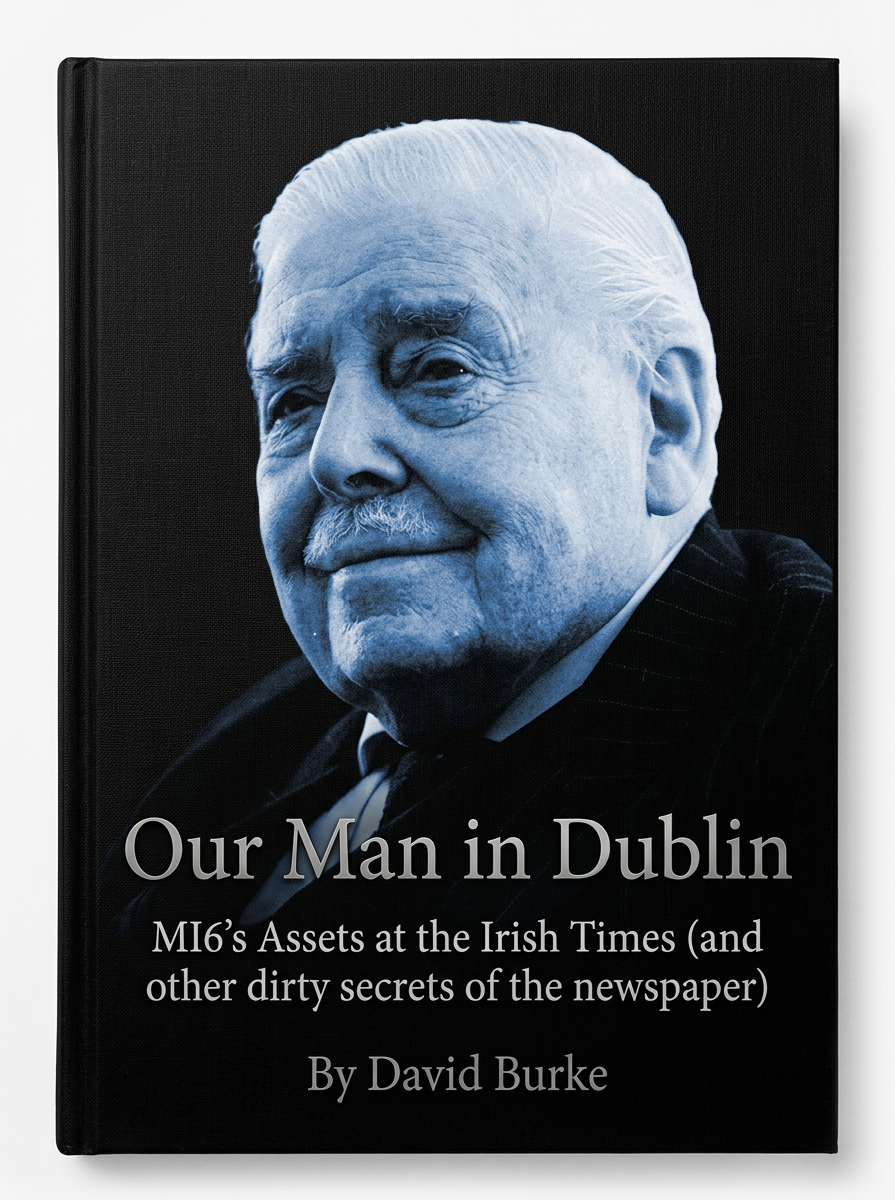
2. Maj. Thomas McDowell, the ex-MI5, opera cloak wearing bemonocled chief executive of the Irish Times.

Maj. Thomas McDowell, chief executive of the paper, was the dominant force behind the publication.
McDowell hailed from Northern Ireland, had served in the British Army and was a former member of MI5.

Cecil King, who owned The Daily Mirror, was another MI5 asset who had also become a newspaper proprietor. King not only knew McDowell, but was aware that he was a former MI5 officer. King’s diary entry for Sunday, 23 January 1972, touched upon McDowell’s service with MI5. Having enjoyed a lunch with McDowell and his wife, King recorded that McDowell:
“asked us to talk about Irish affairs. He is a man with a very varied background – a Protestant father from the North, mother from the South, service in the British Army (Ulster Rifles), and had served on the staff in Edinburgh, and in M.I.5.“

In his book ‘The Irish Times: Past and Present’, John Martin revealed that his sources:
“within The Irish Times have indicated to me that [McDowell] worked for British Intelligence in Austria at the end of the [second world] war”.
McDowell approached Downing Street in 1969 in great secrecy to offer his services to the British government.
A series of dinners took place with officials of the Foreign Office. One diplomat, Kelvin White, wrote in an official memo later that: “At the moment I think it will be useful, so far as we in the Department are concerned, to keep in touch with McDowell, to keep him briefed in general terms, and to encourage him to forward the moderates’ cause in his paper. This is very much what you had in mind.”

McDowell became an asset of MI6. He was soon in receipt of regular clandestine briefings on UK policy on NI from the embassy.
[MI5 is a part of the Home Office. During the 1970s and early 1980s, it was staffed by former police officers and soldiers. MI6 is a part of the Foreign Office.]

McDowell was also a member of the Naval and Military Club in London, an establishment that boasted a large membership drawn from former and serving members of the Britain’s intelligence community.

A process to infiltrate The Irish Times was launched – at the latest – in 1970.
3. John Peck, the Black propaganda expert at the British embassy

John Peck, the British ambassador to Ireland, 1970-1973, was the former head of the Information Research Department (IRD), Britain’s propaganda machine.
Peck was involved in the recruitment of McDowell.
One of Peck’s tasks was to influence the Dublin media. He instructed all the members of his staff to seize any opportunity to find out what was happening in the Republic from “government ministers, politicians of all parties in and out of office”. He made specific reference to “the Press” which, he explained, “means not only what is printed but what editors and political correspondents know or think they know and can discuss but cannot print“.

The foregoing quotes are taken from Peck’s memoirs. One can only imagine what might be contained in classified reports about the manipulation of the Irish media.

Peck did not disclose the truth about his dealings with McDowell in his memoirs.
4. Hugh Mooney, black propagandist, formerly of The Irish Times
In 1971, the IRD sent Hugh Mooney, a black propaganda specialist, to Ireland to help in the effort to suborn the Irish media.
Mooney was an ideal choice as he was a graduate of Trinity College Dublin and, better again, had been employed as a sub-editor at The Irish Times.

Mooney paid a visit to Dublin in June 1971. One of those he consulted was Peter Evans at the British Embassy. Evans was most likely working with MI6 but possibly the IRD. In a letter Mooney wrote to the IRD’s Special Operations Adviser, Hans Wesler, he explained that his “talks with Mr Evans shows that IRD can start working at once through the Dublin Press, which is the priority target. Though unable to place draft articles, [Evans] said he was willing to pass on absolutely accurate information to (the) journalists he meets regularly.”
Who were the journalists that Evans met “regularly”?
5. MI6 attempted to recruit the Deputy Editor of the Irish Times
An attempt was made to recruit Dennis Kennedy, the deputy editor of the paper between 1982 and 1985, as an MI6 asset.
McDowell probably recommended to MI6 that they approach Kennedy.
McDowell – or whoever recommended the recruitment pitch – chose the wrong man. Kennedy was an honourable journalist.

Kennedy has described what happened. The recruitment pitch was launched, “One day in the late 1970s” when he “received a phone call in the office from a well-spoken Englishman, asking me if he could meet me for lunch, as he was coming to Dublin in connection with a research project on Northern Ireland. …. He named a research institute in the English Midlands as the base for the programme, and hinted that the proposed lunch might be the first of several.”
The man from MI6 met Kennedy a few times. The encounters included a trip to Bloom’s Hotel restaurant. After a short while, the MI6 man said to Kennedy: “Dennis, I am sure you realise by now what this is all about”. Kennedy describes how he “almost choked on” his “smoked eel” as he “cast desperately around for solid ground”.

The ‘academic’ then revealed that he worked for the Foreign Office and that the “research project was just a front, and they used the institute as a useful contact point. They would like me to work for them. They needed first-hand information on individuals, what they were thinking, what they were doing. I sat in a daze..”.
Afterwards, Kennedy “began to wonder if my experience was unique; how many of my colleagues had similarly been approached, and how had they reacted? I never found out, but I could not help noticing how some of them spoke highly of the food in the restaurant at Bloom’s Hotel.”
The astonishing aspect of this affair was the brazen manner in which MI6 approached the journalist. This might have been because MI6 had found it easy to recruit assets in the paper on prior occasions.
6. Weekly meetings at the NIO
Another Irish Times journalist – a particularly high-profile one – enjoyed regular meetings with British officials at which he swopped information with them. Some declassified documents have shed light on these meetings.
This individual was also involved in the dissemination of British black propaganda elsewhere.
7. It’s what you don’t say.
Some staff members of The Irish Times reflected perfectly the political policy of the Thatcher government and the Dublin embassy in the 1980s, namely to favour the then Taoiseach, Dr. Garret Fitzgerald, and undermine his opponent, Charles Haughey, the then leader of the Fianna Fail opposition.
This was achieved by various methods, one of which was to not report certain issues that didn’t suit this agenda. In or about 1986 the paper received a verbal report from one of its staff members that Dr Fitzgerald was dining with a member of the Irish National Liberation Army (INLA), an illegal paramilitary organisation. A photographer could have been dispatched to record the event as it was still taking place – at Dr FitzGerald’s home.

The reporter was told by his line editor, “We do not want to know.”
Nothing appeared in the paper. The reporter who discovered the FitzGerald-INLA meeting story told me, “If it had been Charles Haughey [with the INLA man], the story would have appeared on the front page the next day.”

A further indication of the mindset of the paper can be gleaned from an edition which appeared in September 2001. In what can only have been a reference to the Miami Showband massacre, one of the paper’s staff members wrote that:
‘… other cultures presumably must have the equivalent of the peculiarly Irish abomination, the showband: and the only thing one might learn from the existence of that peculiar cultural artefact is how to put a machine gun to good effect.‘
Three members of the Miami Showband were massacred by members of the UVF’s infamous Glenanne Gang. The Miami atrocity was led by Robin ‘The Jackal’ Jackson, a British agent.


8. Birds of a feather: the high flying former politicians chosen to write for The Irish Times
The paper also provided Conor Cruise O’Brien with a platform.
In 1969 O’Brien provided information about Irish military intelligence operations to Ambassador Andrew Gilchrist of the British Embassy.
O’Brien was also aware that Det Garda Crinnion of Garda intelligence precipitated the Arms Crisis of 1970. Crinnion worked for MI6. Crinnion was convicted for some of his crimes in February 1973 along with John Wyman of MI6. Later that year Crinnion wrote to O’Brien in effect admitting he had leaked confidential information to the leader of Fine Gael which ignited the Arms Crisis. O’Brien covered this up.

David Astor, a former British intelligence officer and later, an MI6 asset, owned The Observer newspaper. He appointed O’Brien as editor-in-chief in 1978. O’Brien sent journalist Mary Holland a memo during which he stated that the “killing strain” of Irish republicanism “has a very high propensity to run in families and the mother is most often the carrier”. He added: “It is a very serious weakness of your coverage of Irish affairs that you are a very poor judge of Irish Catholics. That gifted and talkative community includes some of the most expert conmen and conwomen in the world and I believe you have been conned.”
O’Brien was one of those who undermined the campaign for justice for the victims of Bloody Sunday.

Garret FitzGerald also received the 1973 letter from Crinnion admitting his role in the Arms Crisis. FitzGerald concealed this too.
FitzGearld too became an Irish Times columnist after he retired from politics.

In the early 1970s FitzGerald served as a member of the Institute for the Study of Conflict (ISC) in London. He contributed a chapter to a book it published called ‘Ulster Debate’. The ISC was run by Brian Crozier who later admitted the ISC was financed by MI6 and the CIA. Crozier also worked for the IRD. It is doubtful FitzGerald knew that he was a pawn in an MI6 propaganda offensive at the time he worked for the ISC but he certainly discovered this later after Crozier was exposed as a propagandist during the fallout from Watergate scandal. ‘Ulster Debate’ was used to smear John Hume and whitewash what happened on Bloody Sunday. FitzGerald made no reference to Crozier in either of his autobiographies.

FitzGerald was a friend of the British Embassy. He provided Ambassador Peck with information about Public Accounts Committee (PAC) deliberations in 1970, and details which enabled Ambassador Robert Haydon draw up a profile of Charles Haughey for Britain’s Foreign Secretary, Peter Carrington, in 1979. The respect was not mutual. The Foreign Office openly mocked FitzGerald as a sycophant during one Christmas pantomine while he was Minister for Foreign Affairs.
One of FitzGerald’s first acts upon becoming Taoiseach in 1981 was to release Kenneth and Keith Littlejohn from prison. The Littlejohns were MI6 agents who had been convicted in 1973.

FitzGerald was also a member of the Bilderberg Group and Trilateral Commission.
Part 2: The Irish Times and The Official IRA.
9. My enemy’s enemy is my friend.
Dick Walsh of The Irish Times was a supporter of Cathal Goulding, chief-of-staff of the Official IRA.
The Official IRA declared a ceasefire at the end of May 1972.

Shortly before the so-called ‘ceasefire’, the organisation slaughtered six members of the kitchen staff and the chaplin at the HQ of the paratrooper regiment at Aldershot.

They were also responsible for the torture and murder of Ranger Best. On 21 May 1972 a 19-year-old Catholic from Derry, Ranger William Best, who was serving in the British Army, was murdered by one of Goulding’s death squads while he was home on leave to visit his family in the Creggan estate. He was one of a family of seven. He left his home to make a phone call after which he was snatched by Goulding’s thugs who beat him up – his corpse showed signs of kicks and punches – before shooting him in the head and dumping his body on waste ground. The coroner would describe the murder as “one of the most brutal murders I have heard of”.

Goulding’s killers boasted that Ranger Best had been “apprehended in suspicious circumstances, tried by an IRA court and sentenced to death”. Anticipating a negative response, their statement was defiant: “Regardless of calls for peace from slobbering moderates, while British gunmen remain on the streets in the six counties the [Official] IRA will take action against them”.
The ‘judge’ claimed that the death squad was acting on orders from on high: “Once we had him there was nothing we could do but execute him. Our military orders after Bloody Sunday were to kill every British soldier we could. They didn’t say anything about local soldiers. He was a British soldier and that is all there was to it”.
Did Dick Walsh shun Goulding and his comrades after these atrocities? (The answer to this question is provided in section 10 below.)
10. A limited deal between the Official IRA and MI6.
The Provisional IRA are convinced that the Official IRA struck a deal with MI6 after the 1972 ceasefire. This would have been entirely consistent with the modus operandi of Maurice Oldfield who was chief of MI6 at the time.

According to the Provisionals, the RUC and MI6 (and later MI5) turned a blind eye to Official IRA racketeering in the North. The quid pro quo was the supply by the Officials of information about the Provisionals to MI6.
There is circumstantial evidence to support this contention: the RUC did little or nothing to suppress Official IRA rackets in the North.
11. Cathal Goulding and Dick Walsh
Another benefit of a deal with the Officials was that it afforded MI6 indirect access to an array of journalists at The Irish Times.
Cathal Goulding had allies at the paper. Dick Walsh was his most important asset. Walsh was the paper’s political correspondent during the Troubles (and beyond).

Walsh was so close to Goulding, that he wrote the eulogy Goulding delivered at the funeral of an Official IRA volunteer a few weeks after the Aldershot massacre. Clearly, Walsh had no qualms about helping an organisation responsible for the slaughter of innocent civilians, a vivid insight into his character.
After the May 1972 ‘ceasefire’, Walsh wrote or helped to write a speech delivered by Tomás Mac Giolla which was delivered in July 1972. It attacked the Provisional IRA and called for Loyalist and Nationalist workers to unite against their common foe, capitalism.

Walsh also participated in negotiations between the Provisionals and Officials in a funeral home to end a murderous feud that was taking place between the two organisations. Again, it did not bother him that he was acting on behalf of murderers such as Goulding and Sean Garland.

Walsh is revered by the paper to this day. He is seen by it as all that is apparently great about the publication. A bust of him appears in the lobby of The Irish Times.

12. Why did The Irish Times spike a report on the Official IRA?
The true extent of the relationship between The Irish Times and the Official IRA is one of the best kept secret of the Troubles. The paper covered up crimes committed by the Officials including bank robbery and construction site fraud.

In 1982, Ed Moloney of The Irish Times delivered a report on these crimes to the paper. The report was spiked.
Moloney’s report was subsequently published in Magill magazine. At this time the political wing of the Official IRA was called Sinn Fein the Workers Party. It later became the Workers Party. The full Magill report is reproduced at the end of this article.

Moloney’s report was passed by a person at the paper to the Official IRA. The Officials were incensed at Moloney. Two Officials approached the UDA in Belfast where Moloney was based and told them that Moloney was an intelligence officer with the INLA. This was a lie calculated to spur the UDA to murder Moloney. Davy Payne of the UDA was one of those to whom the lie was fed. He and two of his colleagues held a meeting with Moloney at which Payne revealed the plot to Moloney. The meeting took place because Payne knew Moloney and did not believe the lies the Official IRA had fed to him.
In recent times, Moloney has asked The Irish Times to investigate the affair. To date, the paper has refused to lift a finger to find out what happened. The individual believed to have passed the report to the Officials is still alive and in receipt of a pension from the paper.

It is probable that the MI6 station in Dublin knew about the manoeuvres at The Irish Times to spike Moloney’s report and was happy with the outcome.
If MI6 got wind of the Official IRA scheme to have Moloney murdered, they failed to warn him about it.
Part 3: The Irish Times and the Stalker Affair
13. Mountpottinger RUC Police Station
A substantial amount of information has emerged in recent years about the existence of collusion between Loyalist murder gangs and the British state during the Troubles.
Collusive murder was a feature of MI6 and the RUC’s counterinsurgency strategy in the early 1970s, aided and abetted by British military intelligence, especially Brigadier Frank Kitson. Kitson was Britain’s counterinsurgency guru.
In Belfast, an assassination programme was run out of Mountpottinger RUC police station. RUC officers from it transported weapons through checkpoints to UDA gangs. The guns were handed over and shooting operations took place. After the killings, the UDA returned the weapons to the RUC who transported them safely back to Mountpottinger.

The RUC then investigated the murders. One of the participants in the programme, Albert Baker of the UDA, has disclosed details of the murder programme. Baker was a British agent codenamed Broccoli. The RUC and PSNI have ignored his evidence for decades.
Baker had some sort of a breakdown and voluntarily confessed to murder. He was convicted and sent to prison. Details of the RUC and British intelligence assistance to the UDA did not emerge.
In the 1980s, however, Baker provided information to Ken Livingstone MP (later Mayor of London) about what had happened. Livingstone published details of his interview with Baker in his book, ‘Livingstone’s Labour’.
The Dublin media has showed little or no interest in Baker story for decades. Readers of The Irish Times would be forgiven for never having heard his name.
14. The Shoot to kill detour.
‘Decades of Deceit, The Stalker Affair and its Legacy’ (2024) by Paddy Hillyard examines a detour taken by the RUC and their British spymasters from the strategy of collusive assassination. The detour took place during the early 1980s. It involved the establishment of an in-house assassination capacity by the RUC special branch. A ‘shoot-to-kill’ squad, staffed by RUC officers, was sent into action. Many of the participants were former British soldiers. The squad was trained by the SAS.
Hillyard’s book dissects three infamous shoot-to-kill incidents perpetrated by the new unit in 1982.
One of those killed by the flying squad was Michael Tighe (17), an innocent teenager who stumbled across an arms dump in a hay shed. His companion, Martin McCauley (19) survived.

The activities of the RUC operatives in 1982 became a cause of public concern culminating in the appointment, in 1983, of John Stalker, the Deputy Chief Constable of the Greater Manchester Police force, to investigate the shooting incidents. Stalker discovered the role of MI5 in the killings and refused to back away. In 1986 Stalker was removed from the inquiry by MI5 dirty tricks. The tactic deployed by MI5 was to vilify Stalker as an associate of an alleged criminal outfit in Manchester, The Quality Street Gang. Most of the British media went along with the smear campaign. Stalker, although entirely innocent, never returned to his inquiry.

This part of this article is not a review of Hillyard’s book. If it was, it would award it five stars (out of five) and recommend it to anyone interested in the Dirty War in NI. Rather this part is an examination of The Irish Times’ reporting of the Stalker Affair. Curiously, it would appear that MI6 did not lift a finger to help its colleagues in MI5 during the media onslaught against MI5 during the Stalker Affair.
Why did MI6 and its assets at The Irish Times abandon MI5 in its hour of need?
15. Internecine feuding between MI5 and MI6.
The Stalker affair took place a few years after MI5 had become the dominant intelligence service in Northern Ireland (NI), a position previously held by MI6.

As described earlier, MI5 is a part of the Home Office. During the 1970s and early 1980s, it was staffed by former police officers and soldiers.
MI6 is a part of the Foreign Office and recruited many of its officers from Cambridge and Oxford.
The Foreign Office elite often looked down their noses at the vulgarians from MI5. It was a humiliation for them when MI5 ousted them from NI.
16. The Dublin media
The cumulative effect of sloppy RUC tactics in 1982, evidence at the trial of one of the RUC gunmen in a separate murder trial, and widespread media coverage of the shoot-to-kill strategy, led to pressure on the Dublin government of Dr Garret FitzGerald to exercise its influence on London to halt the programme.
Some of the media pressure was applied by The Irish Times.
There were no articles or opinion pieces in The Irish Times from the usual suspects in defence of the RUC, claiming that there was no evidence of a shoot-to-kill policy, or that the criticism of the RUC was the work of IRA and INLA propagandists, or conspiracy theorists.
Why did Maj. McDowell, the paper’s chief executive, one of MI6’s most influential assets at the paper, not to mention MI6’s other assets, do nothing?
17. Honest John Stalker
MI5 had run into real trouble over the killing of Michael Tighe in the hay shed. The service had placed a listening device in the building which had recorded the shooting of Tighe. The RUC shooters alleged they had shouted a warning to Tighe and McCauley which had been ignored. No one believed them. A recording made by MI5 existed. It had the potential to reveal what had really happened. Stalker asked for it. He was rebuffed. He kept pressing for its disclosure to his inquiry.
In 1986 Stalker was removed from his investigation. Hillyard’s book dissects the dirty trick manoeuvres behind the shafting of Stalker.

18. MI6 Schadenfreude
MI5 and the BBC went to extraordinary lengths to link Stalker to the so-called Quality Street Gang. The BBC broadcast a documentary about the outfit. The Quality Street angle became the justification for the removal of Stalker.
MI6, on the other hand, does not appear to have participated in the anti-Stalker smear campaign at all.
So, what did the press officers at the Dublin embassy (i.e. MI6) discuss with their friends at The Irish Times over boozy lunches at Bloom’s Hotel and the Kildare Street Club, at this time?
It is likely that the elite MI6 spies in Dublin experienced a pleasurable ripple of schadenfreude as they read the Stalker coverage in The Irish Times which was devastating for MI5 and the RUC.
Is also likely MI6 instructed its assets in Dublin not to interfere with the ongoing reports that were exposing the truth about the Stalker affair.
In the event, The Irish Times produced one revelation after another while the UK media was distracted by the Quality Street smear.
Ultimately, it became so obvious that Stalker was being set up to protect MI5 that the British media realised he was an honourable man and took his side.
Hillyard’s demolition of the Quality Street smear campaign is fascinating.
19. Outsourcing Assassination
After the Stalker scandal, MI5 and the RUC were forced to rethink their strategy. They reverted to the more subtle Kitsonian tactics of the Montpottinger era, albeit in a more refined and sophisticated fashion.
Hillyard summarises what happened next:
“The allegations of shoot-to-kill, cover-up by the RUC and the three incidents, and the rigorousness of Stalker’s investigation were to lead to a profound change in the counter-insurgency strategy by the late 1980s. The RUC’s deployment of its own anti-terrorist flying squads was reassessed as the British army once again assumed an enhanced role in the strategy to defeat the IRA. To avoid further allegations that the security forces were shooting to kill suspected members of the IRA and when and to avoid the intense legal and judicial scrutiny arising from a security force killing, the army increasingly outsourced the war against the IRA to loyalist paramilitaries. It recruited its own agents within the UDA, assisted them in purchasing arms and provided them with intelligence on suspects. .. By the early 1990s Loyalists were killing more people than the IRA.”
For further information about the influence of Foreign Office officials and diplomats over the Irish Times, see: https://coverthistory.ie/2024/11/15/no-such-thing-as-a-comfortable-free-lunch/

David Burke is the author of four books published by Mercier Press.

These books can be purchased here:


One response to “Our Man in Dublin. [WebBook]”
[…] Maj. Thomas McDowell, the driving force behind The Irish Times, was one of MI6’s prime assets in Dublin. He had access to plenty of political information that never reached the pages of his paper, which he undoubtedly relayed to London. See also: Our Man in Dublin. [WebBook] […]