
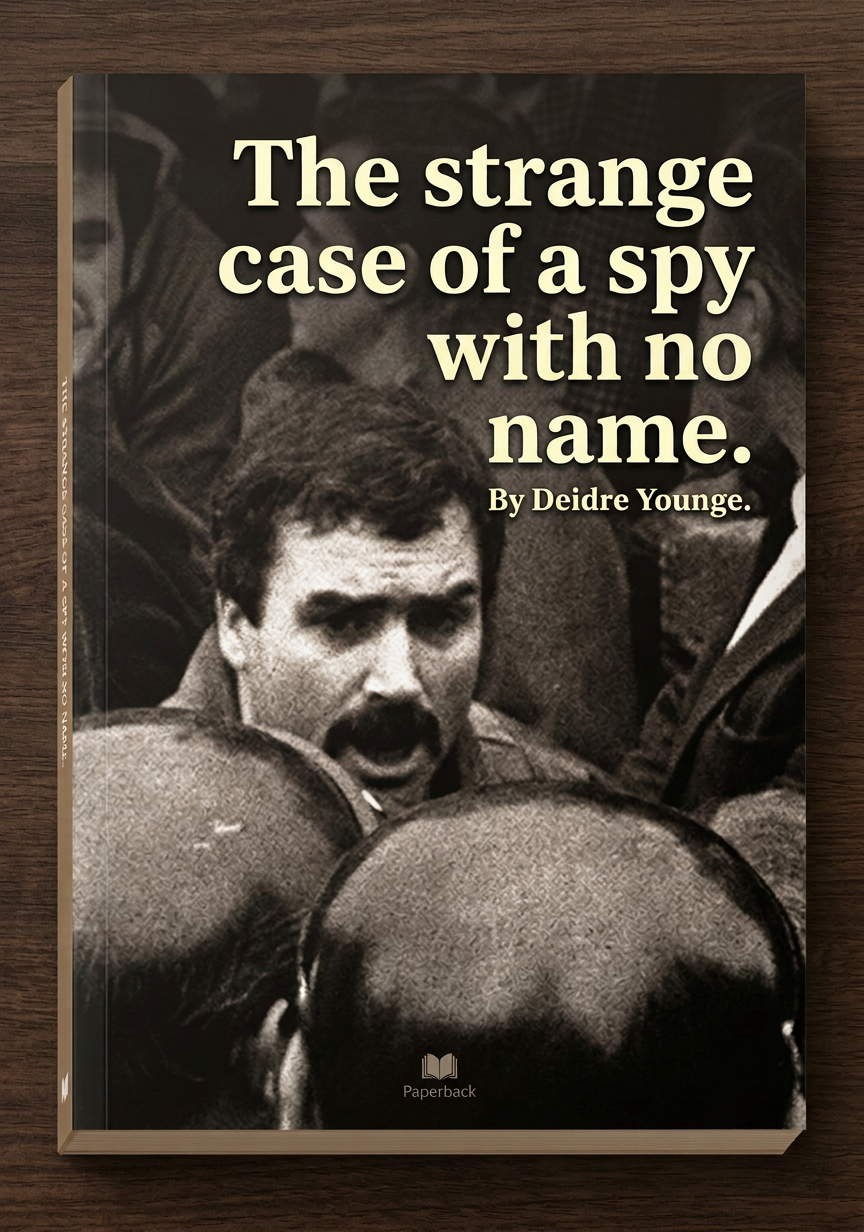
Iain Livingston who now heads Operation Kenova since Jon Boutcher was appointed Chief Constable, is in the bizarre position of not being able to name the alleged British Army/MI5 superspy, ‘Stakeknife‘.
Livingston took over Operation Kenova after Jon Boutcher was appointed Chief Constable of the RUC.
He is now appealing to the British Government to depart from its rigid adherence to the “Neither Confirm Nor Deny” formula of words so he can name Stakeknife.
The Scappaticci story is mired in a lack of transparency. In response to an FOI request for information relating to the terms and date of any immunity/amnesty that may have been given by the Attorney General of England and Wales to provide legal cover in relation to the interactions between Freddie Scappaticci his lawyers and the Smithwick Tribunal in Dublin, the UK Attorney General confirmed that there is no information in the AG’s office in relation to immunity/amnesty for Scappaticci at Smithwick. The Tribunal was set up in 2005 but only started public hearings in May 2011.
It produced an annual report in 2013.

This calls into question the decision by Judge Smithwick, chairman of the Smithwick Tribunal, not to reveal details of covert meetings with Scappaticci. It certainly calls into question the decision by the Irish State through the Department of Justice, to pay Scappaticci nearly €400,000 in legal costs, primarily to claim he was not a British Military Intelligence and MI5 Agent called Steaknife or Stakeknife.
Senior legal sources assert that Scappaticci spent three days in Dublin talking to the Tribunal in 2011/12. These well placed sources say there was considerable annoyance and disquiet at the actions of Judge Smithwick and his lawyers in relation to British agents and secret meetings. It was, after all, supposed to be a public tribunal.

Documents which were released by the Department of Justice (Ireland) under the Freedom of Information Act, reveal both the substantial legal costs paid to him in 2015 and indicate extensive interactions between Scappaticci and the Tribunal.
1. Smithwick on immunity.
In the opening chapters of his 2013 report, Judge Peter Smithwick has a chapter on immunity or amnesty for witnesses, and the legal cover afforded by the Irish Tribunals of Evidence Act as follows:
“Any witness before the Tribunal would have protection in this jurisdiction from criminal prosecution on the basis of evidence given before it. The protection is enshrined in section 5 of the Tribunals of Inquiry (Evidence) Act 1979 which provides as follows:
A statement or admission made by a person before a Tribunal or when being examined in pursuance of a commission or request issued under subsection (1) of section 1 of the Principal Act shall not be admissible as evidence against that person in any criminal proceedings (other than proceedings in relation to an offence under subsection (2) ( c ) ( as inserted by this Act) of that section) – ( and that is a reference to the offence of providing false testimony to the Tribunal) and subsection (3) of that section shall be construed and have effect accordingly”
The Judge went on to explain how witnesses from outside the jurisdiction could be provided with legal cover, particularly those from Northern Ireland and the UK:
“The Tribunal accordingly sought and received an undertaking from the then Attorney General of England and Wales, the Right Hon, Baroness Scotland to similar effect. Subsequent to the devolution of policing and justice powers to Northern Ireland on the 12th April 2010, the new Attorney General of England and Wales, AG Dominic Grieve, agreed to continue with such undertakings.“
Judge Smithwick went on to to refer specifically to Scappaticci in the one and only reference to him in the Tribunal report, as follows :
“The Tribunal subsequently, at the request of Freddie Scappaticci, sought and received a similar undertaking in relation to Scotland. This was given in terms specific to Mr Scappaticci..”.

The then Lord Advocate of Scotland in his role as Crown Prosecutor, gave Freddie Scappaticci immunity from prosecution to cover his interactions with the Smithwick Tribunal in Dublin so that Scappaticci could provide “a full account” to the Tribunal in 2012.
The AG of England and Wales it is now apparent gave no such amnesty to Scappaticci.

Other witnesses from the UK and Northern Ireland included Scappaticci’s former FRU, British Army Intelligence handler, retired Major David Moyles, other British army officers, as well as ex RUC and PSNI officers. Witnesses also included representatives of the IRA ASU who talked to the Tribunal from 2008 onwards.
2. First representation
Scappaticci’s solicitor first made an application for legal representation in 2006 but this was refused.
However his legal representative, Belfast solicitor Michael Flanagan submitted his first bill in relation to meetings in 2007.

Like all Scappaticci’s covert interactions with the Smithwick Tribunal, information about these meetings were withheld from other interested parties at the Tribunal.
3. Awarded legal representation
By May 2011 the Tribunal decided that Scappaticci would get limited legal representation which was later to develop into full legal representation by his solicitor Michael Flanagan, Senior Counsel Martin O’Rourke and a junior. He had now been brought into evidence by the various assertions of Ian Hurst, a former Sergeant in the British Army’s Force Research Unit who put a ‘statement’ online in 2011 containing various allegations concerning Scappaticci.

Kevin Fulton whose real name was Peter Keeley, a former FRU, RUC and PSNI Special Branch agent and informant also implicated Scappaticci in his statements and evidence in December 2011. He had already described Scappaticci, who he called ‘Michael’ in his book ‘Unsung Hero’ and claimed that he (Keeley) had acted as a driver for the Internal Security Unit including Scappaticci and John Joe Magee. Sources close to Keeley and Hurst at the time say they were determined to convince Judge Smithwick that Scappaticci should be brought before the Tribunal.
Ian Hurst had already made the allegation that Scappaticci was involved in the murder of Louth man Tom Oliver in the book he co wrote on Scappaticci. An allegation he couldn’t stand up in evidence in 2011. In his evidence Keeley accused Scappaticci of involvement in the abduction and interrogation of Mr Oliver in July 1991. (See Smithwick’s Secret Witness for details of these allegations). Scappaticci emphatically denied involvement in Oliver’s abduction and murder.
Kenova was investigating the murder of Mr Oliver and appealed for witnesses to come forward. Like the four or five previous Garda investigations into Oliver’s death, the Kenova line of Inquiry seems to have run aground.
It is believed Jon Boutcher found no evidence Scappaticci was involved in the murder of Tom Oliver.

4. Scappaticci denials
Importantly, Scappaticci primarily received legal representation to deny claims that he was not the British Agent known as Steaknife or Stakeknife.
In July 2011 Judge Smithwick made a ruling as follows :
“He (Scappaticci) has consistently denied these allegations and maintains that denial. Nevertheless the public may identify him with ‘Stakeknife’. Mr Flanagan argues cogently that he should receive all documentation in relation to the ‘Stakeknife’ allegation so that his client may disprove the allegation once and for all and secondly, so that his client has the opportunity to test such evidence as that could impact on the credibility which the Tribunal ultimately attaches to the witnesses who made this allegation”.
Scappaticci was awarded legal representation accordingly.
In a final legal submission given to the Tribunal on his behalf in 2013 Scappaticci himself claimed that Smithwick extended legal cover primarily to allow him to claim he was not an agent called Steaknife or Stakeknife.
5. Steaknife’s handler
Scappaticci’s British Army Intelligence handler during most of his career as a Force Research Unit agent, Major David Moyles, giving evidence about Agent Steaknife ( his spelling) was clearly answering questions about Scappaticci. In particular in response to ex FRU Sergeant Ian Hursts assertions that Scappaticci was a Garda handler, he denied that the agent had ever given him (Moyles) information relating to Gardai colluding with the IRA or had given prior warnings relating to the IRA ambush of Chief Superintendent Harry Breen and Superintendent Bob Buchanan in March 1989.
At the end of Witness 82, Moyles’ cross examination, Scappaticci’s Junior council Ms Fitzgerald reiterated Scappaticci’s denials in a somewhat surreal exchange:
Q – I am aware, Mr Chairman, of the witness’s position that he won’t confirm or deny. I merely want to ask him if he is aware of the fact that my client has always and continues to deny those allegations that he was in fact a British agent.
A – Sorry I don’t know who your client is.
Q – I appear for Mr Scappaticci.
A – OK.
Q – . .Witness 82. So you will be aware of those allegations I am sure. And are you aware of the fact that my client has always and continues to deny those allegations ?
A – I believe that is in the public domain..
6. Costs awarded
At the end of the Smithwick Tribunal Scappaticci was awarded his costs, signed off by the Secretaries General of the Departments of Justice and Public Expenditure. They were cut almost in half by the State Claims Agency. A heavily redacted document also referred to one meeting with Scappaticci in the UK but the rest of the paragraph, presumably relating to other contacts, was redacted.

7. Weasel words
After the Tribunal Owen Corrigan took a Judicial Review against certain assertions in Judge Smithwicks report. The fact of Scappaticci’s involvement was highly relevant new evidence. The solicitor for the Tribunal denied emphatically he gave ‘evidence’ in the following terms:
“Without prejudice to the relevance..we can confirm that Mr Scappaticci did not provide evidence to the Smithwick Tribunal. Mr Scappaticci (who is outside the jurisdiction) would not cooperate in providing evidence. He declined to provide a signed statement to the Tribunal and declined to give oral evidence”.
These assertions are highly reliant on a strict definition of evidence which in the context means a signed statement or sworn evidence. It is evident the Tribunal withheld important information from lawyers.
In Belfast, as part of its investigation into Agent Steaknife or Stakeknife, Operation Kenova under the then Chief Superintendent Jon Boutcher submitted files relating to perjury to the PPS. One of those files was in relation to Freddie Scappaticci.

In the High Court in Belfast in 2018 Judge Mark Horner refused to grant an application made on behalf of Operation Kenova (September 23) that a stay be put on civil proceedings in relation to ‘historic crimes’ committed by FS – the ‘alleged agent Stakeknife’. That ruling by Judge Mark Horner’s meant that 25 civil cases against the Chief Constable of the PSNI and the Ministry of Defence in relation to the activities of ‘Stakeknife’ proceeded. Compensation has been paid to victims or their families without admittance of liability.
8. The past is another country and besides the spy is dead
The response of the Attorney General of England and Wales to the FOI request about Scappaticci begs questions about who was and is prepared to defend his activities.
Operation Kenova recently found a new tranche of MI5 files which were overlooked in an earlier trawl. According to the late GOC John Wilsey it was actually MI5 who ran FRU. The British army fed, clothed, administered and paid them but “Box” [MI5] called the shots.
What hope the present head of MI5 Ken McCallum, or one of his predecessors, who are now worthy members of the British establishment, will claim Scappaticci and his works?

A final report may be published without confirming whether the late Freddie Scappaticci is, or is not, the agent being investigated for seven years.