
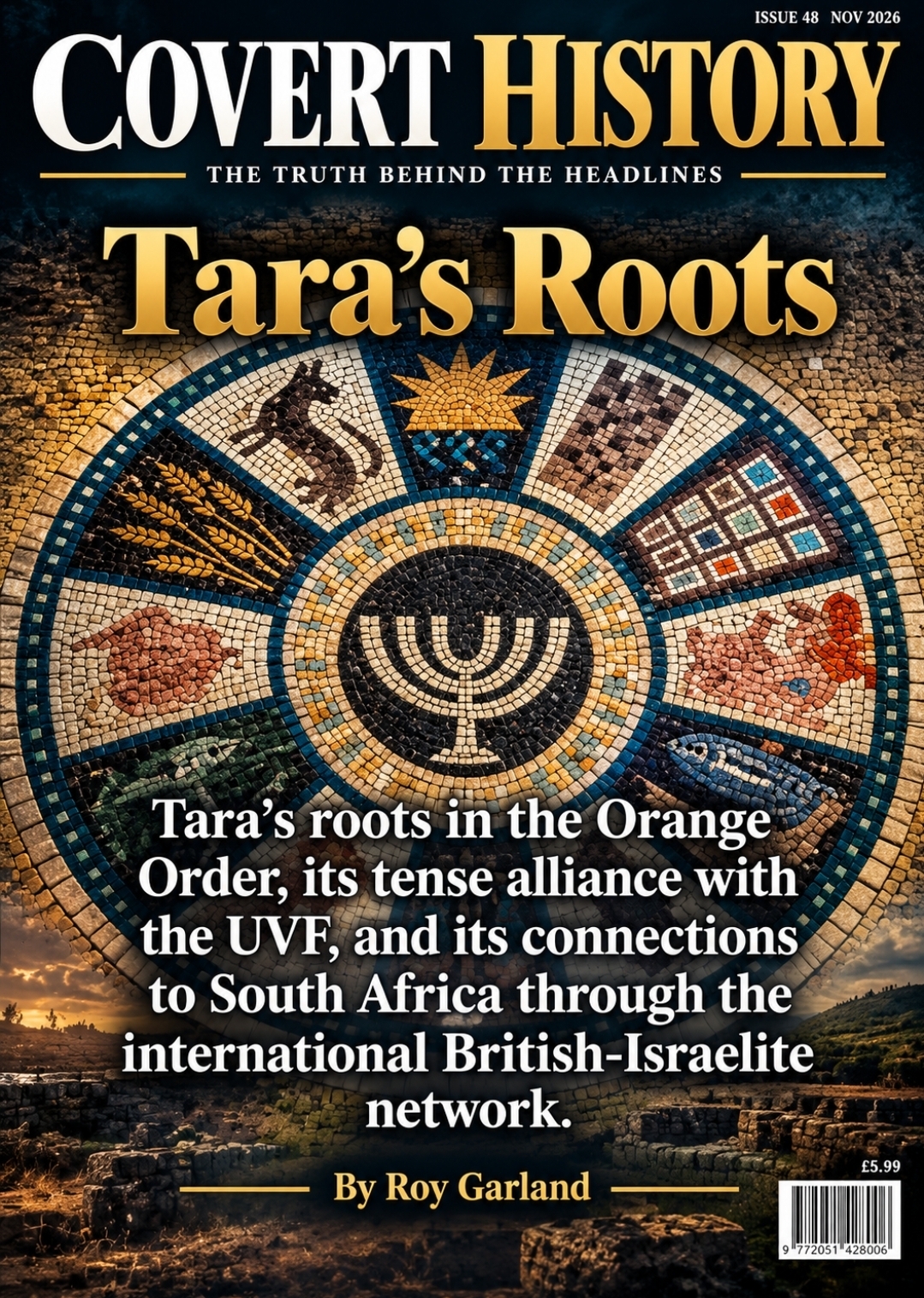
In this article, Roy Garland describes the origins of Tara, an armed Loyalist paramilitary organisation. Garland was once a member of Tara. It was led by William McGrath. Tara was once part of the Orange Order. It had supporters in the Republic of Ireland and later linked up with the UVF. There were also international connections through the international British-Israelite network, which extended as far as South Africa.
British Intelligence exploited Tara to further its aims in Northern Ireland during the Troubles. McGrath was convicted for sexual abuse of minors at Kincora Boys’ Home.
1. The ‘Cell’ within the Orange Order.
A ginger group in the Orange Order known as “Cell” was led by Canon Ernest Long who said “Cell” was taken from the idea of a small seed that could influence a larger group. I assume the larger group was the Orange Order.

William McGrath joined Cell in the 1960s. Canon Long became uncomfortable with McGrath’s strident views and left. McGrath grabbed the opportunity and became chair and changed its name to Tara which became a paramilitary group in late 1969.
2. An invitation to join Tara.
I received an anonymous invitation to join Tara and other Orange organisations, and joined. The invite was given to me by William McGrath but was said by McGrath to have been tendered by someone else.
I was also invited in the letter to join the Orange Lodge of Research in the early 1960s, formed by a moderate Orangeman and whose members engaged in historical research into the Order’s history, but others feared for the future of the Orange Institution.

3. Differing views on contact with the Catholic Church.
At one memorable meeting a speaker told members they should feel free to invite Catholic Priests to visit their Lodge meetings. This received a startled reaction, which was immediate and fierce. It began with a member from a nationalist area shouting “Never! never! Never!” Others repeated the refrain and soon the whole place joined in shouting until order was eventually restored.
This reaction symbolised the differences within Orangeism. In the minds of some, the primary aim was academic, but others feared for the future and wished to ensure that Orangeism, would stick to the old ways believing that Orangeism and Protestantism faced serious decline.

Given this it was remarkable that Senator Gerry Lennon of the Ancient Order of Hibernians asked for a meeting with Sir George Clark, Orange Order Grand Master. The objective he said was to consider ways and means of ending discrimination in employment. The Grand Master accepted the invitation and was prepared to engage in talks. However, it was never agreed that discrimination existed, and some completely rejected this allegation.
4. McGrath’s ambition to convert Catholics to Protestantism.
McGrath was then secretary and unofficial controller of a Protestant evangelical mission with an Irish slant that claimed to preach an evangelical gospel to the whole Irish people.
McGrath began passing letters to me from an unnamed source said to be interested in my future. I suspect McGrath wrote some of these himself, but his activities involved more than one man. He frequently passed letters to me which, I suspect, had come from a hard-line MI5 group.

At that time, I was contacted by a small firm in the Shankill area, which I had worked with in the past, but was then being sold. I wasn’t interested because they were doing the same kind of work I was doing, a chemical business. The Shankill firm sold bleach, disinfection, pine soap etc. The firm was located in a number of backyards joined together in Emerson Street, near where I had lived. I mentioned this to McGrath in passing. His reaction shocked me as he immediately decided that the business opportunity could provide funds to finance “the salvation of Ireland.” By this he meant the conversion of Irish Catholics which would thereby increase Protestant numbers. This, for him, was of crucial importance because evangelicalism as the true gospel, was said to be dying out in Ireland.
McGrath needed money. He spent much of his time abusing boys. I believe there were about 100 plus victims – possibly hundreds – and some women too. The Historical Institutional Abuse inquiry (HIAI) (also known as the Hart Inquiry) alleged that McGrath’s business interests kept him busy but I do not believe that – it was his continuous abuse.
I spoke with a number of victims and came to the conclusion that it was continuous at the mission.
Despite the existence of the HIAI, no serious investigation took place.
Decades ago, when an attempt was made to look at it, the RUC hindered it.
After I spoke to McGrath about the chemical business, he suggested we could pay half of the cost each, but this never materialised, and he told me I should have known he had no money. My dad had died of stomach cancer at that time, and I believe McGrath wrongly thought I had inherited a small fortune and would share it, but dad had been very ill and left only petty cash and debts and I had returned from college penniless.

He then offered to do the practical work, which seemed fair, and I accepted this although doubts remained. I decided we could purchase the business as a partnership if he did what he promised and paid the £200 but nothing was paid.
More anonymous letters arrived either typed or written in capital letters to disguise the writer’s identity. McGrath claimed to be working with British Intelligence, and I suspected an extreme element in MI5 was involved.
5. McGrath and British-Israelism.
McGrath was the self-selected leader of Tara, who, as a British Israelite, believed the UK and the Commonwealth inherited Old Testament promises to Israel. Some believe British-Israelism was associated with British Imperialism and that promises to Israel in the Old Testament now applied to Britain and the Commonwealth.

This kind of thinking also existed in Southern Africa and other places, in which Tara members played a part.
At least one Tara man was killed in Southern Africa while laying explosives in an adjacent country.

Jay Wyatt, a member of Tara, visited parts of Europe as well as Africa where arms etc were available.
A leading British Israelite based in Dublin said a member of Ireland’s Heritage Orange Lodge had set up an Orange Lodge in Johannesburg. There were other British Israel contacts and support in Europe.

McGrath like many other British-Israelites thought British people had a destiny under God and would play a major part at the end time when Christ returned to occupy the British throne and lead the British people in a military struggle against their enemies.
6. Tara and the UVF.
When I first told a UVF leader, in 1969, that Tara was being formed inside the Orange Order, he immediately said, “We’ll come in with you.” He never asked me to explain but I told McGrath that the UVF wished to join with Tara in the Orange Order. McGrath was not keen, possibly because he could not control the UVF whose leadership wanted an end to sectarianism. McGrath was displeased but could do nothing hence the UVF became part of Tara. Later McGrath admitted that the UVF attended meetings regularly and fulfilled their obligations. However, when the UVF learned that McGrath’s was a sexual predator, in 1971, many UVF walked from Tara as a group. As they left one leader told me they were engaged in “new thinking” and I was thrilled at this because I knew and trusted him.

7. Religious tension between Tara and the UVF.
Tara under McGrath was intended to become an army capable of defeating all enemies including the Irish state and Communism. However, his politics were not based on compromise and accommodation and could have led to genocide or unending conflict and terrible suffering.
The UVF’s non-religious approach made it easier for Tara’s leader to denigrate the UVF as Communist but the UVF approach was more rational in seeking a more democratic, peaceful, accommodating and inclusive way forward. The UVF was not religiously oriented in an intransigent sense as Tara was although the UVF used the slogan For God and Ulster.

Gusty Spence wanted an end to sectarianism and sectarian language and instead of referring to Protestants and Catholics he suggested referring to Unionists and Republicans. The Tara leader had no time for this or for the UVF’s “new thinking”. He seemed determined to see a violent struggle that would not be amenable to compromise, an essential element in ending conflict.