
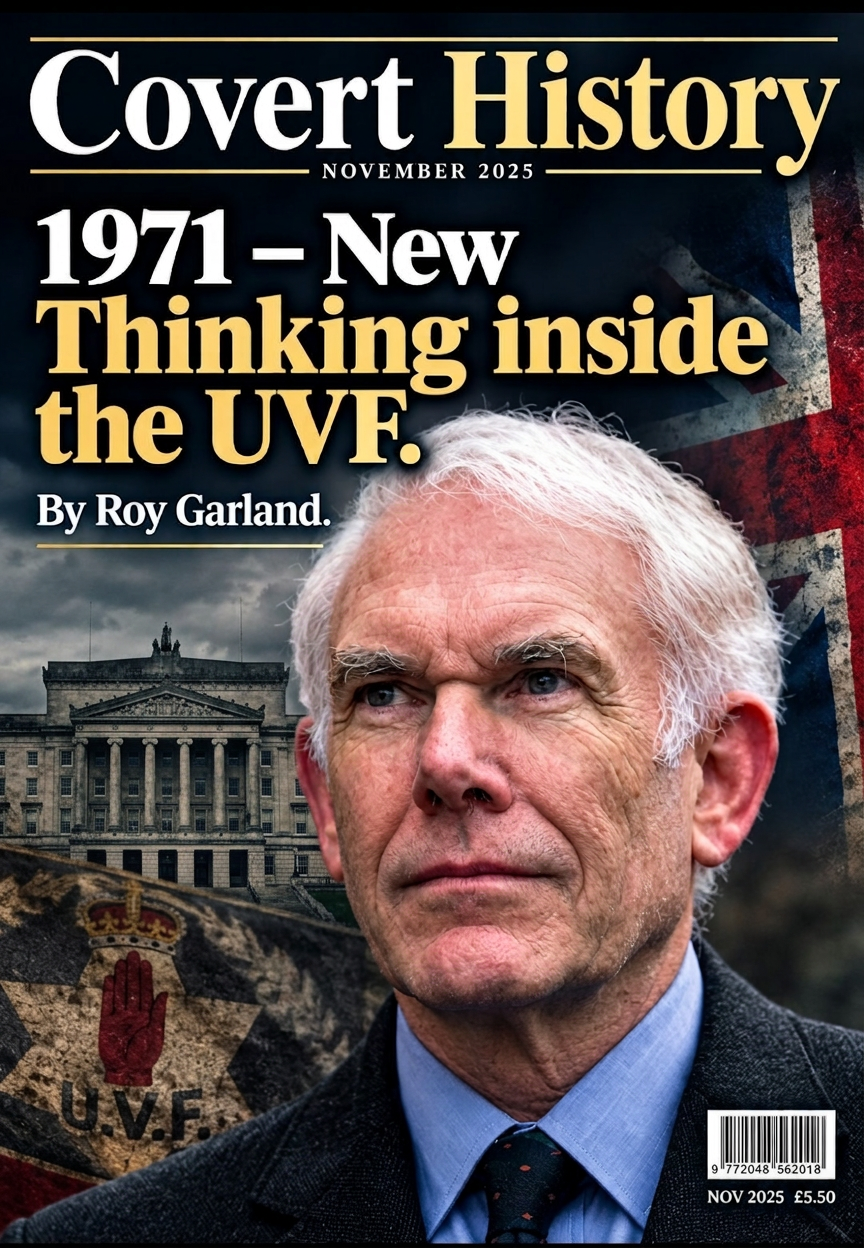
In the 1960s Roy Garland played a part in setting up TARA alongside William McGrath. McGrath was a leading figure in the Orange Order. McGrath became the commander of Tara. Garland later discovered that McGrath was abusing children and risked his life trying to halt the abuse perpetrated at Kincora Boys’ Home by McGrath. This included approaching the RUC who ignored his complaints.
Roy Garland, who had family links to the Republic, became interested in reconciliation with Nationalists at a very early stage of the Troubles, as this article demonstrates.
He left Tara in the early 1970s and dedicated his efforts thereafter to seeking peace.
In this article, he describes how Tara and the UVF were linked, for a while in the early 1970s; and how some in the UVF were interested in building bridges with Nationalists, something which did not come to fruition until decades later.
“New Thinking” by Roy Garland
When I told a UVF leader that Tara was being formed inside the Orange Order he immediately said, “We’ll come in with you.” He never explained but I told William McGrath the UVF wished to join with Tara. The UVF leadership wanted a new beginning, and an end to sectarianism. McGrath was displeased but could do nothing hence the UVF became part of Tara and McGrath, the Tara leader, had to admit that the UVF attended meetings and paid their dues and so on.
I had learned that McGrath had been sexually abusing young Christians since the 1940s, if not the 1930s. I accepted this view after speaking with older members of McGrath’s evangelical mission who admitted being abused by him as far back as the 1940s after the Christian Fellowship Centre and Irish Emancipation Crusade (CFCIEC) mission was formed in 1941. The sexual abuse continued for at least four decades and was done in the name of Christ with young Christians being manipulated using psychological and Biblical concepts at McGrath’s CFCIEC.

At an early stage, McGrath abused children attending children’s meetings run by a female volunteer, in the 1950s. I contemplated walking from Tara but shared my concerns about the sexual abuse of children and others with a Loyalist leader in 1971. He was a good friend of mine. He immediately said the UVF had been using McGrath and Tara but would use them no more hence within days the UVF walked from Tara leaving only a smaller remnant.
As the UVF delegation left a Tara meeting for the last time a friend turned to me and quietly said the UVF was engage in “new thinking.” I was thrilled with this knowing that a new beginning involved a more inclusive way forward, which was being discussed. They made it clear they would talk with anyone who would talk with them. Within months direct talks were took place with British representatives followed by the UVF leadership initiating a new beginning by engaging in serious discussion with the IRA leadership. Ken Gibson led the delegation, but when I saw him, he was very ill and drifting in and out of consciousness. Ken had played a major part in moves towards peace but was disappointed when Rev. Ian Paisley, who had indicated support for the talks, seemed reluctant to be involved in this process.
I was a member of the Ulster Unionist Party at that time and was told in no uncertain terms to get back to my friends in the Republic and stay there. In fact, alongside the work I was doing, I had known that my mum and dad had visited the old Monaghan homestead from which my Garland family had come from and who still had an Orange Hall on their land. That was in the 1920s many years before I was born. I had decided to find the farm and get to know some of the people of the South of Ireland. I drove into Monaghan town and asked directions from a stranger and was given accurate directions and found the farm. A picture of one of the Garlands was still hanging at the front of the hall which had been framed by my grandfather. A local lady remembered my grandfather visiting the farm in the 1930s and I was given a picture of my mum and dad and grandfather at the old homestead.

However, after the Loyalist talks with the British and the IRA my feeling is that things has changed for the better and can never be the same again despite a series of horrific bombings by hardline Loyalists in Dublin and Monaghan. A new future is still possible, this with be more inclusive and based on mutual respect, and tolerance and a willingness to learn from each other and from the mistakes of the past. I told Gusty Spence I would love to meet Loyalist prisoners at Long Kesh. He suggested I contact Plum Smith who introduced me to five Loyalists in Long Kesh. I expected to talk for an hour, but it was four hours later before our discussion finished and I enjoyed every minute of it.
