
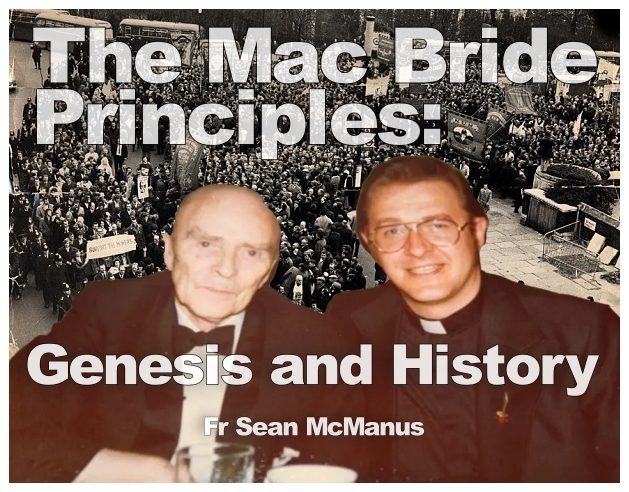
An Army of Principles Will Penetrate Where an Army of Soldiers Cannot—Thomas Paine 1.

I want to set out here for the historical record how the Irish National Caucus initiated, proposed, and launched the Mac Bride Principles. This is all the more important since there have been some attempts at revisionism. I will have to give an abundance of quotes from the press and other sources to document the clear and incontestable role of the Irish National Caucus. And the issue here is not the drafting of individual Principles, which are not particularly unique but generally modelled on the Sullivan Principles 2 and other such principles.
But first a statement of what the Principles are: the Mac Bride Principles – consisting of nine fair employment principles – are a corporate code of conduct for U.S. companies doing business in Northern Ireland and have become the Congressional standard for all U.S. aid to, or economic dealings with, Northern Ireland.

The Principles do not call for quotas, reverse discrimination, divestment (the withdrawal of U.S. companies from Northern Ireland) or disinvestment (the withdrawal of funds now invested in firms with operations in Northern Ireland). The Caucus positively encourages non-discriminatory U.S. investment in Northern Ireland. The Mac Bride campaign is conducted on a three-fold level:
(1) Federal: the Mac Bride Principles became the law of the U.S. in October 1998.
The U.S. House and Senate passed the Mac Bride Principles – as part of the Omnibus Appropriations Act for Fiscal Year 1999 – and President Clinton signed them into law. The Mac Bride law mandates that recipients of U.S. contributions to the International Fund for Ireland (IFI) must be in compliance with the Mac Bride Principles. (The U.S. has been contributing about $19.6 million per year since 1986 to the IFI.)
(2) State and cities: millions of dollars in State and city pension and retirement funds are invested in American corporations doing business in Northern Ireland. The Mac Bride campaign lobbies to have legislation passed to direct these funds to be invested, in the future, only in companies that endorse the Principles (again, note, not divestment or disinvestment). This is the first step. The second step – once the Mac Bride Principles investment law has been passed – is to get a contract compliance law passed.
(3) Shareholder Resolutions: the Campaign works to have shareholders pass resolutions endorsing the Principles.

The Mac Bride Principles did not suddenly appear from the sky like the Ten Commandments. They were the result of many years of hard and unrelenting work by the Irish National Caucus. The Principles were ‘conceived’ in August 1979; ‘born’ in June 1983; and ‘christened’ in November 1984.
The Mac Bride Principles Conceived
One of the first objectives of the newly opened office of the Irish National Caucus was to ‘stop United States dollars subsidizing anti-Catholic discrimination in Northern Ireland.’ To have impact on foreign policy, you have to find the foreign policy nexus – that which connects Northern Ireland and the United States. The obvious ‘nexus’ was the United States companies doing business in Northern Ireland. These companies could also be the ‘fulcrum’ through which we could exercise leverage to oppose discrimination in Northern Ireland.

So, these companies had to be held accountable to American legislators and investors. In July 1979, Congressman Ben Gilman (R-NY), a member of the House Committee on Foreign Affairs, and a member of the Subcommittee on International Economic Policy and Trade, commissioned the Irish National Caucus to conduct an investigation of the U.S. companies in Northern Ireland.
We travelled to Northern Ireland at the end of July 1979, and the Sunday News announced our mission:
‘Caucus in Jobs Blacklist Move: Americans probe workers’ religions.’
‘American firms with production plants in Ulster are to be asked for a religious breakdown of local workers in a move to tighten up on United States equal opportunity laws. And some companies located in ‘sensitive’ areas of the Province which do not have balanced Protestant–Catholic worker ratios could have a black mark against them in a report to an influential Congressman in Washington.
‘Later this week leading members of the Irish National Caucus from the federal capital will be touring Northern Ireland, knocking on the doors of American firms for details of their employment registers.
‘The most significant of the credentials the team will present is a letter from New York Republican Congressman Ben Gilman, who sits on an international trade subcommittee with powerful controls on U.S. corporations operating overseas.
‘Fr. Sean Mc Manus said the letter from Congressman Gilman gave their visit to American firms in the North a semi-official status. He added that the INC delegation would almost certainly be visiting the Ford-owned Autolite components factory at Finaghy and the management of the new DeLorean car assembly plant.‘

The Irish Times said:
‘While in Northern Ireland the members of the Caucus will visit some American-owned companies to ascertain whether any discriminatory employment practices operate. The investigation is being carried out at the request of Congressman Benjamin Gilman, who is a member of the House Committee on Foreign Affairs and the Subcommittee on International Economic Policy and Trade. U.S. corporations, which are found not to reflect American respect for and protection of equal opportunities for all, could face withdrawal of tax concessions and trading licenses.‘

One of the Caucus’ recent achievements concerns the suspension of U.S. arms sales to the RUC, pending an investigation into the human rights situation in the north. They are also speaking of their determination to make Ireland an issue in the coming Presidential campaign.
The Irish Press carried the story this way:
[Leaders of the Caucus] are in Ireland at present to investigate the behavior of American firms in the North. They are undertaking this mission on behalf of Congressman Benjamin A. Gilman, who is a member of the Congress Committee on Foreign Affairs and the Subcommittee on International Economic Policy and Trade.
This committee controls overseas aid, and if American firms locating outside the country are found to be discriminating against anyone on the basis of race, creed or colour, their U.S. tax concessions may be cut off.
The Belfast Telegraph said:
‘The Irish National Caucus is investigating alleged discrimination at Goodyear’s Craigavon factory. The Caucus has asked for a breakdown of religious affiliations of the 1,400 people employed at the Silverwood plant.
‘Goodyear was one of many firms which signed the Fair Employment Declaration … Prominent members of the Caucus are involved in the investigation – including Fr. Sean Mc Manus.‘

We made contact with most of the U.S. companies and asked them to submit a detailed breakdown of the religious composition of their workforce (in doing so we were years ahead of the British government’s Fair Employment Laws, which did not make this demand until 1989).
Sean Mac Bride, INC Liaison Group
But the launching of the investigation into U.S. companies in Northern Ireland was not the only important initiative the Caucus took on its August mission to Ireland. There was another equally important initiative that would be full of significance, symbolism, and solidarity for the MacBride Principles later on. The Caucus established, in Dublin, the Irish National Caucus Liaison Group, chaired by Dr. Seán Mac Bride himself. The inaugural meeting was held in Seán’s home, Roebuck House.
The Irish Times reported:
‘Mr. Seán Mac Bride, the Nobel Prize and Lenin Peace Prize winner, has become chairman of a new group in Ireland which aims to put forward the views of the Irish National Caucus, a United-States-based organization.
‘Mr. Michael Mullen, general secretary of the Irish Transport and General Workers’ Union, is another member of the new group.
‘The Rev. Sean Mc Manus, a leader of the Irish National Caucus, said last night in Dublin that the new group in Dublin would be called Irish National Caucus Associates. It would be based in the Republic and, besides Mr. Mac Bride, it would include Mr. Mullen and Mr. Kevin Boland, a former Fianna Fáil Minister.
‘The initial meeting, which was attended by 20 people, was held on Thursday, and another one would be held later this month.’

Back in the US, the Irish World told Irish-Americans of this initiative in the following way:
‘Sean Mac Bride, recipient of both the Nobel Peace Prize and Lenin Peace Prize, has announced his agreement to act as chairman of a new organization in the Republic of Ireland which aims to act as a liaison between the U.S.- based Irish National Caucus and the people of Ireland.
‘… “The idea of our organization”, Mac Bride said, “is to get across to the Irish public the truth about the United States organization and to emphasize the significance of the Irish-American dimension. The success of the Irish National Caucus was seen in the U.S. State Department policy review on supplying arms to the RUC.” Mac Bride added that, in his opinion, the work of the I.N.C. had been somewhat misrepresented by a number of individuals in Ireland and that it is his hope that the work of the new organization will present a clearer picture of Caucus activities. “The Irish National Caucus is not a ‘front’ for any group in Ireland. It is undoubtedly the most effective and widely-respected Irish-American Organization in The States and we hope to contribute to its goal of a just and lasting peace in the North of Ireland“.’
It should be obvious to all that in these two Caucus initiatives (investigation of U.S. companies in Northern Ireland and Seán Mac Bride becoming Chairman of our Liaison Group in the Republic of Ireland) were sown the seeds of the Mac Bride Principles. Since he had left the Dáil in 1958, Seán Mac Bride had established a policy of not belonging to any party or group dealing specifically with Northern Ireland. But he broke this policy to identify with the Irish National Caucus. He was attracted to the Irish National Caucus for the following reasons:
(1) It is nonviolent.
(2) It has no foreign principal – that is, it is neither controlled nor directed by any, party, or government in Ireland.
(3) It did not send funds to Ireland.

Seán Mac Bride particularly admired the Caucus’ focus on stopping U.S. dollars subsidizing anti-Catholic discrimination in Northern Ireland. Paddy Harte, TD for Donegal, launched an appalling personal attack in the press on MacBride, calling him senile and other abusive things. (Harte never apologized for his attack.)

The other Donegal TD, the late Neil Blaney, congratulated Mac Bride, joined the Liaison Group, and announced he was going to the U.S. to speak for the Irish National Caucus. Neil had a life-long record of concern for the North of Ireland. Paddy Harte would later become the founder of Irish-American Partnership that was launched by Taoiseach Garret FitzGerald in 1984.
We decided that a good way to ‘frame the issue’ of U.S. dollars subsidizing anti-Catholic discrimination in Northern Ireland would be to have the Ad Hoc Committee for Irish Affairs, which we had initiated, hold a Hearing, and bring Fr. Brian Brady over from Belfast to testify about the hiring practices of U.S. companies in Northern Ireland. The hearing took place on July 22, 1981. It was the first time ever that discrimination by U.S. companies in Northern Ireland was raised in the United States Congress.

After the Ad Hoc Congressional Hearing, the Irish National Caucus planned to have our principle, that United States dollars should not subsidize anti-Catholic discrimination in Northern Ireland, enshrined into law. We worked assiduously on this. In 1983, we succeeded at last in having a Bill introduced into Congress, HR 3465: ‘Requiring United States persons who conduct business or control enterprises in Northern Ireland to comply with certain fair employment principles.’ It was modelled on the Sullivan Principles and became known as the ‘Ottinger Bill,’ after its chief sponsor, Congressman Dick Ottinger (D- NY). Although the Bill did not pass, it was of singular importance because it perfectly framed our issue. We now had in place all the essential elements of what we would later call the Mac Bride Principles:
(1) The ongoing investigation of the United States companies in Northern Ireland.
(2) The high-profile involvement of Seán Mac Bride in our campaign.
(3) A set of fair employment principles for those companies to serve as a corporate code of conduct.
The very first lobbyists against the Ottinger Bill were the Irish Embassy in Washington, DC, and John Hume. I issued the following press release:
‘Irish Embassy Cover-up on Anti-Catholic Discrimination.
‘Washington, D.C., November 4, 1983.
‘The Irish National Caucus has reacted with anger to attempts by the Irish Embassy to sabotage legislation in Congress that would outlaw discrimination by American companies in Northern Ireland.
‘The Caucus claims that it has been told by a number of Congressional offices that the Irish Embassy is advising them not to sponsor the Bill of Congressman Richard L. Ottinger (D-NY). One office reported in amazement to the Caucus that the Irish Embassy is saying that the Ottinger Bill would actually increase unemployment in Northern Ireland.

‘Fr. Sean Mc Manus, National Director, said: “The Irish Embassy is quite simply conspiring with the British Embassy to cover up anti-Catholic Discrimination in Northern Ireland. I call upon the Opposition Parties and Independents in the Dail to demand that this disgraceful sellout of the Catholics in Northern Ireland cease.”
‘The greatest weapon the British have for oppressing Catholics in Northern Ireland is the Irish Embassy in Washington.
‘Whenever the Irish National Caucus succeeds in raising the Irish issue, the British always make the Irish Embassy jump to defend British interests,” concluded Fr. Mc Manus.‘
‘When Congressman Ottinger first introduced the Bill, Irish Embassy officials told him that they approved of it. Then John Hume and [the Rev. Ian] Paisley came to Washington. John Hume was quoted in the Washington Times, September 20, 1983, as saying, “There are 27 U.S. plants in N.I., and I have not heard one complaint about discrimination practices. We have a fair employment bill that makes discrimination illegal.” That is an extraordinary thing for John Hume to say. Paisley has leaned on John Hume, and the British Government has leaned on the Irish Government to oppose the Ottinger legislation. How can Garret FitzGerald possibly explain to the people of Ireland that it would be bad for the U.S. Congress to make it illegal for U.S. companies in N.I. to discriminate?

Niall O’Dowd – who would later become the publisher of the Irish Voice newspaper and Irish America magazine in New York – would report from San Francisco:
‘The revelation that the Irish Embassy was actively campaigning against the Bill came yesterday from the offices of Congresswoman Barbara Boxer (D-CA) who confirmed that in separate meetings representatives from both the Irish and British governments had asked her to oppose the Bill … In response to Fr. Mc Manus’ criticism, Michael Collins [later the Irish Ambassador in Washington], the Irish Government’s press and information officer in the United States, stated that the embassy had “taken a long and detailed look at all aspects of the Ottinger Bill and that they foresee problems with it. We believe that this Bill could have a counter-productive effect.‘

The Mac Bride Principles Born

The Ottinger Bill contained, in essence, the principles we would later call the Mac Bride Principles. That is why we say that the Mac Bride Principles were born in 1983. To promote the Ottinger Bill, the Irish National Caucus sponsored a visit to Northern Ireland by Congressman Ottinger in 1983. We hosted the Congressman’s appearances at meetings and Press Conferences in Belfast. The visit received considerable press coverage in the Irish and British media. Bob Blancato, the Staff Director of the Ad Hoc Congressional Committee for Irish Affairs, was also part of the delegation, representing the Chairman of the Committee, Congressman Mario Biaggi (D-NY).

We could tell we were on to something very important by the way the press reacted. The Daily Telegraph, under the heading ‘Americans in Ulster Maelstrom,’ said:
‘Mr. Ottinger’s mission is regarded with far more suspicion in the Protestant camp. At the moment, he is steering legislation through Congress to force American companies investing in Northern Ireland to employ more Roman Catholics.
‘In June, he introduced a Bill called the Northern Ireland Fair Employment Practices Act, which would require American firms with branches or other enterprises in Ulster to desegregate employees of different religions and eliminate religious discrimination in jobs.
‘The spotlight is being put on Short Brothers, the Belfast plane-makers, who are bidding to sell aircraft to the United States Air Force. The contract would mean an extra 600 jobs … Advising the Congressman, and helping him in the talks, was Fr. Sean McManus, the Washington-based Redemptorist priest ordained in England and now a scourge of the British Government. The lime-and-soda-drinking cleric is not liked by British diplomats in the American capital, where he leads the Irish National Caucus, a lobbying group aimed at influencing American foreign policy with the target of Irish unity, freedom, and peace.‘
The News Letter screamed the headline, ‘Anti-British to the Hilt,’ and said:
‘The leading light in the delegation, Fr. Sean McManus, is a well-known republican sympathizer who rarely disguises his anti-British stance … this fiery advocate of Irish republicanism did his utmost to embarrass British diplomats in Washington with a brief hunger strike outside the Embassy in support of Bobby Sands’ death fast.
‘He was instrumental in persuading the Carter administration to impose an embargo on American gun sales to the RUC in Belfast. And his latest campaign aimed at undermining the attempt by Shorts to secure a multi-million-pound order to sell its SD-330 Sherpa freighters to the United States Air Force.
‘It was back in 1979 that Fr. Mc Manus told reporters: “The British thought they were getting rid of me in 1972 when they had me packed off to America. Little did they know I would be far more vocal on Capitol Hill.”‘
The Daily Express, August 18, 1983, however, really outdid itself. It devoted an editorial to our visit:

‘Sean Mc Manus, a rancid bigot loosely described as a “priest,” is campaigning to stop a £33 million order from the United States Air Force going to Shorts, the Belfast plane-makers.
‘Mc Manus – born in Northern Ireland but now in Washington heading an anti-British pressure group – alleges there is discrimination against Catholics at Shorts: though the firm denies it.
‘Doubtless, he is delirious at the calls from other pip-squeak Irish-American politicians urging President Reagan to appoint a special envoy to Northern Ireland.
‘Indeed, he probably has a hand in the setting up of the “Irish-American Presidential Committee” to push the issue of a unified Ireland into the 1984 presidential campaign.”
Shorts

While in Belfast, we took the occasion to pursue the other very hot issue – the question of the United States Air Force doing business with Short Brothers (Shorts had a notorious record of anti-Catholic discrimination). The Caucus had been raising this issue for quite some time. This was really one of our pivotal campaigns because it dramatically raised the whole issue of U.S. dollars subsidizing anti-Catholic discrimination in Northern Ireland. We met with Short’s executives at the office of the Fair Employment Agency. Again, this meeting received considerable press coverage. Our Shorts campaign would eventually lead to Congressman Joe Kennedy (D-MA) getting an Amendment passed (1988, 1989 and 1990) in Congress to the U.S. Defence Bill. The Amendment required Shorts to submit an annual statistical report to the Defence Department on its subcontracting and recruiting practices.
At the meeting, I remember the Shorts’ spokesman – with barely concealed hostility – telling me, ‘Shorts does not have to give any explanations to the Irish National Caucus or anybody in America.’ How their tune has changed. That same spokesperson would later have to go, cap in hand, to meet with the then Comptroller of New York City, Elizabeth Holtzman, to assure her that Shorts was making attempts to hire more Catholics.

The Empire Strikes Back
Just before one main press conference was due to take place, Fr. Brian Brady called and told us that a high-ranking Catholic Church official in Belfast had asked him to ask us to meet with someone who had a special interest in the Shorts issue. We agreed.

The person arrived and asked to meet with us behind a big curtain in the room where the press conference would take place, in the Europa Hotel in Belfast. He did not want to be seen by the press. His name was James Eccles, a former Head of the Knights of Columbanus (a lay Catholic organization in Ireland. It is quite powerful and very ‘respectable’). Eccles’ pitch was that the Knights had done a lot of investigation into anti-Catholic discrimination in Northern Ireland. We asked him to provide us with the results of the alleged investigation. He was completely taken aback. We knew the guy had an angle, to say the least. He said he agreed that Shorts was guilty of very bad discrimination, but … ‘But,’ I cut in, ‘you still think they should get the contract with the U.S. Air Force?’ Eccles said yes. He then promised if Shorts got the contract, the Knights would put pressure on them to end discrimination. We politely told him that we would keep up the pressure on Shorts, and showed him the door (or rather, the curtain).
While he was giving us this unbelievably disingenuous pitch, I couldn’t help remembering that it was the Catholic Bishop of Belfast, Cahal Daly, who was among the very first to voice public opposition to our campaign against Shorts. There is a morning radio program in Northern Ireland called Thought for the Day on BBC Ulster. Bishop Daly instructed Fr. Gerry Patton – the media person for the diocese – to use the program to attack our campaign.

Patton deplored the fact that there was a campaign in the U.S. to oppose Shorts getting an Air Force contract and wanted to make sure the people realized that the priest (myself) who was leading it had no connection with the Diocese of Down and Connor.

Mr. Eccles, about a year later, sent us an unsigned note identifying himself as the person who had met with us prior to the press conference and he wanted us to know that we had been right about Shorts – that they had only made promises to get the contract with the U.S. Air Force, and then it was business as usual.

The same Mr. Eccles would surface again in the U.S. as the main lobbyist against the Mac Bride Principles – assuring legislators that discrimination was a thing of the past, that the Mac Bride Principles would only hurt Catholics, etc. Eccles travelled all across the U.S. with the same message.
At one Mac Bride Hearing in Nebraska, on March 13, 1989, one of Eccles’ prize statements was:
‘I was knighted by the Pope, and I’m very close to the workings of the Catholic Church in Ireland.’
I hung my head in shame and thought to myself, ‘Once again the Catholic Church is being used for British interests in Ireland.‘

I had many reports that while lobbying in the U.S. against the Mac Bride Principles, Mr. Eccles allegedly gave the impression that he was doing so with the blessing of the late Cardinal Tomás O’Fiaich, Archbishop of Armagh and Catholic Primate of Ireland. I made a statement in The Irish Times that I would be very surprised and deeply disappointed if Cardinal O’Fiaich was allowing his name to be used by the British government’s anti-Mac Bride campaign in the U.S. The next day, I received a mailgram stating,
‘No one authorized to use my name in any way to oppose Mac Bride Principles. Northern Catholic Bishops have never made any statement on the Mac Bride Principles.’
It was signed: Cardinal O’Fiaich, Ara Coeli, Armagh.
Mr. Eccles would later spread the word in the Sunday News that he was not paid for his anti-Mac Bride work:
‘.. Mr. Eccles’ son Jim said: “My father does speak out against the Mac Bride Principles because he firmly believes that they will do more harm than good. But he has never received money for it, not even travelling expenses … He visits America frequently. While he is there, he makes his views known on the MacBride Principles … He sees it as an extension of the charity work he has been heavily engaged in for nearly 30 years”.’

But former British MP Kevin Mc Namara in his book on the Mac Bride Principles would reveal – having had access to British government documents – that Eccles,
‘was expensive. He was employed for a maximum of 60 days a year at £220 per day plus expenses, and was in receipt of an annual retainer.’

Mr. Eccles was also a member of the board of the Fair Employment Agency (FEA) from 1985 to the autumn of 1989 when the Agency was replaced by the Fair Employment Commission (FEC). In May 1990, the FEC issued a report charging that the motor trade in which Mr. Eccles worked had a very serious imbalance – that Catholics were seriously under-represented. Indeed, the FEC said that the actual company for which Eccles worked – A. S. Baird Ltd – was only 18 percent Catholic. The FEC 1991 figures are 67 Protestants (73.6 percent); 24 Catholics (26.4 percent); 34 ‘unknowns’; in all, a total of 125 employees.
What did Mr. Eccles say in response to this very embarrassing exposure? He alleged he ‘had not come across any pattern of discrimination during his years in the trade. I was too busy trying to earn an honest pound.’ Indeed.

Aer Lingus Cover-Up

By the way, the other very interesting ‘champion’ that sprang to the defence of Shorts was Aer Lingus. One of our members had written to them complaining that they were using Shorts 330 aircraft. The Chief Executive Officer of Aer Lingus, David M. Kennedy, wrote back on June 23, 1983, saying, ‘We are satisfied there is no religious discrimination in recruitment or employment practices of Shorts.’ At that time, Short’s percentage of Catholics was less than 5 percent out of a workforce of 6,300.18

I was outraged and issued the following press statement:
‘I simply cannot believe that any responsible spokesperson for Aer Lingus – not to mention the chief executive – would make such an extraordinary statement. There is simply no other way to put it: This is a blatant cover-up. Whenever the British Government is in trouble, it seems it can always get some gombeen man to do its dirty work. Mr. Kennedy is but the latest example in this dismal tradition.‘
Aer Lingus is semi-state owned, and it is unlikely Mr. Kennedy would have made that statement without the explicit approval of the Irish government. Garret FitzGerald was Taoiseach at the time.

On May 3, 1983, I sent a letter to all 535 Members of the United States House of Representatives and Senate, outlining the case against Shorts. The following week (May 10, 1983), the British Ambassador, Oliver Wright, sent letters to all the same people – with a glossy brochure, specifically written by Shorts to refute our charges of discrimination. Two black-and-white photos were enclosed with the brochure: one of Garret FitzGerald standing beside a Shorts’ aircraft, and one of the heads of Aer Lingus receiving a Shorts’ aircraft.
Dublin Government Cover-Up

But the plot thickens. In 1983, James Shannon was a Democratic Congressman from Massachusetts. He was very close to the Irish Embassy in Washington, DC, and would not make a move on the Irish issue without the blessing of the Embassy. One of our members – a constituent of his – wrote to the Congressman asking him to support the Caucus’ campaign of opposing Shorts getting a U.S. Air Force contract. This was his response:
‘The Irish Government recently reviewed the situation at Short Brothers in Belfast. It noted historical patterns of clear discrimination, and also noted recent efforts to correct that situation, including: the appointment of a Catholic personnel director, active recruitment in Catholic schools and in the Catholic press, and agreeing with the Fair Employment Agency to set up an affirmative action program. It also noted that the prevailing opinion in both communities in the North was that the proper approach is to eliminate discriminatory hiring practices, and then to promote foreign investment and employment. The Irish Government recently contracted with Short Brothers for the production of aircraft for the national airline, Aer Lingus. This is the best evidence that progress is being made in correcting historical patterns of injustice.’
So, there you have it. The first opponents of our campaign to stop the U.S. subsidizing anti-Catholic discrimination were John Hume, the Catholic Bishop of Belfast, the Knights of Columbanus, Aer Lingus, and the Irish government. And you thought the British government ruled only through the Protestants of Northern Ireland! It would seem that the Irish Embassy was a wholly owned subsidiary of the British government. The architects of the Embassy’s policy were Garret FitzGerald, Sean Donlon, Michael Lillis – and John Hume.
Who could blame me for my utter disgust at the Dublin government of that time? And, examining all this again makes me no less disgusted. It was disgraceful and appalling.
The Mercurial Mr. Devlin
It is also interesting to note here that on our visit to Ireland in 1979, we met with the late Paddy Devlin, former Social Democratic and Labour Party (SDLP) leader. He was very excited about our idea of making an impact on discrimination through the leverage of American companies. He kept saying he could not believe that he himself had not thought of this idea and that nobody in the North even knew which ones were the American companies.

The next time I saw Paddy Devlin was in the U.S. at a State hearing testifying against the Principles. He became one of the team of Catholics the British government (through its Department of Economic Development) recruited. Devlin would write later in his column in the Sunday World:
‘My personal view of the Principles is that they will undermine our efforts to eliminate discrimination, deflect U.S. investment away and cause the withdrawal of U.S. companies by putting them into conflict with our labour laws.’
The following year he said,
‘The Mac Bride Principles are a sham. It is time we identified the primary issue of the hidden agenda that is the disestablishment of Northern Ireland society.‘
Watershed
The Caucus/Ottinger visit to Northern Ireland served as a watershed in our campaign. After this, a number of elected officials contacted us, wishing to become associated with our campaign. Chief among these were: New York City Comptroller Harrison J. Goldin, Council Member Sal Albanese of the New York City Council, New York State Assemblyman John Dearie, New York State Senator John Flynn, and Massachusetts State Senate President Bill Bulger.

The Caucus saw the need not only to involve United States legislators but also institutional investors in our campaign. As New York City Comptroller, Mr. Goldin was one of the custodians of millions of dollars of New York City funds invested in a number of United States companies doing business in Northern Ireland. We eagerly welcomed him into our campaign. We worked with his office on issuing a new set of principles. For me, there could be no question as to the person after whom we should name these principles: Seán MacBride.
Mac Bride Principles Christened
But let me go back a bit. I first met Seán Mac Bride in New York City in the spring of 1976 when he was the guest speaker at an AOH function. At the time I was the Deputy National Chaplain of the AOH, and as such, I was seated at the head table, next to Seán. I was amazed and humbled he took such an interest in me and the work of the Irish National Caucus. I was used to the ‘great and the good’ in Ireland not wanting to know me, which I took as a badge of honour.
The next time I saw Seán was at the American AOH Convention in Killarney, June 27-29, 1978. When he spoke, he went out of his way to commend me and the work of the Irish National Caucus. A journalist commented to me that it was significant that he had done so, given the open hostility of the Dublin government to me. I kept in touch with Seán, and as explained earlier, in July 1979, I asked him to head up the INC Liaison Group in Dublin.

Then I invited Seán to be the guest speaker at the Fifth Annual Testimonial Dinner Dance of the Irish National Caucus on December 10, 1982, in New York City, attended by close to 1,000 guests. The following morning, I picked him up at his hotel to bring him to speak to the Caucus chapter in Huntington, New York. ‘Did it [the dinner dance] end peaceably?’ he smilingly inquired in his still partial-French accent. I asked him why he put the question. ‘Well, in my day, Irish-American events sometimes ended in a fight,’ he replied.
Later on, I dropped him off at the airport. As we sat for a moment, before he left the car, I was deeply conscious of the history he represented and felt in some inchoate way that I needed to do something to honour his family history. In truth, he was the only person in whose presence I felt overawed, indeed, a bit intimidated. I asked him if we ever came up with something – a document, proclamation something – if he would lend his name to it. Without hesitation, he consented.
So, when the time came, I talked to Seán Mac Bride on the phone a number of times about naming the Principles after him. On October 18, 1984, I formally wrote him, proposing and enclosing, the Principles.
On Monday, November 5, 1984, the Irish National Caucus announced the launching of the Mac Bride Principles. Thus, the Principles were ‘christened.‘
Our press release carried the heading, ‘Caucus’ New Plan to Combat Discrimination’ and went on to say:
‘The Irish National Caucus today announced a major new initiative to combat employment discrimination in Northern Ireland … The Caucus has endorsed a set of Equal Opportunity Affirmative Action Principles for Northern Ireland that have been sponsored by Seán Mac Bride … “This approach,” said Fr. Sean Mc Manus, “.. is the way for Americans to deal with anti-Catholic discrimination.’ ”
The Irish Echo (New York) captured the historic moment accurately with the headline: ‘Caucus Proposes New Initiative to Stop Discrimination in Northern Ireland.‘
The Sunday Tribune reported:
‘The nine-point employment code, which was drawn up by the Washington-based Irish National Caucus (I.N.C.) is sponsored by Seán Mac Bride S.C., leading Northern Ireland trade unionist Inez Mc Cormack and Northern surgeon Senator John Robb and Father Brian Brady.’
That was the very first occasion the Mac Bride Principles were mentioned by name in the Irish or American media.
Thus, a historic initiative was conceived, born, and christened.

We wanted to mention Comptroller Goldin’s name in our announcement, but at that stage, he was not prepared to associate his name with the Principles. In fact, he backed out at the last moment, after I had told Seán Mac Bride that he would join us in the announcement. The first New York politician, in fact, to publicly associate himself with the Mac Bride Principles was City Councilmember Sal Albanese (D-Bay Ridge). I had been advising Goldin to associate himself publicly with the Mac Bride Principles, otherwise other New York politicians would beat him to the punch. But he thought it was just a tactic to stampede him into supporting the Principles earlier than he wanted to.
Caucus Launches Mac Bride Campaign
The moment Council member Albanese read The Irish Echo’s report on the launching of the Mac Bride Principles, he contacted the Irish National Caucus with a view to introducing a Bill in the New York City Council. He and the Caucus worked on the drafting, and on December 19, 1984, a Bill was introduced: #878. This was to be the very first Mac Bride Bill in the U.S.
And so, the Mac Bride campaign had formally begun. The New York Daily News reported: ‘City Councilman Sal Albanese (D-Bay Ridge) will appear at City Hall tomorrow in a rally with Rev. Sean Mc Manus, National Director of the Irish National Caucus, to seek support for the bill.‘
The Irish Echo announced:
‘Fr. Sean Mc Manus, national director of the Irish National Caucus, will hold a press conference with Councilman Albanese at City Hall on Jan. 3 at 10:30 am calling on Irish groups to support Intro. No. 878.‘
The Chief Leader said:
‘The Irish National Caucus has chosen New York City to be the first where pension fund investments will be used to increase pressure for equal rights for Catholics in Northern Ireland …‘
The Catholic New York newspaper said:
‘Father Mc Manus was present at City Hall recently to speak in favour of the [Albanese] legislation … Father Mc Manus said that proposed legislation is “eminently reasonable … One of the most effective ways for us to combat the situation is to get the investors involved and make them aware they are supporting anti-Catholic discrimination,” he told Catholic New York.‘
The Sunday Times of London:
‘The [Mac Bride] campaign is being run by the Irish National Caucus … The move, inspired by Father Sean Mc Manus, who has been consistently opposed to British policy, is particularly well timed. For even if the law is never passed, it provides an opportunity to link, however, tenuously, the issues of South Africa and Northern Ireland. The Mac Bride Principles also call for the same kind of affirmative action programs for Catholics which American companies already use in the employment of women and blacks in the U.S.A.’
This was the very first mention of the Principles in the English press.
In an interview with Niall O’Dowd in The Irish Press Comptroller Goldin said: ‘Moreover, having reviewed the Mac Bride Principles, I endorse this initiative.‘
(Notice: he speaks about ‘having reviewed,’ not having originated the Principles. It was only later that people associated with the Comptroller made the retroactive claim that he had developed the Principles.)

But in New York papers, Comptroller Goldin, unfortunately, came out very publicly against the Bill. The New York Daily News, under the headline ‘Koch & Goldin Oppose Ulster Investment Ban,’ said:
‘Mayor Koch and City Controller Harrison Goldin expressed opposition yesterday to a City bill that would prohibit city Pension fund investments in the U.S. owned businesses that discriminate against Northern Ireland. Their reaction came after the Rev. Sean Mc Manus, National Director of the Irish National Caucus Inc., a Northern Irish Catholic lobbying group based in Washington, appeared at City Hall to urge passage of the bill. The measure, sponsored by Councilman Sal Albanese (D-Brooklyn) [sic], is awaiting a hearing in the Council’s economic development committee
‘… Goldin said the Council Bill was premature.‘
A leading column in The Irish Echo stated:
‘Mayor Koch and City Comptroller Harrison Goldin are opposed to such tough measures on the grounds that the British have an official policy that is against discrimination, and the situation in Belfast is very different from South Africa where the government has an official policy of discrimination.
‘The “unofficial” nature of discrimination in Northern Ireland notwithstanding, it is still a fact that Catholics do not have equal opportunity in the North, and that New York City officials have every right to be concerned about it …
‘It is for this reason Councilman Albanese should be encouraged … and that Mr. Koch and Mr. Goldin – who I am sure are acting in good faith – should be asked to take another look at their position. Mr. Koch has the strong support of the majority of the Irish community in New York, and I am sure he would like to maintain that support.’
The New York Times reported:
‘The Council measure is opposed by Mayor Koch, who sits on the boards of the four largest pension funds for city workers, and City Comptroller Harrison J. Goldin, the custodian for all five funds in the system and a trustee of the four largest funds.‘
At this stage – and for a good while later – Goldin was opposed to legislation on the Principles. He felt that shareholder resolutions would have sufficient leverage, and his office did not want anything to overshadow his role. His office fought Albanese’s office on this, so much so that Albanese and I had to call a meeting in New York City to push the need for legislation. About 400 Irish-Americans attended the meeting. I spoke very forcefully about the need for legislation – not just shareholder resolutions. Even at that meeting, Goldin’s office opposed the idea of legislation. But the mood of the meeting was clearly in our favour, and soon afterward, Goldin’s office withdrew their opposition to legislation. That meeting was a key building block in the long construction of the Mac Bride campaign. At the meeting, Pat Doherty, Goldin’s aide, was visibly shaken by the anger towards Goldin. Time and time again, I witnessed people say to him, ‘There has to be a law. There has to be a law,’ the adopted refrain of the Albanese–Caucus supporters. Indeed, I had to run interference several times to ask them to leave Pat alone. Goldin soon realized, however, that he had made a terrible mistake. The train was leaving the station, and he was not on board! He was in a position to play a key role in our campaign, but his public opposition to the New York City legislation had hurt him badly.

Comptroller Goldin had lost the high ground. How could he reclaim it? The Caucus wanted Goldin to be prominently involved because as the custodian of millions of dollars, he represented the vitally important role of investors in the Mac Bride campaign.
Caucus-Golden Visit

There is a well-known technique whereby American politicians stake claim to an interest in Irish issues – the highly publicized visit to Ireland. There is nothing wrong with this. Presidents Kennedy and Reagan did it; why shouldn’t a non-Irish-American also do it? So, Comptroller Goldin needed to visit Ireland. But how to go about it? Who would sponsor the visit? Who would set it up? And very importantly, who would have the resources to pay for it? The answer – the Irish National Caucus. That the Caucus attached great importance to the role Goldin could play is seen in the fact that it was prepared to spend so much money on the trip.
Furthermore, the Caucus had already ‘covered’ the legislative dimension of the Mac Bride Principles – we now needed to ‘cover’ the investment dimension. The New York Daily News would give the Caucus–Goldin visit prominent coverage:
‘A U.S. based Irish lobbying group paid up to $12,000 so City Comptroller Harrison Goldin could visit Ireland – with his family and aide – to look into complaints of economic discrimination against Catholics in Northern Ireland … A spokesman for the comptroller said it was official city business.‘
The aide was Pat Doherty, who would go on to feature prominently in the Mac Bride campaign, and become a good friend. Some Irish-American groups shortsightedly criticized the Irish National Caucus for ‘wasting money.’ But when they finally understood the significance of the Caucus strategy, they were very eager to associate themselves with the Mac Bride campaign. The Goldin visit received heavy coverage in the British and Irish media, thereby helping to establish the Mac Bride Principles firmly in the public mind. It was on this trip that Goldin met Seán Mac Bride for the first time – eight months after the Irish National Caucus had launched the Mac Bride Principles.

The Caucus arranged meetings with Charlie Haughey, the Fair Employment Agency, John Hume and various U.S. companies.

It was ironic that the British government attempted to make great play out of the fact that Sinn Féin was the only political party in Northern Ireland to support the Mac Bride Principles. However, when Sinn Féin met with the Goldin group in Belfast, they expressed strong opposition to the Principles, saying they were not radical enough—that they were ‘akin to President Reagan’s constructive engagement with [apartheid] South Africa.’ However, the real reason for their opposition was because the Principles were launched by the Irish National Caucus. (Sinn Féin opposed the Irish National Caucus because it is nonviolent and because the Caucus does not allow itself to be controlled from Ireland.) But later, when Sinn Féin saw that the Principles were driving the British government up the wall, they reversed their position and began to express public support for them.

In the United States, the trip was also given considerable press coverage. The New York Times, the New York Daily News and the New York Post all devoted editorials to it. For example, the New York Daily News editorial said:
‘How did Goldin get involved with the so-called Mac Bride Principles? Although named for an aging Irish Nobel laureate Seán Mac Bride, they were actually drawn up in the U.S. by the Irish National Caucus. The Caucus organized and paid for Goldin’s trip – at a cost of about $12,000.‘
The New York Times editorial said:
‘A lofty but misguided proposition for opposing discrimination against Catholics in Northern Ireland has reared its head in Congress, three state legislatures and the New York City Council. Based on what is called the “Mac Bride Principles” … The principal sponsor is the Irish National Caucus, a Washington lobby intent on getting Americans to pressure Britain to withdraw from Northern Ireland … Comptroller Harrison Goldin, just back from Northern Ireland, is pressuring pension funds to act on their own.‘
Mac Bride Becomes State Law

At our urging, our good friend State Senator Billy Bulger used his influence to have Massachusetts become the first State to pass the Mac Bride Principles. I launched the Massachusetts Campaign in Springfield with a speech before the John Boyle O’Reilly Club – a very appropriate place – in February 1985. The Sunday Republican reported:
‘U.S. dollars mustn’t subsidize anti- Catholic discrimination in Northern Ireland … the Caucus is asking American firms to adopt the Mac Bride Principles … “American businesses can have a profound effect,” [Fr. Mc Manus] said. “You’re talking about millions of dollars … We’re not calling for disinvestment. We are not trying to end American investment in Northern Ireland,” he said. ‘
We worked closely with State Representative Tom Gallagher (D-18th Suffolk District). On October 1, 1985, he wrote to me:
‘I expect the Massachusetts House will shortly take up legislation applying the Mac Bride Principles to state pension fund investment. I believe the measure will reach the Governor’s desk this session and will make Massachusetts the first state to apply Mac Bride to its investments. I look forward to working with you in the future.‘

The Massachusetts Mac Bride Bill was signed into law by Governor Michael Dukakis on November 21, 1985. It was the first Mac Bride law in America. Dukakis still supported the Mac Bride Principles as a presidential candidate in 1988 (despite the strong lobbying of John Hume). While I was still based in Boston, Governor Dukakis invited me to his office on St. Patrick’s Day 1978, to present me with a proclamation he was issuing at our request, ‘Human Rights for Ireland Day.’ (That, of course, caused Irish Consul Carmel Heaney further fury.)
New York Assemblyman John Dearie and New York State Senator John Flynn initiated Bills on the Mac Bride Principles.
Soon afterward, in May 1986, New York became the second State to pass the Mac Bride Principles. In 1992, New York State became the first State to pass a Mac Bride Principles Contract Compliance Bill.
The Irish National Caucus then initiated Congressional legislation on the Mac Bride Principles (the Fish-D’Amato Bill, introduced on October 1, 1986), just as we had done on the seminal Ottinger Bill in 1983. And, as they say, the rest is history. Virtually all Irish-American organizations, the AFL-CIO, many religious groups (Catholics and Protestants) rallied behind the Mac Bride Principles, making them the most powerful American campaign on Northern Ireland since its creation in 1920.
MacBride’s Death
After Seán Mac Bride’s death on January 15, 1988, his son Tiernan – with typical Mac Bride generosity – wrote to me:
‘On behalf of the late Seán Mac Bride, I would like to thank you most sincerely for travelling to Dublin to attend his funeral. He will never be forgotten while the Principles drawn up by the Irish National Caucus are named after him.‘

And on June 28, 1993, Caitriona Lawlor in Dublin wrote the following letter to Ken Bertsch, Investor Responsibility Research Center:
‘I understand that you are preparing an updated version of “The Mac Bride Principles and U.S. companies in Northern Ireland” … During the years 1976 to 1988, I worked as Personal Assistant to Seán Mac Bride and witnessed the attention he paid to the causes in which he believed, in days when such causes were neither popular nor profitable. It amused me, therefore, to see the reference contained on p. 60 of the current edition, “Doherty and Mc Manus dispute exactly who should take credit for the idea of a fair employment code for recruiting Seán MacBride as Sponsor.” My understanding always was that the fair employment initiative for Northern Ireland lay squarely with Father Sean McManus and the Irish National Caucus in Washington, and it was to great advantage when the Comptroller of New York City, Harrison Goldin, and his office took up the cudgels. Indeed, Father McManus was adamant even in the initial stages of preparation, that MacBride should be involved and should lend his name to the Principles, based loosely on the Sullivan Principles for South Africa.
‘This is a very slight correction, but I feel in the interests of historical accuracy, due credit for initiating the code and recruiting Seán Mac Bride, should be given to Father Mc Manus and the Irish National Caucus, and I hope you will feel able to do so …‘
In 2009, former British MP Kevin Mc Namara released his book, The Mac Bride Principles: Irish-America Fights Back. In it he makes the remarkable statement about me:
‘What is not comprehensible is why he [Mc Manus] should seek to exclude the important role played by Comptroller Goldin’s office in the run-up to the launch, particularly as he takes great pains to credit him for his support once he came on board in 1985.‘
Of course, Mc Namara partly refutes his own accusation by pointing out that Goldin only came on board in 1985, whereas we had launched the Principles in November 1984. However, it is patently absurd to claim I tried to exclude Goldin when I went to great pains, and expense, to dig him out of the hole he had dug for himself.

Things admittedly became messy when Pat Doherty improperly made an issue of the drafting of the Mac Bride Principles. That was not expected, as staffers are not supposed to claim pride of authorship when assigned a project. And I have never known one to do so except for Pat. These were the MacBride Principles, not anybody else’s. Just as, ‘Ask not what your country can do for you …’ is JFK’s speech, not anybody else’s.

That is also why I found it extraordinary when Mc Namara criticized me for saying the drafting of the Principles never concerned me too much: ‘This was a surprising statement to make.’ There was nothing surprising about it. I was never too concerned about the drafting of the principles contained in the Ottinger Bill, the Fish–D’Amato Bill, or the Gilman legislation that became Federal Law in 1998. Nor did their staff make an issue of it.
But what had really forced me to go public and set the record straight was Doherty’s bizarre version of events as reported by the iconic journalist, Mary Holland in The Irish Times in 1987:
‘Mr. Doherty researched the problem and drew up a set of guidelines for American companies …Through Irish-American contacts, he then approached Seán Mac Bride and asked him to sponsor them.‘
Now that’s chutzpah for you! Pat did not even really know who Seán Mac Bride was until I named the Principles after him – as Pat himself admitted to me at the time. Mary Holland was very upset when she realized she had got the story wrong. She apologized profoundly, writing in a personal letter to me:
‘I am really sorry that … I misrepresented the genesis of the Mac Bride Principles … I’m sure you’ll understand that I was told the story as I recounted it.‘

The historical reality is that the Principles only became the powerful force they did when they became the Mac Bride Principles. And the Principles would never have got off the ground with such a bang had they not been launched by the Irish National Caucus, which did all the initial publicity – framing the issue, briefing the media, educating the public, and lining up political support. As Mc Namara states, Goldin only ‘came on board in 1985.‘
However, apart from the corrections forced on me here, I am the first to acknowledge the vital importance of Pat’s contribution. In 2008, The Irish Echo asked me to rate his work. This is what I said:
‘Pat has played a key role in the campaign to stop U.S. dollars subsidizing anti-Catholic discrimination in Northern Ireland … He is one of the most effective Irish- American campaigners since the time of the Fenians in 1858.‘
Pat just needs to be reminded occasionally that it was the Irish National Caucus that took him and Goldin to Ireland – not the other way around; and that we dug them out of the hole they had dug for themselves politically, launching Pat onto an excellent Irish-American adventure.

Addendum 1: Barbara Flaherty, Executive Vice President of the INC.

Barbara Flaherty is the Executive Vice President of the INC.
Her late husband, Martin, a Galway native, introduced her to the extent of discrimination which was taking place in Ireland at the age of 18. She has been continually involved in working to end discrimination ever since.

On 24 October, 2013, she was presented with the World Peace Prize by the World Peace Prize Awarding Council (WPPAC) in Seoul, South Korea and was sworn in as Roving Ambassador for Peace.

Additionally, she has been appointed as a Judge and Corporate Manager for WPPAC.

Addendum 2: Chairman Ben Gilman ( R-NI) House Foreign Affairs Committee, October 1998.
In October 1998, the MacBride Principles were passed by both the U.S. Senate and the U.S. House of Representatives and signed into U.S. law. Chairman Gilman took to the floor of the U.S. House of Representatives to welcome this singular achievement, saying:
“I want to make a special note regarding Father Sean McManus. No one has fought harder against discrimination in Northern Ireland. Father Sean single-handedly brought the MacBride fair employment principles to … enactment.”

Addendum 3: Retirement speech of Congressman Ben Gilman.

In Praise of Father McManus. By Congressman Ben Gilman, former Chairman, House International Relations Committee. (February 2003.)
‘As I retire from Congress, I want to pay tribute to Father Sean Mc Manus, the President of the Irish National Caucus.
‘For 30 years as a Member of Congress I have been privileged to work for many good and noble causes around the world. None has given me more pleasure than my work for equality, and peace in Ireland.
‘Throughout my 30 years of congressional work, Father Mc Manus has been constantly by my side – encouraging, guiding, and giving invaluable advice from his unsurpassed knowledge of the Irish issue. No one has done more than Father Mc Manus to keep the U.S. Congress on track regarding justice and peace in Ireland. Indeed, I believe historians will record that no one since John Devoy (1842-1928) has done more to organize American pressure for justice in Ireland. (The only difference being that Father Mc Manus – in keeping with his priestly calling – is committed to nonviolence).
‘During the past 30 years, the fingerprints of Father Mc Manus are over every piece of Congressional action on Ireland: from the formation of the Ad Hoc Congressional Committee For Irish Affairs in 1977 (which in turn sparked the formation of the Friends of Ireland in 1981) to Congressional Hearings on Northern Ireland, once banned until I became Chairman of the International Relations Committee in 1995; from individual human rights cases, like the Birmingham Six and Guildford Four to the political assassinations cases of Pat Fincucane and Rose Mary Nelson; from the Hunger Strikes of Bobby Sands and his nine colleagues to the general mistreatment of political prisoners; from individual cases of anti-Catholic discrimination to the full, frontal and triumphal campaign of the Mac Bride Principles; from stopping the sale of U.S. weapons to the RUC to putting human rights conditions on U.S. dealings with the Northern Ireland police.
‘Summarily, Father McManus’ doctrine “that the United States must not subsidize anti-Catholic discrimination in Northern Ireland” has now become U.S. law and policy. Accordingly, it has been my honor and privilege to have given Congressional shape to Father McManus’ dream for his beloved Ireland.‘

Addendum 3: James Eccles and the Knights of St Columbanus.
James Eccles was interviewed by RTE in 1980. The broadcast can be viewed here: https://www.rte.ie/archives/2020/0710/1152514-the-knights-of-saint-columbanus/

See also: From the Vaults: Britain’s lies about the Irish National Caucus (INC) and MacBride Principles.


