
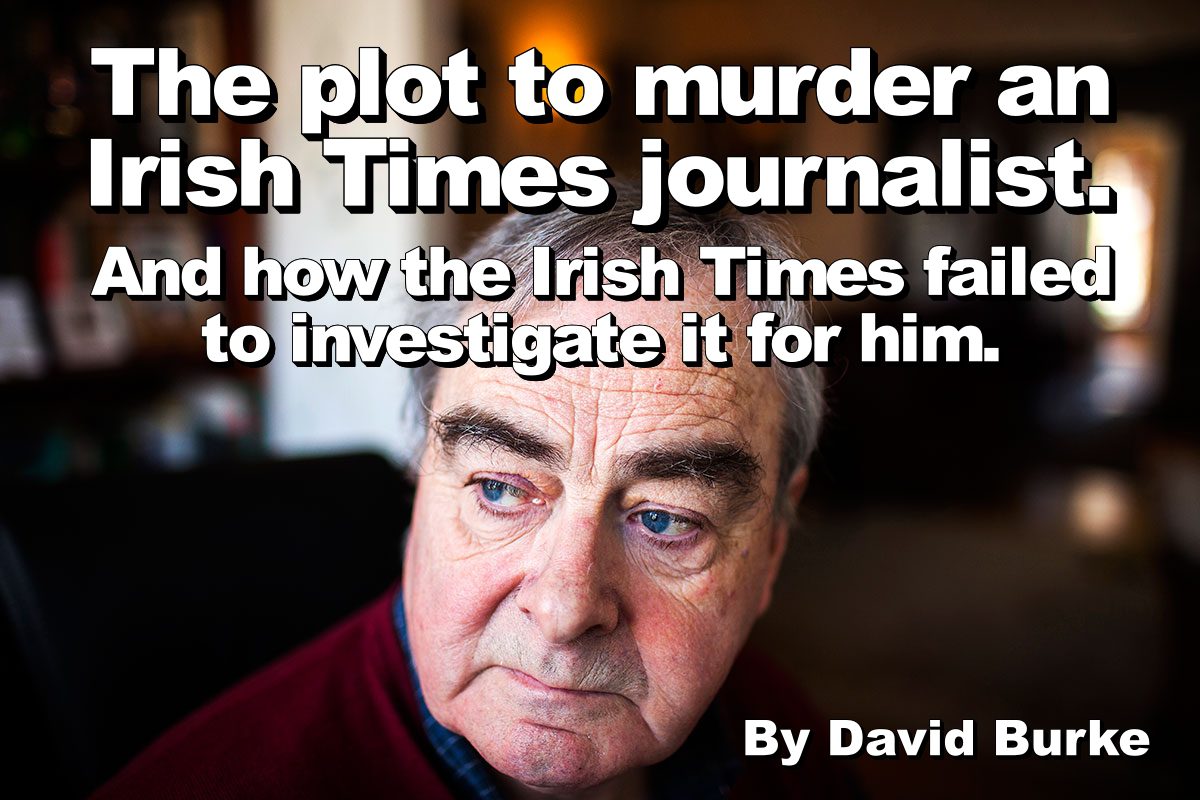
Ed Moloney, who passed away last October, served as Northern editor of The Irish Times, 1981-85. He wrote a weekly column titled ‘Northern notebook’ for the paper.
On 21 October 2025, The Irish Times lauded Moloney and quoted a family statement revealing that he ‘was briefly a member of the Official IRA – in its political phase – during his early years in Belfast’ and later ‘survived several assassination attempts by that same group’. There was a lot more to tell, all of which was left out of the paper’s obituary.

In 1982, Moloney submitted a Northern Notebook report exposing crimes committed by the Official IRA (OIRA), the paramilitary wing of Sinn Féin The Workers’ Party. A supporter of the OIRA within the paper suppressed it. Behind Moloney’s back, a copy of the report was passed to the OIRA.

The content of the article later appeared in Magill magazine.
Inflamed by an article about a plot to murder him, which appeared in Village magazine, in 2020, Moloney wrote to Paul O’Neill, the then editor of The Irish Times, stating,
‘I heard about [a] threat to kill me from the UDA when one day I got a phone call [in 1982] asking me to come over to their Gawn Street headquarters in east Belfast where, in an upstairs office, I was told that the UDA had received information that I was an intelligence officer for the INLA. However they had checked the story and found it to be untrue. My life was therefore no longer in danger.‘
The OIRA ran rackets in Northern Ireland in liaison with Davey Payne of the UDA. Moloney proceeded to tell O’Neill:
‘I strongly suspect that OIRA told the UDA that I was an INLA intelligence officer in the hope they would kill me, and that Davey Payne was .. the conduit through which this false claim was transmitted. I suspect it was no accident that at my meeting with the UDA, Payne did most of the talking.‘
Moloney also discovered, in more recent times, that after the Magill article had been published, the then OIRA Belfast commander, declared that ‘Moloney will have to go‘.
In his letter to The Irish Times, Moloney criticized the ‘unhealthy relationship’ the publication had ‘enjoyed’ for
‘far too long with the Official Republican movement, an association which led some of your employees to believe they could behave as they apparently did towards me.‘
Moloney called on the paper to investigate these allegations.
The Irish Times responded on 16 September 2020, dismissing the request due to the elapse of time and defending its journalistic integrity.
In response to this, Moloney pointed out that the lapse of time had not deterred Irish Times editorials urging inquiries into Bloody Sunday (1972); the Dublin-Monaghan bombings (1974); the murder of Seamus Ludlow (1976); the Stalker affair (mid-1980s) and the Patrick Finucane murder (1989).
Some additional information about the infiltration of the paper by the Official IRA and the plot against Moloney can be read by clicking on the following link: Our Man in Dublin. [WebBook]
The Magill article based on Moloney’s research is also reproduced in full at the end of ‘Our Man in Dublin’.
