
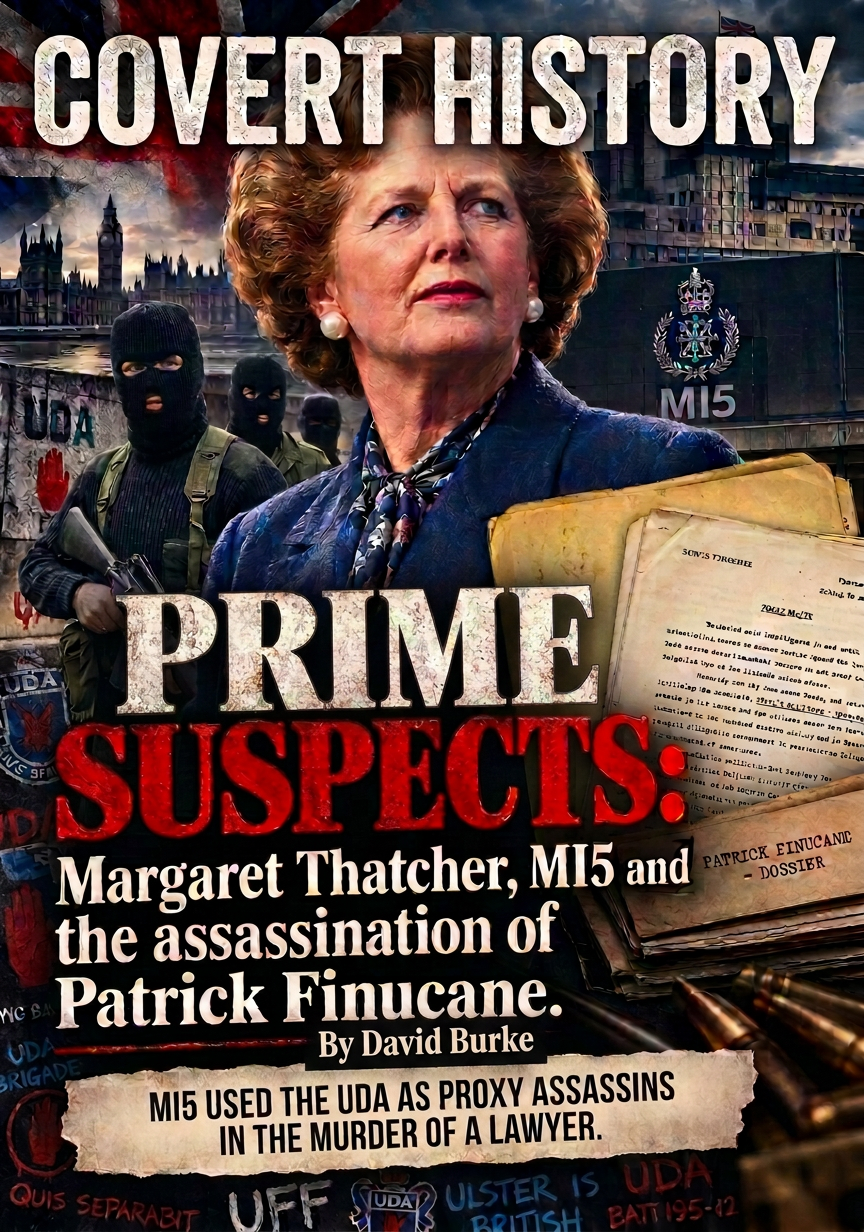
Introduction:
Margaret Thatcher, MI5 and the cold-blooded murder of an Irish lawyer.
The independent public inquiry into the murder of Patrick Finucane hopes to examine ‘to what extent were his killers encouraged, assisted, protected or directed’ by the British state, at least according to barrister Matthew Hill, its lead counsel.

He added that,
‘There is no more serious question in a democratic society governed by the rule of law.’
Patrick Finucane was murdered by the UDA on 12 February, 1989. Finucane, a highly regarded 38-years-old Belfast solicitor, was shot 14 times by two masked Ulster Defence Association (UDA) gunmen who sledgehammered their way into his house in North Belfast. His wife Geraldine was also injured during the attack, which took place while the couple was enjoying a meal with their young family.

The murder was ordered by Tommy ‘Tucker’ Lyttle of the Inner Council of the UDA. The evidence that Lyttle was an agent of MI5 (a department of Britain’s Home Office) is thick on the ground – and is the main focus of this webbook.
Lyttle is the domino which, if it falls, will topple the cover-up and expose those in officialdom behind the plot.
There is ample evidence as well that the UDA was urged to commit the crime by RUC Special Branch officers. MI5 and the RUC Special Branch worked hand in glove.
The British Army’s Force Reconnaissance Unit (FRU) was also deeply involved. The FRU has long since admitted that it ran Brian Nelson, the Director of Intelligence of the UDA. He was a key part of the murder plot.
The FRU and MI5 were partners.
All of this explains why Matthew Hill outlined to the tribunal the known involvement of British Army and RUC Special Branch agents in the murder, and made reference to a passage in a report by Sir Desmond de Silva, in 2012, to evidence that suspected paramilitaries arrested in connection to the killing were congratulated by RUC officers.

Hill said there was no evidence that Finucane was a member of the IRA but said his UDA killers may have wrongfully believed that he was because of information peddled to them by the security forces.

Hill also recalled how the report of a previous inquiry had caused Britain’s former PM David Cameron, 2010-2016, to state that it showed ‘frankly shocking levels of collusion’.
Hill promised that the
‘alleged direct culpability of an RUC officer, or RUC officers, in the decision to murder Patrick Finucane, is a matter that this inquiry will examine and examine thoroughly.’
It will also examine the role of Brian Nelson, who is known to have been involved in targeting Finucane, and the extent to which MI5 oversaw the work of the FRU.
Hill said the inquiry would consider a possible ‘stark explanation’ for the interaction between the security forces and the UDA, namely that they were the consequence of ‘a deliberate and directed action to use the UDA as a proxy to murder a lawyer who had incurred the enmity of the state’.
Time will tell if this proves to be a lot of hot air. Even with the best will in the world, the tribunal will not succeed without the cooperation of MI5 and the British Army. There is every possibility that it will fail like the Savile Inquiry (the Bloody Sunday investigation which ignored the motive behind the massacre of innocent citizens in Derry, namely that it sprang from a military-MI5 plot to provoke a street battle with the IRA) or the bumbling Independent Inquiry in Child Sexual Abuse (the pointless meander into VIP sex abuse which ignored allegations about Lord Mountbatten, James Molyneaux MP, Prince Andrew and other VIPs) or the abjectly corrupt travesties that include Hart (Kincora) and Widgery (the original Bloody Sunday inquiry).

The only reason for optimism thus far with regard to the Finucane Inquiry is the involvement of Baroness Nuala O’Loan DBE MRIA, the first Police Ombudsman for Northern Ireland.


Various British governments attempted to prevent a judicial inquiry into the murder.
Why?

In 2019, the Supreme Court in London ruled that the various British governments had failed to investigate the murder properly. The only tenable reason for this was that it was organised by the state, i.e. the RUC Special Branch and MI5.
But did it go even higher?

More than two decades ago, a retired Canadian judge, Peter Cory, investigated the slaying. During his inquiry, MI5 officers broke into his office and stole some of the evidence he had accumulated.
Significantly, Cory told Geraldine Finucane that he had seen a document relevant to her husband’s case marked ‘for Cabinet eyes only’. Mrs Finucane knows no more about the document than what Cory told her. This raises the distinct possibility that her husband’s case was discussed in Whitehall in sinister circumstances before the murder. These revelations formed part of BBC NI’s compelling seven part Spotlight series, ‘The Secret History of the Troubles’. The mainstream media in Britain ignored the revelations.
Put simply, the finger of blame should be pointing at Margaret Thatcher as well as MI5 and the RUC. It now looks like Thatcher gave MI5 the green light to murder a perfectly respectable, law-abiding lawyer. If Thatcher and her circle did not order the murder, why were the top echelons of the Tory Party so terrified of an inquiry?
Would MI5 have killed a lawyer behind the back of Margaret Thatcher?

MI5 was led by Sir Patrick Walker at the time the assassination was planned and executed. If MI5 was involved, it was he who called the shots – literally.

When David Cameron was in 10 Downing Street, he told the Finucane family that he could not order a public inquiry into the scandal. When asked why not, by Finucane’s brother Martin, he turned to Mrs Finucane and said,
‘Look, the last administration couldn’t deliver an inquiry in your husband’s case and neither can we.’
According to Cameron, this was because,
‘there are people all around this place, [10 Downing Street], who won’t let it happen’.
As he was saying this, he raised a finger and made a circular motion in the air.

Theresa May, who was Cameron’s Home Secretary between 2010 and 2016, did not establish a proper inquiry either when she took over at 10 Downing Street.
The opportunity to call one passed to Theresa May’s successor, Boris Johnson, and his Home Secretary, Priti Patel. Unsurprisingly, they proved every bit as disdainful as Blair, Cameron and May, and persisted with the cover-up.

Finally, on 11 September 2024, Hilary Benn, the Secretary of State for Northern Ireland in Keir Starmer’s Labour Party cabinet, announced the establishment of an independent inquiry into the murder. This decision followed a long campaign by the Finucane family and their supporters.
Now, in 2026, the inquiry is up and running. But is it too late? Thatcher is dead. Thatcher’s then Home Secretary, Douglas Hurd was born in March 1930, and will probably avoid having to face a grilling due to his age. He published a 524 page autobiography in 2003. Unfortunately, there was no entry under the word ‘Finucane’ in its index.
William Stobie and Brian Nelson of the UDA are dead. Both were involved in the killing.
Sir Patrick Walker of MI5 passed away in 2021.
Stella Rimmington died in 2025. At the very least, she knew the details of the operation. She became deputy Director-General in 1990, and Director-General of MI5 in 1992 after Walker stepped down.
The evidence that continues to accumulate points to the probability that Finucane, a skilful lawyer, was targeted by the British State because he had mastered the intricacies of the Diplock Court system in Northern Ireland and was representing his clients to the best of his very considerable abilities. Many alleged Republicans were walking free from court. In the mind of Thatcher and others in London, he was or may as well have been a member of the Provisional IRA in consequence whereof his death warrant was approved. In these circumstances, the task of assassinating him was passed to Walker and his cutthroats at MI5.

Finucane was not a terrorist. On the contrary, he represented both Republicans and Loyalists. Who ever heard of a Provo securing the freedom of the Loyalist enemy – ones allegedly involved in terrorism? Moreover, he was married to a Protestant. Finucane was perfectly innocent of any involvement with the IRA, although he was vilified as a member after his death.
Insofar as the UDA was concerned, the kill-order was issued by Tommy ‘Tucker’ Lyttle, the UDA’s ‘brigadier’ or commander in West Belfast. Ian Hurst, who served with the then top-secret Force Reconnaissance Unit (FRU) of the British Army, has stated ‘with cast-iron certainty ‘ that Lyttle was a British agent who was ‘handled‘ by the RUC’s Special Branch using the codename ‘Rodney Stewart‘.
Lyttle himself confirmed to an internal UDA inquiry that he had been a British agent, arguing that he had exploited the relationship to help the UDA.
He also admitted his role to his son.
The RUC Special Branch served as MI5’s foot soldiers in Northern Ireland. Lyttle told author Greg Harkin that his RUC ‘handler’ had asked him:
‘Why don’t you whack Finucane?‘
Lyttle’s role as a British agent also saw him participate at the heart of the paedophile ‘honeytrap’ operation which swirled around Kincora Boys’ Home in Belfast in the 1970s. Lyttle was working for MI5 from the mid, if not early, 1970s.
The next three sections of this webbook will examine the sordid links between MI5 and the UDA, especially those involving Lyttle, before returning to the specifics of the murder of Finucane in Part Four. Part 3 will also examine aspects of collusion with the UVF.
Contents

PART 1: TOMMY ‘TUCKER’ LYTTLE AND KINCORA
1. TOMMY ‘TUCKER’ LYTTLE, THE UDA’S WEST BELFAST BRIGADIER
The late Tommy ‘Tucker’ Lyttle is a pivotal figure in the assassination of Patrick Finucane. His MI5 file, if produced to the Finucane Tribunal, will reveal the full sordid truth about {i} his role as a British agent; {ii} MI5 blackmail operations involving child abuse and {iii} MI5-UDA collusion in murder.

Lyttle was born in 1939. His son John, who became a journalist, has written that,
‘At first my father had no abiding interest in politics – it wasn’t a job requirement for machinists at Mackie’s foundry in the late Sixties – but his family was something he was fiercely protective of. The one he came from: three sisters, one brother, his adored mother and father, and the one he created and was dead centre of, as only an Irish patriarch can be: three sons, two daughters. My father and mother entered wedlock young – he was 18, Elizabeth Baird was 19 – customary at our end of the social scale. My siblings and I arrived more or less every two years – also customary. ‘

John Lyttle has also explained that his father was seen by his family as ‘smart, very smart ‘ – he did well at school and could have gone to grammar school on a scholarship but for a shortage of funds.
Lyttle became involved with the UDA after a bomb atrocity in Belfast on 11 December, 1971. John Lyttle has quoted his sister Linda, about how this happened:
“‘There was an IRA bomb on the Shankill and my Ma and Elaine nearly got blown up. That started me Da off”. She hesitates, then says something that makes perfect sense. “Two kids were killed. The first time kids were killed. Me Da took it… personally. Don’t you remember?” But, John Lyttle goes on, “I don’t remember. I have forgotten, or buried, much, a mountain of clippings, snapshots and unforgiven images: the gunman with the high-velocity rifle who aimed for someone else and nearly got my Da, the kidnapping that landed him on the front page of the Belfast Telegraph, a pistol to his head, midnight raids by police, various peaks and troughs as palace revolutions repetitively rocked the Ulster Defence Association. Old guard vs young turks, hardliners vs soft centres – they fall out, kill, regroup, splinter, my father somehow surviving each coup. But I instinctively know that what Linda says is true“.‘

By 1972 Lyttle had become a lieutenant colonel in the UDA’s ‘C’ Company, 2nd Battalion, Shankill Road. In 1973, he ran unsuccessfully for election to the NI Assembly. In November 1974, he visited Colonel Ghaddafi in Libya. In 1975, he rose to become the Brigadier of West Belfast Brigade, the UDA’s spokesman and a member of the Inner Council. He had a virtual free hand in running UDA operations in his domain and enjoyed a very high public profile.

2. MURDER INC, THE UDA’s INNER COUNCIL
The Inner Council of the UDA came into existence after a meeting on 15 May, 1971, in the dining hall of North Howard Street school. Approximately 300 representatives from the various Loyalist vigilante groups sprinkled around NI attended the gathering. The Inner Council would soon organise a network of Loyalist murder gangs.
The UDA was divided into seven brigade areas: North Belfast, East Belfast, South Belfast and West Belfast, South-East Antrim, Londonderry and the Border Counties. The brigades consisted of battalions, companies, platoons and sections. The structure was ruled over by the Inner Council which was made up of the seven brigadiers and their various ‘staffs’. At one stage it consisted of over 50 people but was later streamlined.
3. WILLIAM McGRATH, THE ‘BEAST OF KINCORA’ AND THE BIRTH OF THE UDA
The delegates at North Howard Street included UVF and Tara members. William McGrath, the Leader of Tara, a Loyalist paramilitary organisation, was deeply involved. He produced a document which has been called the birth certificate of the UDA.
McGrath was close to two senior UDA leaders, Davey Payne and John McMichael.

McGrath became Housefather at Kincora Boys’ Home a few weeks after the North Howard Street meeting. It is highly likely that he had become a British agent prior to the North Howard Street convention.
If the Finucane Inquiry is serious about examining the links between the UDA and the British State (here meaning the Northern Ireland Office (NIO), the Home Office, MI5, MI6 and Military Intelligence), it should have a look at the orders issued by the state to McGrath about the amalgamation of the various Loyalist grops into the UDA.
4. THE ‘ROMPER ROOM’ TORTURE AND MURDER NETWORK
Tommy Lyttle was also a ruthless and violent man. Space does not permit a description of the appalling violence meted out by the UDA to random Catholic victims in the 1970s. Davey Payne of the UDA established a string of human abattoirs known as ‘romper rooms’ where random Catholics, abducted from the streets, were tortured and murdered, often for the amusement of drunken UDA men and their girlfriends.

As a senior UDA leader, Lyttle was one of the men who was fully aware of these atrocious murders.
The UDA and other Loyalist groups were always deeply penetrated by the British State.
It is inconceivable that MI5 did not know who was running the Romper Rooms, but they didn’t intervene. From MI5’s perverse perspective, they undermined support for the IRA, interfered with the ability of the IRA to conduct operations, and kept Catholics off the streets at night.

Lyttle’s son knew just how violent his father could be. He has written how, when he was a boy, he once searched
‘through the pockets of my father’s overcoat for loose change. We kids are not supposed to, but we do. I plunge my hand in and feel this wet, wringing wet. I drag it out. It’s a handkerchief. With an embroidered ‘T’. The linen is as red as the red hand of Ulster, soaked with blood, saturated with blood, dripping with blood. I squeeze, though I shouldn’t. The red trickles through my fingers. I watch, repelled and exhilarated. My father is in the front room. I hear football match results. He isn’t injured, hasn’t said anything about a nosebleed, a fall. He hasn’t mentioned a friend’s accident. I return the handkerchief, go to the bathroom, wash my hands ‘.

John Lyttle has also written about an incident when he was ‘nine or ten ‘:
“The wee small hours of the morning. I come downstairs. I want a drink of water. In the front room a man is tied to a chair. He’s battered and bruised. My father is there with how many others? Three? Four? I stare until I’m noticed. “What do you want?” my father asks. “A drink of water”. “Get him a drink of water”. I continue to stare until my water is brought. I drink it on the spot. “Not so fast”, my father cautions. I hand the glass back and tread quietly back upstairs and climb into bed beside my brother Bill. By daylight, I’m certain it’s a dream. It must be: I’ve dreamt of it ever since.‘
5. HER MAJESTY’S CHILD PIMP, TOMMY LYTTLE TRAFFICS RICHARD KERR.
Richard Kerr was the victim of child sex abuse. He sued the Crown for what happened him. The Crown was afraid to let his case reach court and agreed to pay him £100,000 plus legal costs. The role of Tucker in the Kincora scandal was one of the issues Kerr intended to raise. MI5 and MI6 used Kincora Boys’ Home as a paedophile ‘honeytrap’ to collect ‘kompromat’ about Loyalist politicians and paramilitaries.
Kerr was a resident at Kincora Boys’ Home between 1975 and 1977. In September 1976 or thereabouts, Kerr was picked up at Kincora by two men who were driving a Volkswagen vehicle. Since the men used the front compartment boot for storage, they were undoubtedly driving a VW Beetle. Kerr was put in the front passenger seat. He was only 15-years-old yet had been a victim of the Anglo-Irish Vice Ring (A-IVR) – of which Kincora was a part – since he was eight.

The two men drove to a hotel on the Antrim coastline which overlooked the sea. Kerr recalls that it was like a ‘big old house’ with stone statutes of ‘lions or other animals at the front of it with a country road leading up to it’. His driver was called Eddie and the trip seemed to him to have taken a few hours. After the group reached the hotel, Kerr was left waiting in the lobby area while the men went looking for another man. After about 20 minutes they returned with Lyttle and the group set out in the Volkswagen again for another destination. The men addressed Lyttle as ‘Tommy ‘ openly in front of Kerr. Indeed, it would have been pointless to try to disguise Lyttle’s identity due to his high profile.
Kerr was supplied with a number of glass bottles containing Coca Cola which had been spiked. The effect of the liquid – whatever it contained – was to render him drowsy. He soon ‘felt out of it but not fully out of it ‘ and began to drift ‘out of reality like being hypnotised’.

When they reached their destination – a hotel in the ‘middle of nowhere – it was still daytime. There was a field to the rear of it. He recalls seeing ‘cows and sheep‘ around it. He believes it may have been near Newtownabbey. Kerr was ushered to a small room where he was handed over to an abuser, a man in his 30s with a NI accident who used Northern slang words. Despite his drowsiness, Kerr knew full well what was going to happen to him next. The man asked him to take off his clothes and ‘things like that‘. The rape ordeal that ensued lasted between three and five hours with breaks in between during which Kerr was provided with a sandwich and taken out of the room. Sometimes his abusers gave him gifts to assuage their guilt or in a sick attempt to ingratiate themselves with him. This man gave him nothing.

It was dark by the time the nightmare ended. Kerr was then driven back to Kincora. No stops were made on the return journey. They got back to Kincora at approximately 9.30 pm. Kerr re-entered the premises through the front door and went into the TV room. A number of boys were present. William McGrath, the ‘housefather’ was on duty. The Warden, Joe Mains, who lived at Kincora, was also present. Neither of them asked him a single question about where he had been.
6. TOMMY’S GOON SHOW
Kincora was a brutal institution. In addition to being passed around to depraved perverts, Kerr was also bullied – and a lot worse – by some of his fellow residents. Some of the friction arose from the fact he was allowed out between Thursday and Sunday although this invariably meant he was being subjected to sex attacks. Kerr must have mentioned this during his road trip with Lyttle because the UDA brigadier sent down two of his ‘goons‘ to intimidate the boys who were making life a misery for him at Kincora.

Both Mains and McGrath were present when the ‘goons’ bounded in but did nothing to impede them. The intruders set about terrorising Kerr’s tormentors. Witnesses to this event are still alive. After the intrusion of the two ‘goons’, even McGrath became wary of Kerr. This says a lot because McGrath was someone who was prepared to murder. McGrath was close to Davey Payne – the man who had invented the ‘romper room’ system – and once asked him to kill Roy Garland, the former Deputy Leader of Tara. He wanted Garland killed around 1973 because he had begun to talk about McGrath’s abuse of boys.

7. THE ENGLISHMAN WITH THE SUEDE FLARES.
Kerr encountered Tommy Lyttle on one further occasion. Once again he was taken from Kincora to a hotel. This time he was escorted by the two ‘goons’ who had barged into Kincora. Their destination was a bar where they linked up with Lyttle. This time Kerr was destined for a man from the North of England whom he had never met before. He described him as a ‘nice person ‘; someone who was ‘well-dressed ‘ in a fashionable pair of flared trousers. The flares were made from suede. He remembers this vividly as he got to touch them after the man asked him to remove his trousers as part of the ritual of the abuse of that day. Afterwards, Lyttle and his ‘goons’ returned him to Kincora.
8. THE WHIP AND SADDLE BAR AT THE EUROPA HOTEL

Kerr would encounter the UDA ‘goons’ again at the ‘Whip and Saddle’ Bar in the Europa Hotel in Belfast where Mains often brought him to be abused and later secured him a job through his friend Harper Brown, the then manager of the hotel.
The man with the flared trousers turned up at the hotel at least one night.
The Whip and Saddle was well known in journalistic circles as a venue frequented by Unionist politicians with a sexual interest in juvenile males. Some of the journalists – including some from the Republic – made ribald jokes about the venue, especially by reference to its name.
Kerr would also meet the UDA ‘goons’ at a Loyalist drinking den in Belfast.
9. THE GIRTON LODGE HOTEL
Lyttle also socialised at the Girton Lodge hotel which was a short walk from Kincora Boys’ Home. Richard Kerr was abused by John McKeague, a notorious Loyalist killer, at the Girton on three or four occasions. Kerr would receive a phone call ordering to go down to it, and would then walk down and arrive in about six minutes. There was a reception area on the ground floor with a small corridor off it which had rooms. The abuse took place in these rooms. There was also a bath at the venue. Kerr was given alcohol prior to the abuse he suffered at it.
McKeague, Lyttle and their associates would gather at the hotel. There was an area where cars could park out of sight from the road. All the abuse took place on the lower level.

There is no suggestion that Lyttle himself was an abuser. Indeed, no one has ever claimed anything remotely of the sort. He presumably mixed with the likes of McKeague for network and intelligence gathering purposes, something that suited both his UDA and MI5 associates.
Colin Wallace, a PYSOPS officer at British Army HQ NI, was aware of some of what was going on at the Girton and other hotels. Wallace wrote up and submitted this information to his superiors at British Army HQ NI in 1973 seeking clearance for the disclosure of it to the press. A second hotel was the Park Avenue, a third was called The Queens Court. One of the reasons General Peter Leng, one of the most senior British Army officers in NI in the 1970s, became worried about the Kincora allegations in 1974 was that he had been told that Kincora inmates were being lured into the UDA’s paramilitary activities. He also was aware that the two hotels where paedophile activities were taking place were also used as meeting places by the Leadership of East Belfast UDA. He also was aware that the Girton and Park Avenue were used as meeting places by the East Belfast UDA. Indeed, the UDA had an office approximately three blocks away.

In September 1975, Wallace was disciplined for allegedly passing a restricted document to a journalist. During his disciplinary hearing, he wrote to his former boss at Army HQ NI referring to
‘attempts made by the Security Service to discredit various Loyalist politicians, including the Rev Ian Paisley, by linking MPs with Loyalist paramilitary figures involved in homosexual prostitution at children’s homes in Belfast‘.
Wallace gave copies of these documents to the HIA Inquiry in 2016 though it ignored them. Hart reported in 2017. He concluded that the state did not know about the abuse at Kincora. There is a mountain of evidence – including documentary evidence – that the state knew about the abuse. See Andy Burnham (Webbook)
Joe Mains, the Warden (i.e. boss) of Kincora was involved in paedophile activities at these hotels too. William McGrath lived very close to it.
10. TOMMY LYTTLE, A HINT OF REGRET?
John Lyttle, who is gay, has written about the moment when his father ‘sat on my bed, weeping. I had just reiterated the fact of my sexuality, and my reward was deep and sore sobbing’. The revelation would contribute towards a ‘distance’ between father and son.

Tommy Lyttle’s reaction might have been prompted in part by a measure of guilt about the sexual assaults perpetrated by older men on juvenile males, in which he was complicit.
PART 2: ALBERT ‘GINGER’ BAKER AND THE UDA’S KNOWLEDGE OF KINCORA
11. A CONFIRMED SPY, ALBERT BAKER AND THE MILITARY REACTION FORCE (MRF)
The Inner Council of the UDA knew about the sex attacks on children at Kincora from at least 1972.

Albert ‘Ginger’ Baker was a British soldier who infiltrated the UDA for the British Army’s Military Reaction Force (MRF). The MRF was created by Brigadier Frank Kitson. Kitson was obsessive about intelligence gathering. No fact was too small for his attention as a string of books he wrote about intelligence gathering attest. It is inconceivable that he did not know about Kincora through the MRF, Baker and MI5 and MI6.

Michael Taylor, who worked in the intelligence section of Lisburn, told me that Baker was a British agent. Taylor saw reports from Baker to his handlers.
Sadly, Mike Taylor passed away in July 2026.
Chris Moore of BBC NI, author of ‘The Kincora Scandal‘, managed to track William McGrath down to Ballyhalbert, on the Coast of County Down, after his release from prison for the sex attacks he had perpetrated at Kincora. Moore extracted an amazing comment from McGrath who said,
‘This whole matter does not stop at Lisburn’. (p210)
Lisburn, of course was home to a swathe of intelligence organisations including Military Intelligence, MI5 and MI6. This is consistent with a mountain of evidence which points to the fact that Kincora and other parts of the Anglo Irish Vice Ring (A-IVR) were ultimately controlled by officials at the Home Office/MI5; the Foreign Office/MI6 and officials at Downing Street.
Albert Baker is still alive and living in Belfast. He was not interviewed by the Hart Inquiry which concluded in 2017 that the abuse of the boys at Kincora had been restricted to the home itself and that the only perpetrators were members of its staff; moreover, that MI5, MI6 and military intelligence had not known about it.

According to Baker’s family, his handler was a ‘Capt. Bunty’ whom he met in a Belfast coffee bar. Not only did Baker succeed in joining the UDA, he became a bodyguard to its Inner Council and monitored its leaders including Tommy Herron.
Baker had enlisted in the Royal Irish Rangers in Belfast in March 1970 at the age of nineteen with a character reference from Ian Paisley’s wife Eileen. He was sent for training in Ballymena, where he won prizes as a crack shot. From there he went to Warminister in England where the Regiment’s 2nd Battalion was based. After Warminister Baker received special forces training at Fort Hood, Heuston, and may have become a member of the SAS. He was then sent to the Persian Gulf where the SAS was being deployed. He returned to Belfast in 1972. At first, he told people he was on leave from the British Army; later that he had deserted from it. He may have been on a mission to penetrate the UDA all along.
Baker became a part of a barbarous torture and murder gang controlled by the Inner Council. He slipped out of Belfast at some stage before May 1973 with a lot of blood on his hands. One of Baker’s victims was Philip Anthony Faye, a twenty-one year-old waiter who had been serving the UDA Inner Council drinks at the Girton Lodge Hotel on 18 August, 1972. He was murdered on the orders of Tommy Herron. Baker has admitted that: ‘There was me, V, ‘R’, and a few others doing security in the hotel. We’d move into the hotel and take the waiters’ coats and things. We’d be armed and we’d be walking through the hotel and down the lobbies and the corridors underneath. So the Inner Council was in this room and Faye came in with drinks. Tommy Herron found out the geezer was a Catholic and ordered his assassination in case he’d overheard anything. I went down to Island Street and assassinated him’.

12. THE ‘BROCCOLI’ CONFERENCE
On 24 May, 1973, a meeting took place in London. It was attended by Major General Frank King, the General Officer Commanding Northern Ireland (GCO NI), and the Vice Chief of the General Staff (VCGS), Sir David Fraser. Fraser was based in London. A declassified record of the meeting reveals that:
‘We have now got good intelligence on [Tommy] Herron [of the UDA] and the Protestant extremists’.
Baker was Herron’s bodyguard, something that is consistent with him being the source of this information.
The document also reveals that Fraser brought GOC King
‘up to date and discussed the problem of protection of the “source” of their information’.
Baker fits the bill as the ‘source’ perfectly. He certainly would have needed ‘protection’ from his erstwhile UDA colleagues who by then must have suspected he was a spy who had been privy to all of their secrets – including orders to murder – after he had disappeared from Belfast.
The source was codenamed ‘Broccoli’. Tom Griffin, a highly astute and intelligent observer of these matters, was the first to deduce that since the recipient of the information about ‘Broccoli’ was Major General King – who was still in charge of the British Army in NI – ‘Broccoli’ must have been an agent who had recently served in NI. Mike Taylor subsequently confirmed that Griffin was right. Baker was a British spy and his codename was indeed ‘Broccoli’.

‘Broccoli’ cannot have been James Miller, another British soldier who also penetrated the UDA as he was not uncovered as a spy until the following year.
Griffin may also have struck the nail on the head with the observation that Baker’s ‘name would account for the Broccoli designation in a most apposite way, since he shared a first name and initials with James Bond producer Albert ‘Cubby’ Broccoli’.
After leaving NI, Baker suffered some sort of a breakdown. His direct involvement in a string of brutal tortures and murders may have contributed to this. A short while later he went to Warminister County Police Station to confess to murder. From this point on damage limitation became the order of the day: MI5/6, the MRF and the RUC would be protected though a few UDA killers would go on trial – and be acquitted – while Baker was locked away until 1992.
Tommy Herron was murdered by Loyalist opponents as part of an internal UDA feud in September 1973. Ian Paisley led prayers outside his home on the day of his funeral.
13. BAKER REVEALS WHAT THE UDA KNEW ABOUT KINCORA TO KEN LIVINGSTONE
In July 1988, Baker told Ken Livingstone, who was a Labour MP (and later Mayor of London) what he knew about Kincora.
‘The whole Inner Council of the UDA knew about it’, he revealed,
‘but no Inner Council members were involved in it. There were politicians and senior Northern Ireland Office officials involved in it. I know one who’s in the House of Commons. He’s one of your own men [i.e. the British Labour Party].”
He also revealed that:
‘Well, as far as they were concerned it was being organised by British Intelligence and they kept away from that. They knew the intelligence services were running it.‘

William McGrath was particularly well known to the Inner Council. He was friendly with UDA men like Davey Payne and John McMichael. Indeed, McGrath had been pivotal in establishing the UDA. He also ran his own paramilitary organisation called Tara and had connections to the UVF. The UVF fell out with McGrath in 1971 because of his boasts about his links to British Intelligence. All of this made it likely – if not imperative – for the UDA to monitor McGrath who had been assigned a job at Kincora in 1971 and was close to other paramilitaries and politicians such as Ian Paisley, James Molyneux and Knox Cunningham. Hence, Baker’s assertion that the Inner Council knew about Kincora is entirely credible.
‘I know for an actual fact that a Conservative MP was involved’, Baker further informed Livingstone.
‘The Inner Council members discussed Kincora and knew who was there because they had them under surveillance. The UDA have photographs of the people going into Kincora, of politicians, Unionist politicians. The Inner Council knew who was operating behind them. They knew they could be arrested, but given what they knew they could never be charged or face imprisonment for any length of time‘.
The Inner Council’s knowledge of Kincora would also explain the precautions Tommy Lyttle took in and about the transport of Richard Kerr to his abusers. Lyttle knew better than to have been spotted anywhere near the shameful premises.
14. BAKER’S DEAL WITH THE PAEDOPHILE TORY MINISTER OF STATE FOR NORTHERN IRELAND.

Ted Heath appointed Sir William Radcliffe Von Straubenzee MBE as the Deputy Secretary of State for NI in 1972. Just like Heath, Van Straubenzee was a lifelong bachelor and a paedophile. His role as a child molester emerged in July 2015 when ‘formerly’ missing files about paedophile politicians were ‘discovered’ in London at the Cabinet Office. The files, which included details about Van Straubenzee, were sent to the Independent Inquiry into Child Sex Abuse in London.

Liam Clarke published a story in January 2015 in the Belfast Telegraph describing how a pair of whistleblowing RUC officers had revealed their knowledge of visits to Kincora by a Tory MP to him. Van Straubenzee is a likely candidate as the Tory MP.
Indeed, Baker’s probable knowledge about Van Straubenzee’s visits and his – Baker’s – work for the MRF offer likely explanations as to why Baker was able to secure a meeting in prison with Van Straubenzee after his conviction. At the time Baker was trying to secure a deal with Van Straubenzee about where he would serve his prison sentence.
PART 3: OTHER PARTS OF THE MI5-UDA JIG-SAW
15. JAMES MILLER, ANOTHER MI5 AGENT INSIDE THE UDA WHO KNEW ABOUT KINCORA
Other pieces from the UDA-Kincora jig-saw have fallen into place in recent years. In the late 1980s, James Miller, another ex-British soldier, revealed to journalists that he had served as an MI5 agent inside the UDA. In 2017, the Hart Report stated that MI5 had acknowledged that Miller had been an MI5 agent and someone who knew about the sexual proclivities of William McGrath.

Miller had also spied on McGrath for MI5. Unfortunately, Judge Hart made a calamitous error in his reporting of Miller. He concocted a speculative and nonsensical notion – purely from his own imagination – in 2017 that MI5 had not reported what Miller told them about McGrath to the RUC – as they were obliged to do by law – because they wanted to protect Miller’s cover. Hart did not even bother to ask MI5 if his theory might be true. Sadly, it was an impossibility because Miller fled Northern Ireland in 1974 when the UDA discovered his role as a spy. The Kincora scandal was not exposed until 1980. So why did MI5 keep silent between 1974 and 1980? Unfortunately, the best that can be suggested is that Hart was not a man to pay attention to detail (as other astonishing mistakes in his report attest). What is worse, is that he took every opportunity to concoct excuses for MI5 while treating victims of abuse such as Richard Kerr with disdain. Beyond question, Hart was a man deeply out of his depth when it came to dealing with the world of dirty tricks. His report – in so far as Kincora is conerned – was a lamentable disaster.
16. THE SENIOR MI6 OFFICER JAMES ALLAN AND THE ‘RIBALD’ COMMENTS HE SHARED WITH THE UDA ABOUT THE VIOLENT CHILD RAPIST, JOHN DUNLOP McKEAGUE.

John McKeague, a long-time associate of William McGrath, was another member of the Anglo-Irish Vice Ring of which Kincora was a part. On 23 May 1975 Andy Tyrie, the Supreme Commander of the UDA – who is still alive – and another UDA commander, John Orchin, held a meeting with James Allan, a senior MI6 officer posing as a civil servant at the NIO. According to declassified British files, during the discussion there were
‘some ribald discussions of Mr McKeague’s proclivities’. (CJ/43734; also Margaret Urwin, A State in Denial at page 139.)
This clearly demonstrates that MI6 and the NIO knew a lot about McKeague’s sexual deviancy. Incredibly, although Margaret Urwin’s book came out in 2016 and McKeague featured in the index, Judge Hart ignored the research and the declassified document it was based on. His report emerged in January 2017. Nor did Hart ask Tyrie to provide an account of the meeting.
17. TOMMY LYTTLE, BRITISH INTELLIGENCE AND SOUTH AFRICAN GUN RUNNING
Tommy Lyttle told author Greg Harkin that British military intelligence had provided him with assistance in importing arms into NI from South Africa.

There are other indications of the assistance NIO officials afforded to Loyalist gunrunners. In 1977 William McGrath sent a member of Tara called Colin Wyatt to Holland to procure guns for Tara. Wyatt returned home and was debriefed in McGrath’s house by someone McGrath introduced to him as an Under Secretary from the NIO. It was far more likely that the individual was an intelligence officer.
Davey Payne and others were involved in Ulster Resistance gunrunning. See The Resistance Men (Webbook).

18. THE UDA PRESS RELEASE, A SHOT ACROSS THE BOWS OF MI5 AND THE NIO
There is yet further evidence of UDA knowledge of Kincora. On 21 February, 1982, at the height of claims that Kincora had been transformed into a child brothel by MI5/6, the UDA told the media that its eight-man Executive Committee was scheduled to meet the following day to decide whether or not to publish documents naming Unionist politicians involved in Kincora in its newspaper. The Belfast Newsletter reported a UDA spokesman who referred to a
‘wave of revulsion throughout Ulster about this case and people want to make sure that it never happens again. … Innocent people could be under a cloud of suspicion and may remain so until the names are released.‘
The UDA never released a single name. Tommy Lyttle, who was still a brigadier of the UDA at this time, knew that an effective inquiry would expose his name once the Kincora boys were interviewed (not as an abuser, rather a trafficker). In reality the statement was a warning shot aimed at MI5 and the NIO to ensure that the matter was covered-up.

Unfortunately, the Hart Inquiry did not secure evidence from the UDA, nor Albert Baker, whose interview with Ken Livingstone had been published in Livingstone’s book, ‘Livingstone’s Labour’ in 1989.
19. THE TRUTH IS A VOLATILE SUBSTANCE, WILLIAM McGRATH SPILLS THE BEANS ON MI5 TO JOHN McMICHAEL
Some Loyalist paramilitaries decided they would assassinate McGrath when he got out of prison. However, John McMichael, the UDA’s South Belfast Brigadier, ensured they didn’t, perhaps in return for McGrath having spilled the beans to him about what had really happened at Kincora. McGrath might have told him about Lyttle’s role in the scandal. McMichael was assassinated aged 39 by a car bomb in 1987.

McMichael believed Lyttle was a British agent. He shared his suspicions with his colleague Michael Stone, the Milltown Cemetery bomber. According to Stone:
‘McMichael constantly warned me about Tucker Lyttle and on this particular night he took the time to ram the point home. I distinctly remember him saying, “Tucker is a tout, so never tell him anything, don’t befriend him and keep him away from your UDA business”. He knew Lyttle had Special Branch handlers and was the weakest link in the UDA’s Inner Council. Also, he knew that Lyttle had a better and more intimate working relationship with the Special Branch handlers than his Loyalist brothers. McMichael wasn’t telling me anything I hadn’t discovered for myself. I had first-hand experience of Tucker the Traitor.’ (Stone page 98)
McMichael was killed by a bomb planted in his car on 22 December 1987. The Provisional IRA claimed responsibility. Ever since his death, rumours have abounded that the IRA was assisted by McMichael’s enemies inside the UDA with James Pratt Craig and Tommy Lyttle cited as conspirators. No hard evidence has emerged one way or the other.
20. TOMMY LYTTLE ASSUMES CONTROL OF A HIGH SECURITY PRISON
After the Milltown Cemetery bombing during which Michael Stone attempted to assassinate Martin McGuinness and Gerry Adams while they attended the funerals of IRA members who had been killed in Gibraltar by the SAS, Lyttle visited Stone in prison. Amazingly, Lyttle managed to cancel all other visits to the prison and secured exclusive use of the visiting centre for an exclusive interrogation of Stone. He demanded that Stone tell him the names of those on the Inner Council who had approved the Milltown Cemetery attack. Stone refused and came away more convinced than ever that Lyttle was a British agent. How else could he have managed to gain control of what was taking place inside the prison?
21. THE MAINSTREAM UK MEDIA IGNORED ALLEGATIONS OF COLLUSION AND LET THE PRACTICE CONTINUE UNABATED.

The collusion between British State actors such as MI5 and MI6 and Loyalist murder gangs did not end after ‘Ginger’ Baker left Northern Ireland. On the contrary, it continued unabated. In the early 1980s two whistle-blowers, Capt. Fred Holroyd and Capt. Colin Wallace, both of whom had inside information about state collusion with Loyalist murder gangs, went to the press with what they knew. While they received a lot of positive attention in the Republic of Ireland and elsewhere, they were denounced in some quarters in the UK by journalists. This was a tragic lost opportunity as their allegations about collusion – and a lot more besides – have been confirmed repeatedly ever since, most recently by the BBC NI’s excellent Spotlight series. There is no doubt they knew what they were talking about: the highly regard Barron Inquiry produced by Irish Supreme Court judge Henry Barron, confirmed that in 1974 Wallace had prepared a list of most of those who participated in the Dublin and Monaghan bombings including Robin Jackson, also known as ‘The Jackal’. Allegations about ‘The Jackal’ – based on details provided by Wallace and Holroyd – appeared in the Dublin based magazine The Phoenix as early as 25 May 1984 in a piece written by Frank Doherty. Jackson was named in the piece. Despite all of this and more, no one was ever charged with the Dublin bombings and ‘The Jackal’ was left free to murder at will. He died in May of 1998 from lung cancer aged 49. Overall, State collusion with Loyalist murder gangs deepened.


The high point of the push back against Holroyd and Wallace was an article in The Independent – a British newspaper – by an Irish journalist called David McKittrick in 1987. Wallace complained The Independent to the British Press Council. His complaint was upheld.
Two declassified 1987 documents from the Northern Ireland Office provide an insight into McKittrick’s scepticism and are reproduced here. They were written by Brian. A. Blackwell of the Law and Order Division of the NIO and sent to other government departments including MI5.


Blackwell (now deceased) was a Colonel in the Royal Signals. He had been stationed at Thiepval Barracks in Lisburn during the 1970s when he commanded 233 Signals Squadron as a Major. The Law and Order Division, as name implies, liaised with the various elements of the Security and Intelligence Services. The Division was later renamed the Security and International Liaison Division.
One of the exceptional high points of the Spotlight series was Mandy McAuley’s interview with Laurence Maguire, a former UVF assassin, about the murders of innocent Catholic families by Billy Wright’s UVF gang. Wright, better known as ‘King Rat’ was a British agent. His murder spree continued long after the likes of McKittrick and The Independent had attempted to debunk Holroyd and Wallace in respect of the earlier phase of collusion. Grotesquely, one of those who helped ‘King Rat’ was the notorious serial killer Robin ‘The Jackal’ Jackson. Holroyd and Wallace quite literally risked their lives in outing Jackson. Despite naming him to journalists and police, Jackson continued his murder spree.
Alan Oliver, another member of King Rat’s UVF murder gang refused to talk to Many McAuley when she confronted him at his place of business. He is presently refusing to talk about his past unless he is given immunity from prosecution. At the same time he claims that he has discovered God.
Ironically, Margaret Thatcher was one of those who told MPs in the House of Commons that collusion was not taking place. One letter – reproduced here – gives an indication of the type of assurance she fed her fellow Tory MPs. It is addressed to Sir Terence L. Higgins MP and dated 12 March 1987.

PART 4: THE FINUCANE ASSASSINATION
22. TOMMY LYTTLE AND THE FINUCANE ASSASSINATION
Tommy Lyttle remained in place as a British spy inside the UDA after the killing of John McMichael. He would become central to the 1989 murder of Patrick Finucane, something that was organised in tandem with the RUC Special Branch and MI5. The guiding hand of MI5 is the reason that Theresa May would not allow a sworn judicial inquiry into the Finucane murder when she was Home Secretary and as PM. Her lack of integrity was demonstrated after she persisted in this stance after the ruling of the Supreme Court in London on 27 February 2019. Her action was tantamount to being an accessory after the fact, politically at least.
There is no controversy about the fact that Tommy Lyttle – a British agent – issued the kill order. Indeed, we even know how he felt about it. According to the UDA’s Supreme Commander, Andy Tyrie, Lyttle was fearful that if he gave the order, he would become a target of IRA retaliation. Lyttle’s concerns are consistent with the fact that pressure was being placed on his shoulders by someone in control of him. Who else but MI5 could fill that role?
23. THE MURDEROUS ROLE OF BRIAN NELSON, FRU-MI5 AGENT.
The intelligence provided for the Finucane assassination was supplied by Brian Nelson, the UDA’s then Chief of Intelligence. Nelson was a sadist who, for example, beat, tortured and electrocuted a man called Jerry Higgins. (Stakeknife 171)
FRU whistle-blower Ian Hurst has revealed that it was Lyttle who ordered Nelson to compile the targeting information on Finucane.
Nelson was later arrested by a team led by Sir John Stevens, then serving as Deputy Chief Constable of Cambridgeshire. Stevens had been charged with investigating British State collusion with Loyalist paramilitaries. Stevens’ team confiscated Nelson’s files which contained various incriminating documents and photographs based on information supplied to him by the FRU. Nelson was put on trial for his part in the murder of various Republicans in 1992. His links to the FRU were acknowledged during the trial by no less a figure than Brigadier Gordon Kerr, the Head of the FRU.
Nelson pleaded guilty to 20 charges including five of conspiracy to murder in 1992 and was sentenced to 10 years. After his release, he disappeared. He apparently died from a brain haemorrhage aged 55 on 11 April 2011 but we only have MI5’s word for this.

24. QUARTERMASTER WILLIAM STOBIE OF THE UDA IS MURDERED
The gun which killed Finucane was supplied by Williams Stobie, a UDA quartermaster who was also a British agent, something he admitted to author Greg Harkin who wrote Stakeknife.
In 1992 Stobie’s role as a British agent led to an attempt on his life by his erstwhile colleagues, or at least this was the story the RUCSB put about. Stobie was taken to an alleyway where he was shot five times in the back and legs but somehow managed to escape. His death would have been a godsend for MI5.
In April 1999 he was arrested by the Stevens’ team and charged with Finucane’s murder. The charge was later changed to aiding and abetting the murder. The trial fell apart after Neil Mulholland, the then NIO press officer, refused to take to the witness stand.

In 2001 Stobie let it be known that he was willing to testify at an enquiry into the Finucane murder and that while he would name his RUCSB ‘handlers’, he would not name any Loyalists. On 12 December 2001 he was shot dead outside his house.
25. UDA HITMAN BARRET SERVES 2 YEARS OF A 22 YEAR SENTENCE
The door of the Finucane family home was sledgehammered apart by two masked assassins while a third waited outside in a car. Ken Barret was part of the hit team. One of the gunmen shot Finucane in front of his family, 14 times. Barret later told the BBC’s Panorama programme that RUCSB officers had encouraged him to kill Finucane. The RUCSB is controlled by MI5.

During the turmoil created by the arrests made by the Stevens’ team, Ken Barrett, rose briefly to become acting West Belfast Brigadier but in May 2003 he was arrested for the Finucane killing by Stevens. In September 2004 Barrett pleaded guilty to Finucane’s murder although there is some controversy about the precise role he played in it – driver or gunman. He was sentenced to life imprisonment with a recommendation that he serve a minimum of 22 years. He was released in May 2006 after serving two years and has since disappeared.
26. LYTTLE TELLS HIS SON, ‘FUCKIN’ MI5 – THEY SET IT UP, GOT CORNERED AND RAN‘
By late 1989 or early 1990 the ‘Young Turks’ inside the UDA were withholding information from Lyttle ‘because he was thought to be not reliable’ according to one of them quoted in Peter Taylor’s book Loyalists (p209)
According to Michael Stone:
‘Tucker had a secret. He was a Special Branch informer and had several handlers. He cosied up to his RUC bosses and sold out his Loyalist brothers. To those of us who knew him, he was affectionately known as “Tucker the Fucker”. He was despised for bringing the Loyalist cause into disrepute with his covert relationship with the RUC’. (105)

As Stone has written, Lyttle ‘brought the full force of a major police investigation on the UDA’ in 1989 when he
‘tried to justify the shooting of a Catholic man by passing a security-forces intelligence file to journalists…The outcry led to the establishment of the Stevens Inquiry to investigate collusion between the security forces and Loyalist paramilitaries. A year later [Lyttle] was arrested after his fingerprint was found on one of the restricted files’. (107)
The arrest took place in January 1990. The UDA had been using files containing state information to target IRA members for assassination. Lyttle was charged with receiving and passing unclassified security force intelligence files and intimidating potential witnesses. He was hauled up before Belfast’s Crumlin Road Court. His son John has written about how,
‘Policemen with machine guns haunt the back of the court as the prosecution rehearses the reasons bail should be denied to this “dangerous man”. The inquiry, being conducted by Chief Detective Inspector John Stevens into RUC and loyalist paramilitary collusion in the murder of suspected IRA terrorists, is still proceeding. Mr Lyttle, m’lud, has been accused of receiving and passing on classified security force intelligence files (‘Fuckin’ MI5 – they set it up, got cornered and ran,’ my father will later laugh), which is a serious charge. Quite as serious, it seems, as Mr Lyttle’s likely attempts to interfere with potential witnesses.’
Lyttle later pleaded guilty and was sentenced to six years.
Lyttle did not spill the beans on MI5 in open court. He continued to keep his mouth shut about MI5 and was released in 1994 on remission. Upon his release, he was summoned to appear before the Inner Council and admitted having worked for the RUC Special Branch but excused himself on the basis that his relationship had been to benefit of the UDA, as indeed it had.

Lyttle must have become angry at ‘fucking MI5’ because he spoke to Greg Harkin, co-author of the book ‘Stakeknife‘ who went on to report that it ‘was Lyttle who ordered the murder of Mr Finucane’. Harkin adds that Lyttle,
‘was also the source of my story in 1990 exposing Brian Nelson’s existence and his subsequent arrest by the first Stevens Inquiry.’
Harkin also reported that Nelson had been,
‘summonsed to Lyttle’s home in Sydney Street West and told to prepare a file on the lawyer’.
‘When [Nelson] reported back to his [FRU] handlers’, Harkin has revealed,
‘rather than discourage him from taking on the operation FRU members actively encouraged him to go ahead and gave him every possible assistance. They provided photographs and map details of Mr Finucane’s home off the city’s Antrim Road. But even more alarmingly, two different handlers were involved in THREE separate reconnaissance missions at the Finucane family home’.

Harkin also learnt that an
‘experienced FRU officer accompanied Nelson on two car trips to the street. Another officer, posing alongside Nelson as window cleaners, offered their “services” to Mr Finucane’s neighbour so they could check out the rear of their target’s home. Mr Finucane didn’t stand a chance’.
27. THE DEATH OF TOMMY LYTTLE
Lyttle died on 18 October 1995, aged only 56 after a massive heart attack while playing pool in Millisle. Michael Stone recalls at the time
‘the young Johnny Adair was in charge of the UDA’s C Company in the Lower Shankill, and his battalion placed [a death notice] as coming from Tucker’s “friends in Tennent Street and Ladas Drive”, two well-known Belfast RUC stations’. (109)
PART 5: DOWNING STREET & THE FINUCANE COVER-UP
28. DAVID CAMERON, THE FINGER WAVING IMPOTENT PRIME MINISTER
In 2011 PM David Cameron’s Director of Security and Intelligence, Ciaran Martin, privately warned Cameron that senior members of Margaret Thatcher’s government may have been aware of what he cautiously described as ‘a systemic problem with loyalist agents’ at the time of Finucane’s assassination and that nothing had been done about it.
The Finucane murder was investigated by the Stevens Inquiry after which a review of the evidence was conducted by Peter Cory, a retired Canadian judge who recommended a full-blown public inquiry. Tony Blair indicated his support for just such an inquiry.
The Finucane family met Cameron in Downing Street on 11 October 2011. In a moment of rare candour, Cameron disclosed that there were powerful people around him – clearly more powerful than even he was in the realms of the dark world of intelligence – who were preventing a full-scale inquiry.


Instead of an inquiry, a review of the Stevens and Cory case files was ordered. It was conducted by Sir Desmond de Silva QC. It was released on 12 December 2012 and documented extensive evidence of state collaboration with Loyalist gunmen, including the selection of murder targets, and concluded that
‘there was a wilful and abject failure by successive governments to provide the clear policy and legal framework necessary for agent-handling operations to take place effectively within the law’.
Significantly, however, de Silva concluded that there had not been a high-level conspiracy. The Finucane’s family denounced the Review as a ‘sham’ and a ‘suppression of the truth’.

Cameron responded by referring to the ‘shocking levels of collusion’ outlined by de Silva. Still, there was not going to be an inquiry under his watch.
Theresa May was Home Secretary at this time and undoubtedly knows who inside the Home Office wanted to suppress the inquiry.
29. DOUGLAS HOGG’s ILLOGICAL AND INCENDIARY REMARKS.

The ‘whack Finucane’ discussion with Lyttle’s RUC Special Branch handler took place in the wake of inflammatory remarks made by Douglas Hogg, then a Tory Home Office minister, in the House of Commons. Hogg stated that
‘some solicitors were unduly sympathetic to the cause of the IRA’.
A rather obvious point presumably never occurred to Hogg: without lawyers who are prepared to appear for defendants, it would be impossible to hold trials and all sorts of criminals would walk free. Did Hogg think that any lawyer who took on the defence of an individual should do anything less than his or her level best? Did he think the lawyers who acted for the Birmingham Six and Guildford Four in the 1970s – when everyone thought they were guilty – were also ‘unduly sympathetic’?
Hogg was hardly so bereft of intelligence that he made these remarks knowing that a hit against Finucane was in the works. It is more likely he was used as a pawn by MI5 to create an atmosphere conducive to the hit. Indeed, after the murder, he was blamed for inflaming Loyalist anger whereby the murder looked like it was an outburst by hot heads and not a calculated plot masterminded by cold minds.
Hoggs was promoted by Thatcher the following year to Minister of State at the Foreign Office. David Cameron made him a life peer in 2015 and he now sits in the House of Lords.
30. THE MAN WHO CALLED THE SHOTS, SIR PATRICK WALKER KCB, DIRECTOR-GENERAL OF MI5, 1987-92
In 1989 MI5 was led by Patrick Walker. Before he became top gun, he had served in Northern Ireland and as Head of MI5’s counter-terrorism unit.

The judicial inquiry should resolve the following issues:
What information is contained in the Cabinet level document Judge Cory told Geraldine Finucane about?;
What is in Tommy Lyttle’s MI5, MI6 and RUC files?;
What is in the MI5, MI6 and RUC files of William Stobie, Ken Barret and Brian Nelson?;
Is it possible that the RUC Special Branch and the MI5 Station in Belfast arranged the slaying of Finucane behind Walker’s back?;
If Walker was involved, would he have acted behind the back of his superiors in Downing Street?;
Is there a paper trail which traces the root of advice which prompted Douglas Hogg’s statement about unduly sympathetic lawyers in Northern Ireland?;
Who placed pressure on Blair, Cameron and May and their successors not to call a full judicial inquiry, and why did they so act?

A properly run inquiry also has the potential to unravel Lyttle’s entire history as a British agent including his sordid role in Kincora by simply reviewing his file.
PART 6: THE LINKED SCANDALS THAT REFUSE TO GO AWAY
31. THE HONEST EX-RUC OFFICERS WHO ARE SUING THE PSNI
There were some officers in the RUC who stood up to the malign influence of MI5 in the cover-up of the Finucane assassination. Foremost was Alan Simpson who led the RUC investigation into the atrocity. Simpson’s team included Trevor McIlwrath and Johnston Brown, two men with a similar mindset as him. In 2015 all three instigated proceedings in the High Court in Belfast against the PSNI, the successor organisation to the RUC. The basis of their claim was that the RUC obstructed the Finucane investigation to perpetrate a cover-up of a conspiracy to murder him in violation of the European Convention on Human Rights.

Simpson has revealed that within days of the assassination a senior RUC officer warned him not to get ‘too deeply involved in this one’.
In addition, they were fed misleading information about suspects.
‘I do not need Special Branch coming up and organising one (murder) and then standing in a room with me keeping quiet and all the time knowing the true facts and leading me astray.‘
Simpson has said that he has been left with a
‘deep sense of betrayal’.
Johnston Brown has written a book Into the Dark which provides his account of the scandal.
David Burke is the author of four books published by Mercier Press.
