
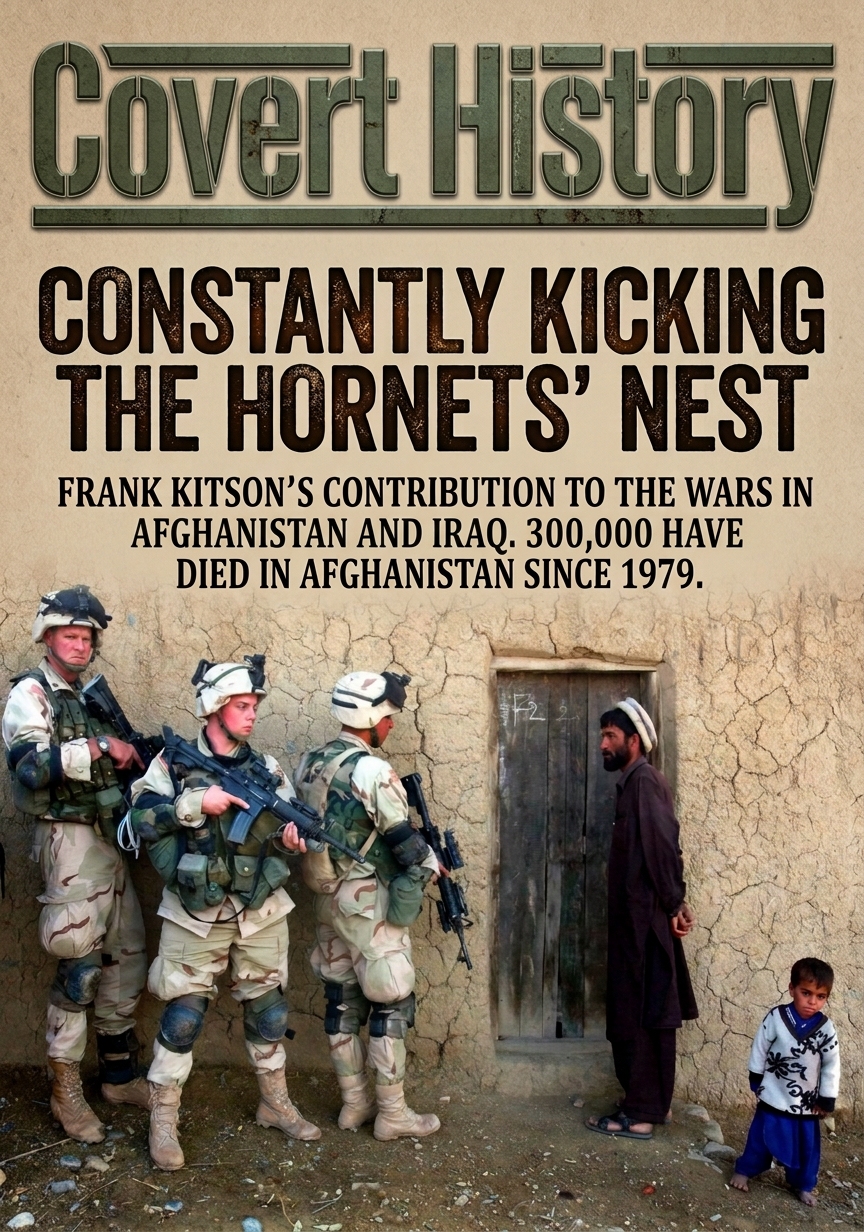
By David Burke.

1. The counter-insurgency gurus.
From 1970 to 1972, Brigadier (later General Sir) Frank Kitson served as Brigadier of 39 Brigade in Belfast. Some argue he damaged relations between the British government and the Nationalist community more than any other individual in the British Army. This website has many stories about Kitson, and readers are invited to visit them. Despite the hornet’s nest he kicked over in Ireland, Kitson rose through the ranks of the British Army and was hailed as a counterinsurgency expert around the globe. He even served as Queen Elizabeth’s aide de camp.
Unfortunately, Kitson learned little from his mistakes in Ireland. Nor did the American counterinsurgency specialist, General David Petraeus. The latter served as commander of the United States Central Command and Coalition Forces in Iraq and Afghanistan. Petraeus viewed Kitson as some sort of guru.

In 2006, when Petraeus was planning the so-called military‘surge’ in Iraq, he visited Kitson for guidance. Kitson was in retirement at the time but was happy to share his views with the American. The ‘surge’ involved increasing the number of American troops to provide security in Baghdad and Al Anbar Governorate. It served as the template for the 2009 ‘surge’ of 30,000 troops in Afghanistan, which was meant to stabilise the country and defeat the Taliban.

2. Petraeus supports Kitson in his defence of Mary Heenan’s action against him.
On 27 April 2015, Kitson was cited as a co-defendant, along with the British Ministry of Defence, in an action brought by Mary Heenan. She is the widow of Eugene ‘Paddy’ Heenan. Her husband was murdered by Albert ‘Ginger’ Baker’s UDA gang. Tommy Herron, a senior UDA figure, commanded Baker. Herron oversaw UDA assassination teams in the early 1970s. Herron and Baker were allies of British military intelligence. Herron entered into his alliance with British Army counter-insurgents during Kitson’s tour of duty in Belfast. Hopefully, more details will emerge during the forthcoming trial.
Baker did not join the UDA until sometime in the second half of 1972, by which time Kitson had left Northern Ireland. Crucially, however, Herron put Baker in contact with British military intelligence. Baker is still alive. Although Baker has said little in recent decades, he spoke at length in the 1980s about his connections to British military intelligence. He explained how the UDA conducted operations with guns supplied by the RUC.

Petraeus undoubtedly kept in contact with his hero during the rest of his military career. President Barack Obama appointed him Director of the CIA, and he served in that role from 2011 to 2012.

At the very least, Petraeus monitored how his British hero was faring. In November 2019, he defended Kitson by attacking the type of legal action Heenan had initiated. Petraeus did so in the foreword to a paper he wrote, ‘Lawfare – the Judicialisation of War’. He argued that this development was ‘as much of a threat to Britain’s fighting capacity as would be a failure to meet NATO budgetary targets, and it risks putting the special relationship under increasing strain … The extent to which those who served decades ago in Northern Ireland, including the highly distinguished soldier-scholar General Sir Frank Kitson, remain exposed to legal risk is striking and appalling.’

Mary Heenan’s action against Kitson and the Ministry of Defence has not yet received a trial date. No doubt they will use every trick to delay it as long as possible. While he was alive, Kitson defended the action. It is important to note that this is a civil action, not a state prosecution, and Mary Heenan controls whether it proceeds. If it is not derailed by Northern Ireland Office and MoD dirty tricks, the Heenan prosecution could become one of the most important legal actions to arise out of the Troubles.
One person who will await the trial with concern for the ‘highly distinguished soldier-scholar’ Frank Kitson is his great admirer, David Petraeus.
3.The Man who boasted about starting the war against the Soviets in Afghanistan in July of 1978. 300,000 have died since then.

The modern tragedy in Afghanistan began in July 1978 with American intelligence dirty tricks. Zbigniew Brzezinski, the US National Security adviser to President Jimmy Carter, admitted during an interview that he instigated the turmoil. He confessed this to a French reporter – on the record. The Americans, he boasted, were plotting against Afghanistan even before the Soviets invaded the country. See Obit(ch)uary: Zbigniew Brzezinski
It is inconceivable that Brzezinski and his subordinates did not consult the British about their intentions in 1978. The Americans held their British partners in very high esteem in those days. The role of MI6 (Britain’s overseas intelligence service) and the British Army’s special forces in the plotting against Afghanistan before the Soviet invasion in 1979 has yet to emerge.
All told, about 212,000 people died during the Afghanistan war waged by the US, UK and their allies. At least 70,000 died during the earlier conflict involving the Soviets. The real overall figure probably exceeds 300,000. Many more were maimed and injured.

David Burke is the author of four books published by Mercier Press.
