
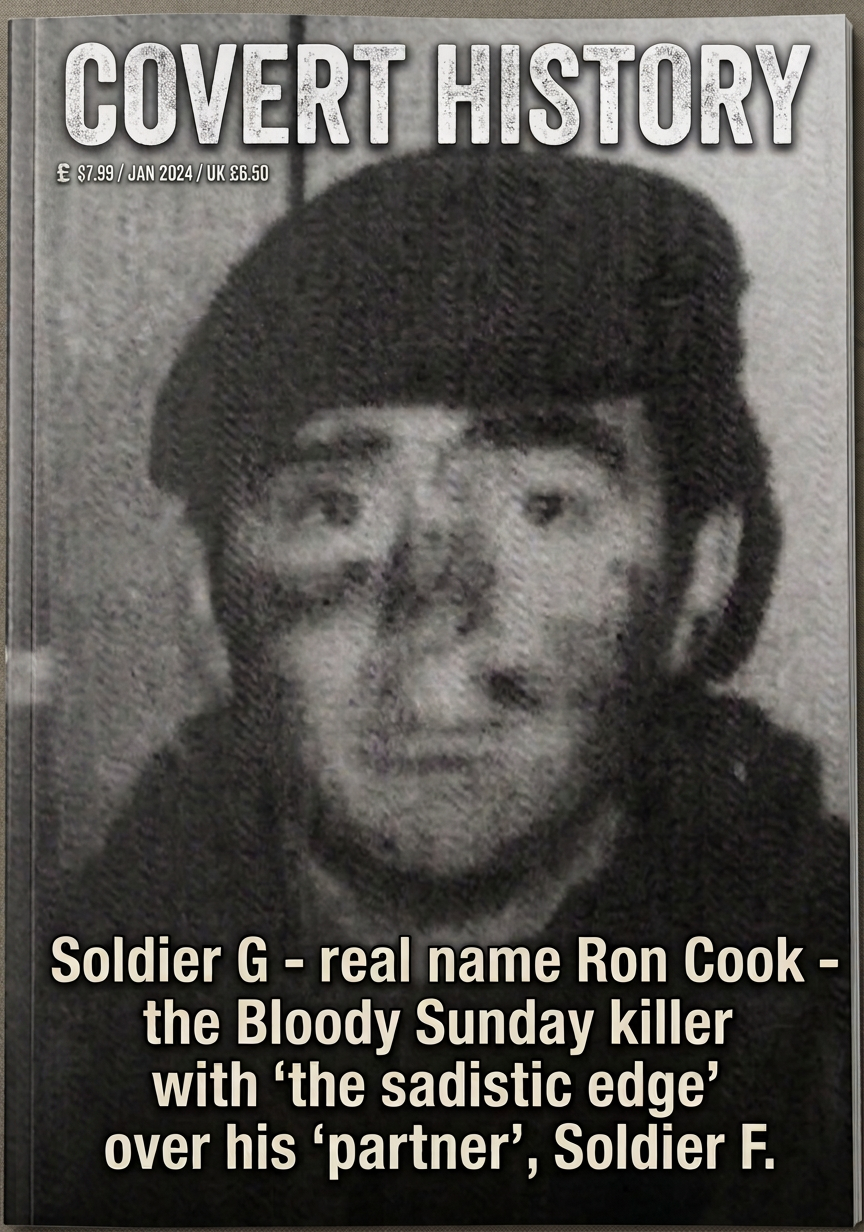
By David Burke.
Soldier G was Soldier F’s ‘partner’.
Both soldiers served with the Support Company of 1 Para.
Soldier F’s real name is David Cleary.
Soldier G was Ronald Alan Cook.
Cook was a private in 1 Para on Bloody Sunday. His military number was 24180769. He was probably 21 at the time of Bloody Sunday. He was referred to as ‘Soldier G’ at the Bloody Sunday tribunals.
Both Cook and Cleary were awarded the honour of being ‘mentioned in dispatches’ for their roles during the internment swoops of August 1971 in Belfast.

They were key figures in the events of Bloody Sunday. Their superior, Colonel Wilford, paid them a mysterious visit at the Presbyterian Church, where they were based, in the hours before the massacre of that day. Cleary described the discussion to the Widgery Tribunal in 1972 as an ‘unusual’ one, but gave no details of what was said.
When soldiers E, F, G, and H went into action on Bloody Sunday, Major Edward Loden let them shoot at civilians in the Bogside for a while before he ordered them to cease fire. Byron Lewis, a 1 Para radio operator (designated ‘Soldier 027’ at the Saville Inquiry), relayed Loden’s order to the soldiers. Still, Cleary and Cook disobeyed the major and moved into Glenfada Park, where they continued shooting civilians. Lewis later described how they seemed to have a ‘preconceived idea’ of what they were going to do and were acting ‘with purpose’.

After the shootings, Cleary and Cook led the ‘beasting’ of prisoners at Fort George in Derry. According to a local priest, Fr. Terence O’Keeffe, who was among the prisoners, Cook had ‘scary eyes’ and an ‘almost psychotic look’. The pair ‘roamed’ among the prisoners, stamping on their feet, kneeing them in the groin, forcing their faces up against electric heaters, spitting in their mouths and engaging in other acts of ‘idle brutality’. Fr. O’Keeffe recalled Cook as having had ‘the sadistic edge’ on Cleary.
Fr O’Keeffe was also a professor of philosophy and held a chair at Coleraine University.
Cook was never disciplined for disobeying Major Loden’s cease-fire order on Bloody Sunday. Why? The only logical answer is that he acted on orders from Colonel Wilford, who outranked Major Loden.
Cook engaged in further acts of extreme brutality following his return to Belfast after Bloody Sunday in Derry. See Mobile torture chamber.

Cook later joined the South African Army’s 5th Reconnaissance Regiment, a special force unit which fought along South Africa’s borders to preserve apartheid. The regiment was based at Phalaborwa in the Limpopo Province of Northern South Africa. He fought in the conflict along the province’s northern border. His superior officer was Colonel J. R. Hills. Cook was shot dead by a sniper on 12 February 1986. He was 35. At the time of his death, he was a sergeant designated as soldier 80021827PE.

Cook has family in Wales, so he may have come from there.
Only three soldiers were involved in the highly secret discussion at the Presbyterian Church in Derry immediately before Bloody Sunday. Cook is long dead, but Cleary is alive. Wilford probably ordered Cleary and Cook to provoke the IRA into a gun battle so the elite Support Company of 1 Para could smash its way into Free Derry and wipe out the IRA. Support Company would have acted as the tip of the spear, with C Company following them into the Bogside. If so, Wilford chose them because they were his ‘go-to’ soldiers, men who had proven themselves to him and Brigadier Frank Kitson in Belfast, especially during the internment swoops in August 1971 – hence their ‘mention in dispatches’.
See also ‘EFGH’

Cook’s name appears on a memorial at the present-day HQ of South African special forces. It is unlikely that the South African government is aware that it is honouring such a controversial figure in such a respectful way.

Another publication has very recently suggested that Soldier G died in Angola in the 1970s. I disagree but understand how confusion about the issue may have arisen. Another paratrooper who may have participated in Bloody Sunday died in Angola, but he was not Ron Cook. This lack of clarity would not have arisen without the British government’s ongoing attempts to conceal the identities of Soldiers E, F, G, and H.

David Burke is the author of four books published by Mercier Press.

3 responses to “Soldier G.”
[…] After the shootings, Cleary and Cook led the ‘beasting’ of prisoners at Fort George in Derry. According to a local priest, Fr Terence O’Keeffe, who was among the prisoners, G had ‘scary eyes’ and an ‘almost psychotic look’. The pair ‘roamed’ among the prisoners, stamping on their feet, kneeing them in the groin, forcing their faces up against electric heaters, spitting in their mouths and engaging in other acts of ‘idle brutality’. Fr O’Keeffe recalled Cook as having had “the sadistic edge” on Cleary. See also: Soldier G – real name Ron Cook – the Bloody Sunday killer with ‘the sadistic edge’ over his … […]
[…] It now emerges that Ron Cook, another paratrooper, a comrade of Cleary, who engaged in the attack on the Bogside on Bloody Sunday, was also ‘mentioned in despatches’ for his activities in Belfast in 1971. See also: Soldier G. […]
[…] See also: Soldier G. […]