1. The Irish Times gave a platform to the Official IRA during the Troubles.
Dick Walsh, the political correspondent of The Irish Times during the Troubles, was an adviser to Cathal Goulding.

Cathal Goulding was chief-of-staff of the IRA and, after it split in 1969, he held the same position with the Official IRA.
The Official IRA was responsible for a campaign of murder, bombing and torture. In terms of resort to violence, they were little different to the Provisional IRA, INLA, UDA, UVF, Red Hand Commando, MI5, MI6, SAS and the RUC.

On 21 May 1972, a 19-year-old Catholic from Derry, Ranger William Best, who was serving in the British Army, was murdered by one of Goulding’s death squads while he was home on leave to visit his family in the Creggan estate. He was one of a family of seven. He left his home to make a phone call after which he was snatched by Goulding’s thugs who beat him up – his corpse showed signs of kicks and punches – before shooting him in the head and dumping his body on waste ground. The coroner would describe the murder as ‘one of the most brutal murders I have heard of‘.
Goulding’s killers boasted that Ranger Best had been ‘apprehended in suspicious circumstances, tried by an IRA court and sentenced to death’. Anticipating a negative response, their statement was defiant: ‘Regardless of calls for peace from slobbering moderates, while British gunmen remain on the streets in the six counties the [Official] IRA will take action against them.’
Did Walsh abandon the Official IRA after this and other atrocities?

Walsh did not.
It is also a demonstrable fact that The Irish Times covered up many of the crimes committed by the Official IRA (OIRA). See: MI6’s Assets at the Irish Times (and other dirty secrets of the newspaper). By David Burke
2. Sir Maurice Oldfield.
Sir Maurice Oldfield, Chief of MI6, and the wider British intelligence community, exploited and exacerbated the frictions that existed between the Officials and the Provisionals for their own ends.
The Official IRA was an organisation which MI6 wanted to subvert and, where possible, manipulate and exploit.

As an expert in propaganda, Oldfield undoubtedly coveted the Officials’ influence at The Irish Times. At least six (if not more) Official IRA figures worked at the paper as journalists and at various editoral levels.
At senior executive level, the door to the Irish Times was open to Oldfield to make any move he wanted because MI6 had a strong relationship with the chief executive of the paper, Maj Thomas McDowell, the Belfast-born Unionist, ex-British Army, ex-MI5, owner of the paper. (See the link referred to above for more details).
As it turned out, the activities of the Officials at the paper would dovetail neatly with the interests of MI6 throughout the 1970s and 1980s.
This article touches upon some of the evidence which suggests that this was more than a mere coincidence involving people with a similar political outlook.
3. The Provisionals believe the Officials teamed up with British Intelligence.
The Official IRA declared a purported ‘ceasefire’ in 1972 but continued to rob banks and murder their opponents.
In the North, the RUC special branch made little effort to curb a widespread building site fraud scheme run by the organisation.
The Officials were also involved in a myriad of other crimes including currency forgery.

The Provisionsl IRA believe the Officials entered into an arrangement with MI5 and MI6 whereby the RUC turned a blind eye to the OIRA’s building site rackets. In return, the Officials provided information about the Provisionals to MI5 and MI6.
In the mid-1970s, the Officials engaged in a lethal feud with the Provisionals. This also suited the purposes of MI5, MI6 and RUC special branch. There is no doubt MI6 helped promote that feud. A former MI6 operative has revealed to me how he ‘lifted’ guns from one camp and placed them in the other to fuel the conflict.
Later, the Officials feuded with the INLA. The INLA was a paramilitary group which broke away from the Official IRA, inter-alia, as the INLA wished to pursue an armed campaign against Britain whereas the OIRA had declared a ceasefire. The feud suited the purposes of MI5 and MI6.
4. The death sentence transcript.

Seamus Costello lived by the sword. While OIRA Director of Operations, he masterminded the botched 1972 Aldershot bomb massacre. That atrocity stole the lives of a number of domestic workers and a chaplain at the HQ of the Parachute Regiment after Bloody Sunday.

The OIRA’s May 1972 ceasefire displeased Costello deeply. He became critical of Goulding, Sean Garland and other OIRA leaders.
Costello was expelled from the organisation by court-martial in mid-1974.
Costello set up the INLA the following December at the Spa Hotel in Dublin with approximately 80 other Republicans.
An OIRA-INLA feud erupted in early 1975.
On 1 March 1975, Sean Garland of the OIRA was shot as he drove home to his house in Ballymun, Dublin with his wife. He was badly wounded but survived.
In May 1975, Costello survived an assassination attempt outside Waterford City.
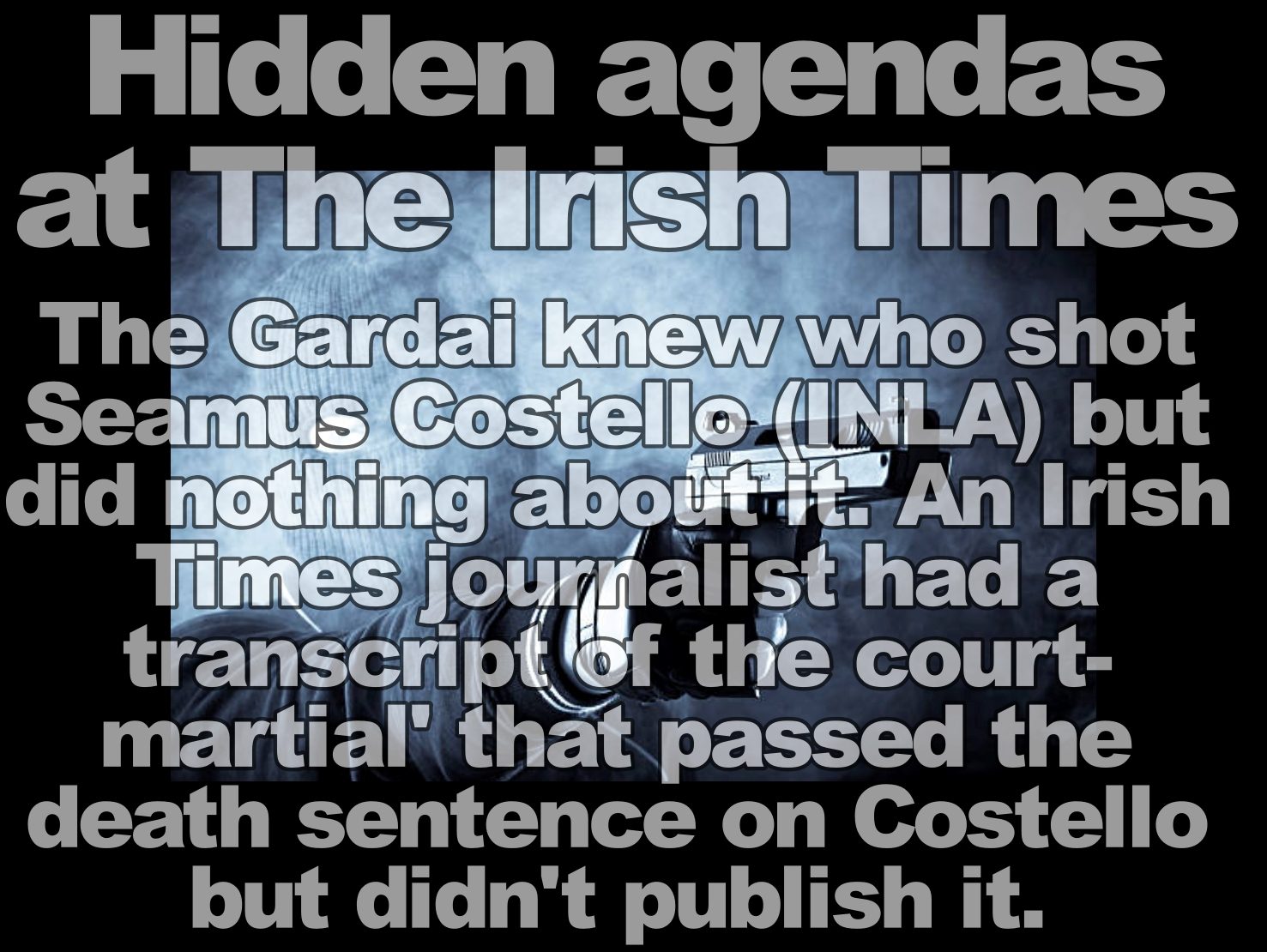
Costello was finally shot dead on 5 October 1977, while he sat in his car reading a nespaper on Northbrook Avenue, off the North Strand Road, in Dublin, by a member of the OIRA called Jim Flynn from Crossmaglen. The OIRA denied they were responsible at the time although no one believed them.

James Downey, a former deputy editor of the paper, revealed in his memoirs that ‘…the position of Dick Walsh [at The Irish Times] was, to say the least, anomalous. He was so close to the ‘Official’ chiefs that he was able to show me a transcript of the court-martial (in absentia) of Seamus Costello, a noted [Official IRA] defector. Costello was sentenced to death, and the sentence was carried out [in 1977], long after the Official IRA had announced the cessation of violent activities North and South [in 1972]. The organisation tried to attribute the murder to a dissident group, but indubitably the Official IRA “executed” Costello’. (Downey page 102.)
On 4 June 1982, the INLA exacted their revenge by shooting Flynn dead in Dublin.

The Irish Times holds itself out as a reputable paper of record. It may care to explain to its readers one day why Walsh failed to publish a story revealing the names of the participants at the ‘court-martial’ of Seamus Costello. His assassination – ordered by the court-martial – was one of the most momentous events of the Troubles.
None of the conspirators were ever brought before a court of law.
5. The Gardai turn a blind eye to the murder of Seamus Costello.
A former special branch officer has revealed to me that an OIRA hit man with a voice he recognised instantly as that of Jim Flynn rang Sean Garland, an Official IRA leader, immediately after the Costello hit, on a tapped phone line. ‘That job has been done’, Flynn told Sean Garland.
The information was sent up the line.
Hence, the Gadai had credible evidence against Flynn, yet he never faced charges.
Why?

The force was led by Garda Commissioner Ned Garvey who – according to the Barron inquiry – held illegal meetings with Fred Holroyd. Holroyd, a British military undercover operative, met Garvey on behalf of Craig Smellie, the Head of MI6’s station at Lisburn. Garevy’s head of intelligence at C3 was Larry Wren, who had multiple links to British intelligence.
Garvey told Barron that he had no recollection of these meetings.
If the Officials were shooting people like Costello, something that suited Oldfield and his colleagues, Garvey and Wren may have left Flynn alone as a favour to London.

6. Dick Walsh and Charles Haughey.

The Official IRA had a number of assets in the Dublin media who – whether by coincidence or design – pursued an agenda which reinforced one of the most important MI6 dirty trick campaigns of the 1970s and 1980s: the smear campaign against Charles Haughey of Fianna Fail.

Conor Brady, the editor of The Irish Times, 1986 – 2002, described in his 2005 memoirs, ‘Up With The Times’, that while some at the paper were balanced in their reporting of Haughey, ‘On the other hand, the political staff [at The Irish Times] led by Dick Walsh, was more harshly critical of [Charles] Haughey [of Fianna Fail] in particular and of his government in general. Dick’s political voyage had been complex. He was originally close to [Official] Sinn Fein, during its Marxist years. He was a man of extraordinary acuity and intelligence as well as great personal charm. He was not the only journalist with [Official] Sinn Fein associations within the newspaper. A cohort of five or six, none at senior level but nevertheless influential, were members or had been members of the so-called ‘Stickies”. (Brady page 100.)

MI6, Maurice Oldfield and Maj. Thomas McDowell, the chief executive of The Irish Times, must have been delighted with Walsh’s attacks on Haughey.
7. The deputy editor confirms Dick Walsh was ‘an intimate of Cathal Goulding’.
James Downey, the former deputy editor of The Irish Times – mentioned earlier – worked with Walsh at the paper. The pair were good friends. When Downey ran for the Labour Party in the 1969 general election, Walsh went out to canvass for him despite Walsh’s support for Sinn Fein.

Walsh’s support for Downey did not test his loyalties to Sinn Fein as Cathal Goulding did not run Sinn Fein candidates in that election.
In his memoirs, Downey did not shirk from pointing out that Walsh was ‘an intimate of Cathal Goulding and the other leaders of what would shortly become the ‘Official’ Sinn Fein and IRA’. (James Downey p. 99)

8. ‘… actual members of the [Official] IRA at the paper.
James Downey also revealed that there were ‘two or three who were actual members of the [Official] IRA on the paper’. (Downey p. 102)

Official Sinn Fein changed its name to Official Sinn Fein the Workers Party, and then became The Workers Party, all under the leadership of Goulding, Garland and McGiolla.
Seamus Martin, the former international editor of the Irish Times recorded in his 2008 memoirs, ‘Good Times and Bad’ that, ‘Dick Walsh, who had been political editor, was seen as sympathetic to the Workers’ Party’. (‘Good Times and Bad’, Mercier, 2008 page. 190).

In his book, Martin points out that Walsh was never a member of the Workers Party. However, he was still sufficiently close to the Workers Party to be writing for The Irish People, its weekly newspaper, until at least 1984. At the same time, he was presentung himself as an objective correspondent to the readers of the Irish Times.

Kevin Rafter describes Walsh as having ‘had close links with the Workers’ Party’ (Democratic Left, the Life and Death of an Irish Political Party, Irish Academic Press 2011 p. 43)
Why were the readers of The Irish Times not told about these links long before the publication of the books referred to above?
9. The deputy editor of The Irish Times accuses the paper of improper behaviour.
James Downey also had this to say about his friend: ‘Much as I liked Dick Walsh and loved his company, I could not think it proper that he could combine such intimacy [with the Officials] with a job as political correspondent of the Irish Times. It amazed me that so few people appear to know his record, of which he made little secret, and that speakers at his funeral praised what they called his dedication to parliamentary democracy’.
10. Dick Walsh circulates Conor Cruise O’Brien’s lies about Charles Haughey.
Conor Cruise O’Brien was a Labour Party TD (1969-77), and government minister (1973-77). In 1969, he furnished details about Irish military intelligence, G2, to the British embassy.

O’Brien was appointed editor of the Observer newspaper by David Astor in 1978. Astor was a former British intelligence operative.

Charles Haughey’s father was one of Michael Collins’ most trusted supporters. The Haugheys came from Derry. Charles Haughey spent his summers in Swatragh. He had at least one unpleasant encounter with the B Specials. Haughey was Minister for Justice during the final phase of the IRA’s Border Campaign. He made speeches about the North long before the Troubles began. Yet, Conor Cruise O’Brien spent years attempting to promote the notion that Haughey had never displayed any interest in the North before the Troubles. This was an absurdity which O’Brien could hardly have believed. So, why did he pursue the lie?

Dick Walsh could not possibly have believed this falsehood either. Yet, in 1986, Walsh published a book on Fianna Fail, ‘The Party’, in which promoted O’Brien’s deception. According to Walsh:
‘Haughey however was one of those who in [Conor] Cruise] O’Brien’s words had not hitherto been suspected of more than conventional republicanism … [Haughey] was noted by a close parliamentary colleague as “never having uttered a peep at all about the North – at any party meeting or anywhere else”.’ (Walsh page 101.)
Why did Dick Walsh regurgitate O’Brien’s nonsense and go to the trouble of supporting it with a quote from either an ignorant (at best) or dishonest (at worst) alleged ‘close’ colleague of Haughey?

Conor Cruise O’Brien also wrote for the Irish Times.
11. What was McDowell’s motive?
The real cost of Dick Walsh and the Official IRA’s infiltration of the Irish Times may be far worse than James Downey ever feared: Maj McDowell and his clique at the paper might have tolerated, exploited and even encouraged the presence and influence of the Officials at the paper at the behest of Maurice Oldfield of MI6 as they were the natural enemies of Fianna Fail.

The worst case scenario is that Maj. Thomas McDowell, the Belfast-born Unionist, ex-British Army, ex-MI5, owner of the paper, was acting on behalf of London. He had, after all, approached 10 Downing Street in London after the Northern Ireland Troubles exploded in 1969. He did so to apologize for the coverage of the North in his paper, described his editor as a ‘white nigger’ and sought ‘guidance’ about future reporting.
Was this how the future reporting panned out?
Why else would McDowell have employed known supporters – and even members – of an illegal paramilitary organisation which was engaged in bank robbery and murder, at his paper?
Why did McDowell tolerate deceitful journalists who often provided unbalanced coverage of Irish politics for their unsuspecting readers?
How did this state of affairs last in excess of three decades?
12. Hampering the peace process.
One of the most unfortunate consequences of Oldfield’s smear campaign against Haughey (during which the latter was portrayed as a Provo godfather), was that it hampered the birth of the peace process.

In the late 1980s, Haughey was fearful of sending emmisaries to Gerry Adams and the Provisional IRA lest Dick Walsh and others find out about it, misrepresent what was happening and thereby sabotage the initative. Walsh, Conor Cruise O’Brien and others had spent decades circulating the Oldfield-inspired lie about the Arms Crisis, namely that Haughey helped set up the Provisional IRA.

The smear about Haughey’s links to the Provisionals was first put into circulation in late 1969 by Garda Patrick Crinnion of C3, and his MI6 handler John Wyman, both of whom were convicted in Dublin for espionage in February 1973. (See ‘The Puppet Masters’.)

Haughey eventually commenced the peace process despite his fears about The Irish Times. His chosen emissary to Adams was Martin Mansergh. Haughey remained so deeply concealed in the shadows that John Hume was given the credit for reaching out to the IRA by the media. Hume was not even aware of Haughey’s clandestine role and sincerely believed he was the instigator of the process.

When Walsh died, he received praise from all and sundry. The then Taoiseach Bertie Ahern described how, ‘It is hard to believe that the man who was for so long at the heart of political life in this country, and whom I have known since I entered Dáil Éireann, is now gone.‘


A more detailed analysis of MI6 and The Irish Times, as well as Walsh’s links to the Officials, can be found here. See: MI6’s Assets at the Irish Times (and other dirty secrets of the newspaper). By David Burke
The ‘MI6 Assets’ article examines Walsh’s speech writing for Goulding and his negotiations with the Provisional IRA on behalf of the Officials.

The ‘MI6 Assets’ article also looks at the attempted murder of Ed Moloney, the Northern editor of The Irish Times, by the Official IRA in 1982. This happened after Moloney submitted an article about the OIRA’s ongoing engagement in criminality to The Irish Times. Moloney’s article was not published by the paper. A version of it later appeared in Magill magazine.

See also: https://coverthistory.ie/wp-admin/post.php?post=53494&action=edit

David Burke is the author of four books published by Mercier Press.
