
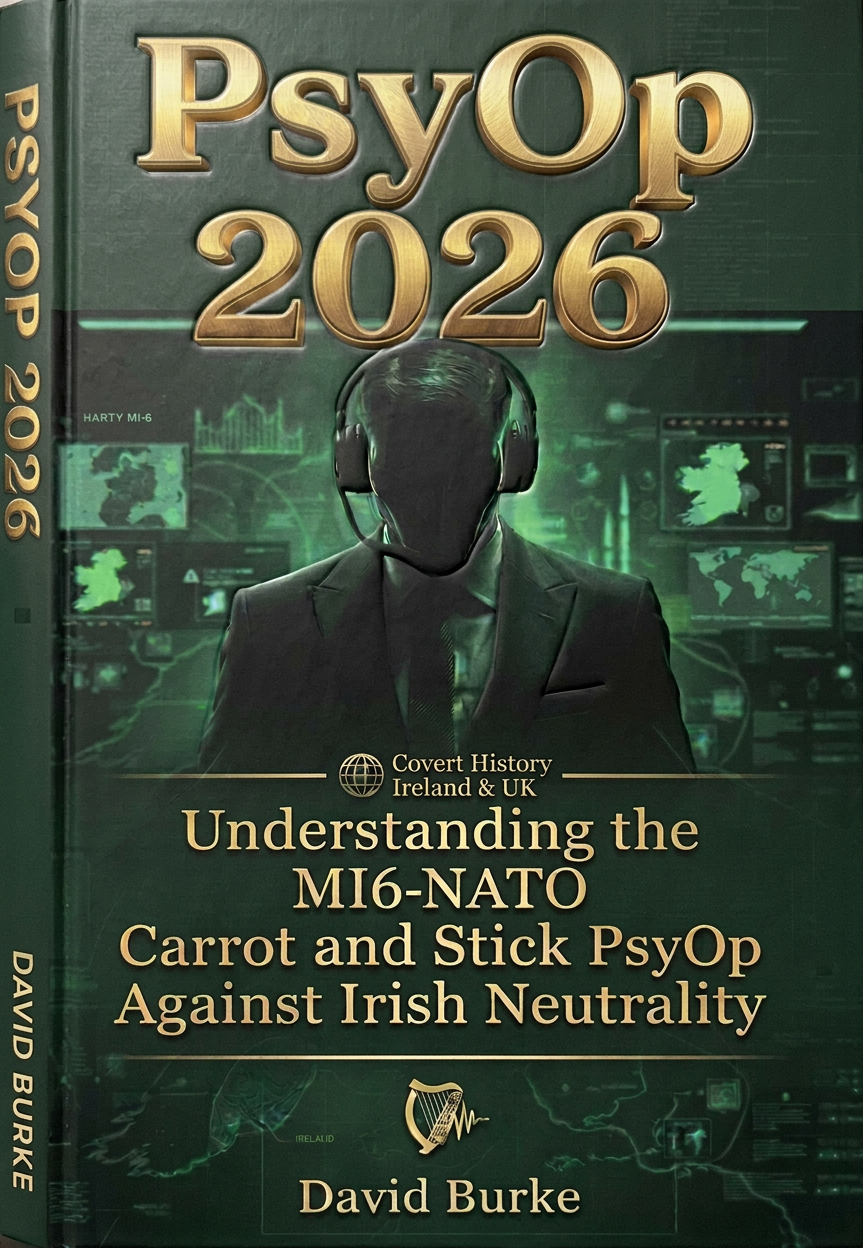
In November 2025, a British ‘security expert’ inadvertently disclosed the broad outline of a British-led psychological operation (PsyOp) to undermine Irish neutrality to London’s Financial Times.
The paper revealed that an anti-neutrality campaign was underway, although ‘still far from fruition and would have to be extremely carefully managed‘. The purpose of the operation was to integrate the Republic of Ireland into NATO’s Joint Expeditionary Force (JEF).
The paper also revealed that ‘Finland and Sweden joined the [JEF] in 2017, several years before their accession to NATO, and the prospect of Ireland doing the same has been under discussion for some time, according to two people familiar with the conversations’.
Four months later, the Irish government released a policy paper stating that it was its ambition ‘to participate in appropriate [JEF] activities.’
Many details of the JEF-NATO PsyOp have yet to emerge. It is likely that it is ‘carrot and stick’ in nature. Irish unity will be offered if an arrangement can be reached whereby the entire island of Ireland is prepared to perform the bidding of NATO.

On 27 August 2026, British Prime Minister Andy Burnham declared that a referendum on a united Ireland was ‘off the table’. It is likely that it will be put back on the table in return for full Irish cooperation with NATO.
Introduction:
Sliding down a slippery slope.
Ireland is respected around the globe for providing aid to countries in need.
The only nation with whom modern Ireland has ever gone to war is Britain (unless one considers the War of Independence a seditious revolt against the Crown by traitors).
Irish soldiers have performed admirably on numerous overseas peacekeeping missions.

Unlike their British and American counterparts, no one has ever accused them of war crimes.
Ireland’s defence forces are undeniably underfunded. The neglect of the army, navy and air force can be reversed without eroding neutrality.
Ireland does not make enemies.
Ireland does not exploit developing countries or those in need.

When Irish army trucks appear on the horizon during peacekeeping missions, villagers typically turn to greet them, confident the Irish have come to help them, e.g., to transport a harvest they have just gathered to their barns or markets.
NATO’s enemies are not ipso facto the enemies of Ireland.

Ireland does not have a duty to protect NATO’s western flank.

Post-Brexit Britain faces significant financial challenges, including the burden of maintaining a large army, navy and air force.
There is much to admire about these institutions, especially Britain’s navy. It helped crush the slave trade, kept the Atlantic open during World War 2 despite the presence of lethal U-boat wolf packs; led D-Day and other perilous amphibious landings; and has always provided employment to Irish people. Nonetheless, it is not the duty of Ireland, France or other nations to fill Britain’s defence budget deficit.


It has become apparent in recent years that Ireland permits Britain’s air force to enter Irish waters and airspace. This enables the RAF to protect Britain. They are not protecting Ireland, nor are they necessarily doing Ireland a favour. On the contrary, they have turned the country into a target for Britain and NATO’s enemies.

The British Establishment and some militarists in Washington view this perspective in a completely different light. They perceive Ireland with contempt and disdain – as a nation of ‘freeloaders’ who refuse to pull our weight in opposing Britain’s foes.

In February 2024, two British former secretaries of state for defence, one of whom is a former Chair of NATO, urged
‘the UK and its regional partners to unite and up the ante in pressing Dublin to do its fair share for collective security’.
The former Secretaries of State for Defence must be pleased by the pressure building against Irish neutrality and the government’s stated intention to participate in JEF activities.

As all of this unfolds, the EU is becoming increasingly militarised. A recent article in The Journal, about General Sean Clancy’s appointment as Director-General of the EU Military Staff, sheds light on this ongoing transformation.👇 (Although this webbook takes a pro-neutrality stance, it is clear that General Clancy is a highly respected and extremely competent and skilled individual who will shine in his new role.)

Britain’s militarists must also be encouraged by the changing nature of the EU, of which Ireland is a member. The Irish public was assured for decades that the EEC/EC/EU would not threaten the country’s neutrality.
It does now.

Ireland hosted the EU Defence ministers meeting in Wicklow in September 2026. The Deputy Secretary General of NATO, General Radmila Shekerinska, was in attendance; yet another indication of the widening overlap between the EU and NATO.

NATO’s Secretary General, Mark Rutte, has predicted that the EU could end up spending 10% of GDP on defence if the US were to leave NATO. Since when did the EU become a potential substitute for NATO?
A deepening militarisation of the EU could provoke an increased level of support for an Irexit. At present there is little or no support for leaving the EU.

In terms of NATO, ‘SOF’ stands for Special Operations Forces. These are elite military units specifically trained to conduct what NATO deems to be complex and dynamic security missions. Their operations can range from direct action to unconventional warfare, intelligence gathering, and counter-terrorism. SOF activities are designed to help build military cooperation among NATO member nations and partner countries. Ireland is now firmly embedded in this process. NATO considers Ireland ‘a highly valued partner making strong contributions to NATO’s mission success’. Read this tweet:


NATO issued a tweet in March 2026 describing us as ‘NATO Partner Nation Ireland’.

In August 2026, Irish defence attachés were appointed to the UK, US and France, to enhance military cooperation.

Also in August 2026, the Supreme Allied Commander of NATO, General Alexus Grynkewich, visited Dublin where he reviewed Irish troops at Cathal Bruagh Barracks.

He also paid tribute to the Irish UN peacekeeping contingent that had been ambushed on 8 November 1960 at Niemba, Congo.
Also in August 2026, Paddy McGuinness, one of Britain’s most senior former intelligence officers, graced the west Cork History Festival, in Inishbeg, where he outlined how the Irish Republic should direct its defence budget spending.

McGuinness served as the UK’s deputy National Security Adviser from 2014 to January 2018. He reported to David Cameron and Theresa May. The Irish Times reported that he did so ‘with a particular focus on relations with Ireland’.

McGuinness began his public service with the UK’s Foreign Service in 1985, making it likely he started out as an officer of MI6. His first overseas posting was as Second Secretary in Sana’a, Yemen, from 1988 to 1991. After that, he served as First Secretary in Abu Dhabi from 1994 to 1996, then as Counsellor in Cairo from 1996 to 1999 and in Rome from 2003 to 2006.
After McGuinness stepped down as deputy National Security Adviser, he was replaced by Richard Moore, who went on to become Chief of MI6.
What tempted such a distinguished figure to visit Inisbeg, West Cork, near Skibbereen?

McGuinness was refreshingly forthcoming. Addressing the secret deal between the Irish and British governments to allow the RAF access to Irish airspace, he said: ‘My experience with the British state is that it does what is in its interest,’ and that, ‘It’s in our interest to have some capability over Irish soil’.
In the same spirit of transparency, McGuinness explained that the ‘geography of security has fundamentally changed’ and that the ‘old geography was borders, coastlines, cables potentially, airspace, territorial waters. The new geography is cloud infrastructure, data, artificial intelligence, access to space, undersea cabling, energy, critical infrastructure. Because of that, Ireland has become really significant in a way it has not been previously.’

The speech was informative and certainly merited coverage but would The Irish Times have reported one by a former British official of equal distinction advocating a reduction in Irish military spending or adherence to neutrality?
A significant victory looms for those in favour of change: the Irish government intends to abandon the ‘triple lock’ mechanism, which presently safeguards Ireland’s neutrality. The solemn promises made to the Irish electorate about the triple lock after the first Nice Treaty referendum are to be cast aside. Retrospectively, these undertakings have been transformed into misrepresentations.
In 2013, Micheál Martin stated that the triple lock was ‘the core of our neutrality’ and that reform of the triple lock would undermine Irish neutrality. He has since changed his tune.

NATO has done much good in the past. Equally, it has had its dark moments (such as the Gladio scandal outlined at section 32). At the moment, NATO’s Secretary General, Mark Rutte, is pandering to Donald Trump and offering encouragement for his war in Iran. So much for a clear distinction between the US military when it acts on behalf of America, in contrast to operating as a member of NATO. The overlap on that Venn diagram is vast.

Britain has allowed US forces use their bases in the UK to fly bombing missions to the Gulf – including reloading bombers with munitions on British soil.
The machinations of people like Rutte and Trump should raise a bunting of red flags for those in Ireland who are enamoured by NATO.
Rutte has stated that he has contacted key European premiers who share his admiration for Trump’s conduct of the war in the Gulf. Watch this short video to see how Rutte lauds the ‘leader of the free world‘. 👇
The prime ministers of Italy and Spain are surely covered by the phrase Rutte used, ‘all the key European leaders’. Yet they clearly are not supporters of Trump’s Gulf War.
Regrettably, deception is the hallmark of some of those who wish to further the anti-neutrality agenda in Ireland. In November 2025, a British ‘security expert’ inadvertently disclosed the broad outline of a British-led psychological operation (PsyOp) to undermine Irish neutrality to London’s Financial Times and integrate the Republic of Ireland with the JEF. (See also section 27 below.)
The Financial Times revealed that an anti-neutrality campaign was underway, although
‘still far from fruition and would have to be extremely carefully managed‘.

The source assumed – correctly – that the Joint Expeditionary Force (JEF) wool would be pulled over the eyes of a gullible Irish public with ease.

Astoundingly, s/he predicted that the Irish media would turn a blind eye.
The source stated that:
‘It won’t be highlighted in any headlines’ one security source predicts. ‘There’ll be lots of complex acronyms and policies quoted by poker-faced civil servants.’
By March 2026, closer ties with the JEF had become Irish government policy. (More details are contained in Part 25.)

Contemporaneously, dubious ‘intelligence services’ have taken to briefing – and misleading – the Irish media. (See section 3 below.) The purpose appears to be to keep the scare tactic pot boiling.

In a report for the International Institute for Strategic Studies (IISS), Charles Edwards, a former senior British Intelligence official, asserted that:
‘Dublin is proceeding cautiously. Cooperation with NATO-linked structures is politically sensitive. Bilateral initiatives remain the focus for the time being.’ (More details at section 13 below.)
It is perfectly reasonable to support either side in the Irish neutrality debate. Neither side is stupid or irrational. But the discussion must be balanced and fair. Equally important is understanding the presence of deceptive and manipulative external factors and dismissing their invidious influence.

The Irish Times has become the target of relentless anti-neutrality lobbying by diplomats, academics and other interested parties. A procession of interesting visitors to our shores, preaching anti-neutralism, has created multiple opportunities to report their views in the paper and hammer home the anti-neutrality message. The end result is that the paper’s coverage of the issue has become unbalanced.
The Irish Times may even be influenced in a clandestine and subtle manner by the US government, inter alia, through its relationship with the Organised Crime and Corruption Reporting Project (OCCRP). Ruadhán Mac Cormaic, editor of The Irish Times, has openly acknowledged the paper’s relationship with the OCCRP, which the paper views positively.
The OCCRP receives funds from USAID. USAID has a veto over appointments at the OCCRP. USAID has worked closely with the CIA on propaganda operations.
Between 2008 and 2024, the US federal government poured $47m into OCCRP. The money was paid via USAID.
Other Western governments –including Britain, France, Sweden, Denmark, and the Netherlands – have donated at least $15 million over the last 10 years.
The Royal United Services Institute (RUSI or Rusi) is the world’s oldest defence and security think tank, founded in 1831 in London. It focuses on research and analysis related to defence, security, and international affairs. It has a close relationship with MI6.

The OCCRP produced a report in May 2024 – in collaboration with RUSI – advising Western governments how to disrupt the avoidance of sanctions against Russia. (See sections 15 and 16 for further details about The Irish Times and OCCRP and USAID.)

If, at some time in the future, the US sends troops to Greenland, without the consent of the people of Greenland and Denmark, or if Trump pulls the US out of NATO, the CIA’s special relationship with MI6 will be cast into disarray. Hence, it is impossible to predict what will happen to the JEF-NATO PsyOp in the event of a serious transatlantic falling-out.
If Trump sends troops to Greenland against the will of the people of Greenland, those in Ireland who are pro-NATO will be in a quandary. Will they urge the Irish government to side with the US, or the EU, or perhaps ….. remain neutral?

The JEF-NATO PsyOp has both a ‘carrot’ and a ‘stick’ element to it. Calculated insults are part of the ‘stick’ approach. They could backfire on the conspirators. It is difficult to imagine anything more inflammatory for an Irish audience than a lecture on our purported duty from condescending British and American commentators and their affluent upper-middle-class admirers in South County Dublin and Dublin 4.
Those behind the JEF-NATO PsyOp have encountered an unforeseen crater on the path to Irish membership of the JEF: the war against Iran. Mark Rutte, the Secretary General of NATO, wants European armies to join Trump’s war in the Gulf. Worse still, some US politicians have become extremely belligerent. NATO supporters in Ireland must be a little embarrassed right now. Like it or not, they are on the same side of the fence as people like the late Lindsey Graham, the Republican senator who passed away on 11 July 2026. He had a lot to say about the Gulf War.👇
And this👇
And this 👇
Graham’s views are not an aberration. WW2 ended with the UK and US incinerating civilians. Multiple regime changes and colonial wars followed. The US is still bombing children.
Religious fanaticism is also a factor to take into account in assessing the merits of abandoning neutrality and moving closer to the NATO, US and British war machines.👇
Contents

1. Were we being lied to all along, or have militarists hijacked the European project?

The European Economic Community (EEC), the European Community (EC), and the European Union (EU) were not established to assume a military role.

Whenever the Irish public was asked to support a change in the structure of the EEC/EC/EU, it was assured that the community would not compromise our neutrality.
Ireland rejected both the Nice Treaty and the Lisbon Treaty, among other reasons, due to concerns about neutrality. Concessions had to be made before the electorate changed its mind in subsequent ballots.

Was it all a big ruse, or is a new generation of transatlantic militarists attempting to betray the earnest promises and intentions of those who pioneered and supported the European project?
We may very well be witnessing the greatest political hijack attempt in global history.

To anticipate what may happen, we can look to the recent past: in 2011, NATO bombed Libya. The bombing and other military actions were led by the US, Britain and France. Other European countries that participated included Sweden, the Netherlands, Belgium, Spain, Denmark, Italy, Greece, Romania, and Bulgaria.
What would have happened in Ireland if the EU had become a military bloc by 2011, and had decided to bomb Libya with an Irish government supporting the initiative without the handicap of the ‘triple lock’?


Would Irish pilots have been asked to drop bombs on urban centres?

Would Irish soldiers have been sent to fight in Afghanistan alongside those from Europe who actually did go? Soldiers were deployed from Britain, France, Germany, Italy, Poland, Sweden, Spain, Romania, the Netherlands, Hungary, the Czech Republic, Estonia, Latvia, Slovakia, Finland, Portugal, Albania, and Denmark.
British and American troops committed war crimes in Afghanistan and Iraq:


NATO played a role in the Iraq war, too. Millions of British citizens opposed it, but to no avail. What would have happened if Irish soldiers had been deployed amid the protests?

The ongoing deepening militarisation of the EU might yet severely undermine much of what the community has achieved. This can be avoided by ending the process of military takeover. European militarists who are unhappy with NATO because of the antics of Donald Trump are free to set up an alternative organisation which is not linked to the EU.

EU nations could then opt to join or reject such a potential alliance.
Ireland could vote to join it as a full member, as an associate, or not at all. A referendum would preserve democracy. The furtive policy to transform the EU into a military bloc without a national vote is deeply autocratic.
The EU could then continue to focus on its more traditional pursuits, free of military complications.

If Ireland voted to join a new European military alliance, and an attack similar to the one against Libya were proposed and proved unacceptable to the Irish public, Ireland could leave the new alliance in protest. That would be preferable to leaving the EU.

The arrogance of the militarists who wish to transform the EU into a military bloc might yet cause political and economic havoc. For a start, they might fuel support for an Irexit, with unforeseeable consequences for foreign investment in Ireland, as companies could come to fear that an Irexit could ultimately occur and that they would not be able to access the EU market.
2. Ireland is already tiptoeing into NATO, by stealth.
Meanwhile, the Republic of Ireland has been tiptoeing into NATO by stealth for decades.
We joined NATO’s Partnership for Peace in 1999. See: https://www.ireland.ie/en/partnership-for-peace-delegation-brussels/ireland-in-the-partnership-for-peace-programme/

The JEF-NATO PsyOp aims to hustle Ireland into a more exacting NATO proxy organisation called the Joint Expeditionary Force.
3. From Wexford With Love.

The people leading the JEF-NATO PsyOp feel fear, intimidation and disparagement are the required tools to achieve their aims in Ireland.
Recently, the JEF-NATO PsyOp team briefed the Irish press that Putin was recruiting Wexford fishermen to aid his ‘hybrid war’ schemes. The Sunday Times identified its sources as ‘Intelligence services’. The paper revealed that:
‘Intelligence services have received reports suggesting that fishermen in Wexford, southeast Ireland, have been offered money to drag metal-cutting objects across the sea floor at specific co-ordinates.‘ [28 December 2025.]
This allegation lacks a single substantive detail. Who are the fishermen? Who approached them? How much were they offered? How were they to be paid? If there was an approach, was it made by Russians rather than by people pretending to be Russians? Did the ‘Russians’ display their passports to the Wexford fishermen? When and where were the approaches made? What are the ‘specific’ co-ordinates they were asked to attack?

Why, if true, has the Soviet ambassador not been asked to account for these alleged attempts at sabotage? Why hasn’t he been expelled? Why not a hint of a word of protest from the Irish government?
The briefings were provided by at least two intelligence services, establishing a coordinated campaign.
The story reeks of deception – by its sources – emphatically not by The Sunday Times itself, which has merely reported the claims as allegations made by the spooks, and not as proven facts.

The list of potential ‘intelligence services’ which could have provided the dubious information to The Sunday Times includes the British Secret Service (aka MI6 or SIS; attached to the Foreign Office); British military or naval intelligence; Irish Military Intelligence; Garda Intelligence (Special Detective Unit or SDU); and the CIA. The CIA reports directly to Trump. At least two of these organisations coordinated their briefings to The Sunday Times.

Not a single Wexford fisherman has stepped forward to corroborate the allegation either.
Germany, another big NATO beast, is banging the same drum. If German spooks are to be believed, Putin tried to cast Europe into digital darkness, albeit without the aid of Irish fishermen, and failed. The Russian saboteurs lost their anchor in an alleged attempt somewhere off the west coast.

4. Donald Trump set the agenda for increased military spending in Europe.

Donald Trump’s foreign policy has led to a sea change in NATO. He is demanding that Europe pay more towards defence than hitherto. He has been complaining about the paucity of European defence budgets since his first term, protesting that the U.S. is being ripped off by freeloading European nations who rely on Washington for a security blanket.
Trump wants Europe to increase defence spending to 5% of GDP.

Mark Rutte, Nato’s Secretary-General, is pushing this level of expenditure too. On 17 June 2026, he declared that he expected NATO member states to ‘present clear, concrete and credible plans’ to be spending 5% of GDP on defence by 2035, and ‘ideally well ahead of the agreed timeline’.
5% of Ireland’s GDP is approximately €25.5 billion, based on a GDP of €510 billion in 2023.

The European nations that have angered Trump the most are those maligned as ‘laggards’ for spending the least, such as Spain and Portugal. Clearly, NATO and Trump both want to increase military spending.

This is more or less the same message that The Irish Times has been pumping out to its upper-middle-class South County Dublin readership for the last number of years. Its focus is on what it perceives as the Irish Government’s inadequate military expenditure.
5. ‘I strongly urge the United States to stop making threats against a historically close ally‘.
Trump wants a lot more. In December 2025, he reasserted his claim to control Greenland, a semi-autonomous region under Danish governance. His reasoning echoes the calls for Ireland to move closer to NATO: a fear of Russian and Chinese naval interference. Trump told reporters in Palm Beach, Florida, that
‘We need Greenland for national security.’
One of the reasons is the presence of Russian naval vessels:
‘If you take a look at Greenland, you look up and down the coast, you have Russian and Chinese ships all over the place. We need it for national security. We have to have it.’

He repeated his claim in early January 2026, with the focus remaining on Russian and Chinese vessels:
‘It’s so strategic right now. Greenland is covered with Russian and Chinese ships all over the place. We need Greenland from the standpoint of national security, and Denmark is not going to be able to do it.’

He is dismissive of the wishes of the citizens of Greenland:
‘They have a very small population. They say Denmark, but Denmark has spent no money, they have no military protection. They say that Denmark was there 300 years ago or something with a boat, well we were there with boats too I’m sure. So we’ll have to work it all out… We need Greenland for national security, not for minerals – we have so many sites for minerals and oil and everything – we have more oil than any other country in the world. We need Greenland for national security.‘

Trump is creating the sort of military turbulence of which Ireland would be well advised to steer clear. Denmark’s Prime Minister, Mette Frederiksen, stated in January 2026 that if Trump launched a military attack against Greenland, it would mean the end of NATO.
‘I believe one should take the American president seriously when he says that he wants Greenland. But I will also make it clear that if the U.S. chooses to attack another NATO country militarily, then everything stops, including NATO and thus the security that has been established since the end of the Second World War.‘

Mette Frederiksen added:
‘I strongly urge the United States to stop making threats against a historically close ally, as well as against another country and another people, who have made it clear that they are not for sale.’
Some sort of a ‘deal’ over Greenland is being negotiated by Trump and NATO Secretary General Rutte. The situation remains volatile.

As things stand, Greenland’s Prime Minister, Jens-Frederik Nielsen, has stated that he is unaware of the specific details of the deal discussed between Trump and Rutte, emphasising that any agreement must respect Greenland’s sovereignty and territorial integrity. He insists that no deal can proceed without the involvement of Greenland and Denmark

At the end of the day, Putin and Trump have cast the West into disarray over defence. Meanwhile, The Irish Times and other organisations continue to campaign for Ireland to {i} abandon its traditional neutrality and {ii} increase its arms spending.


6. From the infamous ‘Dodgy Dossier’ to the Wexford fisherman plot.
The yarn about the Wexford fishermen posing a threat to undersea cables is reminiscent of the UK’s infamous ‘Dodgy Dossier’ psyop; the ploy former prime minister Tony Blair used to justify Britain’s participation in the Iraq war. The dossier contained the controversial – and false – claim that weapons of mass destruction (WMD) could be deployed within 45 minutes of an order from Saddam Hussein to use them.
Some of the actors in the WMD psyop are still around.
The Daily Telegraph – which hyped up the WMD threat – presently supports Trump’s demand for Greenland.👇

The Daily Telegraph is highly critical of ‘freeloading’ Ireland for not pulling its weight over the defence of Britain’s western flank. See the section about Tom Sharpe of The Daily Telegraph, starting at section 43 below.)
MI6’s former chief, Sir Richard Dearlove, also supports Trump’s plan to seize Greenland and would undoubtedly like to see Ireland join the JEF.
The Iraq Inquiry criticised Dearlove for providing unverified intelligence about weapons of mass destruction to Blair which were included in the ‘Dodgy Dossier’. There were no such weapons.

Alastair Campbell was Tony Blair’s Director of Communications between 1997 and 2003. Campbell played a key role in the dossier.

In his evidence to the Iraq Inquiry, Campbell said he ‘defended every single word’ of the document and that it did not ‘in any sense misrepresent the situation’ with regard to Iraq at the time.

Describing it as a ‘cautious’ assessment, he insisted it had not been designed to present the ‘case for war’ but to highlight why Blair was increasingly concerned about the threat posed by Iraq.

But Michael Laurie – who was responsible for delivering intelligence material on Iraq to assessment teams within the Ministry of Defence – said he disagreed with Campbell’s argument.

‘Alastair Campbell said to the inquiry that the purpose of the dossier was not to “make a case for war”,’ he wrote. ‘I had no doubt at this time this was exactly its purpose and these very words were used.’
He added: ‘We knew at the time that the purpose of the dossier was precisely to make a case for war rather than setting out the available intelligence.‘

A similar document produced six months earlier had been rejected as it had ‘not made a strong enough case’, Laurie claimed.
‘From then until September (2002), we were under pressure to find intelligence that could reinforce the case.’

The CIA relied on German Intelligence, which had a source they believed had access to top-level scientific data. In reality, he was a dishwasher who was feeding them what they wanted to hear. He was given the codename ‘Curveball’. John Kiriakou, who was directly involved in this calamitous farce, has had this to say about ‘Curveball’.👇
The lesson for Ireland arising from all this is that we simply cannot take at face value what London, Washington and NATO tell us about threats to our nation.
The costs of these lies was devastating for all involved. Britain went to war in Iraq. The estimated death toll from the conflict, which lasted from 2003 to 2011, is around 461,000, with many deaths attributed to violence and the collapse of infrastructure. Some studies suggest that the total number of deaths could be as high as 1.2 million when considering indirect causes and other factors.

Aside from the fact that NATO members, the US and Britain, led the attack on Iraq, NATO’s involvement in the Iraq War primarily focused on training and supporting the Iraqi security forces after the initial invasion led by the US in 2003. The NATO Training Mission in Iraq operated from 2004 to 2011, aiming to help build the capabilities of the Iraqi military and police.

7. Trump wants everyone in the West to spend more on arms.

Trump wants Europe to spend more on defence. He is leading by example. In December 2025, Trump announced that he had commissioned what he termed ‘Trump-class battleships’ for the U.S. Navy. They will be larger, faster and more potent than previous American battleships. They will feature advanced technologies such as artificial intelligence and laser systems, with plans to build 20 to 25 ships for his armada.

The militarists who want Ireland to join NATO or the Joint Expeditionary Force would presumably be happy to let Trump’s Golden Fleet make itself at home in the harbours of Cork, Derry, Shannon, Galway, Dublin, and Waterford.
Trump said his ‘Golden Fleet’ will be partially funded by $26 billion allocated by a defence spending bill passed by Congress in December 2025.
8. Freeloaders.

As things stand in 2026, a cabal of imperious commentators with links to the US and British military establishments is trying to persuade Ireland that Russia is a deadly threat to Ireland; that it is time for the stupid Irish to grow up, stop ‘freeloading’, spend more on arms and join NATO (or one of its shadow organisations).

The Irish Times is providing them with a platform to circulate these views.
The assertion that the people of Ireland are ‘freeloaders’ is unfair.

Ireland is one of the most generous nations on the planet, a fact that came into sharp focus 40 years ago after Live Aid, and has been reinforced at every turn since.
In 2026, Ireland will donate €840.3 million in aid to other countries.

Ireland’s Minister of State for International Development and Diaspora, Neale Richmond, has pointed out that:
‘Ireland is ranked in the top 20 donors globally in terms of humanitarian support and has responded quickly with funding to major crises in Gaza, Sudan, Ukraine and elsewhere.‘
The Irish government has spent hundreds of millions taking care of migrants who fled Iraq, Afghanistan and elsewhere due to wars involving NATO member states.

The destruction of Libya by NATO has opened the Mediterranean to people trafficking on a scale never witnessed before. Ireland has accommodated thousands of asylum seekers who have entered the EU across the Mediterranean
9. What if Reform wins the next British general election?

Many British supporters of NATO back European unity, but only in the context of military cooperation. In the political arena, they include Nigel Farage MP. Farage is the leader of Reform and may yet become Britain’s prime minister.

Farage says Britain should shoot down Russian jets if they enter NATO airspace. Since the RAF has secret permission from the Irish government to monitor Russian flights over the Republic, Farage presumably believes the RAF should shoot down any aircraft they perceive as Russian over Irish territory, too. A legal case taken by Senator Gerard Craughwell, about the secret arrangement to permit RAF overflights of the Republic, is due to be heard by the High Court in Dublin later this year.

The nature of the arrangement with the RAF is secret; hence, the legal action seeking clarity. One opaque aspect is whether the RAF is entitled to intercept, ground, or even fire upon Russian air force jets.
Could the agreement permit Farage, were he to become British PM, to instigate an aerial dog fight over Ireland?

According to an Ipsos poll published in January, Reform is the most popular political party in the UK.

Reform does not have a policy position on Irish membership of NATO, but it is reasonable to assume that Farage would favour Irish accession to the alliance or its proxy, the Joint Expeditionary Force.
In the media, top-selling pro-Brexit newspapers such as The Daily Telegraph and Mail fall into this pro-Brexit, anti-Irish neutrality category as well.

Farage is not renowned for his knowledge of Ireland👇
10. The Forum on International Security.

The Irish Government is on the side of the militarists. It is behaving in a deeply manipulative fashion.
In 2023, the Irish Government set up the ‘Forum on International Security’. It was designed as a series of public meetings in Cork, Galway, and Dublin, aiming to prompt a national discussion on foreign, security, and defence policy.

The then President of Ireland, Michael D. Higgins, told the Business Post that this timing was ‘playing with fire’ due to the drift in foreign policy, warning leaders to avoid ‘burying ourselves in other people’s agendas’ as policy is reviewed. Ireland should steer clear of the ‘strutting and chest-thumping’ of those promoting a ‘hold-me-back version of Irish neutrality’ who want the state to ‘march at the front of the band’ into alliances such as NATO. He added:
‘The most dangerous moment in the articulation and formulation of foreign policy and its practice, since the origin of diplomacy, has been when you’re drifting and not knowing what you’re doing. I would describe our present position as one of drift.‘

The now-former President also questioned the role of the Forum’s chairwoman, Dame Louise Richardson, an Irish academic who was previously vice-chancellor of the University of Oxford. She is now president of the Carnegie Corporation of New York, a $4.7 billion philanthropic foundation established in 1911. The President remarked that she came to the Forum ‘with a very large DBE – Dame of the British Empire’. He added, ‘I think it’s grand, but you know, I think there were a few candidates I could have come up with myself.’
He noted that the Forum members were mostly ‘the admirals, the generals, the air force, the rest of it,’ and ‘the formerly neutral countries who are now joining NATO’.

Defending the forum, Micheál Martin said the panellists came from
‘a wide range of backgrounds and with a variety of expertise and experience, including in peacekeeping, peacebuilding, arms control and disarmament, and conflict resolution internationally.’
He cited the Government’s ‘fundamental duty’ to address the global situation as it is.
‘Political leadership means taking on the responsibility of putting in place policies and practices to keep this country, and its people, safe and secure.’

Richard Boyd Barrett, the People Before Profit TD, said the Forum was heavily biased, dominated by people with pro-NATO or pro-EU militarisation views. He acknowledged that Dame Richardson had legitimate views but noted she was on record as a supporter of US foreign policy.
He described the Forum as a ‘stitch-up’ and called for a balanced debate.
‘The Forum is absolutely dominated by people who’ve worked in the military, have associations with NATO, or have a record of arguing for Ireland to move away from neutrality or towards NATO or into the project of EU militarisation.‘

He added that the Government had been moving closer to the NATO military alliance by stealth.
He argued the forum lacked balanced representation. ‘I am the President of the Anti-War Movement,’ he said, and
‘we were not informed about the forum by the Government. Why aren’t the people who have a known record of campaigning against militarism, campaigning for neutrality, equally represented on the panels?‘
The Forum’s report, released in October 2023, encouraged a more robust Irish partnership with international security organisations, including NATO and the EU, as well as increased defence spending and procurement. Having recommended this severe erosion of neutrality it recommended that Ireland’s neutral status should continue. Orwell’s Big Brother would be impressed with this perfect example of doublespeak.

11. The International Institute for Strategic Studies (IISS), NATO and Ireland.
The IISS is an international research institute based at Arundel House in London. The Guardian newspaper has described it as ‘one of the world’s leading security think tanks.’
It features many US and British military and intelligence luminaries among its ranks.

The IISS has offices on four continents. It produces pro-NATO reports on defence, security, and global affairs. It also convenes security summits.
Jonathan Stevenson works for the IISS. He was a professor of strategic studies in the Strategic Research Department at the US Naval War College in Newport, Rhode Island, 2005-16. He served as National Security Council director for political–military affairs, Middle East and North Africa, at the White House, 2011-13.

Stevenson has provided a detailed insight into what it might take to get Ireland to join NATO: proponents of such a policy ‘would probably need to secure the assent of a majority of Sinn Féin voters, as well as those of Fianna Fáil and Fine Gael voters’.
Stevenson suggested this strategy in an article published on the IISS website:
‘The upshot is that the Irish population is ambivalent, arguably reluctant, but convincible with respect to joining NATO. Given the depth and potency of the tradition of Irish neutrality, Irish membership would require a constitutional referendum as a practical matter if not a strictly legal one. For a government in favour of joining NATO to win over Irish voters sufficiently to prevail in a referendum, it would probably need to secure the assent of a majority of Sinn Féin as well as Fianna Fáil and Fine Gael voters. This would call for a frank and nuanced public narrative that placed Ireland’s prospective NATO membership in the context of both Irish history and contemporary geopolitics, and detailed the practical changes – including costs – that NATO membership would entail. With respect to Sinn Féin, whose core members remain invested in neutrality, it would also require a significantly more proactive national commitment to advancing Irish unification.

MI6 and its colleagues in the sprawling British Intelligence community are best placed to covertly instigate, influence and maintain a ‘frank and nuanced public narrative’ to change public opinion in Ireland.
The IISS has close ties with MI6 and the CIA. Sir Richard Moore was appointed as Chief of MI6 in 2020. He chose the IISS as the venue for his first speech.

12. The recently retired Chairman of the IISS joins the Board of Directors of The Irish Times DAC.
In 2025, Bill Emmott, a leading figure in the IISS, was appointed to the Board of Directors of The Irish Times DAC.
Emmott served as Chairman of the IISS from 2019 to 2025, and was a trustee for fifteen years prior to that.

Emmott has a distinguished background in the media in addition to his role at the IISS. His appointment will surely open doors at the paper to pro-NATO experts should the paper require specialist guidance.

The Irish Times website omits a reference to Emmott’s chairmanship of the IISS.
However, Emmott’s CV on the website of Magdalen College, University of Oxford, fills in this gap:


Let us hope that in the interest of balance, the paper will open channels to pro-neutrality advocates as well. At the moment, it is failing miserably in this regard.
13. The IISS confirms secret military arrangements exist; that the JEF+ is a proxy for NATO; and that US and UK patience is running out with Ireland over neutrality.
According to the IISS, NATO may yet ‘demand’ Ireland abandon neutrality, albeit this is ‘unlikely’ at the moment:


These points were raised by Charlie Edwards of the IISS, a man with impressive British Intelligence credentials. He CV discloses:

An IISS report published by Edwards in August 2026, provides further insights into what London and Washington are thinking and planning:

The IISS believes that ‘Ireland is also seeking access to JEF+’. If ‘Ireland’ in this context denotes the people of Ireland, this is not the case. The majority of the population (in excess of 70%) want to remain neutrality and have little or no inkling what the JEF represents (let alone ‘JEF+’).
The IISS is entirely accurate when it states that:
‘Dublin is proceeding cautiously. Cooperation with NATO-linked structures is politically sensitive. Bilateral initiatives remain the focus for the time being.’
Put simply, according to the IISS, the Irish government is trying to sleep walk Ireland into NATO.

But the patience of London and Washington is running out. As Edwards notes:


Edwards believes Washington may yet resort to coercion, i.e., by threatening our economic security:

Edwards takes it for granted that the EU is now part of the wider NATO structure. Note the reference to ‘Brussels’ accepting our neutrality as if NATO and Brussels were one and the same:

Charlie Edwards’ analysis can be read in full here: https://www.iiss.org/online-analysis/online-analysis/2026/08/irelands-security-model-is-approaching-its-limits/
This is a recent X/tweet (21 August 2026) from the IISS:

14. The threat of a ‘false flag’ attack on the Corrib or undersea cables.
The various intelligence services of NATO include many adept at ‘false flag’ operations designed to manipulate public opinion. Gladio (described in more detail in section 32) carried out these type of operations for NATO in the past. Hence, if an attack on undersea cables in Irish waters, or against the Corrib gas supply network, takes place, it will be as likely that a modern Gladio-type department of NATO would be responsible as those of Russia. If NATO carries out such an attack, it will be blamed on Moscow.

The IISS believes that it may take something as dramatic as an act of sabotage to change public opinion in Ireland. Charlie Edwards raised the issue of potential Russian sabotage in his IISS article which shows it is a genuine concern in pro-NATO circles.

While the integrity and good faith of the overwhelming majority of the pro-NATO community is not in question – especially in terms of false flag terrorism – the same cannot be said of the subterranean forces that lurk in the darkest corners of Whitehall and Washington and direct the dirty trick departments of their nations, i.e., the people capable of carrying out false flag operations.
MI6 and the CIA have many friends, allies and assets in the Irish media – not to mention ‘useful idiots’ – upon whom they could rely to pin the blame on Moscow if such a horrible scenario ever gets to play out.

The Nord stream gas pipeline attack is a recent example of undersea sabotage which is still surrounded in mystery.

On 26 September, 2022, a series of underwater explosions occurred on three Nord Stream pipes, rendering them inoperable. They were part of a network of twenty-three natural gas pipelines between Europe and Russia. The attacks took place in international waters. Both pipelines were built to transport natural gas from Russia to Germany through the Baltic and are majority-owned by Russia’s gas company, Gazprom.
Russia was blamed for the sabotage of the pipeline by certain sections of the Western media despite the fact it was hardly in Russia’s national interest to destroy its own asset. No one knows who was truly responsible, most likely Ukrainian special forces. The propaganda machines on all sides have been busy pointing fingers ever since.
The Sun came up with this:

The Daily Telegraph had this:

The Sun also produced a graphic speculating about how Putin might attack undersea cables.

The latest development is that Germany is blaming Ukraine:

If Ireland wakes up one morning to the news that the Corrib has been attacked, one can safely assume that The Irish Times will unblinkingly lead the media charge blaming Russia. The slimmest possibility that it might be a Gladio-CIA-MI6 false flag operation will be ignored and, if raised by others, dismissed with lofty disdain as a ‘conspiracy theory’.

15. USAID, the CIA, the Organised Crime and Corruption Reporting Project (OCCRP) and The Irish Times.
The United States Agency for International Development (USAID) presents itself primarily a humanitarian agency focused on international development and assistance. It was established in 1961. However, it has worked closely with the CIA on black propaganda operations.
USAID was involved in creating a fake Twitter program in Cuba, known as ‘ZunZuneo’, aimed at undermining the Castro regime. This program was designed to build a subscriber base through non-political content before introducing political messages to inspire protests.
USAID finances a media organisation called the Organised Crime and Corruption Reporting Project (OCCRP).
The OCCRP works with The Irish Times.
On 21 May 2026 The Phoenix magazine revealed that:
‘IN RECENT months the Irish Times has presented a series of stories on Aughinish Alumina metals company – owned by Russian oligarch Oleg Deripaska – supplying alumina to Russia, where it is then sold to firms that make weaponry for that country’s war effort in Ukraine. The newspaper has for some years made much of its collaboration with various global (or rather western) investigative outfits such as the International Consortium of Investigative Journalists. The Aughinish story has been greatly resourced by the Organised Crime and Corruption Reporting Project (OCCRP) and IT editor Ruadhán Mac Cormaic boasts of the collaboration between the OCCRP and “our new investigations unit” in exposing this “high-impact public interest” story. But most ironically, another global investigative collaboration in December 2024 unearthed some very interesting information about the OCCRP – information that the well-resourced IT could not but be aware of.

‘The Irish Government has been accused by the IT of going to “extraordinary lengths” to protect Aughinish, while being forced to acknowledge (correctly) that the company is not sanctioned by the EU. And the Government has fought to protect 500 direct jobs and the another 500 indirectly employed from the disaster that sanctioning Aughinish would entail.
‘Eighteen months ago the US-based Drop Site News combined with French investigative outlet Mediapart, Italian outlet Il Fatto Quoidiano and Reporters United in Greece to investigate the investigators of OCCRP.

‘Its main conclusion is that OCCRP, “one of the world’s most influential global investigative news organizations, whose work has regularly produced political shockwaves, has been primarily funded since its launch by the United States government, according to a review of budget documents, audit reports, and interviews with its founder and government funders… OCCRP’s founding and most generous donor, the one responsible for a majority of the organization’s budget, is the government of the United States and within the government, the largest donor is Usaid – the US Agency for International Development.”
‘The report states that between 2008 and 2024 the US federal government poured $47m into OCCRP.
‘As well, “other Western governments –including Britain, France, Sweden, Denmark, and the Netherlands – have kicked in at least $15 million during the last 10 years”.
‘These figures, culled from OCCRP’s annual audit reports, were cross referenced by the team’s journalists with federal budget documents.

‘Interestingly, the report states that the OCCRP produced a report in May 2024 – in collaboration with Britain’s Royal United Services Institute – advising governments how to disrupt the avoidance of sanctions against Russia. This would have been a few short months before “our first internal discussions about the Aughinish project took place late last year”, as the IT told readers recently.

‘OCCRP senior staff did not deny the funding or its extent but argued that it made no difference to its editorial output.‘

RUSI recently hosted the rather belligerent Chief of the Defence Staff, Sir Richard Knighton. His speech was leaked in advance (in December 2025). In it, he warned that the UK faced a level of danger ‘more dangerous than I have known during my career’ and that confronting it will require ‘our whole nation stepping up’.

‘Our armed forces always need to be ready to fight and win, that’s why readiness is such a priority,’ he was expected to say. ‘But deterrence is also about our resilience to these threats, it’s about how we harness all our national power, from universities, to industry, the rail network to the NHS. It’s about our defence and resilience being a higher national priority for all of us. An “all-in” mentality.’

Also that:
‘The situation is more dangerous than I have known during my career and the response requires more than simply strengthening our armed forces. A new era for defence doesn’t just mean our military and Government stepping up as we are, it means our whole nation stepping up.’
Naturally, Sir Richard Knighton would like for the Irish media to step up too.

16. The Irish Times works with an organisation which permits the US Government to ‘veto [its] senior personnel, including senior editorial staff, as well as an annual work plan‘.
The Phoenix’s 21 May 2026 article continued to describe how the US government – i.e. the CIA – influences who works for the OCCRP.
‘Even more extraordinary, as Mac Cormaic might say, is the report’s discovery that “the federal government can veto senior personnel, including senior editorial staff, as well as an annual work plan… It can veto top hires. If OCCRP needs to change key personnel, for example then they submit a request with a resumé and we [Usaid] review it and say… we approve your nominee for a new chief of party or whoever it is.”

‘One can only imagine the reaction of the IT’s investigative journalists to the notion of government officials sanctioning or vetoing editorial appointments and annual editorial plans.

‘But sure it’s all in the interests of the West’s valiant war against that ‘corrupt’ Vladimir Putin.‘

NATO, the JEF and JEF+, Chatham House, Policy Exchange (PX), the IISS, OCCRP, RUSI, MI6 and the CIA are all part of the same web. Journalists from Irish newspapers should sup with long spoons whenever in their company.

17. Ireland’s ‘independent’ pro-NATO Azure Forum.

Ireland has its own pro-NATO ‘think tank’, the Azure Foundation. For a fascinating insight into its activities, click here: https://www.theburkean.ie/articles/2023/06/21/azure-forum-nato

18. The former Defence Secretaries voice their concerns, February 2024.

In February 2024, the pro-Tory British think-tank ‘Policy Exchange’ (PX) criticised Ireland’s security policy in a document titled ‘Closing the Back Door’.

Sir Michael Cathel Fallon KCB, co-author of the foreword, served as Britain’s Secretary of Defence from 2014 to 2017. His co-author (of the preface), George Robertson, aka Baron Robertson of Port Ellen, served as the 10th Secretary General of NATO, 1999-2003. Robertson was also Secretary for Defence 1997-99.

The document alleged ‘persistent’ Irish security freeloading, just as ‘Russia once more poses a maritime threat to the Western Approaches to the British Isles.‘
Is Fallon a figure deserving of admiration and respect – such that we should overlook his condescension and rudeness?
Alas, no.
Fallon’s career has not lacked controversy, as this summary in Wikipedia indicates 👇

He was also involved in an expenses controversy 👇


The introduction to the PX book states that:
‘for ideological and financial reasons, Dublin has limited itself to subpar participation in the European and transatlantic security frameworks designed to uphold collective prosperity and stability. The unavoidable fact is that the [Republic of Ireland] grounded its security upon the transatlantic-European economic and security order, whilst freeloading off the significant investment of others in protecting it, absent any Irish desire to play a constructive part in the broader Atlantic security system. This home truth was admitted by Micheál Martin himself this year, as he put the weak state of Ireland’s Defence Forces down to the long-held view that the ROI’s “geographic isolation on the periphery of Europe [was] a source of security”.‘

‘Closing the Back Door‘ asserted that:
‘the UK also faces a back-door threat from the growing Iranian, Russian and Chinese presence in the Republic of Ireland, a mounting challenge for a chronically deficient Irish security and intelligence apparatus’.
PX urged:
‘the UK and its regional partners to unite and up the ante in pressing Dublin to do its fair share for collective security’.
PX is a registered charity. It generally refuses to disclose its funding sources and is ranked among the least transparent think tanks in the UK.


In addition to former Defence Secretaries and NATO luminaries, senior Tories such as Michael Gove are involved in PX. The group influences government policy, especially when the Tories are in office.

Michael Gove became editor of The Spectator in September 2025. Recently, it published an unhinged and racist anti-Irish rant, which touched upon Irish neutrality. (See section 42 on Julie Burchill below).
19. The “freeloading” buzzword.
‘Freeloading’ has become a buzzword in the British and Irish press when it comes to reporting Irish neutrality.

The ‘freeloading’ slur has all the hallmarks of a talking point drawn from a playbook prepared by the puppet masters behind the JEF-NATO PsyOp.

The Irish Times has brainwashed its readership with its incessant references to the word and a slew of variations thereof.
Ireland is ‘basically freeloading on the rest of us, especially Britain’, according to a ‘senior former European diplomat’ quoted in the Financial Times on 25 November last.

Yet, Ireland contributes more per person per month than any other nation to the EU:-
Ireland: approximately €53;
Luxembourg: €51;
Belgium: €44;
Netherlands: €39;
Denmark: €38.
At the lower end of the scale is Bulgaria at about €10.50.
These are gross figures, mainly based on national wealth. The EU average is about €25 per month.

There is no resentment about this in the Republic. Irish people appreciate that the nation was a net beneficiary of EEC/EC/EU funding for decades. It helped build up the country’s infrastructure and supported the farming and other communities. Irish people now wish for other countries to benefit in a similar way.
But there is more: the alleged ‘freeloading’ Irish taxpayer handed over a total of €64.1 billion to bail out international bankers during the 2008-09 financial crisis. Eurostat figures reveal that 42% of Europe’s banking losses were paid by Ireland, i.e., €9,000 per citizen.

Moreover, in December 2025, the Republic of Ireland agreed to provide €4.1 billion towards a €90 billion EU loan to Ukraine.
The loan is in addition to €173.5 million in humanitarian assistance and stabilisation support, and €100 million in non-lethal military support, already donated to Ukraine.
According to the Irish government, the support
‘is in addition to a range of items provided through the Department of Defence including military rations, body armour, mine flails, vehicles, and satellite communications systems.’
Ireland has also supplied air defence radar systems, ambulances, and bomb disposal robots.
Ireland’s total funding to Ukraine from February 2022 to September 2025 was over €380 million.
An additional €125 million was announced during President Zelensky’s official visit to Ireland on 2 December 2025.
20. The Irish are ‘stupid’ hypocrites.
There are many in the UK who describe the Irish as drunks, lazy slobs, ‘Micks’ – meaning ‘Spud thick Micks’.

When British PM Boris Johnson was informed that Leo Varadkar was Ireland’s leader, he quipped, ‘I thought they were all called Murphy’.
Irish people are used to this sort of racist abuse from Britain. It is shocking, however, when a German calls us ‘stupid’. Worse still, that he did so while on a visit to Ireland.
He may not be aware that the Irish are the second most educated race in the world. Germany comes in at 13th.

The Programme for International Student Assessment (PISA) is a worldwide study by the Organisation for Economic Co-operation and Development (OECD). It assesses the scholastic performance of 15-year-old students in mathematics, science, and reading, assessing their ability to apply knowledge to real-life challenges. This international assessment helps evaluate and compare educational systems across different countries. Here are the results for 2025. Note how well the ‘stupid’ Irish fared:

According to this German, our stupidity lies in our connection to neutrality.

The German involved is Prof Carlo Masala, the former Deputy Director of the NATO Defence College in Rome. In a Trumpian address, he told an Irish audience at the Institute of International & European Affairs in Dublin, in December 2025, that he found it
‘very hypocritical, if you use your neutrality to basically save money in terms of defence policy – I know that this is changing now – and relying on others, if push comes to shove, to defend you.’


One apprehends that the Irish in attendance at the Institute of International & European Affairs gave the professor a round of applause after he described the Irish as ‘stupid’.
Prof Masala might take a moment to discover just how highly the ‘stupid’ Irish value education. 👇
The Finns have joined the anti-Irish neutrality in early 2023 as this article from The Phoenix demonstrates:


21. Whitehall considers the Republic of Ireland to be part of Britain’s ‘sphere of influence’.


The British anti-Irish neutrality lobby contends that we are letting the side down on neutrality, a mindset that presupposes we are part of Britain’s ‘sphere of influence’, not an independent democratic nation.

One of the chapter headings of the Policy Exchange document on Ireland refers to our ‘Flimsy Contribution to Allied Security’ [3.3] as if Ireland were already a member of NATO, not an independent, neutral nation.

The democratic choice of the Irish nation to remain neutral can infuriate the officer class in Britain, leading to intemperate and intimidating language. The Financial Times quoted a rather indignant
‘former UK military official [who] was even blunter. This [internet infrastructure] is Ireland’s cash cow. And it’s taking the piss‘ [over neutrality] [25 November 2025.]

Rear Admiral (Retired) Chris Parry, of the Royal Navy, told a meeting at the House of Lords last October (2025) that NATO should consider conducting naval exercises in the Irish Sea, even without Dublin’s approval, and urged Ireland to engage more directly with the alliance.

Parry was interviewed about his views by RTE’s Claire Byrne: https://www.rte.ie/radio/radio1/clips/22554711/
Parry is active on Twitter/X:


According to his website, he has served in Northern Ireland:

Another commentator, UK Admiral Alan West has said that:

22. The British Ambassador spells out the UK’s military intentions and desire to work with Ireland.
In June of 2025, Paul Johnson, then serving as British ambassador to Ireland, spelt out the concerns of the British military establishment and the steps his government intended to take to assuage them, in the Sunday Business Post.

Johnson (a popular man who certainly does fall into the ‘intemperate’ critic category) has a significant NATO background.
He joined the Ministry of Defence (MoD) in 1990 and, in 1993, moved to the Foreign Office as the Desk Officer for Bosnia, a post he held until 1995.

Johnston was appointed Ambassador to Sweden from 2011 to 2015. (Sweden officially joined NATO on March 7, 2024, after applying for membership in response to Russia’s invasion of Ukraine in 2022. This marked a significant shift from Sweden’s long-standing policy of military non-alignment.)
He was the Deputy British Permanent Representative to NATO in 2015-16 and the Permanent Representative in 2016-17.
He served as the British ambassador to the EU Political and Security Committee from 2017 to 2020 (January).
He was sent to Dublin the following September.

Johnson disclosed that the UK’s overall plan was to ramp up military spending and that Britain was ‘committed to developing’ its relationship with Ireland’s defence forces.
A selection of tweets from the British Embassy is contained in the gallery below. It provides some insight into the developing relationship between the armed forces of Britain and Ireland. There is, of course, nothing to criticise here. It is reasonable – nay desirable – for the military forces of neighbouring nations to remain on friendly terms. Equally, it is important to bear in mind that the UK is the only nation on earth with highly detailed plans to invade the Republic by land, sea and air. (Interested readers can click on the first picture and then swipe through the tweets for easier reading.)


Paul Johnson retired as Britain’s Ambassador to Ireland in 2025. He has decided to reside in Dublin, a most charming and welcome development, but let us hope that he has cut all (non-social) ties with the MI6 station and military attaché at the embassy. Born in 1968, Johnson is now Chair of the Irish Universities’ Association (IUA). The IUA is the representative body of Ireland’s seven universities.
The IUA Council consists of the presidents/provosts of each college. IUA activities are run through a network of committees and working groups.

Those simping for the Trump-NATO-MI6-CIA anti-Irish neutrality agenda are well represented within academic circles in the Republic. Incredibly, the rudest remarks made about those in favour of preserving Irish neutrality are spat out by academics—one particular individual rants incessantly, like a drunkard, on social media and occasionally in The Irish Times.

The charming new British ambassador is Kara Owen, an Irish language speaker. Wikipedia summarises her career to date as follows:
‘Owen joined the FCO in 1993 as Desk Officer for Russia. From 1996 to 2000 she was Vice Consul (Consular) and then Vice Consul (Political) at the British Consulate General in Hong Kong. She was Assistant Private Secretary to Junior Ministers at the FCO from 2001 to 2023; and Private Secretary to the Foreign Secretary, Jack Straw, from 2003 to 2005. Owen was Deputy Head of Mission in Hanoi from 2005 to 2009. From then until 2011 she was assistant director, Head of Diversity and Equality at the FCO. She was Deputy Head of Mission in Paris from 2012 to 2016; and Director for the Americas at the FCO from then until her appointment in Singapore.’
Owen served as the United Kingdom’s high commissioner to the Republic of Singapore (the UK’s foremost diplomatic representative in Singapore) from 2017 to 2024.
23. ‘NO’ and ‘NO’ again. The Irish electorate has prioritised neutrality over deeper European integration twice in recent years – the Nice and Lisbon treaties
The Irish people have prioritised neutrality over deeper European integration in recent years.

The 26th Amendment of the Irish Constitution permitted the state to ratify the Treaty of Nice. It was approved by a referendum of the people of Ireland on 19 October 2002 and signed into law on 7 November 2002.
However, the amendment followed a failed attempt in 2001 to approve the Nice Treaty. The 2001 vote revealed widespread concerns about an erosion of Irish neutrality within the changing structure of Europe.

A key factor in the change of mind of the electorate in 2002 was that the vote on what became known as ‘Nice 2’ included the following amendment to the Irish constitution:
‘The State shall not adopt a decision taken by the European Council to establish a common defence pursuant to Article 1.2 of the Treaty referred to in subsection 7 of this section where that common defence would include the State.‘

Ireland also rejected the Lisbon Treaty, in 2008, for a number of reasons, including a fear it would erode neutrality. Once again, concessions were made, and it was passed the following year.
The Lisbon Treaty modified the institutional framework of the European Union (EU). It was originally signed on 13 December, 2007 and came into force on 1 December, 2009. It brought about significant changes to the way the EU operates and is governed.

In the first Irish referendum, in 2008, the electorate rejected the Lisbon Treaty, with around 53% of voters saying ‘no’. The reasons for this rejection were varied, ranging from concerns about the loss of national sovereignty to fears about Ireland’s military neutrality and tax issues.
Faced with this rejection, the Irish government negotiated guarantees with the EU on sensitive issues such as neutrality, taxation and certain social rights. A second referendum was held in 2009, and this time the treaty was approved with around 67% of votes in favour.

24. Lies, damn lies and statistics. Whatever you do, don’t mention ‘Other Europe’ opinion poll findings.

Various opinion polls confirm a strong ongoing Irish opposition to the erosion of neutrality.
Just over 1,200 people were polled by the polling company Ireland Thinks in January 2025. 75% said ‘yes’ to Ireland maintaining the current policy, 17% said ‘no’, and 7% were ‘not sure’.
Incredibly, there are other polls which would have you believe that nearly 50% of the Irish population wants the country to join an EU army.

The ‘Other Europe’ poll illustrated in the graphic reproduced above suggests that nearly half of the Irish population supports the creation of a European army with Ireland as a member. How can that be equated with the 75% finding of the Ireland Thinks poll of 2025?
How can the ‘Other Europe’ poll be reconciled with a February 2026 poll in The Irish Times, which showed that 71% of the Irish people wanted Neutrality enshrined in the Constitution, while only 18% disagreed?

25. The dark actors arrive onstage: the operatives of the 77th Brigade (Psychological warfare).
The JEF-NATO PsyOp to secure Irish membership of NATO’s Joint Expeditionary Force (JEF) will require, inter alia, the input of MI6 (Foreign Office) and 77 Brigade (Ministry of Defence), among others. These are the type of people who concoct yarns such as those about Putin’s group of treacherous Wexford fishermen. One of their brethren (see the next section) has already raised his head above the parapet.

General Sir Nicholas Patrick Carter, who served as Chief of the Defence Staff from June 2018 to November 2021, has spoken about the deeply clandestine 77 Brigade. The Declassified UK website reported in 2020 that:
‘Little is known about the role or rationale of the British army’s 77th Brigade, which is based at Denison Barracks in Berkshire, southern England. In a 2018 speech, however, General [Nick] Carter dubbed it an “information warfare” initiative, affording the military “the capability to compete in the war of narratives at the tactical level”.‘
‘Some indications of the Brigade’s operations can be found in the media coverage of its launch in 2015. A Channel 4 article referred to “Twitter troops… shaping behaviours through the use of dynamic narratives” and the army was said to be specifically recruiting individuals with “journalism skills and familiarity with social media”.
‘There has been virtually no serious reporting on the Brigade since, although in 2018 the publication Wired was granted exclusive access to its Denison Barracks headquarters.
‘While a textbook example of “embedded journalism”, Wired’s article did highlight soldiers using advertising industry phrases such as “key influencers”, “reach” and “traction”, as well as a sign on the wall declaring “behavioural change is our USP [unique selling point]”.

‘“One room was focused on understanding audiences: the makeup, demographics and habits of the people they wanted to reach. Another was more analytical, focusing on creating ‘attitude and sentiment awareness’ from large sets of social media data”, the article continued. “Another was full of officers producing video and audio content. Elsewhere, teams of intelligence specialists were closely analysing how messages were being received and discussing how to make them more resonant.”
‘The 77th Brigade shrouds its activities in neutral language to describe its operations. While the 15th Psychological Operations Group was among the four units merged to form the Brigade, it does not publicly acknowledge that “psyops” form part of its remit.
‘Instead, the Brigade is said to employ “non-lethal engagement and legitimate non-military levers”, while the term “information warfare”, referenced by General Carter in 2018, is absent from its listing on the Ministry of Defence (MOD) website.

‘More forthcoming UK military doctrine is, however, regularly published by the MOD. A 2018 document updated in January 2020 reveals that “deception” is a core practice for the armed forces, stating “it’s critical we develop mindsets and capabilities that deny information to our adversaries – to degrade their understanding – … incorporating both passive and active measures”.
‘Deception is defined as “measures designed to mislead adversaries” with information “used to create deception or as ‘camouflage and concealment’ to support deception”.
‘The document adds this can “range from encouraging the responsible use of social media by our own personnel through promoting and developing and continuous reinforcing of a security culture, to camouflage, concealment and deception techniques”.

26. Colonel Hamish de Bretton-Gordon OBE.

Colonel Hamish de Bretton-Gordon OBE served as Assistant Director of British Army Intelligence, Surveillance and Reconnaissance, 2007-10.
He was based at HQ Land Command.

The Grayzone website has reported that his Twitter profile used to reveal that he once served with the 77th Brigade.

See: https://thegrayzone.com/2022/03/24/british-intelligence-ukraine-false-flag/

De Bretton-Gordon is now putting his shoulder behind the campaign to end Irish neutrality. The spymaster recently told the Mail Online:
“‘Ireland is absolutely a key vulnerability, and probably needs to start paying its way to make sure that it is not a vulnerability, not just for its own people, but for the rest of us in Europe and NATO,” said de Bretton-Gordon.
“‘They need to start bearing the burden that the rest of us are bearing at the moment. And they are probably financially more able to do it the most.” [30 November 2025]
The Grayzone website has also reported that the Colonel worked with MI6 on disinformation operations in the Middle East.


27. A clandestine scheme is underway, although ‘still far from fruition and would have to be extremely carefully managed‘.

On 25 November 2025, London’s Financial Times revealed that an anti-neutrality campaign was underway, although
‘still far from fruition and would have to be extremely carefully managed‘.
The aim of the plot is to shuffle Ireland into NATO-by-another-name: the Joint Expeditionary Force (JEF).

The source assumed – correctly – that the wool could be pulled over the eyes of a gullible Irish public with ease. Significantly, s/he knew the Irish media would ignore the machination.
‘It won’t be highlighted in any headlines’ one security source predicts. ‘There’ll be lots of complex acronyms and policies quoted by poker-faced civil servants.’
Please read the extract from The Financial Times in the next picture.

The JEF is run by Britain’s Ministry of Defence.

In February 2026 the Irish Government made its first move to join the JEF with the publication of a strategy paper entitled: ‘National Maritime Security Strategy 2026 – 2030.

Chapter 3 concerned ‘Cooperation with Regional and International Partners’.

Chapter 3 contained this reference to the JEF, as follows:

The intention of the Government appeared in Appendix 4:

Paragraph 4.8 of the appendix confirmed what The Financial Times had predicted in November 2025. It is now policy to
‘Commence agreement with JEF countries for Ireland to participate in appropriate activities.’

No one took any notice of this development.
28. Are any of these ‘poker-faced civil servants’ Irish? If so, are they covert allies of the British Secret Service?
The Irish government has no mandate to join NATO.

So, who are the ‘poker-faced civil servants’ who are scheming to hustle Ireland into the Joint Expeditionary Force?
Clearly, some of them must be Irish, as otherwise the operation would be pointless. At a bare minimum, the British conspirators must have contacts in the Irish departments of foreign affairs and defence.

Who are the ‘two people familiar with the conversation’?
Based on historical precedent, an operation like this would be run by a joint task force made up of the Cabinet Office, Foreign Office personnel drawn from MI6 and FCO propaganda departments; officials of the Ministry of Defence (including 77th Brigade); the Northern Ireland Office, and any other body deemed valuable, such as MI5 which is part of the Home Office.

The CIA and other NATO intelligence services will also be involved.
29. Chatham House trained.

The people running the JEF-NATO PsyOp must have a way to deliver their themes, messages, and psychological ploys to the public. This must be done in a deniable fashion, such as through clandestine assets in the British and Irish media rather than press releases from MI6 HQ.
MI5 and MI6 have deep roots in the Irish media. Their entry point to this market was via Maj. Thomas McDowell, the dominant force behind The Irish Times during the Troubles.
See: Our Man in Dublin. [WebBook]

Chatham House is another conduit which serves MI5, MI6 and the Ministry of Defence.

Chatham House is where NATO generals, CIA and MI5/6 spooks, Psyop officers, British diplomats – even disgraced mercenaries – and the like, assemble in secret to discuss global military strategy.

It also convenes less secretive seminars and produces papers on security and defence issues. More recently, it has broadcast podcasts.

Once in a while, they invite an Irish journalist or academic along, but only if they are properly Chatham House-trained.
The establishment was run by Eliza Manningham-Buller, the former Director-General of MI5, until last September.

Her replacement is Baroness May of Maidenhead.
When Jens Stoltenberg, the former NATO secretary-general, was about to step down in 2022, the Baroness was mooted as his replacement. Britain’s then defence secretary, Ben Wallace, led the charge, saying the former prime minister had been a ‘fantastic’ leader in ‘really tough’ times and would make an ‘excellent’ candidate to lead the transatlantic military alliance. Unfortunately for her, Mark Rutte, the former Dutch prime minister, prevailed.

Hardly a week goes by without a spokesperson from Chatham House appearing on RTE to promote Whitehall’s point of view on one international topic or another.
RTE also provides a platform for people with known links to British military intelligence to address military issues such as the war in Ukraine. While most of these people are articulate, balanced and well-informed, why not interview former Irish military or diplomatic figures instead? It has even become quite unremarkable for someone described as a former British military ‘intelligence’ officer to appear on RTE to comment on global military affairs. One such broadcast (about Ukraine) took place on 23 January 2026.
30. The Daily Mail quotes the Spymaster.

All the familiar propaganda points were trotted out for readers of the Mail Online on Sunday, 30 November 2025, but with a number of comments by a rather interesting character.
First, an attack on President Connolly:
‘During a debate on a Defence Bill in May 2024, the now-President of Ireland controversially declared: “Ireland will never be able to have an army. We do not need an army.“
‘A year later, after a landslide election, Catherine Connolly finds herself the supreme commander of the Irish Defence Forces, encompassing the Air Corps, the Naval Service and, by definition, the Army.
‘The comments of the leftwing former barrister chime jarringly with the realities of today, where militarising NATO countries have sounded the alarm about the threat of World War Three because of an increasingly aggressive Moscow.’
Mention has been made earlier in this webbook to retired Colonel Hamish de Bretton-Gordon OBE, formerly of the 77th Brigade Psychological Warfare Unit. He has stepped forward to provide his views:
‘Neutrality is built into its modern identity, but according to Hamish de Bretton-Gordon OBE, a former British Army Colonel, the country’s reticence to militarise is a ticking timebomb for European security.
‘”Ireland has nothing to protect itself,” he told the Daily Mail. “It is absolutely the soft underbelly [of Europe]. It is virtually an open goal and if Ireland doesn’t realise it is in Russian crosshairs, then it needs to do so pretty quickly.”

‘Evidence of the country being in Putin’s sights are alarming. On top of the multiple sightings of Yantar spy ships in its 340,000 square miles of marine territory, Russian hackers launched a cyberattack on the health service in 2021, crippling computer systems.‘
Since when was it determined that Putin ordered the attack on the HSE?
If there were evidence of this, surely the Russian ambassador would have been expelled.

Does the 77th Brigade know something about the attack on the HSE that it is not telling us?
As noted at the start of this webbook, the Colonel clearly believes Ireland is part of Britain’s sphere of influence and that we are freeloaders:
‘But compared to other cash-strapped European nations, Dublin has enjoyed three years of bumper budget surpluses and is expecting a €10.2 billion surplus this year and €5.1 billion for 2026.
“‘Ireland is absolutely a key vulnerability, and probably needs to start paying its way to make sure that it is not a vulnerability, not just for its own people, but for the rest of us in Europe and NATO,” said de Bretton-Gordon.
‘”They need to start bearing the burden that the rest of us are bearing at the moment. And they are probably financially more able to do it the most.”
31. Britain and NATO’s track record.
Why would Irish civil servants (‘poker faced’ or otherwise) get into bed with an MoD-MI6-NATO cabal?
Do they genuinely believe NATO has a track record to admire?
Are they genuinely afraid of a Russian invasion, or corrupt Wexford fishermen casting Europe into digital darkness?

Have they been promised that, if the project is successful, Irish unity will follow?
Are they assets of MI6 or the CIA, or ‘useful idiots’?
Are they in receipt of bribes or lavish presents from arms manufacturers?
Are they being blackmailed?

Since they operate anonymously behind closed doors, we can’t ask these questions, let alone get answers.
They should be aware that they are playing with fire. Britain has a track record of military engagement (good, bad, and ugly) that is unparalleled in world history. 👇

And what do they think of the clandestine MI6-CIA partnership, which has meddled in international affairs in recent decades? 👇

Are they aware of any of this? 👇👀

Does it matter that a Nazi war criminal once commanded NATO?
Adolf Heusinger, Chief of Nazi Germany’s Army’s High Command, helped Hitler plan the invasion of Eastern Europe during which the Nazi war machine slaughtered millions of civilians. He became Chair of NATO.

Friedrich Foertsch, a convicted Nazi war criminal was also embraced by NATO. In his case it was as part of the army of West Germany. Many other former Nazi commanders served NATO through the West German army.

32. NATO, the CIA and Operation Gladio and other dirty tricks.
The most controversial NATO department is what has become known as Gladio. NATO set it up with the CIA and MI6 in the driving seat. It started as a stay-behind network which would lead an underground resistance army if the Soviet Union overran Europe. However, it soon metastasised into a dirty-tricks army that engaged in all sorts of nefarious acts.
Gladio is a controversial subject, and readers are encouraged to research it independently.

There is evidence which indicates Gladio was involved in false-flag bombings and atrocities in Belgium and Italy, and the abduction and murder of Prime Minister Aldo Moro.
Christian Democrat Prime Minister Giulio Andreotti acknowledged the existence of Gladio on 24 October 1990. Andreotti spoke of a ‘structure of information, response and safeguard’, with arms caches and reserve officers. He gave a commission of enquiry a list of 622 civilians who were part of Gladio. Andreotti also stated that 127 weapons caches had been dismantled, and said that Gladio denied that it had been involved in any of the bombings committed from the 1960s to the 1980s.
In 2000, a parliamentary commission report from the left-wing coalition Gruppo Democratici di Sinistra l’Ulivo into Gladio asserted that certain massacres, bombings, and
‘military actions had been organized or promoted or supported by men inside Italian state institutions and, as has been discovered more recently, by men linked to the structures of United States intelligence.’

The report stated that US intelligence agents were informed in advance about several terrorist bombings, including the December 1969 bombing atrocity in Milan and the Loggia bombing in Brescia five years later, but did nothing to alert the Italian authorities or to prevent the attacks from taking place.

It also reported that the terrorist Pino Rauti, received regular funding from the US embassy in Rome.
Regardless of the evidence of Gladio’s dirty tricks, it is indisputably one of the least transparent organisations in Europe.

While Gladio was shut down, there is no doubt that successor organisations have been put in place. Do we want our military entangled with it/them?
An overview of Gladio can be found here: https://en.wikipedia.org/wiki/Operation_Gladio

33. Does Ireland want to associate with armies that invented and have deployed biological weapons on civilians.
The US military, the dominant force in NATO, has engaged in all sorts of war crimes. It deployed the toxin Agent Orange in Vietnam.

Agent Orange caused significant health damage in Vietnam, including approximately 400,000 deaths and a range of cancers and other ailments affecting around 4.8 million people.

Long-term exposure has been linked to severe birth defects, chronic diseases, and persistent dioxin contamination in the environment. See this short video:
The history of biological warfare dates back to at least 1763. Lord Jeffery Amherst was a British Army officer and the Commander-in-Chief of British forces in North America during the Seven Years’ War. Amherst suggested the use of smallpox-infected blankets as a tactic of biological warfare against Native American tribes during Pontiac’s War in 1763. His letters indicate that he believed this method could help eliminate ‘disaffected tribes’.

Amherst wrote to an officer, ‘Could it not be contrived to send the Small Pox among those disaffected tribes of Indians?’
Blankets were duly infected by the British Army and distributed to Native American families. Thousands perished slowly in agonising terror across the Great Lakes and Ohio Valley regions.

He further elaborated, advising to ‘try to inoculate the Indians by means of blankets, as well as to try every other method that can serve to extirpate this execrable race.’
The British Army, that other stalwart of NATO, deployed Agent Orange-type toxins in Malaya during the 1950s, a strategy which inspired the US to use the tactic in Vietnam.
This took place during the Malayan Emergency. British Commonwealth forces used herbicides and defoliants to deprive insurgents of cover and food sources. This included the use of a chemical called Trioxone, which was similar to Agent Orange used later in Vietnam.
The British Army engaged in other war crimes in Malaya.

34. Valley of the squinting cyber windows, sexual blackmail and ‘kompromat’.
Britain’s GCHQ and America’s National Security Agency (NSA) are key parts of NATO. They engage in electronic espionage worldwide on behalf of London, Washington, and NATO.
How do the ‘poker-faced civil servants’ feel about the activities of GCHQ and the NSA? Do they approve? Do they turn a blind eye? Do the acts of these agencies not raise red flags in their eyes?

GCHQ monitors the phone calls, texts, and internet habits of Irish politicians, senior Gardaí, defence luminaries, and assorted VIPs.
For some reason, we all take this intrusion lying down.

In addition to industrial-level theft of Irish government secrets, the cyber-snoops at GCHQ and the NSA (and no doubt other agencies such as Russia) gather blackmail material. They have access to the intimate details of their targets’ lives. This includes their financial affairs, legal advice (e.g., tax and divorce), health details (e.g., sexual health and related matters), marital and extramarital affairs, and internet usage (e.g., visits to dubious websites).
The use of sexual blackmail as a tool of statecraft was not appreciated by the public prior to the eruption of the Epstein files scandal in 2026. It is much better understood now.

MI6, the CIA, KGB, Mossad and other spy agencies all have long histories of sexual blackmail around the globe.
Intelligence agencies can listen to and record (voice and image) private interactions via computers, mobile phones and other devices connected to the internet.
The American whistleblower, Edward Snowden, who worked for the NSA, says that
‘They can see everything about you. They can see everything about what your device is doing and they can do what they want with your device.‘
Snowdon has also leaked documents which revealed that NSA agents tracked the online sexual activity of people they term ‘radicalizers’, in order to discredit them. They call this activity ‘LOVEINT’.
The word ‘LOVEINT’ is a play on ‘HUMINT’, the latter being the collection of ‘human intelligence’.
Snowden has also revealed that it was common practice within the agency to circulate nude photographs found during surveillance.

Intelligence agencies routinely monitor porn websites. Blackmailing criminals do too. These sites are vulnerable to hacking. On 16 December 2025, Pornhub, an adult content platform, notified more than 200 million of its ‘premium users’ that their data had been stolen in a security breach. Cyber blackmailers made an extortion demand to Pornhub. The cybercriminals stated that they had email addresses, users’ locations, video titles viewed, search keywords, and timestamps. Surely thousands of politicians, government officials and VIPs feature among the 200 million ‘premium users’, including Irish ones.
‘Only Fans’, another pornographic platform, boasts that it has 400 million viewers worldwide. It is equally vulnerable to surveillance by intelligence agencies and cyber criminals.

Potential Irish targets of GCHQ and the NSA who are unfaithful to their partners, retain the services of escorts via the internet, visit adult platforms, or consume illicit substances, may fear that their digital fingerprints are available to GCHQ and the NSA (which they most definitely are). They may experience a mixture of vulnerability and paranoia. This may lead some of them to act against their better judgment, even though no one is actually bothering them. There isn’t a TD in Ireland who believes their phone or emails are secure. The fear that GCHQ and NSA know about their indiscretions may be enough to keep some of them in line.
Some TDs use WhatsApp in the hope that it provides confidentiality. It doesn’t. Snowden has revealed that 👇

MI5 and MI6 have been engaged in sexual blackmail for decades. In 1964, while Stanley Johnson, father of Boris, was training to become an MI6 officer, sexual blackmail was very much on the curriculum. One of Stanley’s instructors advised him that there was little point in taking sexually compromising photographs of Egyptian targets since they were likely to ask for copies for their friends. There is no reason to suppose they have abandoned sexual entrapment in the modern world.

Anthony Cavendish, a former MI6 officer, wrote in his memoirs, ‘Inside Intelligence’ (1990), that:
‘Then there is the agent who is set up for blackmail from the beginning. The groundwork having been laid and the agent having been photographed in bed with a small boy or his boss’s wife, he is then forced to provide information.’

British Intelligence established brothels in Belfast, such as the ‘Gemini’, during the Troubles to entrap and blackmail targets.
Then there is the sordid Kincora Boys’ Home paedophile ‘honeytrap” operation which was run by MI5 and MI6 in Northern Ireland. See https://coverthistory.ie/category/kincora/
An Irish Times journalist (with a very high profile who collected child pornography) was clearly vulnerable to sexual blackmail. Is it a coincidence that he produced articles attacking MI5 critics during the Troubles? His output has long since been exposed as demonstrable lies.

The Chinese Ministry of State Security (CMoSS) recently issued a warning to its citizens to avoid ‘exotic beauties’ seeking to lure them into the hands of Western spies. The CMoSS revealed that Mr Si Li, who worked for a Chinese state enterprise, was enticed by a tour guide to visit an adult entertainment venue during an overseas trip. Next, Mr Li was encouraged to ‘pick’ several women to entertain him for the night. While he was enjoying their company in a bedroom, several ‘burly foreigners in uniform’ barged in and photographed him naked. He had fallen into the clutches of a well-organised MI6 ‘honey trap’. The British spies forced Mr Li to hand over his work laptop. According to the CMoSS, ‘the computer … contained close to 10 years of classified information’ and that Mr Li’s ‘nightmare was far from over’ as he was coerced into providing MI6 with classified information upon his return to China. He now faces a ‘rigorous’ trial.

Chase Hughes worked in PsyOps for the US military for two decades. In the next video, he explains how the CIA recruits broadcasters. The target is shown their browsing history and even private, compromising footage. This is followed by praise, promises of protection, and financial reward, sometimes much as $20,000 a month.
As the Chase Hughes clip reveals, one of the priorities of a PsyOp is to get an influencer/podcaster to exclude people from the airwaves. This is not a modern development. When Charles Haughey was leader of Fianna Fáil, Brian Lenihan Snr was once booked to appear on Gay Byrne’s radio show. Two key figures intervened to have his appearance cancelled. One of these men had irrefutable cast-iron connections to the British embassy. The other man once boasted in my presence, in the Montrose hotel bar, that he was able to influence public discourse. ‘We are the people who shape what the public thinks’, he boasted to an up-and-coming young female broadcaster while seated next to me. She was half his age. I recognised him instantly from the time I worked part-time at ‘Studio 5’ (Madigans bar in Donnybrook), where he was often rude to the serving staff. (He was a miserly man who never once gave a tip to any of the lounge staff, which was not typical of his RTE colleagues.) He was also a key member of the Official Sinn Féin cabal at RTE.
Recently, an Irish Fine Gael politician was convicted for the theft of €170,000 from a charity, some of which was spent on Brazilian male escorts. Had he not been caught and achieved high office, would GCHQ and the NSA have monitored his sexual activities?
Against this background, it is not unreasonable to ask whether key people in State employment and the media are being controlled by blackmail and/or bribery.

Russia and other powers presumably also hack Ireland’s communications and web traffic. The ‘Cobalt’ case shows that the Russians are engaged in attempts to suborn Irish politicians. (The ‘Cobalt’ operation failed as the Irish politician – a serving member of the Oireachtas – is a man of immense integrity on every level.)
Finally, might some key Irish figures be taking an anti-neutrality stance because of yet another issue: UK/US corporate pressure?
35. With friends like these.
Whether they are motivated by ideology, bribery, fear, paranoia or blackmail, the preservation of US investment in Ireland, the ‘poker-faced’ Irish civil servants are playing a dangerous game. If their shady scheming is exposed by a whistleblower or a leaked email, the Irish public could turn on them. In turn, confidence in the state would take a severe hammering. That would play into the hands of political extremists.

The conspirators behind the JEF-NATO PsyOp have a lot to contend with when it comes to resentment about Britain’s military aggression in Ireland. The only nation with whom modern Ireland has ever gone to war is Britain (unless one considers the War of Independence a seditious revolt against the Crown by traitors).
The worst atrocity of the Troubles in the Republic was the UVF bombing of Dublin and Monaghan in 1974. Serving UDR soldiers, i.e., members of the British Army – who were also in the UVF – took part. The attacks were led by William Hanna, a former British serviceman decorated for his service in Korea. The go-ahead was given by Thomas West, the commander of the UVF. He had served in the Royal Artillery Regiment for twelve years before returning to Belfast in 1971.

Worse still, the British government will not share its intelligence files on the attacks with Dublin, despite repeated requests from Irish governments. The UK could do this to quell concerns that the UVF bomb gang was manipulated by MI5? See: Dublin-Monaghan bombings. [WebBook]

Germany bombed Dublin and Belfast in the 1940s. Germany was allied to Italy, Hungary, Bulgaria, Finland, Croatia and Romania, all of whom are now in NATO.
The War of Independence was over a century ago, you protest. WW2 ended in 1945, you add. Well, yes, correct – but Britain’s Ministry of Defence (MoD) has a databank bursting with plans to invade the Republic in the event of a conflict with Russia.
Do natural allies prepare plans to subjugate their neighbours?
The British government proscribed the UVF, you presume. (Actually, no – believe it or not, it was not proscribed at the time of the 1974 bombings.)

The past keeps returning to poison the present. The 2025 acquittal of Soldier F for murder on Bloody Sunday has reignited resentment against the British army, another challenge for the JEF-NATO PsyOp.
An invasion of the Republic by the British Army, prompted by a NATO war with Russia, would cost thousands of lives.

The Parachute Regiment would probably be involved in an invasion of the Republic.
How many Ballymurphy/Bloody Sunday-type massacres of civilians would take place?
Russian special forces could easily attack the transatlantic fibre-optic cables that traverse Irish soil in response to a British invasion.
So might the IRA.
The cables are also easy targets for a range of non-Russian actors. The UDA, UVF and Red Hand Commando groups might attempt a severance in the event of a United Ireland.
Militant groups from the Middle East and further afield might be tempted to cut the cables for their own reasons.

Where would Britain hold Irish prisoners of war in the event of a British invasion of the Republic of Ireland?
What would happen to RTE and other media outlets?

Another scenario is that in the event of WW3, we could hand over the keys to the Republic’s deep-sea ports, airports and oil reserves.
Put simply, this is a nightmare for Britain, which – realistically – can only be resolved in Britain’s favour by Ireland joining NATO or one of its proxies.
Inevitably, if Ireland joins NATO, it will increase Russian paranoia and raise the international temperature. If NATO is correct that Putin is waging ‘hybrid’ war on Western Europe, the Republic would surely become a target for sabotage operations. In that event, we would feature more prominently on the IISS graph reproduced above. Thus far, it contains one alleged Russian attack.
While Russia never bombed Ireland, it did supply the Official IRA with arms in the 1970s. They were smuggled aboard a ship disguised as a trawler by the KGB to Seamus Costello. Costello’s campaign included a botched bomb attack in Aldershot, directed at the HQ of the Parachute Regiment, which took the lives of six kitchen staff and a priest. Costello later set up the INLA.
36. Money to burn.

If Ireland abandons neutrality in accordance with the scheming of the ‘poker-faced civil servants’, we will have to watch our finances closely.
The British economy is in intensive care, due in no small part to the grotesque cost of maintaining its army, navy and air force.

The US owes trillions.
The UK will spend £62.2 billion on defence in 2025/26.

Yes, £62.2 billion on the army that was run out of Afghanistan by men on horses.
(Shussh: don’t mention the Basra debacle either 🙈🙉🙊.)
While it may not have much success on the ground, NATO is, sadly, on par with Putin when it comes to dropping bombs on family homes.
On 28 February 2026, the first day of the 2026 Iran war, the Shajareh Tayyebeh girls’ elementary school in Minab in southern Iran was destroyed by a missile strike. According to witness accounts verified by satellite-based analyses, the school was triple tapped by three distinct strikes. The roof of the school collapsed on students. According to Iranian media, between 175 and 180 people were killed, most of whom were schoolchildren.

Do the poker-faced civil servants believe the revenue collected from the Irish taxpayer is better spent blowing up schools, hospitals and houses abroad rather than building them at home?
Do they think the Irish public wants to align militarily with the NATO member states who are providing munitions to the IDF?

The £62.2 billion His Britannic Majesty spends on his military is not the end of the splurge. The cyber snoops at GCHQ cost him approximately £3.8 billion per annum.
Throw in another £4 billion for MI6.

That’s £70 billion, or about €80 billion, per annum.
Despite the expenditure, Britain’s defence forces are in disarray, especially the Royal Navy.

A question for the neutrality debate: should the Irish taxpayer contribute financially to NATO because President Trump wants European states to spend more, and the UK is in financial difficulty?
37. Is the Russian army a real threat or not?
On 1 July 2024, Bloomberg News reported that a
‘Russian sub had reportedly been chased away from Cork Harbour.’
And if that wasn’t enough to cause a panic:
‘Russian attack submarines have conducted missions around the Irish Sea twice since [2022]… an unprecedented move by the Kremlin that forced the UK military to take steps to protect British and Irish waters.’
No one in Ireland paid any attention to the Bloomberg bombast.


Few Irish people feel threatened by the prospect of a Russian attack. We have been fed this type of alarmist bilge since 1945. Back in the day, it was swivel-eyed loons in dog collars who were obsessed about the godless Reds coming to get us.

Moscow’s deplorable, cruel and inhumane invasion of Ukraine commenced in February 2022. The rate of territorial conquest thus far – facing only the Ukrainian army – is hardly impressive from a military perspective. At this rate – and facing the armies of Europe – it would take a Russian army a few millennia to limp to Dublin – if ever. It’s far more likely that the Dr Strangeloves on both sides will have blown the planet apart centuries before that.

It would assist the debate about Putin’s capacity to wage war if the pro-NATO militarists could agree whether or not the Russian Army is a deadly threat to Europe or an organisation made up of alcoholic conscripts who are so badly fed, they have resorted to cannibalism.
Are you kidding?‘
To add to the confusion, US General Alexus G. Grynkewich, says the Russians are ‘not looking for conflict’. I suspect he has his feet placed more firmly on the ground than the average scaremongering politician looking for a headline. His view is also infinitely more honest and informed than the corrupt arms dealers who strive to hype up the threat of war to sell arms. He may very well be the right man in the right place just now.

Chris Parry (who wants Ireland to ramp up military spending because of the Russians) believes Putin’s army is full of alcoholics. He tweeted this recently 👇

And the Express would have us believe this👇

The Ukrainians claim they continue to degrade the Russian army👇

38. Gordian knots of hypocrisy.
Those in the British media who oppose Irish neutrality lose balance, misinform and end up entangled in Gordian knots of hypocrisy. They are incapable of saying something as simple as this: ‘Russian spy ships, such as the Yantar, should not be mapping the undersea cables resting on the Irish seabed. Equally, GCHQ cyber-snoops should not monitor traffic passing through them. The intrusion by GCHQ is something Ireland should defend itself against. The Irish should also defend themselves against similar violations by Russia.’

39. Where did it all go so wrong? Putin once wanted to join NATO.

After he first came to power, Putin behaved in a friendly manner towards the West.
He rode in a royal carriage with Queen Elizabeth, was chummy with Bush and Blair and even performed a version of ‘Blueberry Hill’ for Hollywood A-listers.
He obviously knew about informal assurances (i.e., not contained in a formal treaty) provided to Mikhail Gorbachev that NATO had no ambition to extend eastward. Jack Matlock, US Ambassador to the Soviet Union, 1987-91, revealed in 1994 that
‘We gave categorical assurances to Gorbachev that if a United Germany could remain in NATO, NATO would not move Eastward.’
On 9 February 1990, US Secretary of State James Baker, wrote a memorandum describing a conversation he had had with Gorbachev at the Kremlin in which Baker stated he had assured Gorbachev that if Moscow agreed to the peaceful reunification of Germany with a unified Germany in NATO, NATO would not expand ‘one inch to the east’.

This came after Germany’s foreign minister and Vice Chancellor, Hans-Dietrich Genscher, had publicly supported the idea of ruling out an expansion to the east. He floated this notion in late January 1990.
German Chancellor Helmut Kohl gave parallel reassurances to Gorbachev.

Bush, Mitterrand, Thatcher, Douglas Hurd and others offered related security guarantees in 1990-91 meetings.

However, these were verbal diplomatic assurances – the diplomatic equivalent of a gentleman’s agreement.
The ‘2+4 Treaty’, signed on 12 September 1990, was an agreement between the two German states and the four Allied powers (the USA, Soviet Union, France, and the UK) that finally facilitated the reunification of Germany on 3 October, 1990. This treaty marked the end of the post-World War II division and restored Germany’s full sovereignty.
The 2+4 Treaty, however, contained no prohibition on other sovereign states joining NATO and explicitly allowed full NATO rights for Germany.
While later enlargements involved independent choices by Eastern European countries after the Warsaw Pact and USSR had collapsed, the US, UK, Germany and France did not seek to honour the non-expansion policy. While candidate nations were entitled to apply to join NATO, the US, UK, Germany and France had no obligation to consent to their accession. An existing member of NATO can object to an application by a country wishing to join. In fact, all NATO members must reach a consensus for a new country to join, so if one member objects, the application cannot proceed.

In 1997, Joe Biden warned that the only thing that could provoke a ‘vigorous and hostile’ reaction by Russia against the West would be for NATO to expand all the way to the Baltic States.
Strange as it may seem now, Russia indicated that it wanted to join NATO but was not made welcome.
In September 2022, during the 7th month of the Russian invasion of Ukraine, George Robinson, the former chair of NATO, was interviewed by Channel 4 about his nine meetings with Vladimir Putin. Robertson said, ‘At the first meeting (in Moscow, October 2001) Vladimir Putin clearly said, “I WANT RUSSIA TO BE PART OF WESTERN EUROPE”…at the 2nd meeting (in Brussels) he said..”WHEN ARE YOU GOING TO INVITE RUSSIA TO JOIN NATO?’”…I started to sort of reach out and engage them in so many activities that they basically couldn’t fight with us.. but after I left NATO (in Dec 2003), the American administration, the Bush administration .. lost any interest basically in doing business with Russia, they saw it as a threat..they didn’t really want to make it part of the overall partnership. I think we missed an opportunity at that time because I think it’s what he (Putin) wanted, and we could have grabbed hold of him!’

NATO kept expanding to the East.
In 2007, Putin gave a speech in Munich, in which he warned that NATO’s gradual expansion toward Russia’s borders would be an intolerable ‘serious provocation’.
Supporters of NATO rarely ask if the alliance bears any responsibility for creating the gulf that subsequently grew up between Russia and the West over NATO’s rebuff of Putin and the organisation’s subsequent expansion to the East.
How would Washington have reacted if Russia had entered into a military alliance with Mexico, Canada or Cuba? What if Putin had promised to deliver nuclear bombs to them?

George Bush visited Bucharest on 1 April 2008, where he announced his support for Ukraine and Georgia’s applications to join NATO.
Robert Gates, the former CIA Director and U.S. Secretary of Defence, is an exception to the wall of silence. He expressed his concerns about NATO in his memoirs, published in 2014. He described how he felt that NATO expansionism was
‘recklessly ignoring what the Russians considered their own vital national interests… When Russia was weak in the 1990s and beyond, we did not take Russian interests seriously. We did a poor job of seeing the world from their point of view… Trying to bring Georgia and Ukraine into NATO was truly overreaching’


General Jaap de Hoop Scheffer, NATO Secretary, January 2004 to August 2009, argued in January 2018, that offering future NATO membership to Ukraine and Georgia in 2008 was a mistake as it crossed Russia’s red line and drove Putin into a corner, which destroyed relations between NATO and Russia.
Washington’s involvement in Ukraine widened the rift. President Viktor Yanukovych won the 2010 Ukrainian election. He was favourably disposed towards Russia. Militant opposition to Yanukovych began to coalesce around Maidan Square in Kiev.

Washington and London were unhappy with Yanukovych. Their preference was for a leader who wanted to join NATO. Russia was bitterly opposed to this, fearing, inter alia, nuclear missiles being deployed along its border with Ukraine.
On 20 November 2013 (three months before the Maidan coup), a Ukrainian deputy denounced what he asserted was a regime change plot which was being orchestrating by the US. He stated that US-backed NGO’s such as USAID were involved. USAID was operating from the American embassy. The plotters were involved in riling up mobs, spreading chaos, and lighting the fuse to topple the government.
Assistant US Secretary of State Victoria Nuland made appearances in support of the Maidan protesters.

Senator John McCain gave this interview in 2013👇
More from McCain 👇
In December 2013, Nuland told the US-Ukraine Foundation that the U.S. had invested over $5 billion in democratic skills and institutions, civic participation, and good governance in Ukraine since 1991. The Russian government seized on this statement, claiming it was evidence that the U.S. was orchestrating a coup.
Also in December 2013, Senator John McCain gave this speech:
On 4 February 2014, a recording of a phone call between Nuland and Geoffrey Pyatt, U.S. ambassador to Ukraine, was broadcast on YouTube. It followed an offer made on 25 January 2014 by Yanukovych to include two opposition members in his government to appease the Maidan protestors, one of whom was to be his prime minister.

Nuland and Pyatt discussed the offer. Nuland told Pyatt she felt a man called Arseniy Yatsenyuk would be the best candidate. She also suggested the UN, rather than the European Union, should be involved in a full political solution, adding ‘fuck the EU’.

On 20 February 2014, the then Dutch Minister of Foreign Affairs Frans Timmermans (PvdA) and Hans van Baalen (VVD) together with Guy Verhofstadt in Kiev made speeches on a platform in Kiev. See video clip:
Frans Timmermans became vice president of the EU the following November.
The Yanukovych administration fell on 24 February 2014 after the Maidan protest turned into a full-blown armed insurrection.

Rightly or wrongly, Moscow believed the CIA had orchestrated a coup.


Russia invaded Crimea a few weeks later.

An article by Mark Curtis in Declassified UK looks at the alarm in Russia at the rapid rate of NATO’s expansion. London appreciated that NATO was playing with fire. The article is not based on speculation or opinion. It refers to declassified UK state papers. The full article can be found here: https://www.declassifieduk.org/nato-expansion-would-provoke-russians-uk-understood/
Here are some extracts relating to the expansion in the 1990s:


The British were well aware of the ‘psychological’ impact on Russia of the expansion, and discussed it with Ireland’s Taoiseach, John Bruton.


40. American hawk.

Nuland was a hawk. A career US foreign service officer, she served in prominent roles in the State Department under Presidents Obama and Biden and represented the U.S. at NATO under George W. Bush.
Nuland was one of the most aggressive proponents of U.S. backing for Ukraine and NATO expansion.

She was the Principal Deputy National Security Advisor to then-Vice President Dick Cheney during the first two years of the Iraq war, and then served as U.S. NATO ambassador in Brussels during George W. Bush’s second term. Nuland was an early cheerleader for Ukrainian membership in the alliance. She reportedly advised the Ukrainian government at the time to launch an information campaign to ‘dispel the image of NATO as a “four-letter word.’”

As the U.S. representative at NATO at the 2008 Bucharest summit, she pressed allies to grant Membership Action Plans (MAPs) to Ukraine and Georgia. When the German and French governments baulked at that idea, she uttered a promise that Ukraine and Georgia would one day be admitted to NATO. The Bucharest promise contributed to the tensions that led to the war in August 2008 between Russia and Georgia.
41. Cancelling history.
There are many ways to interpret what has happened in Ukraine. The full facts are not known. A balanced analysis would afford some consideration to the role played by the colour revolutions, the injection of US billions, figures like Victoria Nuland, the Maidan insurrection and expansion of NATO membership to countries next door to Russia. Yet, in PsyOpland, these factors are ignored. Instead, a simplistic good-versus-evil story is trotted out for The Irish Times’ readers: Comrade Putin is a Bond baddie who wants to recreate the Soviet Union and is prepared to start World War 3 to achieve his dastardly aims.

How is it possible to attempt to understand what is going on – and is likely to happen – based on a redacted version of history?
41 (a). A ‘proxy’ war: NATO versus Russia.
A balanced view would also consider what former British Prime Minister Boris Johnson has said about the war in Ukraine: that it is a ‘proxy’ war, i.e., that the Ukranian army is fighting Russia as a puppet of NATO. 👇
When the Dr Strangeloves – on all sides – fail to act like adults, this is where the world ends up 👇

42. Tories, anti-Irish racist bigotry, The Spectator and Policy Exchange (PX)
Anti-Irish hatred looks like it is retaking centre stage in Britain.
This piece was published by The Spectator magazine in London in January 2026. 👇

The Spectator is a mainstream publication widely available in D4 and South County Dublin. It is pro-NATO and opposed to Irish neutrality. A newsagent who sells it tells me that Southsiders who purchase it invariably take it with a copy of The Irish Times.
The piece was written by Julie Birchill. She started her career in the 1970s as a scribbler for the NME, a pernicious London music rag for sneery glue sniffing cranks. The NME provided a platform for childish creeps, nearly all of whom disdained Irish artists as provincial inferiors. The immeasurably superior Hot Press celebrated its 50th anniversary on 6 February 2026, in Dublin, with its hugely successful, ‘History In The Making’ concert, which featured an array of Irish talent. Onstage, the late Glen Hansard singled out the hostility of the NME in comparison to the nurturing approach of The Hot Press during the Frames’ performance.

Birchill’s puerile Spectator rant is worthy of the NME at its juvenile worst, or Punch magazine in its heyday. Note the references to neutrality, the ‘Lie-rish’, half-wits and cretins. Also, the reference to Irish children beating up Jewish schoolkids.
We can’t excuse her piece on the basis she was coked out of her head. Although Birchill snorted cocaine for three decades, she states it had no lasting effect on her mental health. We can assume she was sober while writing it. ‘I’ve never sneered at teetotallers but what I’ve done all of my drinking life is mock moderate drinkers, and now that’s what I’m aiming to become’, she told The Daily Mail in 2020.
Here is her piece in full. 👇


Former Tory minister Michael Gove became editor of the Spectator in September 2025. He is also a leading light in Policy Exchange (PX).

Charles Moore, former editor of The Daily Telegraph and a senior member of the Policy Exchange (PX), is chairman of the Spectator. PX’s anti-Irish neutrality stance is described elsewhere in this webbook.


43. The Sharpest blade in the box.
Others have crossed the red line in the neutrality debate.
If Paddy can’t be frightened into softening his support for neutrality at the prospect of a company of drunken cannibal soldiers invading Cork from Russian submarines, there are other PsyOp tactics upon which to rely. They include shame and embarrassment. Such ploys can sway those with an inferiority complex, the easily led, and people pleasers.

Step forward Commander Tom Sharpe OBE, a man not afraid to tell an ingrate nation what-is-what. He is the naval correspondent of The Daily Telegraph, but that is only half of it.
The Daily Telegraph is the publication of choice of the Tory party, right-wing elements of the British military, not to mention His Majesty’s intelligence chiefs at MI5 and MI6. It can be purchased in Donnybrook, Dublin 4, and in the more affluent parts of South County Dublin, but is difficult to find beyond the Pale.

The Telegraph has become the latter-day version of Punch magazine in terms of its attitude to the muck savages who live in Éire.
Commander Sharpe is a former Royal Navy commander and frigate captain and – ahem – an official of the Ministry of Defence’s ‘communications’ apparatus.
He is also a star turn at Chatham House.
44. Commander Sharpe’s ‘capacity to determine those that matter most‘.
Commander Sharpe is also a
‘freelance communications consultant and partner at http://www.SPP.global, an international communications consultancy. He specialises in managing reputations and capacity building for complex and often contested organisations.’
SSP stands for Strategic Project Partners.
One of Commander Sharpe’s colleagues was – you will never guess it – a press officer for NATO in Afghanistan.

SSP tells its customers that:
‘We employ scientific principles coupled with military precision in order to achieve the outcome you desire. We have the experience to deploy globally with a small footprint and assist right away, determining objectives, target audiences and optimum strategy, unlocking potential using our scalable team or building and training a unit to do it for you.
‘This capacity to determine those that matter most to your organisation, to understand them, access them and deploy resources with precision gives clients the edge.’
45. The threat to the Corrib gas field.
In June 2025, Sharpe told us that the Corrib gas field, some 83 kilometres west of the Mullet Peninsula, County Mayo, was vulnerable to attack by Putin.

The commander was also indignant that a Norwegian submarine-hunting aircraft was allegedly deployed to follow a Russian submarine in Irish waters. He scoffed that:
‘Ireland has a GDP larger than Norway’s—and yet here it is, reliant on Norway’s real maritime patrol aircraft to help defend it. The difference is that Norwegians are not freeloaders.‘
The manipulative shaming language kept flowing:
‘the Irish, who can’t do anything for themselves or worse, can’t be bothered to and assume someone will do it for them…‘

As best can be told, the Russian naval invasion of the Corrib gas field has yet to commence.
46. A ‘backwards-leaning stance‘.
Commander Sharpe quoted Micheál Martin, when he was Irish Minister for Defence, as having said that Ireland would ‘never be in a position really to engage in [anti] submarine warfare’.
‘This backwards-leaning stance sits at odds with [Martin’s] Defence Force’s mission statement for the navy which states, “Defence roles include defending territorial seas, deterring intrusive or aggressive acts, conducting maritime surveillance, maintaining an armed naval presence, ensuring right of passage, protecting marine assets…”

‘[Martin is] right though. Ireland has no frigates or submarines. It claims to have two “maritime patrol aircraft”, Airbus C295s, but these are not Poseidons: they are unarmed fishery patrol planes with no underwater capabilities.’

47. Susceptible targets of PsyOp tactics.
Recall how Commander Sharpe boasted about his ability to ‘employ scientific principles coupled with military precision in order to achieve’ an ‘outcome you desire’. And that ‘we have the experience’ to achieve such an ‘outcome’.
The core of the commander’s message is getting through to a growing number of vulnerable Irish media commentators; vulnerable to PsyOp tactics, that is. They must figure among the targets Sharpe, the Ministry of Defence, MI6 and his colleagues at Chatham House, believe ‘matter [the] most’ in the battle to get Ireland in line with NATO.
48. Dublin’s presstitutes.
Then there are the ‘presstitutes’.
A few free dinners at a mediocre restaurant, paid for by the military attaché or press officer (i.e. MI6) at the British embassy, was once the path to enlightenment for the impressionable young Irish reporter.

The restaurant in Bloom’s hotel used to be a favourite spot to seduce presstitutes – according to no less a figure than Dennis Kennedy, the former deputy editor of The Irish Times, who had to fend off MI6 advances – including offers of money – in the late 1970s.
During the Troubles, others at The Irish Times enjoyed a clandestine relationship with London, especially with the spooks of MI6 and the black propagandists of the IRD. See: Our Man in Dublin. [WebBook]
See also: https://coverthistory.ie/tag/irish-times/

Here is a suggestion the presstitutes and their like won’t take up: in the interest of transparency, any politician, journalist, columnist or academic writing or broadcasting on the issue of Irish neutrality, should account for free dinners, free trips, financial benefits and gifts of any sort received from representatives of NATO member state governments.
49. The Irish Times, a newspaper on permanent life support.
The hypnotic anti-neutrality message seems to be gaining sway over the minds of a growing number of commentators in Dublin, including some at The Irish Times.
While the puppet masters behind the JEF-NATO PsyOp might welcome this, they would be well advised not to overestimate the influence of The Irish Times. The paper is read primarily by old-age pensioners on the south side of Dublin. Its market share has dropped precipitously. Only about 30,000 people purchase the print copy. The paper alleges about 145,000 readers, including its digital platform.
The publication cannot survive on sales alone, not even when combined with advertising. Instead, it receives regular lifesaving infusions from a string of business assets it owns to prop it up.

There is plenty of money available to it.
In 2006, the paper splashed out €50m on MyHome, which earned a fortune while helping to overheat the Irish property market, which exploded in 2009.
In 2024, The Irish Times Group purchased RIP.ie for a figure yet to be disclosed, but, by reference to its accounts, must be between €7.5m and €8.5m. Once a free service, it began to charge funeral directors €100 to list a death notice. This has the potential to gross €5 million per annum, unless one of the alternative free rivals seizes the market from it. See: https://www.rte.ie/news/ireland/2025/0108/1489776-rip-death-notices/
It also bought the GAA website, Score Beo, in 2024.
The Irish Times group reported a pre-tax profit of €4.05m in 2024.
Where does the money go?
In 2023, €1.15m of it was doled out to two outgoing senior executives – editor Paul O’Neill and group MD Paul Mulvaney. Meanwhile, the paper castigated the gravy train over at RTE.
Staff numbers stand at about 837, while payroll cost is about €60.9.
Directors’ remuneration is approximately €1.07 million. The managing director and the editor earn circa €275,000.
The Irish Times DAC is also among the news outlets that received funding from the Irish government’s Coimisiún na Meán under the new Journalism Schemes.
The bottom line is that no matter how badly the sales of The Irish Times continues to drop, the paper will survive to pontificate about freeloading.
50. The Irish Times mocked the murder victims of British soldiers serving in the UVF.
While the residents of D4 believe The Irish Times is the font of all wisdom and infallible with regard to matters military and security, it most definitely isn’t.

The paper can sometimes veer completely off the rails. In September 2001, it mocked the victims of the Miami Showband massacre. That atrocity was carried out by a murder gang which included Ulster Defence Regiment (UDR) soldiers and members of the UVF. One of the paper’s high-profile staff members wrote that:
‘… other cultures presumably must have the equivalent of the peculiarly Irish abomination, the showband: and the only thing one might learn from the existence of that peculiar cultural artefact is how to put a machine gun to good effect.‘

51. Uh-ah, Up the Marxist RA.
A further indication of the disordered history of the paper is the fact that the Marxist murder gang, the Official IRA, was well represented on the staff of the paper during the Troubles.
The hydra-headed Irish Times had at least seven Officials on its books, including its political editor Dick Walsh. What Dick never told his fawning D4 readership was that he was also speech writer for the murderer and Bank-Robber-in-Chief of the Official IRA, Cathal Goulding.

The Official IRA group was tolerated at the paper by Maj McDowell and his friends in the British embassy because of the cabal’s opposition to the Provisional IRA and Provisional Sinn Fein. My enemies’ enemy and all that.

The Official IRA used to bomb ‘legitimate’ targets left, right, and centre. It was they who slaughtered the kitchen staff at Aldershot. In terms of bombing non-combatant bystanders, they were a mini version of NATO.
Dick Walsh stuck with the Officials after Aldershot.
Believe it or not, there is a bust of the bearded old fraud in the lobby of the paper.

The Officials declared a ceasefire against Britain in 1972, something that made it easier for Maj McDowell and MI6 to tolerate their presence at the paper. The organisation, however, did not disband. It engaged in lethal feuds with the IRA and the INLA, and engaged in armed robbery during the 1970s and 1980s.
See also: From the Vaults (1987): The Workers Party and the Official IRA. By Derek Dunne.
PS: discover what Official IRA thugs at The Irish Times did to Ed Moloney when he stepped out of line –Ed Moloney murder plot.
See also: https://coverthistory.ie/2024/11/18/mi6s-friends-at-the-irish-times/

52. The Emperor has no clothes.
The publication has a deeply dysfunctional side. This can be found in its sectarian reporting of sex abuse: it is permissible to attack the Catholic Church but not Protestant institutions.
In April 2025, The Irish Times was criticised by the Press Council and the Press Ombudsman for ignoring child abuse perpetrated by Protestant paedophiles.

Victims of abuse can be sneered at too.
Roisin Ingle, a star columnist in The Irish Times, has described the experience of the child rape victims at the ‘fee-paying, private Blackrock College, a place we all knew Official Ireland sent its boys to become men’, as a reason for those ‘not being as well-bred as them’ to feel ‘better off’.
To feel ‘better off’?
Ruadhán Mac Cormaic, the editor of The Irish Times, did not seem unduly concerned about the appearance of this type of article in his paper.

Journalists at the paper retweeted the link so their followers could read it.
There would have been uproar if something like this had been said about victims of child rape at a Protestant school.
One of the highest-profile Irish Times reporters of the Troubles carried child pornography in his briefcase. This individual had a close relationship with MI6. He was probably controlled by MI6 via blackmail. He produced indisputable lies which suited the spooks’ agenda during the Troubles. Although no longer employed by The Irish Times, he is still a practising journalist.
He is far from the only sexually deviant reporter to have been employed at the paper.
One of the paper’s most popular writers (sports department) was exposed as a paedophile in 2011. Six years later, Dublin’s Circuit Criminal Court heard how he exchanged a vast number of text messages with a 14-year-old girl. They were transmitted during three months up to March 2011 as part of the grooming process before sexually abusing her.
He pleaded guilty to two counts of defilement of a child in Dublin between 5 December 2010 and 19 February 2011, and four counts of inviting a child to participate in a sexually explicit, obscene or indecent act between January 2010 and March 2011.
GCHQ has access to the search histories of those who visit all sorts of porn sites.
Many VPN anonymity programmes available online are fraudulent – they do the opposite of what they claim. Intelligence services secretly run them. They are an effective way to detect people who want to hide their internet activity.
Overall, London has the ability to detect Irish media figures who visit dubious websites (as do other potentially interested intelligence services).
Is an organisation such as MI6 prepared, in the 2020s, to exploit this sort of information to blackmail people?
53. Stirring up more anti-Irish hatred in Britain.

The Spectator is not the only publication whipping up anti-Irish hatred over neutrality. Commander Sharpe’s unbridled article unleashed a gale of anti-Irish abuse on The Daily Telegraph’s website.

An individual called Chris Riding alleged that:
‘Ireland has always relied on free handouts from other countries to survive.‘
A chap who couldn’t spell his name properly – Robn (sic) Jones – asked:
‘Why is NATO doing anything for Ireland who sides with Iranian backed terrorists when a western ally with actual capabilities needs help. We should leave them to the Russians as they are no friends of ours.’

‘Nick Taxpayer’ was aghast that the Irish spent their tax revenues to the benefit of Ireland:
‘It’s absolutely typical of the Irish to freeload off the UK and other NATO nations while pretending to be neutral and spending their money on themselves. The most falling (sic – presumably ‘galling’) part is that at the same time as expecting the UK to defend them they spend the whole time whinging (sic) and complaining about the UK and attempting to sabotage efforts to improve relationships. Far being (sic) part of a Celtic tiger economy encompassing Wales and Scotland they are typical Celtic whingers who blame the UK for everything including their awful weather while wanting yet more money from us. NATO should require Ireland to pay the balance of 2.5% of it’s (sic) GDP for defence services once they have deducted the few millions they spend pretending to have an army.‘

Walt Taylor offered this thought:
‘Ignore the Irish government and ignore their defence. They are like their travellers who do as they wish because they are allowed to unfortunately by other soft (UK). governments.‘ (Sic)

Nate Bertwistle:
‘Relatively small nations that neighbor (sic) countries with more significant defense (sic) capabilities have in recent times behaved like Ireland. That’s dishonorable (sic) enough but the all too common grandstanding that now goes with it is putrid. Take a bow, downwind please, NZ, Canada & Ireland.‘

Amanda Lothian:
‘I hope the Russians do cut your fuel lines.’

Phil Mobbs:
‘The Duke of Wellington did not consider himself to be Irish, saying, “if a man is born in a stable that doesn’t make him a horse“!’

George Pell:
‘The Irish have a lot of the largest American companies (sic) HQs there. It’s a tax haven – freeloading off everyone, not just the UK.‘

‘Bab Boon’ had a go at former Taoiseach Simon Harris:
‘Simon ‘the freeloader’ Harris (Ireland’s new Tea Shop chappie) could be hoping Ivan will lob a tactical nuke at Dublin and resolve his illegal immigants (sic) who moved via England from one part of the EU to his bit?‘
54. We won’t have to ‘start buying Poseidons’ instantly.

Commander Sharpe has outlined how Ireland could embark on a spending spree involving – yes, you guessed it – British and American armaments:
‘It’s not as though Ireland would have to instantly start buying Poseidons either: there are any number of readily available, affordable (often uncrewed) options – air, surface and subsurface – that could help with this long before you have to consider specialist ships and aircraft.‘

As things stand, we have splashed out €60 million on a sub-aqua sonar system and two Airbus A295 maritime patrol aircraft, and we hope to get a new radar soon to track Russian jets. Defence spending will top €1.5 billion in 2026.

Imagine what the bill will be like if/when the JEF-NATO PsyOp succeeds.

Imagine the taxes.

55. The commander wants to ‘Singe Putin’s beard.‘

Is the commander someone the people of Ireland should take seriously?
In more recent times, he has suggested that the West should ‘singe Putin’s beard’ but do so in a way that doesn’t start World War Three.

And let’s have Britain bring back gunboat diplomacy while we’re at it.

56. Ireland’s new enemy: Putin’s India.
Should Irish troops be readying themselves for amphibious landings around the Bay of Bengal on behalf of His Majesty?

Seems we should, according to the commander. India is our new ‘enemy’.👇


57. Britain has been warned: ‘It would be foolish though to ignore the significance of [Catherine Connolly’s] victory.’
Is the Financial Times a publication Ireland can take seriously?
It has a long history as a conduit for MI6 propaganda.
No one did more to forge the link than Alan Hare. He joined MI6 in 1948 and was posted to Athens at the peak of the Greek civil war. In Tehran, he was involved in returning the Shah of Iran to power after the overthrow of Mohammed Mossadegh. He left MI6 in 1961, joined the Financial Times and rose through management positions, serving as chairman from 1978 until his retirement in 1984.
Hare wasn’t the only spook at the Financial Times.

The Financial Times is now promoting the notion that Ireland has elected a pacifist dolt for president. It seems the gombeens who voted for her are too stupid to appreciate the threat from Russia. But the Financial Times can, ‘of course’ see the ‘flaw’ in Connolly’s logic: Putin is going to attack Ireland.
Smell the condescension in the reference to the ‘local fishermen’ quoted below.
Note the reference to ‘freeriders’, a variation on ‘freeloaders’.
Note how the President of Ireland is given to ‘sleight of hand’, i.e., dishonesty.
The sneerfest reads as follows:
‘At less than one per cent of national income, Ireland’s defence spending lags behind its partners in the EU.
‘[Catherine] Connolly takes the pacifist tilt further. “We [in Ireland] do not need an army”. Like Corbyn, her answer to conflict is negotiation. Ireland, she insisted during the campaign, must keep its “triple lock” on the dispatch of troops overseas — approval from the UN as well by government and parliament. She strongly opposes the EU’s efforts to build its defence capabilities even as the US shrinks its European security umbrella.

‘The flaw, of course, is that the post-American world is a much more dangerous place — for Europe and for Ireland. Putin has chosen force over dialogue. He demands surrender rather than negotiation. And his ambitions reach beyond Ukraine. The Russian surveillance vessels now operating off Ireland’s west coast are mapping the vulnerability of the subsea transatlantic cables that are vital to prosperity and security. For now it has been left to local fishermen to keep the Russian navy out of Irish waters.
‘Connolly prefers the politics of simple answers. For the populist right, migrants are the scapegoat. For the left, the enemies are big corporations and the “military-industrial complex”. The sleight of hand is obvious. When Connolly declares that Ireland has no need of a military, she leaves unsaid the assumption that the US and Europe will underwrite Irish security.

‘That might have been true a decade or so ago. But Donald Trump is now far from alone in his criticism of free-riders. EU governments, facing their own budgetary constraints, are impatient of paying for Ireland’s defence. Micheál Martin’s coalition government can take comfort from the fact that the Irish constitution puts firm constraints on the power of the presidency. Connolly will be able to speak but not act. It would be foolish though to ignore the significance of her victory. Populists prosper when those holding the levers of power are judged to have failed.‘
What type of mind derides a politician who dares to hope that ‘negotiation’ might be the ‘answer to conflict’?
And what about the bit where the author wrote: ‘It would be foolish, though, to ignore the significance of her victory.‘ This can mean only one thing, chaps – time for a coup – send in 007.

58. The Financial Times always gets it right.
In fairness, it should not be forgotten that the FT is the world’s finest economic journal. It alone predicted the 2007 financial collapse. This was due to the brilliance of its writers and strategically placed sources within Wall Street, the City of London, and other economic centres.
Er.
Actually, it didn’t see the crash coming at all.

But could the Financial Times be right about the imminent invasion of Ireland? Are the Russians closing in on the Corrib right now? Are the subs back in Cork harbour? Have the Wexford fishermen cut the Atlantic cables? Has Shannon Airport been seized?


59. ‘Little Green Men.’

Former British Army Colonel Philip Ingram was interviewed by The Mail, too. Originally from Tyrone, he served in military intelligence. He raised the spectre of a Russian invasion of Ireland with the following consequences:
‘For Ingram, without reform, the worst-case scenario would involve Moscow attempting “a little green man-type takeover of Ireland in the same way that it did with Crimea” in 2014.‘

The ‘little green men’ referred to here are the armed Russian soldiers who turned up in Crimea, dressed in plain green uniforms, before it was annexed by Putin.
Ingram added:
‘Because Ireland is not part of NATO, the alliance would not step in to help defend the nation, and the increasingly isolationist U.S. could also just shrug its shoulders as chaos ensues.
The Mail Online article can be found here: Ireland ‘is Europe’s weak spot’ and ‘an open goal’ if Putin looks to attack the EU, experts warn https://mol.im/a/15332565 via https://dailym.ai/android
Below is a more recent headline generated by Ingram:

60. The Shadow of Treachery.
The people of the Republic of Ireland are guilty of treachery towards His Britannic Majesty, at least in certain British eyes.


61. Droning on.
Sometimes opportunities fall into the laps of the puppet masters behind a PsyOp.
In 2025, a Dublin resident observed frogmen at Seapoint (near Dun Laoghaire) late at night. As he watched, a figure on the sand in front of him turned around and pointed a gun at him.
The resident had most likely stumbled upon an attempt to smuggle drugs from a ship lying out in Dublin Bay.

Drug smuggling is a lucrative business. These types of criminals can easily afford drones as lookout devices for the late-night drop of illicit substances.
In December 2025, the presence of drones in Dublin Bay was seized upon by those trying to ramp up fear about Russian activities in Ireland.
In December 2025, four or five drones were alleged to have breached a no-fly zone in Dublin Bay before encroaching upon the flight path of the aircraft which had taken President Zelensky of Ukraine to Dublin Airport.
The incident took place after Zelensky’s jet had landed, at night, ahead of an official visit.

The drones were flown in the vicinity of Irish Naval Service vessels positioned in the Irish Sea.
Members of the crew on board the LÉ William Butler Yeats spotted the devices north of Dublin while monitoring maritime activity off the east coast.

RTÉ was told ‘the drone activity took place more than 10km offshore, east of Howth and Dublin Bay’.
The weapons on board LÉ William Butler Yeats were not used to intercept the drones, but extensive video footage of them was reportedly obtained.
It was widely reported that the Garda Síochána’s Special Branch was investigating the incident, as it has responsibility for threats to national security.
There was no mention of drug smuggling in the media.

Shortly after the incident, Helen McEntee, the Republic’s Minister for Defence, announced a change in the National Development Plan to prioritise the acquisition of counter-drone technology and other key equipment for the Irish Defence Forces (IDF).
She told an audience at the Curragh IDF base that the Government expected a report on the drone sightings and sought to reassure the public that it was being taken seriously, stating:
‘Yes, there were identifications of drones in the skies at certain times. There is a review ongoing at the moment, I am not going to comment any further at the moment, but what happened here is being reflected right across the EU.’
She added that drone incidents in Europe were designed to cause disruption. There was no mention of the frogmen and the man with the gun, although the Gardai had been informed about the incident.
So, the presumption was that Putin was responsible.
Taoiseach Micheál Martin jumped on the ‘Putin did it’ bandwagon, claiming the drones were ‘suggestive of being part of an ongoing Russian-inspired hybrid campaign against European and Ukrainian interests‘.

Martin’s statement brought the government into line with António Costa, the President of the European Council, who had blamed Putin during a visit to Dublin.
If true, this means that a Russian ship or submarine entered the Irish Sea. If it were a submarine, it entered Irish waters undetected, surfaced undetected, released four or five drones undetected, retrieved them undetected and departed undetected.
Alternatively, it may have been a ship. An EU satellite allegedly detected a ‘dark vessel’ lurking in Dublin Bay.

Yet, a great number of vessels float around Dublin Bay.
It certainly wasn’t the Yantar, as her movements were meticulously tracked and mapped.
According to data from marine traffic websites analysed by RTÉ, one of the vessels present in the Irish Sea at the time of President Zelensky’s arrival was ‘previously suspected of involvement in the sabotage of subsea cables’.

If true, why didn’t the Irish Navy board the ship? Was it not a threat to a plane carrying VIPs?
If hostile foreign military drones had invaded a busy flight pass – or had the potential to do so – Zelensky and thousands of other flight passengers were placed in mortal danger by this inexplicable inaction. Yet, no warning was sent to the airport’s Air Traffic Control either.
However, if the drones were believed to belong to drug smugglers and not a threat to Zelensky’s aircraft, which had already landed, the failure on the part of the Navy to alert Dublin Airport makes sense.
An alternative scenario (and admittedly remote) is that the MI6 Head of Station at the Dublin Embassy packed a few drones into the boot of his car, drove to Howth and sent them out to sea for a few minutes to create drama for the media.

By 21 December 2025, the foreign correspondent of The Daily Telegraph had turned the drone controversy into a full-blown Day of the Jackal extravaganza. The Spud Thick Micks were letting NATO down again.👇


The Garda investigation lasted four months and was unable to ascertain what happened.

US Air Force general Alexus Grynkewich, who serves as both the supreme allied commander of NATO and the senior US general in Europe, has weighed in on the controversy. In August 2026, he provided a more balanced view, stating:

‘Drones can often be nefarious actors, but they can equally often be just some hobbyists or maybe just a criminal actor.
‘I don’t have any attribution to that action, but I will tell you that we do know that some of the drone activity we’ve seen across the broader European continent has certainly been tied back to actors that we suspect have ties to the Russians.
‘So, it’s entirely plausible, but there’s no smoking gun.’
62. More ‘Irish officials’ who are behaving suspiciously.
Did you notice that The Daily Telegraph revealed that ‘Irish officials’ were responsible for briefing journalists that the people controlling the drones
‘were mostly interested in causing disruption.‘
Who were these officials?
Why were they making these claims before the Gardai reported their findings?
Were they acting on Micheál Martin’s instructions? If not, were they acting in concert with the British Embassy?

Why did the officials make these allegations in circumstances where the Garda inquiry had not – and would not – discover links to Russian disruption?
63. Danger during peacetime.
In the real world, Ireland is in more danger from the UK’s near-obsolete fleet of submarines than from those of Putin.
London’s vassals in Scotland are required to host Royal Navy vessels, including a fleet of accident-prone nuclear submarines. The fleet is financed, in large part, by North Sea (i.e. Scottish) oil revenues.

It’s bad enough that these barnacled rust buckets cause havoc with Irish trawlers, but do we want them leaking nuclear sludge into the harbours of Cork, Dublin and Waterford as well? See this:
The war in the Gulf has become a threat to a range of sensible European NATO members. In March 2026, missiles were launched against Turkey, a NATO member. At first, it was assumed Iran had fired them. This was denied, and there is now confusion over the attack’s author. If Iran strikes Turkey, it could trigger Article 5 of the NATO Treaty, obliging NATO member states to aid Turkey, i.e., join Trump’s war on Iran.
Spain, a member of NATO, has firmly denied U.S. access to its military bases for operations in Iran, stating that such use would violate international law and the United Nations Charter. Spanish officials, including Prime Minister Pedro Sánchez, emphasised their commitment not to be complicit in military actions they deem unjustifiable.

Italy has expressed alarm over the escalating conflict in the Gulf, emphasising its commitment to diplomacy and non-participation in the war while preparing to send military aid to Gulf countries for defence. Prime Minister Giorgia Meloni has criticised the U.S.-Israeli military actions against Iran, describing them as unlawful and a threat to global security.
What will Spain do if Turkey – having been attacked by Iran – calls upon it to reopen its skies to Trump’s air force in accordance with Article 5? How will Italy react to a call for a more aggressive brand of assistance?

Ireland does not face these dilemmas as it is not a member of NATO.
NATO currently has 32 member countries that would have to comply with Article 5. They are: Albania, Belgium, Bulgaria, Canada, Croatia, Czech Republic, Denmark, Estonia, Finland, France, Germany, Greece, Hungary, Iceland, Italy, Latvia, Lithuania, Luxembourg, Montenegro, Netherlands, North Macedonia, Norway, Poland, Portugal, Romania, Slovakia, Slovenia, Spain, Sweden, Turkey, United Kingdom, and United States.
65. Extending military conscription to young women in NATO.
Denmark, Britain, France and Germany are moving towards conscription.
If the grasping Irish should increase their military expenditure as part of an effort to keep up with their grown-up European neighbours, and pay their ‘fair share’ and end Ireland’s dirty habit of ‘freeloading’, should we not introduce conscription for the same reason?

Denmark is a founding member of NATO. In March 2024, the Danish government announced that it would be extending military conscription to women for the first time. Also, the standard service time would increase from 4 to 11 months.
Incredibly, they may be deployed to Greenland to thwart Trump, rather than to Eastern Europe to face Putin.

Those changes went into effect on 1 July 2025.
Will this happen in other NATO member states?

France has just announced the return of national service, albeit voluntarily for now.
The Germans are confining their plans for conscription to ‘young men’:

Britain is thinking about it too👇

Could Ireland implement conscription one day?
If we do, let us hope the Irish Army will have cleaned up its act. Complaints of widespread bullying, harassment and the sexual assault of women led to the establishment of a tribunal in 2024.

Conscription is a potentially deadly issue. A lot of NATO personnel died in Afghanistan during the period 2001-21:
24 NATO nations sent troops to Afghanistan after the US invoked Article 5 of the NATO Treaty. Article 5 deems an attack on one member state as an attack on all. If Ireland had been a member, Irish troops would have been deployed.
3,621 NATO troops died.


457 British soldiers were among NATO troops who died during the conflict in Afghanistan. Thousands suffered serious injuries. Their sacrifice has been disparaged. According to Trump, Britain has alleged that she
‘sent some troops to Afghanistan. And they did, they stayed a little back, a little off the front lines’.


66. Enriching Britain’s obscenely corrupt Merchants of Death.
The abandonment of Irish neutrality, accompanied by an increase in expenditure on arms, is something desired deeply by Britain’s obscenely corrupt Merchants of Death.

Those vultures would love to shake us down.
And why not? Aren’t we a soft touch? As highlighted in an earlier section of this webbook, didn’t the ‘freeloading’ Irish taxpayer hand over a total of €64.1 billion to bail out the international banksters during the 2008-09 financial crisis? Eurostat figures reveal that 42% of Europe’s banking losses were paid by Ireland. That’s €9,000 per citizen.

The Merchants of Death need as much loot as they can lay their hands on since they have a habit of ’employing’ hordes of gamey former generals, MoD mandarins and politicians, to sit on their boards.
And the vultures are also required to splash out bribes left, right and centre on corrupt politicians and officials with arms purchasing power.
This recent Guardian story 👇 may be of interest. It concerns the fortune being made by Boris Johnson from the war in Ukraine: £1,000,000 from one donor:

There is another urgent need for the British arms industry to open up a market in the Republic. In 2026, it was confirmed that the UK was to be excluded from the EU’s €150bn rearmament fund.
67. Ireland needs politicians who are sound on the international question.

If successful, the JEF-NATO PsyOp being conducted by the ‘poker-faced civil servants’ will require the Irish government to appoint a minister to procure a mountain of arms for us. Someone with a proven pro-NATO track record would most likely be sincere and immune to any bribe.
Where are such politicians to be found?

Someone like Liam Lawlor would fit the bill perfectly. Lawlor was sound on the international question: he was a member of the pro-NATO Trilateral Commission.

Another notable member of the Trilateral Commission was Jeffrey Epstein, convicted of child rape in 2007.
An indication of Liam’s integrity can be found by clicking here👇: https://en.wikipedia.org/wiki/Liam_Lawlor

Osborne & Partners, a consulting firm, encouraged Epstein to use his membership in the Trilateral Commission as a stepping stone to the Bilderberg Group. They did so in a confidential report dated 14 June 2011, which was released by the US Department of Justice in 2026. Osborne was advising Epstein on how to rehabilitate his reputation. The next time someone in The Irish Times sings the praise of NATO or one of its partners, such as the Trilateral Commission, recall that Jeffrey Epstein remained a member of the Trilateral Commission for years after his child rape conviction.
68. The Taoiseach wants Ireland to join the Arms Race.
In December 2025, Taoiseach Micheál Martin urged Irish industry to go out and win defence contracts.
The comment was made in the context of the EU’s aim to create an €800 billion defence fund.

The Taoiseach said
‘I’m very clear, I have no issues with it; and to me, it doesn’t affect military neutrality, which I’ve always defined as not being militarily aligned.
‘So we’re not members of NATO, but that doesn’t mean you can’t cooperate with NATO countries. It doesn’t mean you can’t cooperate with European Union states in terms of ensuring that we know what’s going on around us.’
69. Who are the ‘outsiders’ who think our neutrality is a ‘joke’? And should we care?
Stephen Collins of The Irish Times published an opinion piece stating that ‘outsiders’ view our neutrality as a ‘joke’.

After the piece was published, there were multiple comments by people who pointed out that they had never heard such a comment while abroad – ever.
So, who is laughing at us? The bigot Julie Birchill, or her one-time cocaine snorting editor, perhaps?

The sex pest British former Secretary of Defence?
The former NATO chair implicated as a paedophile in the Epstein files?
Maybe it’s President Trump. 👇

Other candidates must include Commander Sharpe, the PsyOp officers from 77th Brigade, the spooks and Tories at Chatham House and Policy Exchange, the staff at the IISS, Colonel Ingram, Rear Admiral Parry, Colonel de Bretton-Gordon, the snoot at the Financial Times, Charles Moore at The Spectator, the pro-NATO worker bees at Bloomberg News, The Daily Telegraph and The Mail Online.

70. The Ulster Unionist Party supports the NATO line.
The Ulster Unionist Party policy on Irish neutrality reads like an Irish Times column.👇

71. Never-ending story.


Here is a selection of publications about neutrality, security and defence which appeared between December 2025 and May 2026. All this, despite the fact the Irish public has little interest in the topic compared to other issues.👇


The Wexford fishermen story appeared in The Sunday Times, 28 December 2025:
‘Intelligence services have received reports suggesting that fishermen in Wexford, southeast Ireland, have been offered money to drag metal-cutting objects across the sea floor at specific co-ordinates.‘
Also that:
‘Russian special services have also been observed on the west coast of Ireland, possibly receiving signals from submarines which surfaced at sea.’


The Journal also reported that:


General Clancy gave an extensive interview to RTE which featured on the news and the station’s website on 4 February 2026. Some of it is reproduced below:


Lest anyone suggest there is no advocate for traditional neutrality, this opinion piece did appear in The Irish News in January 2026.

And in the spirit of ‘the exception proves the rule’, the censors at The Irish Times let this fine piece appear in print:


The censors at The Irish Times also let this insightful, intelligent and important piece slip through the net.

72. Will the JEF-NATO PsyOp succeed?

The Financial Times indicated that the JEF-NATO PsyOp was in its infancy. Four months later, it became Irish government policy – without consulting the people – to align with the JEF. That process is well underway as this report from The Journal, 1 September 2026, reveals:

The spin doctors behind the militarisation of Ireland will also be delighted with the pending abolition of the ‘triple lock‘.

Meanwhile, Ireland has also recently participated in NATO’s Partnership for Peace simulations that tested the use of undersea drones to monitor cables.

But will the JEF-NATO PsyOp gain sufficient momentum to ensnare Ireland as a formal member of a proxy NATO agency, such as the Joint Expeditionary Force?

The linked campaign to increase defence spending is also succeeding.


Blaise Metreweli, the new Chief of MI6, must be delighted with her Dublin Station and its network of – ahem – ‘contacts’ inside the Office of An Taoiseach, and the departments of Foreign Affairs, Defence, Justice and Garda HQ.

73. And finally, what about the IRA?
This webbook has focused on the stick MI6 & Co are putting about. The carrot has yet to be dangled: support for Irish reunification linked to membership in the Joint Expeditionary Force or to a revamped, extended association with NATO’s Partnership for Peace.

The IISS has discussed the importance of bringing Sinn Féin on board to erode Irish neutrality. Recall how Jonathan Stevenson said that the conspirators would probably need to secure the assent of a majority of Sinn Féin voters, as well as those of Fianna Fáil and Fine Gael voters.
But what about the IRA?

The IRA came into existence to expel the British from Ireland. They have a long history of intelligence and counterintelligence expertise. They successfully monitored British officials and their Irish allies during the War of Independence. They perfected the art of surveillance during the Troubles. The odds are high that they are watching the ‘poker faced’ civil servants and other MI6 ‘contacts’ very closely indeed.
The IRA is hardly going to take active steps against those promoting an anti-neutrality stance – including the state officials in contact with MI6 – since the end game of the JEF-NATO PsyOp may be Irish unity in return for an end to neutrality. The IRA, however, must be consumed with a desire to know what is going on. That means emails are being targeted; phones monitored and tapped; offices, cars and homes bugged by the IRA and possibly dissident Republican groups.

If the modern UVF and UDA/UFF are capable of more than pushing drugs, it is conceivable they are watching too. After all, their raison d’être is the preservation of the UK.
Since the Russians are equally concerned about Irish neutrality, they are probably engaged in similar activities.

It seems apt to end this webbook by quoting Sir Walter Scott:
‘Oh what a tangled web we weave/ When first we practice to deceive.‘

See also: Flying Under the Radar.

David Burke is the author or four books published by Mercier Press.

These books can be purchased here:
Contents
Post Script: In fairness to Chris Parry, the man has a sense of humour:
