
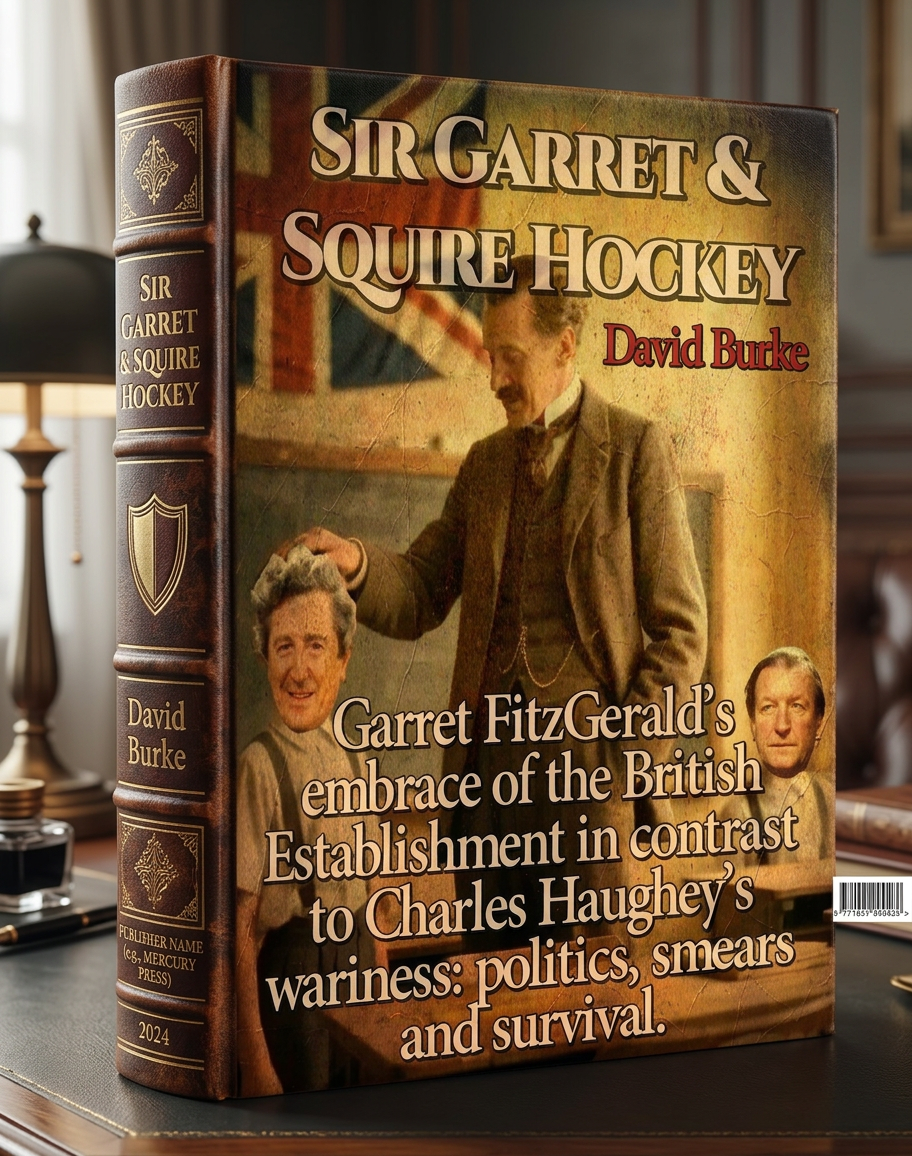
Introduction.
Charles Haughey of Fianna Fáil and Garret FitzGerald of Fine Gael took very different approaches when dealing with Britain’s covert intelligence services and the more questionable diplomats assigned to the Dublin embassy. While FitzGerald was happy to dance with Her Majesty’s emissaries and spooks, Haughey recoiled.

This contrast was never more apparent than when Austin Currie informed Haughey that Brian Lenihan intended to attend the British-Irish Association (BIA). Haughey responded strongly, denouncing the BIA as ‘a front for MI5’.

FitzGerald, by contrast, was a founding member of the BIA.
Haughey and FitzGerald developed two differing styles to deal with Britain. Haughey played hardball while Fitzgerald tried to ingratiate himself with London.

The Phoenix magazine dubbed FitzGerald ‘Sir Garret’ for these preferences. At the same time, Haughey became known as ‘Squire Hockey’, a dig at the British establishment’s inability to pronounce his name correctly and Haughey’s embrace of the high life.
The pair also differed in how they dealt with the press. While Haughey was the first minister known to have retained a public relations firm, he soon tired of appeasing the media and chose a confrontational approach instead. FitzGerald deployed all his charm and was hugely successful in getting them to eat from the palm of his hand.

In or about 1986, The Irish Times received a verbal alert from one of its staff members that Fitzgerald, who was then serving as Taoiseach, was dining with a known member of the Irish National Liberation Army (INLA), an illegal paramilitary organisation, at FitzGerald’s home. A photographer could have been dispatched to record the event as it was still taking place.
The reporter was told by his line editor, ‘We do not want to know‘.
Nothing appeared in the paper. The reporter who provided the alert told me,
‘If it had been Charles Haughey [with the INLA man], the story would have appeared on the front page the next day‘.

This is but one example of an incident in which FitzGerald escaped media scrutiny and criticism, whereas Haughey would have been administered a thrashing.
There was another more serious event where a similar point can be made. It has escaped scrutiny until now. It involves FitzGerald’s behaviour during the first day of the Ben Dunne kidnapping.
Throughout his political career, FitzGerald was able to maintain the credible stance that he was utterly opposed to the violence of the IRA. However, in what must rank as one of the best-kept secret of the Troubles, FitzGerald’s opposition to the IRA was not always as ironclad as it seemed.

FitzGerald was fully aware of what Fine Gael expected of a Taoiseach in the throes of a paramilitary kidnapping. Liam Cosgrave had set the template in October 1975 after the Dutch industrialist Tiede Herrema had been abducted by Republicans. Cosgrave informed his Cabinet that no ransom would be paid; prisoners would not be released, and no concessions would be made to the kidnappers.
Cosgrave’s colleagues promptly lined up behind him.
FitzGerald was in Chicago at the time of the abduction. After he was alerted to it, he contacted his Dutch counterpart, Max Van der Stoel, who was unavailable because he was abroad.
Instead, FitzGerald spoke to his Minister of State, Laurens Brinkhorst.
‘I assured him that we would do all in our power to track down the kidnappers and to release Herrema. Neither then nor later did the Dutch propose to us that we should negotiate with the kidnappers or accede to their demands.’ [All in a Life.]
Herrema was traced to a house in Monasterevin, which was surrounded by the Irish army and Gardai. His release was secured after a gruelling marathon siege.
FitzGerald would not react with such fortitude when he became Taoiseach in 1981.

On Friday morning, 16 October 1981, Ben Dunne Jr. was driving his 500 SEL Mercedes towards Portadown. He was a member of the Dunne family, which owned Dunne Stores, a retail giant. Before Ben Dunne Jnr. crossed the Border, a green car pulled over blocking his route. Four masked men carrying guns tore him out of it, threw him into the rear of their vehicle, hooded him and drove away while two of them sat on top of him.
When the kidnappers, members of the IRA, reached their lair, they extracted the phone numbers of his father and wife from him. They then contacted Ben Dunne Snr.
By all accounts, Ben Dunne Snr. was a forceful and persuasive man; certainly not one to take no for an answer. His son was in the hands of terrorists who were threatening to kill him. At some stage later that day, he contacted FitzGerald. Dunne Snr. told FitzGerald that he intended to pay the ransom, but wasn’t going to alert the Gardai. Even though every minute lost could prove a disaster, FitzGerald did not pass this information to the Intelligence and Security Branch (ISB) division of the Gardai.

Dunne instructed his branch managers and other staff members around the country to bring cash to his home.
There were other indications that a kidnapping had taken place, and some details were in the hands of the ISB.
By Saturday morning, a detective sergeant monitoring the Dunne home surmised correctly that the family was secretly preparing to pay the ransom for the kidnapping and contacted his superiors at Garda HQ.
We may never know precisely what Dunne Snr. said to FitzGerald, but it was enough to secure his acquiescence and, in effect, turn a blind eye to the payment of the ransom.
Ben Dunne was acting as a loving father. His object was to secure the release of his son to his family.

Assistant Garda Commissioner Joseph Ainsworth contacted Jim Mitchell, FitzGerald’s Minister for Justice, on the Saturday morning over a scrambled phone line. He gave him a report and stated that he believed the Dunnes had a plan to pay a ransom, which he intended to thwart immediately.
To his surprise, Ainsworth discovered Mitchell already knew about the kidnapping. He knew because FitzGerald had told him about the abduction.
Ainsworth asked Mitchell if he knew what arrangements were being put in place to make the payment. Mitchell was flustered and refused to answer the question. Ainsworth persisted.

Ainsworth next found himself in the bizarre and unprecedented position of having to secure Mitchell’s approval to halt the payment. Ainsworth was strong, direct and forceful: no ransom was to be paid, he insisted. Ainsworth argued that if it was paid, Ben Jnr. would be killed to conceal the identity of the kidnap gang anyway.
Mitchell refused to commit himself to this course of action.
Eventually, Mitchell agreed he would talk to FitzGerald.
When he reverted to Ainsworth later, he informed him that both he and FitzGerald were now in agreement: the ransom was not be paid.

Once the kidnapping became public knowledge, FitzGerald played the part of the uncompromising man of steel, insisting that no ransom would be paid, nor any concession made.
Several attempts were made to pay the ransom, both north and south of the Border, but the Gardai and RUC intervened to suppress them. On the southern side, the Gardai also sealed off the area where they believed Dunne was being held. With nowhere safe for the exchange in Ireland, the money appears to have been handed over in Europe. Ben Dunne Jnr. was released after six days in captivity at the gates of St Michael’s Church in Cullyhanna, South Armagh. The ransom believed to have been paid was between £350,000 and £500,000, in used banknotes.
£350,000 in sterling is now worth €1,665,000.
£500,000 in sterling is now worth €2,377,000.

In his first autobiography, FitzGerald wrote about the Herrema and Don Tidey kidnappings, but made no mention of the events described here. Instead, he portrayed himself very much in the resolute image of Liam Cosgrave when he wrote about how he had brought in legislation after the Don Tidey kidnapping.
‘We had hoped that the foiling of [the Don Tidey kidnap in 1983] and other kidnap attempts by the IRA and various breakaway groups would have ensured that this possible source of funds would be barred to them. Unhappily we discovered 14 months later that £2 million sterling had been paid to a Swiss bank, from which the great bulk of it was transferred via New York to the branch of an Irish bank in Navan. When we heard this on Wednesday, 13 February 1985 we set to work at once to draft legislation that would enable us to seize this money in a manner that could not be challenged in the courts…”

The payment of the ransom inspired a string of further kidnappings. Ben Dunne warned some of his associates that he believed the IRA was planning more abductions.
Don Tidey was seized in November 1983. That kidnapping ended in the tragic death of a soldier and a garda in Derrada Woods, Co. Leitrim.

In 1986, Jennifer Guinness was abducted. When she was traced to a house in Ballsbridge in Dublin, her kidnapper smashed a window and threatened to kill her. She had to endure the trauma of being in a room with a man who held a grenade in one hand and a revolver in the other before she was eventually released.

In 1987, John O’Grady was kidnapped and mutilated by Des O’Hare. Even animals were not safe; the famous racing horse Shergar was taken in 1983 and never returned.
Senior Garda figures and officials at the Department of Justice knew about FitzGerald’s behaviour during the Dunne kidnapping, as did others. However, not a word of the scandal reached the pages of a newspaper, or if it did, it was spiked.
If Haughey had agreed to {i} turn a blind eye to the payment of a sum in the region of €2,377,000 (in today’s money) to the IRA, {ii} withheld his knowledge of a kidnapping from the Gardai, {iii} prevented his Minister for Justice from performing his duty and {iv} set a precedent which encouraged kidnapping by Republicans, the Irish, British and international press would have had a field day.
Overall, FitzGerald had a talent for manipulating journalists, and never missed an opportunity to ingratiate himself with the British Establishment, which directed myriad intelligence and dirty-trick propaganda departments. All of these factors helped preserve his squeaky-clean image.
This was quite an achievement on FitzGerald’s part, as he was a member of a family which had inflicted considerable damage to the British Empire. His father was a senior figure in the 1916 Rising and the War of Independence. One of his uncles was a key player in a plot to smuggle arms – including chemicals for bombs – to Northern Ireland after the War of Independence truce. Michael Collins oversaw the plot.
Charles Haughey’s father was also a key operative in the plot. He smuggled guns into the North pursuant to Collins’ operation.
Garret FitzGerald’s uncle, France (often described as ‘Frank’), profited financially from the plot despite having fallen foul of the Special Branch in London. Frank caused great trouble for his brother, Desmond, who became a minister in the Free State government.
This ‘long read’ (two hours) is an attempt to explain how Garret FitzGerald was able to spin the media and British Establishment in his favour while undermining Charles Haughey.
This article is an expanded version of a shorter piece published in Village magazine in October 2025.”
Contents.
1. Teacher’s pet.

An early example of FitzGerald’s penchant for ingratiation can be found in a short article he wrote for a book called ‘Must Try Harder’, where he recounted how:
‘When I was in my second year at school I decided to show my appreciation of our Irish teacher, Tadhg Ó Murchú, whom I and the rest of the class felt to be a good teacher and a very warm personality.’
FitzGerald decided to prepare some toffee for him. ‘Unfortunately, I nearly always under-cooked the toffee, which ended up in more or less liquid form.’ He put it in a small tin with clear instructions to open it the right side up.
All went well at first:
‘He received the toffee with great pleasure, but when I came into class the next day I found he was less pleased. He had failed to read my instructions (perhaps because they were written in English!) and had opened the tin the wrong side up, with the result that the contents had emptied themselves on to his carpet!

It is hard to imagine that this was how Haughey operated at school. As a child and young teenager, he earned a reputation among his peers as a ‘tough nut’ who was well able to take care of himself. This toughness carved him out as a successful GAA footballer (although not as successful as his brother Jock, who won an All-Ireland medal for Dublin).
FitzGerald carried this obsequious approach into his dealings with Whitehall and Britain’s shadowy intelligence community. The tactic paid off: while MI6 and the Information Research Department (IRD) spent decades vilifying Haughey, they never attacked FitzGerald. (Details of Haughey’s battles with MI6 are contained in my book, ‘An Enemy of the Crown’.)

Enda Marron, one of FitzGerald’s ‘National Handlers (the 1980s version of a spin doctor) once told me that FitzGerald had the Dublin media ‘pecking little seeds out of his hand; he appreciates that all you have to do is flatter them – no one better than Garret for that’.

2. The sons of revolutionaries
What both men had in common was that they were born into revolutionary families with strong personal connections to Michael Collins.
Garret FitzGerald was the son of Mable McConville and Desmond FitzGerald, himself the son of Irish immigrants who were resident in London.
Desmond, an aspiring poet, moved to Ireland and became a supporter of Sinn Féin. Garret’s mother was the daughter of an upper-class Belfast Presbyterian freemason. FitzGerald described him in his first autobiography, ‘All in a Life’, as,
‘a high-ranking Freemason and the representative in the UK of the Grand Lodge of Alabama’.
The Freemason was outraged when he heard Mabel was involved with Desmond and recalled her to Belfast. But she returned to Dublin, where they eventually married.

The couple had four sons. Garret, the youngest, was born in 1926. Both Mabel and Desmond took part in the 1916 Rising and were in the GPO to hear Pearse read the Proclamation. Afterwards, Desmond was arrested and taken to Britain, chained to Eamon de Valera.
3. Desmond FitzGerald sought POW Status.
De Valera and Desmond FitzGerald spent the next few years behind bars in Brixton, Dartmoor and Lewes prisons, along with 122 other IRA men. De Valera was the prison O/C. In May 1917, while in Lewes, they refused to perform prison work or associate with ‘ordinary’ prisoners. They demanded POW status. Some went on a hunger strike. Eventually, the British Government gave in and released them.

Garret FitzGerald is among those who have distorted these facts. During the 1980 H-Block hunger strike, which he opposed, he claimed that neither his father nor his comrades had ever sought political or elitist status.
4. Minister for External Affairs.
Desmond FitzGerald became William T. Cosgrave’s Minister for External Affairs in the first Free State Government.

Garret was therefore brought up in a political home. When the late H. Montgomery Hyde, author, former Unionist MP, and long-time member of the British Secret Service, visited the FitzGeralds in Dublin, he met the young Garret and predicted that he would one day rise to lead his father’s party.
Garret also felt his future would be significant and kept his papers for posterity from the age of six.
5. Seán and Sarah Haughey.
Charles Haughey’s parents, Seán and Sarah (nee McWilliams), were born and reared almost next door to one another on small farms in the adjacent townlands of Knockaneil and Stranagone, near Swatragh, a few miles from Maghera town in Derry.

Haughey Senior, who was born in 1897, joined the Irish Volunteers in 1917. He rose to become the Second in Command, and later Officer in Command, of the South Derry Battalion of the Irish Volunteers during the War of Independence. At the start of the conflict, he carried out raids on the homes of Loyalists and several retired British army officers.
His military file marked him out as one of the most energetic IRA members in South Derry. In one attack on 5 June 1921, a Royal Irish Constabulary sergeant called Michael Burke was killed while others were seriously wounded in a late-night ambush of the barracks at Swatragh.

As a result of his activities, Seán Haughey had to go on the run. According to his superior, Major Dan McKenna, he would have been killed had he been caught:
‘His enemies were of the opinion, and indeed not without reason, that he was the cause of all their woes in his area.’
Sarah, who was born in 1901, also played an active role in the campaign as a volunteer with Cumann na mBan. She remained a member until 1923.
The Anglo-Irish Treaty was signed on 21 December 1921 and ratified the following January. Yet hostilities persisted in the North.

The UVF began to regroup under Lieutenant-Colonel F. H. Crawford.
Thirty-one people were killed in Belfast between 12 and 16 February 1922.
On 19 March 1922, 200 IRA men surrounded the town of Maghera, County Derry, cutting off the telephones before seizing the Royal Irish Constabulary barracks from which they removed 17 rifles, 5,000 rounds of ammunition and a sergeant as a hostage. The IRA campaign continued the next day with the destruction of mills, sawmills, stables and outhouses in County Derry. Burntollet Bridge (which would become infamous in 1968) was blown up.

On 30 March, Michael Collins, representing the Provisional Government in Dublin, and Sir James Craig, signed an agreement. Collins wanted to neutralise the security forces in the North as a threat to the Catholics. In return for a cessation of IRA activity, it was agreed that Catholics could and should join the Special Constabulary and assume responsibility for policing nationalist areas. In mixed regions, an equal force of Catholic and Protestant officers would be deployed. Meanwhile, all searches would be conducted by mixed units with British soldiers in attendance. The Specials were to wear uniforms with identification numbers and surrender their arms once they had finished their duties so that they could be kept in barracks.

On 31 March, Royal assent was given to the Free State Bill, which became the Free State’s new constitution.
The ceasefire Collins and Craig negotiated proved a failure. On 2 April 500 Specials swooped across County Derry and Tyrone, scooping up 300 men for questioning, but only four were found to be in the IRA. The rest escaped to County Donegal.

By now, the IRA was on the verge of a split into pro- and anti-treaty factions. The 8,500 volunteers who lived in the new state in the North were virtually all anti-treaty. Michael Collins was prepared to supply them with arms for a number of reasons, one of which was that it offered him a possible way to unify the IRA, something that was a priority for him.
6. Séan Haughey played a key role in Michael Collins’ most sensitive and secret cross-border operation after the ceasefire
Seán Haughey became involved in what was perhaps the most sensitive and secret covert operation Michael Collins ever mounted: to provide Catholics living across the new border with weapons to defend themselves from the forces of the new state.

Hundreds of Catholics (and many Protestants) were killed during sectarian riots that had erupted in July 1920. Between 1920 and 1922, 267 Catholics perished, while 2,000 more would be wounded; another 30,000 people were evicted from their homes and driven from their jobs, especially at Belfast’s shipyards. Collins arranged for guns, at least some of which were supplied by the IRA in Cork, to be smuggled across the Border. Collins was keen not to use any of the weapons he had obtained from the British which could easily be traced back to forces under his control.

One ploy was to trade some of the British-supplied guns with the anti-Treaty IRA for weapons acquired during the War of Independence and send the latter to the North.

The First Northern Division of the IRA in Donegal was led by Commandant-General Joseph Sweeney, who went on record stating:
‘Collins sent an emissary to say that he was sending arms to Donegal, and that they were to be handed over to certain persons – he didn’t say who they were – who would come with credentials to my headquarters. Once we got them we had fellows working for two days with hammers and chisels doing away with the serials on the rifles… About 400 rifles and all were taken to the Northern volunteers by Dan McKenna and Johnny [i.e. Seán] Haughey.’ (See also From Pogrom to Civil War by Kieran Glennon.)

Another IRA man, Thomas Kelly, collected a consignment of 200 Lee-Enfield rifles and ammunition from Eoin O’Duffy. In an affidavit, Kelly swore many years later, he revealed that the
‘rifles and ammo were brought by Army transport to Donegal and later moved into County Tyrone in the compartment of an oil tanker. Only one member of the IRA escorted the consignment through the Special Constabulary Barricade at Strabane/Lifford Bridge. He was Seán Haughey, father of Charles Haughey.’ (Michael Collins by Tim Pat Coogan at page 351 Arrow books edition.)
Haughey was also part of another operation, which involved making preparations to kidnap political figures in the new Northern state. This involved building an underground bunker of sorts to hold them captive.

7. Frank Fitzgerald, gunrunning, allegations of profiteering and of a cover-up by Cumann na nGaelheal.

The attempts by Collins to procure arms involved General Richard Mulcahy, Minister for Defence in the pro-Treaty Cumann na nGaelheal government.
John Byrne delved into this issue in forensic detail in the 30 March 1983 edition of Magill magazine. The content of this section is based on Byrne’s incredible piece of work.

Collins, Mulcahy and their comrades decided to purchase a large quantity of arms surreptitiously from professional arms dealers in London. The operation was sanctioned at the highest level in the Free State army. In May 1923, General Sean MacMahon, who had been Quartermaster General at the time, summed up the course of events thus:
‘Early last year, during the pogrom in the North and when our men in the Northern divisions were making every effort to deal with the situation, the demand for arms increased and every weapon we could lay our hands on was sent to one of our Northern divisions. Arms were taken from Southern units and sent up North and later we supplied them with some arms from the regular army. The position became very difficult and, after many meetings with our Northern officers, it was decided that we would procure a quantity of arms under cover to be sent in to the six counties.
8. The role played by Frank FitzGerald, arms dealer.
Frank FitzGerald was the brother of Desmond FitzGerald, who had become Minister of External Affairs in the Dublin Government. Mulcahy also revealed that
‘I went into the matter of procuring a quantity of revolvers and rifles with Mr Frank FitzGerald, who had been procuring materials for us for a long time …. ‘
Frank FitzGerald was a businessman and arms dealer. He had supplied arms and bomb-making chemicals to the IRA during the War of Independence and the Truce, via a series of essentially paper companies, of which he was the proprietor. One of his contacts was Joseph F. White, another London-Irish businessman who had also supplied guns to the IRA.
In April 1922, FitzGerald introduced White to Sean Golden, the Deputy Director of Purchases of the Free State army. The meeting took place in London. The parties discussed what John Byrne described as ‘a formidable list of armaments Golden was interested in buying’. They concentrated on rifles and revolvers.
White later told the Committee of Public Accounts that Frank FitzGerald had informed him that
‘it was desired to obtain a large number (of rifles) secretly for use against Ulster …. “
By mid-June 1922, White and FitzGerald had received offers of 2,500 .45 revolvers, 10,000 Lee Enfield .303 rifles and five Hotchkiss guns – heavy, machine guns which fired one Ib shells. The Hotchkiss guns had come from a British naval vessel which was being converted to civilian use.

General MacMahon approved the contract. Frank FitzGerald was furnished an advance of £10,000 out of army funds. The revolvers were due for delivery at the end of June 1922. However, the attack on the anti-Treaty forces occupying the Four Courts on 28 June 1922 ignited the Civil War, disrupting the plan.
As John Byrne pointed out:
‘MacMahon told FitzGerald to hold things up for the time being because the Free State authorities couldn’t be sure the guns wouldn’t get into the wrong (i.e. anti-Treaty) hands. He didn’t stop the scheme, however, and negotiations with arms dealers in London went on during July while the Civil War raged in Ireland.‘

Arrangements to buy the 10,000 rifles were concluded, and a deposit of £2,250 was paid on August 2.
As Byrne suggests:
‘This may have been connected with a meeting between Collins and Mulcahy and Northern IRA leaders, which was held in Dublin on the same day and at which it was arranged that a large number of Northern IRA men would come South to the Curragh camp. They were to be trained and armed there, ready to resume their activities in the North at some future date.
‘FitzGerald had also been supplying large amounts of bomb-making chemicals to the Free State army since May 1922. There is no indication what these were used for, but the IRA in Belfast launched an incendiary campaign against big businesses in the city at the end of May and there may well have been a connection.‘

The timing of all this was significant. It showed that there was quite a high level of cooperation on the question of the North between sections of the pro- and anti-Treaty forces until literally the eve of the attack on the Four Courts. And it demonstrated that the Free State army’s high command was still involved with the clandestine activities of the Northern IRA for some months after the Civil War had begun.
In June 1922, Frank FitzGerald failed to keep appointments with the arms dealer, who got fed up and sold the guns to Brazil instead.

9. The Special Branch in London intervene.
The bulky Hotchkiss guns were due to be handed over on 24 August. They had been stored at the back of an antique shop behind the Shaftsbury Theatre, near Oxford Street and the Tottenham Court Road.
Secrecy was essential since the weapons were part of Collins’ plan to smuggle the arms to the IRA in the North.
Yet, FitzGerald had the Hotchkiss guns loaded openly on a lorry in full view of the busy main roads and then taken to his own works. Not surprisingly, detectives from Scotland Yard arrived a few hours later and seized them.
FitzGerald promptly denied all responsibility, claiming he was only storing the guns for White. He then asked White to take responsibility because,
‘his brother being a member of the (Dublin) Government, the connection between the two would cause very serious complications with the British Government … ‘
White was interviewed by Colonel Carter, the head of the British Special Branch, and claimed he had intended to sell the guns to Spain. He wasn’t charged, but Scotland Yard kept the guns.

The seizure of the Hotchkiss guns halted the sale of the deal for the 10,000 rifles. These were British Army surplus items stored in the Tower of London. They were to be sold by the British army’s Disposals Board to the same dealer who had handled the Hotchkiss guns, Horace Soley & Co., who were to hand them over to White and FitzGerald. When the machineguns were seized, the Disposals Board called off the deal.

10. Chemicals for bombs in the North.
Frank FitzGerald delivered another batch of chemicals in early 1923.
He began to receive the revolvers in October 1922. They did not reach Ireland until much later.

Michael Collins was shot dead at Beal na Blath on 22 August 1922. The Free State army proceeded to defeat the IRA. Collins’ successors did not revive the plan to arm the IRA in the Six Counties.
The Free State army did not press Frank FitzGerald for the revolvers.

11. Joseph White, left out in the cold, blows the whistle on the arms importation plot.
As Byrne pointed out in Magill:
‘In the meantime Joseph White had become thoroughly fed up with FitzGerald. He had been left to carry the can for the Hotchkiss guns and FitzGerald had refused to pay him commission he had been promised on the various deals. White had gone to Dublin in September 1922 to complain to General MacMahon, who had refused to see him. He then wrote to a number of Free State Ministers who ignored his letters.
‘White suspected a cover-up and began to make allegations about FitzGerald’s financial dealings. Eventually, at the start of 1924, he wrote to Tom Johnson TD, the leader of the Labour Party and chairman of the Dail’s Public Accounts Committee.

12. FitzGerald makes demands
Meanwhile, the Free State authorities were having their own troubles with FitzGerald. He was demanding payment for the 2,500 revolvers and 25 tons of chemicals, which were part of the original deal, even though he had not delivered them, and the Free State army no longer wanted them.
As Byrne pointed out:
‘Whatever pressure FitzGerald put on was effective because on October 19 1923, Mulcahy and General MacMahon, who was now Chief of Staff of the Free State army, had a hurried meeting with the President of the Executive Council, W.T. Cosgrave.

‘Mulcahy and some other Ministers then went to the Department of Finance where Mulcahy drew out £5,000, and he and MacMahon caught the night boat to England to see FitzGerald. They gave him the £5,000 and tried to persuade him to buy back the revolvers and chemicals for half price and dispose of them, but he refused. He didn’t hand them over either.

‘The saga wasn’t over yet. In February 1924 FitzGerald telegraphed Cosgrave and Mulcahy to say that the revolvers had been seized by the arms dealers, Soley & Co., in lieu of money he owed them and that he was being served with bankruptcy papers. He demanded the balance of the price originally agreed for the entire arms transaction. The bankruptcy story transpired later to have been a ruse.
‘It was an awkward moment for the Cosgrave Government. They were involved in delicate negotiations with the British over the commission to review the boundary between the Free State and the North. They may have been worried that a bankruptcy case would bring the whole arms affair out in the open. Cosgrave urged an immediate settlement.

‘Department of Finance officials went to London and agreed to take over FitzGerald’s debts to Soley & Co. (£3,260) and to pay FitzGerald the balance of the original sum agreed (£1,400). FitzGerald got the revolvers back from Soley & Co., but then refused to part with them or the remaining chemicals unless he got an additional £700 from Dublin. The Department of Finance official refused to hand over the £1,400 and returned to Dublin. At this stage the Free State authorities had paid FitzGerald £18,305 out of a total claim of £19,704 but had only received goods to the (nominal) value of £7,069. FitzGerald now held goods to the nominal value of £10,385, which the Free State had paid for. (FitzGerald had also paid Soley & Co. £2,250 as a deposit on the 10,000 rifles. Soley & Co. claimed they had paid this over to the British army’s Disposals Board but the latter denied ever receiving it.)
The Free State authorities initiated legal action against FitzGerald in July 1924, though it never came to court.
Eventually, in December 1924, FitzGerald dropped his claim for an extra £700 and settled for the £1,400 he had been offered in February.
This meant he had received a total of £19,704.
He handed over the revolvers and some of the chemicals, but it took another threat of legal action to secure the remaining chemicals, which weren’t handed over until April 1925.
When the revolvers reached Dublin, 61 were found to be missing.
The chemicals were sold off in London but were found to be five tons short.
Much of what was left was of inferior quality.
The chemicals, which had a nominal value of £2,261, realised a mere £315 when sold.
13. An inquiry by the Public Accounts Committee.

By now, the Public Accounts Committee, chaired by Tom Johnson, had begun to investigate the transaction, with the assistance of Joseph White, who also drew attention to the sizeable profit margins Frank FitzGerald had made on the goods. FitzGerald had charged Dublin £1,000 for the Hotchkiss guns, which had cost him only £750. He had charged £35s per revolver, whereas he had bought them for £23s 6d each. And if the 10,000 rifles had been delivered, he was aiming to make a significant profit.
As for the chemicals, FitzGerald had charged a uniform price of £56 per ton for the bulk of them, although the market price had dropped to about half that over the period when he was supplying them.

White had pointed all this out to the Free State authorities in numerous letters, but had got no response. He now alleged that this was due to FitzGerald’s influence in Dublin, where, as well as having a brother in the Cabinet, he was very friendly with Mulcahy and Ernest Blythe, the Minister of Finance. FitzGerald himself refused to appear before the committee, as did Mulcahy, who had resigned from the Cabinet in the spring of 1924.
The Public Accounts Committee commented in April 1925 that the prices charged for the chemicals had been too high and that FitzGerald’s profit on the Hotchkiss guns was ‘greatly excessive’ (it was not clear whether the Free State authorities ever got these guns). The committee returned to the theme in March 1926, after a more detailed investigation, and said:
‘Every item in this account and almost every incident in connection with the transactions calls for adverse comment … ‘
They noted in particular the Army’s failure to act after White drew their attention to FitzGerald’s profit margins and the Department of Finance’s readiness to meet his claims without taking any measures to ensure he would deliver the goods. Johnson felt that the whole affair was being covered up. He had great difficulty in getting Government agreement to a Dail debate on the committee’s report and, when they did agree, the debate was fixed for the day before the Dail recessed in July 1925, when many TDs were only anxious to get home. Johnson described the whole business as most unsatisfactory and said:
‘It will be difficult to disabuse the public mind of the thought that the Ministry has been affected by personal considerations when . . . Mr. FitzGerald … is a brother of a Minister …’
He said Desmond FitzGerald should have resigned from the Government.

Ernest Blythe, the Minister of Finance, denied that personal considerations had influenced the Government. He said nothing about the allegations of overcharging and excessive profits, or why the Government had met FitzGerald’s claims so readily.
Johnson had discreetly avoided mentioning that the arms were destined for the North.
Blythe was discreet too, but indicated that he had opposed the Collins-Mulcahy policy of arming the Northern IRA. He tried to distance the Cosgrave Government from the events of 1922, saying:
‘Many people were confused after the Treaty (and) were forced to do things that I think they would now say … ought not to have been done.’
Having hinted at the murky and potentially embarrassing nature of the affair, he urged that there was no longer any point in going into the details of it. His approach was effective. No one else raised the question. Desmond FitzGerald said nothing.

Johnson remained indignant about the affair, and the following report by the Public Accounts Committee provided further details of the transaction, including the intended destination of the arms. There was no response from the Government.

14. Fianna Fail enter the Dail.
As Byrne further pointed our:
‘The last word on the question came after the Fianna Fail Deputies entered the Dail in 1927. They confirmed that supplies of arms had been promised for the North. Frank Carney TD, who had been chief supplies officer at the Free State army headquarters in Portobello barracks, said that, two or three days before the attack on the Four Courts, he had fitted out a flying column of 40 men from the South Down/South Armagh area. They had been waiting for the London guns before returning to fight in the North when the Civil War began. Carney himself resigned from the Free State army when the Civil War began and later joined Fianna Fail.

‘The Fianna Fail speakers were cynical about the episode and claimed that the promise of guns had been used to keep the Northern IRA and their Southern sympathisers quiet until the Civil War was under way and then the whole scheme had been dropped. None of them raised the question of FitzGerald’s profits and the alleged cover-up by the Free State authorities.’
15. Garret FitzGerald’s account in ‘All in a Life’.
In his autobiography, ‘All in a Life’, FitzGerald provided his recollection of these events thus:
My father’s older brother, France (sic), an indefatigable dancer, ran a chemical works in Stratford, near his home in West Ham. During the Truce that preceded the Anglo-Irish Treaty of December 1921 he got into trouble collecting arms from barracks in London with the help of a drunken sergeant; he apparently tried his luck in one barracks too many. He cannot have spent too long in custody, since an early 1922, after the Treaty but before the Civil War, he became involved in providing arms and explosives to Michael Collins-the transaction that five years later was the subject of prolonged attention by the Public Accounts Committee of the new Irish Parliament. In 1941 he died following a gas explosion at his factory, resulting from an air raid, and my father, with the help of my brother Pierce, who was an accountant, had to make a number of visits to Stratford during the remainder of the war to keep the factory going, producing chemicals for the war effort-a curious circumstance in which to return to the native East London after so many different careers as poet, nationalist revolution, propagandist, Government Minister, and philosopher. (All in a Life page 4)
16. Commandant Haughey.
Seán Haughey joined the Free State Army and rose to the rank of commandant.
Soon after joining, he was stationed in Co. Mayo. According to Commandant A. Fitzpatrick, in 1923, Haughey and his fellow soldiers had to work in an area which was ‘almost entirely hostile to the [Free State] Army’.
They also often found themselves sleeping in the open. Their base in Ballina had no heating, lighting or windows. Commandant Fitzpatrick commented later that,
‘All these hardships endured by NCOs and men had a very detrimental effect on the health of ex-commandant Haughey as he continually endeavoured to improve the conditions of the men under his command, without result.’
Seán was stationed in Castlebar in September 1925 when his third child, Charles, was born.
He retired in March 1928 with a modest pension. He received glowing references from his superiors and colleagues. Major McKenna said of him that he had ‘done his utmost to make British law impossible in his area‘.
After he retired, the family moved to Sutton, County Dublin, before moving again to Dunshauglin, Co Meath, where they took up farming on a 100-acre holding. All told, the couple had seven children: Maureen, Seán, Charles, Eithne, Bridie, Padraig, and Eoghan.

Haughey Senior developed multiple sclerosis in 1933. He believed that it was caused by the hardships he endured in the IRA and National Army. He became entitled to a disability pension.
He was forced to sell his farm. In 1933, he moved his family to a small two-storey house at 12 Belton Park Road, Donnycarney, in Dublin. By 1935, he was unable to walk. After this, the family had to struggle on in modest circumstances.
His son Eoghan (brother of Charles) told a documentary-maker in 2005 that, ‘My father was an invalid as long as I can remember.‘
Despite these setbacks, Mrs Haughey not only raised her family but also found time to carry out charity work in her parish with the Third Order of St Francis.
17. Encounters with the B-Specials and the Maghera riots of 1938.
All the while, as the children grew up, they received regular visits from relatives and friends from the North, bringing news and stories about what was going on across the Border. In the other direction, the young Charles Haughey spent extended summer holidays in Swatragh, staying with his mother’s parents at Stranagone, about half a mile up the mountain road leading from Swatragh.

The holidays took a lot of weight off his father’s shoulders. His uncle Owen McWilliams was a key figure in young Haughey’s development. According to his first cousin, Professor Monica McWilliams, her father volunteered to help rear Charles and his brothers, who would come to the North every single summer. After his father died, this continued and alleviated the financial pressure on his mother. Owen was a cattle dealer who took Charles and Seán with him to the local fairs.
The boys ‘became little cattle dealers and little farmers and his helpers every summer until he got married’. They visited such places as Maghera, Kilrea, Tobermore, Desertmartin, Cooktown, Dungiven and Toomebridge. Decades later, Haughey would entertain the Derry minor football team after they had played in an All-Ireland final in Croke Park. Several of the team were impressed by his knowledge of the South Derry countryside.

There was an idyllic aspect to the summer holidays he spent in Swatragh, but there was also some darkness.

Violence was still prevalent in the North. In 1935, sectarian rioting had cost eleven deaths and 574 injuries in Belfast.
In 1938, after a visit to the cinema at Maghera, Haughey, his brother Seán and uncle Owen emerged from the building to witness a riot during which Loyalists were firing rifles at unarmed Catholics. The event forged a lasting impression on him. It was, he felt, a visceral taste of what life was like for some Catholics in Ulster; an insight that was shared by very few, if any, of his contemporaries in Dublin, especially the middle-class children he would soon encounter at University College Dublin (UCD).

The young Haughey experienced further sectarian division in the community during these holidays. He and his cousins were sometimes stopped by the B Specials, something he found unpleasant, sinister and often intimidating. These patrols usually intercepted them at night as they were returning to Stranagone. The patrols were made up of men from the neighbouring areas who were known to them, but never friendly; all were drawn from the Protestant community. They were quick to display their authority. Haughey felt there was an element of ‘croppies lie down’ about their behaviour.
One of the reasons Seán Haughey had left Derry originally was because he felt he had become a marked man. His home had been raided ten times in one year. Seán Haughey’s father (i.e. Charles Haughey’s grandfather) had to emigrate to the US. He took one of Sean’s sisters with him.
As Charles Haughey would put it, during all this time he ‘gained at first hand an insight into the manner in which at that time rural communities were firmly divided along sectarian lines’.
By 1941, his father had become so incapacitated that he was only able to mark an ‘X’ on a statement about his illness.

To the end of his days, Seán Haughey remained a great admirer of Michael Collins and had no time for Fianna Fáil.

18. School and college days.
Haughey received his education at Scoil Mhuire National School in Marino (with brief interludes at primary schools in Dunshaughlin and at Corlecky near Swatragh) and at St Joseph’s Christian Brothers’ School, Fairview, where he invariably took first place in each subject.
Part of his education was made possible by a scholarship he received after coming first in the Dublin Corporation scholarship examination.
In 1941, at the age of fifteen, Haughey joined the Local Defence Force, the then Reserve Force of the Irish Army. He rose to become a lieutenant. He enjoyed it so much that at one time, he considered a career in the Army. He remained a member of the Local Defence Force until he became a TD in 1957.
On the sporting field, he represented the Leinster colleges in hurling and Gaelic football. He maintained his relationships with his cousins in the North. After completing his leaving certificate in 1943, he holidayed with his classmate Harry Boland and his uncle Owen McWilliams in Kilrea, County Derry.
Haughey went on to study commerce at UCD and won a bursary. In those days, UCD was located at Earlsfort Terrace.
Garret FitzGerald was privately educated at Belvedere College and at Ring School. He also went to UCD, where he and Haughey first crossed paths.
At UCD, Haughey met Joan O’Farrell, whom both he and FitzGerald would date.
In UCD, both Haughey and FitzGerald were active in the debating societies.
19. Trinity riots.
On 7 May 1944, the British government announced that Nazi Germany had surrendered to the Allies. This triggered jubilant celebrations by Trinity College students who raised a string of flags, including a Union Jack, over College Green. Word soon spread to UCD, then located a few minutes’ walk away at Earlsfort Terrace, where Haughey was a student. ‘This generated a wave of anger. The reason we were so angry was because the [Trinity] students were goading and insulting the rest of us’, said Seamus Sorohan, a friend of Haughey’s, told me during a private discussion at the Law Library in the early 1990s.

Some of the students on the roof of Trinity were singing ‘God Save the King’ and ‘Rule Britannia’ while the Irish Tricolour fluttered beneath those of Allied flags, something which provoked criticism from the passing public. In response to the complaints, some Trinity students hauled the tricolour down and set it ablaze before throwing it onto the ground beneath them. This ‘inflamed the fury’ of Sorohan, Haughey and others from UCD. That night, they tore down a Union Jack flag which they found hanging on a lamppost at the bottom of Grafton Street and set it alight. They then congregated on Middle Abbey Street and marched over O’Connell Bridge towards Trinity College, breaking windows in the offices of The Irish Times on Fleet Street en route. They perceived the paper to be pro-British. It reported the next day that the march was led by a ‘young man [i.e. Haughey] waving a large tricolour hoisted on the shoulder of his comrades’. When they found the gates of Trinity were closed, a group of them tried to scale the railings, but were repelled by the police who baton-charged them.
Garret FitzGerald was one of the eyewitnesses to the event. He watched Haughey leap over bicycles before bolting up Trinity Street. ‘My views and his views would have been different. I was strongly pro-Allied’, he said years later.
The Provost of Trinity later apologised for the burning of the Tricolour.
Haughey would dine out on this escapade for decades.
20. An invitation to join the IRA
Garret and Joan married in 1947. He was 21, she was 24. The age gap was something the couple concealed when FitzGerald entered politics.
At some stage after UCD, but undoubtedly before 1951, Haughey was approached by Sorohan. ‘I was in the IRA. I told him so, and asked him to join’, Sorohan told me in the 1990s. But he had misjudged Haughey, who declined the offer, albeit after considering – or more likely pretending to consider – the offer seriously. An indication of his reasoning may be gleaned from a speech he made on 25 March 1958 in the Dáil, extoling the merits of the FCA. Haughey felt it gave young men.
‘from the ages of 17 to 20 .. an opportunity of being inculcated with patriotism, proper national ideals, a sense of discipline and all the other advantages that go with military training at that early age’.
Moreover, he argued the patriotism the FCA inspired in young men, offered an alternative to the IRA:
‘A lot of young men who find themselves caught up in movements without realising fully what is involved in the ultimate, would never get into these difficulties if the career of a member of the FCA were made more attractive and interesting.’
According to Sorohan, Haughey discussed the invitation with Sean Lemass, who was the father of his girlfriend and future wife, Maureen. Not surprisingly, Lemass, now a Fianna Fáil politician, ‘told him not to join’. Lemass, himself a former IRA man, had served in the GPO in 1916 with Padraig Pearse and had been a member of the ’ Twelve Apostles, the group of men led by Michael Collins, which had eliminated a number of British secret service agents in Dublin on 21 November 1920. During the Second World War, Lemass served as a senior minister in a government which had passed legislation to intern suspected IRA men without trial. Hundreds were held in the Curragh; nine prisoners were executed.
When Sean Haughey died prematurely on 3 January 1947, his old comrades provided a guard of honour at his funeral. He had remained an ardent supporter of Michael Collins and the Treaty throughout his life, while maintaining an aversion to de Valera and Fianna Fáil. Whether a coincidence or not, Charles Haughey did not become active in Fianna Fáil until after his father’s death.

Sorohan went on to carry out intelligence work for the IRA including
‘taking photographs of Special Branch officers. I have piles of pictures at home’. Decades later he pondered what he might do with them, once suggesting rather mysteriously to this author, that he might ‘donate them to the Special Branch for their archives’.
If Haughey had joined the IRA, this perhaps might have been the type of work he would have been asked to undertake.
News of Sorohan’s invitation to Haughey reached the ears of Garda special branch officers by the 1960s. The Garda version was that Haughey had failed to ‘say no outright’. This is at odds with Sorohan’s recollection. Sorohan’s version of what Haughey said is more likely to be accurate, as he was directly involved in the discussions. Most likely, Haughey was being diplomatic when he said he would consider the offer: he probably never had any doubt that he would reject it. ‘That is quite possible, was how Sorohan replied to this suggestion when I put it to him.
Sorohan developed a fascination with British intelligence and amassed an extensive library of materials on their activities, which he studied in detail. After his death, his colleague, Patrick Gageby SC, arranged for the sale of his library for the benefit of his widow. It featured an extensive number of rare books on a wide variety of topics. The ones on British intelligence were often marked with handwritten notes.
21. UCD graduates.
After UCD, both Haughey and FitzGerald studied for the bar, but neither practised as barristers.
FitzGerald went to work for Aer Lingus while Haughey became an accountant. Haughey was articled to Michael J. Bourke of Boland, Bourke and Company, and in 1948 won the John Mackie memorial prize of the Institute of Chartered Accountants (ICA). Haughey became an associate member of the ICA in 1949 and a fellow in 1955.
22. Tax payment.
As a public servant, FitzGerald was forbidden from writing for the media. He assumed a pen name. It is not known how he paid his taxes on his earnings from his journalistic work while working for the State.
Despite becoming Taoiseach, the media never probed his tax affairs.
Later, he became a lecturer in economics. It wasn’t until the mid-1960s that he entered politics.
Haughey made several attempts to secure a Fianna Fáil seat in the Dáil in the 1950s.

On 18 September 1951, he married Maureen Lemass, who had also studied commerce at UCD. Together, they would have four children: Eimear, Conor, Ciaran, and Sean. [9]
Haughey finally became a TD in 1957 and was appointed as parliamentary secretary (junior minister) at the Department of Justice in 1961.
23. Haughey crushes the IRA.
In April 1955, Haughey’s old friend from UCD, Seamus Sorohan, addressed an Easter rally in Galway, at which he called on young men to volunteer for the IRA and be trained in the use of arms to achieve the complete freedom of the Nation. He was followed by Joe Crystal, another IRA volunteer, who told the crowd that the Republican movement would soon be making ‘the Six Counties so hot that England won’t be able to hold them’. The Border Campaign began shortly thereafter.

John A. Costello’s Fine Gael-led government was in power when the campaign began. Insofar as security policy was concerned, it turned into an arm wrestling match over who could best crush the IRA. Fianna Fáil criticised Fine Gael for allegedly not taking a sufficiently hard line against the IRA, purportedly on account of Sean McBride’s presence in Cabinet. McBride was the leader of Clann na Poblachta and a former IRA chief-of-staff. During the 1957 general election, Fianna Fáil claimed that it was the only political party with ‘the unity, capacity and will to curb the IRA’.
As the campaign intensified, Fianna Fáil pursued the issue with vigour. Gerald Boland of Fianna Fáil accused the government of providing ‘illegal organisations’ with a ‘carte blanche’ to ‘arm, drill, openly recruit, hold public collections… and publish a newspaper’.

Fianna Fáil won the election. De Valera became Taoiseach again. He moved quickly to suppress the IRA. Sitting in his prison cell in England, an IRA prisoner, Sean MacStíofáin, was convinced the new Fianna Fáil administration would come down hard on the IRA:
‘We knew, even from the Scrubs hundreds of miles away, what de Valera’s return meant for our comrades in Ireland. The persecution of Republicans would now begin in earnest and collaboration with the British forces would be stepped up.’[1] Seán Mac Stíofáin, Memoirs of a Revolutionary (Gordon Cremonisi, London, 1975), p. 81.

Garda-RUC liaison was indeed intensified, while extra police and soldiers were deployed to border areas. Sir John Hermon, who later became RUC Chief Constable, was a witness to the discreet exchange of information that flowed between the RUC and Dublin Castle during the Border Campaign. In his memoirs, he described how the sharing of
‘sound intelligence and practical co-operation between the Garda Siochana and the RUC was given tacit approval by the Irish and British governments, much to the mutual benefit of both forces. This relationship, which strengthened over the years, was quickly and warmly extended beyond policing into other areas, including recreational and social activities’.[2] Holding the Line by Sir John Hermon p. 37.
De Valera reintroduced internment – arrest and detention without trial – after a Cabinet decision in July 1957. The policy faced a robust legal challenge from an internee, Gerald Lawless. The case eventually reached the European Court of Human Rights. The Curragh internment camp was closed in March 1959, long before the Lawless suit was determined.
Sean Lemass succeeded de Valera as Taoiseach on 23 June 1959. He resolved to end the IRA’s Border Campaign
‘by making its futility obvious rather than making martyrs of those who practiced it’.

Haughey, who had been elected to the Dáil in the 1957 general election, was beginning to make a name for himself there as a moderniser. In his early speeches, he argued that factories should be built by the State and leased to prospective entrepreneurs, an ideal adopted by the Industrial Development Authority. He also proposed that companies be allowed to retain more profits to spur expansion and create more jobs. He generally advocated more State involvement and investment in the economy. He championed the value of research to make farming more profitable. The marine was also on his radar: Board Iascaigh Mhara, he suggested, should stimulate boatbuilding, pier construction, and fish processing.
He became Parliamentary Secretary (i.e., junior minister) at the DoJ in 1959. The Secretary to the Department was Thomas Coyne, who was working with the British Secret Service, MI6. See: Nest of Spies.

Haughey was promoted to Cabinet as the department’s full minister in October 1961, by which time Peter Berry had succeeded Coyne.

After the European Court of Human Rights condemned aspects of Ireland’s laws on internment, Haughey let it be known that the Cabinet felt that the
‘powers of detention should not again be exercised except as a last resort and only where any other effective means of a less repugnant kind were not available’. [John Maguire, IRA Internments & the Irish Government Subversives and the State 1939 – 1962, (Irish Academic Press 2008, Dublin), p. 144.]
Now, in his late 30s, Haughey was faced with the task of defeating the IRA as it attempted to resuscitate its campaign, without the tool of internment at his disposal. He examined the available options with his officials, notably Peter Berry, and formulated a plan which he presented to his Cabinet colleagues. It involved the reactivation of the Special Criminal Court. He also launched a publicity drive designed to highlight the futility of the IRA’s campaign. The Special Criminal Court was composed of military officers and enjoyed special powers. There was no jury. It was empowered to hand down longer custodial sentences than the ordinary courts. On the whole, the public accepted its existence despite Sinn Féin’s attempts to provoke outcry against it. In its first month, twenty-five Republicans were sentenced to a combined total of forty-three years’ imprisonment. The shortage of workforce was devastating for the IRA. Sean Garland, one of the movement’s leaders, felt that the severe sentences the Court had handed down were a decisive factor in the campaign’s end. [Private interview with Sean Garland.] In February 1962, the IRA threw in the towel.[ See John Maguire, IRA Internments & the Irish Government Subversives and the State 1939 – 1962, passim.]

After the IRA announced the end of its campaign, Haughey made a statement during which he recognised the desire in the country to end Partition but condemned what he described as the IRA’s ‘foolish resort to violence’ in furtherance of that aim. Berry deemed the IRA’s collapse as ‘a great personal triumph’ for the young minister. To his intense satisfaction, Haughey had managed to defeat the IRA without turning the volunteers into martyrs, just as Lemass had dictated.
24. Rapprochement with Northern Ireland. Lemass, Lynch and Haughey take steps to normalise relations with the Stormont government.
Charles Haughey has been inaccurately portrayed as a politician who had little or no interest in the North before the outbreak of the Troubles. In his book The Party, published in 1986, the former political editor of The Irish Times, Dick Walsh, who was a friend and speech writer for Cathal Goulding of the Official IRA, contended that
‘Haughey, however, was one of those who, in [Conor Cruise] O’Brien’s words, had not hitherto been suspected of more than conventional republicanism. .. was noted by a close parliamentary colleague as “never having uttered a peep at all about the North – at any party meeting or anywhere else”.’ Back. (See page 101.)
This portrayal, although almost universally accepted as gospel by the Dublin media, has little to commend it as accurate. On the contrary, Haughey, along with Taoiseach Sean Lemass and his then-cabinet colleague Jack Lynch, made great strides in opening relations with Stormont in the 1960s.
In 1962, Lemass dispatched Haughey and Lynch to Belfast to explore the possibility of free trade with the North. The choice of Lynch, who was then Minister for Industry and Commerce, was obvious; Haughey, less so, as he was Minister for Justice, a department not involved in trade. However, his credentials as a moderniser, foe of the IRA whose Border Campaign he had extinguished when he had been Minister for Justice, and his social contact with Stormont Minister (and future Prime Minister) Brian Faulkner must have informed the decision to include him. Haughey had befriended Faulkner through horse riding.

The efforts of Lynch and Haughey helped pave the way for Lemass’ historic meeting with the Prime Minister of Northern Ireland, Captain Terence O’Neill, which took place on 14 January 1965, at Stormont House. That development caught the public completely by surprise. Lemass did not even tell his wife where he was going on the morning of his visit; his driver was informed only after he had picked him up. Haughey later disclosed that Lemass had informed the Cabinet about it, but they hadn’t debated the matter, an indication of the support Lemass enjoyed for the initiative. The meeting was the first of two historic encounters between the premiers.
Lemass did not want Ireland to remain an agriculturally-based society. He refused to believe that Ireland was incapable of developing an industrial base because of a shortage of mineral resources. At this time, Lemass was promoting a policy of ‘fields to factories’ with the enthusiastic support of Haughey. On the other hand, many in Sinn Féin and the IRA, led by figures such as Rúraí Ó Brádaigh, felt these ideas were distracting the Nation from what they believed it should have been focused on: an end to Partition. O Brádaigh thought that the IRA was the polar opposite of the political modernisers, as exemplified by Lemass and Haughey.

It was O’Neill who had extended the invitation to Lemass. After the Taoiseach emerged from his car, he was greeted by O’Neill but maintained silence. He came out of himself during lunch with O’Neill and some of the Cabinet, including Brian Faulkner, who was Minister for Commerce. When Faulkner was interviewed by Jonathan Bardon for BBC Radio Ulster in 1976, he recalled that:
‘The first thing Lemass said to me was “I hear you had a great day with the Westmeaths [i.e. the Westmeath hunt] a few weeks ago.”
‘That’s right indeed, I didn’t realise you knew.’
‘Ah,’ he said, “the boys told me”.
‘He said, “Have you had a day with Charlie [Haughey] lately?” (See also Jonathan Bardon: A History of Ireland in 250 Episodes, Gill and Macmillan, 2008, Dublin. Page 518.)
Faulkner then began to reminisce about several hunt meetings he had attended with Haughey, which kept the conversation flowing. Faulkner was no stranger to the South. He had been educated at St Columba’s College in Dublin, where he had befriended Catholic students, one of whom, Michael Yates, went on to become a Fianna Fáil senator. After St Columba’s, Faulkner spent a year in Trinity College Dublin before returning home during World War II to help his father run his clothes factories, including one in County Donegal. He had also holidayed in the Republic, where he came to know Liam Cosgrave, another equestrian. He was also a frequent visitor to the annual Horse Show at the RDS in Dublin, where he often met Haughey. Faulkner’s wife had also attended Trinity College.
Unlike many of the grandees at Stormont, Faulkner did not have an aristocratic pedigree, something which provoked scorn from some of those in the Unionist Party who deemed themselves above him. He had developed his interest in horses from his father, James, who had worked as a part-time groom as a boy at one of the polo grounds in Belfast, where he earned rides by brushing down the horses of the gentry. Faulkner’s passion for horses prompted accusations that he had risen above his station. Interestingly, this was similar to the type of criticism heaped upon Haughey in the South. Both men also saw themselves as modernisers. These similarities might have provided a fruitful basis for a deepening of the rapprochement between the North and the South, but for the advent of the Troubles. However, Faulkner’s relationship with Liam Cosgrave did benefit the Northern Ireland Power-Sharing Executive, which came into being after the Sunningdale Agreement in 1973.
25. Senator FitzGerald.
Garret FitzGerald became a Senator after the 1965 general election, which Fianna Fáil won. He entered politics at the invitation of Declan Costello, son of John A. Costello, the former Taoiseach. In fact, John A. Costello had offered to retire from the Dáil that year to make way for FitzGerald. FitzGerald refused the offer, and John A. Costello stayed on.
FitzGerald was really a social democrat and struggled before joining Fine Gael. In ‘All in a Life’, he revealed that
‘In theory at least Labour was far more compatible from my point of view. Its dependence on the trade union movement was, however, a negative factor so far as I was concerned. It is true that I had developed considerable respect for a number of the trade union leaders, but I did not like the idea of a political party being tied to a sectional interest, even one representing as large a group as the organised labour force, an interest that in many respects was a conservative force in society. … The realist in me also recognised that under Irish circumstances the Labour Party could become effective in government only if linked to a larger party with at least a bias in favour of a socially more just society.
‘.. The third contact made was with Declan Costello, whom I knew well and who had been a TD since 1951. We met for lunch in the Unicorn Restaurant. He told me that he was at a critical point in his own relationship with Fine Gael. He had recently almost abandoned hope that it might become a progressive party, but his father had said to him that before leaving it and joining Labour he should at least give Fine Gael a chance to decide where it stood by putting to the party the issues that he wished them to adopt this policy, so that they could make a clear decision for or against. Accordingly, he had listed eight points, and was now awaiting the party’s reaction. He counselled me to postpone the decision until the results of this initiative emerged. I agreed.‘
Declan Costello was the leading member of the liberal wing of Fine Gael. He was the author of the ‘Just Society’ document. He had expected Fine Gael to reject the document and give him an excuse to quit Fine Gael. He even considered joining the Labour Party. After the 1965 election, he decided to leave politics. He did not stand in the 1969 election, but FitzGerald did, took a seat, and inherited a leadership role in the liberal wing from Declan Costello.
FitzGerald was also unhappy about Fine Gael’s stance on Irish membership of the British Commonwealth. (See below.)
In the 1980s, while leader of Fine Gael, FitzGerald conspired to set up a social democratic party. One of those he approached was Michael O’Leary, leader of the Labour Party. Nothing came of the initiative.
After he retired from the Dáil, FitzGerald distanced himself from Fine Gael.
26. FitzGerald’s maiden speech in the Dail. (1969)
FitzGerald’s political career was marked by personal attacks on other deputies from the safety of the Dáil chamber, where defamation laws do not apply. He launched his first attack during his maiden speech in 1969. He said that he did
‘not wish in (his) first utterances in the House, or indeed, in any utterances in the house to concentrate is remarks on personalities but would prefer to deal with issues.’
However, he then attacked several personalities. There was an interesting exchange between him and Charles Haughey. FitzGerald criticised the ‘mistake’ in the ‘retention of Deputy Moran as Minister for Justice.’ FitzGerald said: ‘It is a tradition that the Minister for Justice is a person of high repute and one who retains [a] high standard.‘
Haughey, who had been Minister for Justice, took this as a compliment and butted in with ‘Thank you, Deputy.’ FitzGerald, who had not obviously intended to compliment Haughey, replied: ‘I said it has been a tradition. I did not say when the tradition ceased.‘
The words of his maiden speech were a sign of things to come. Over the next two decades, FitzGerald’s remarks in the Dail would often concentrate on personalities.
27. ‘The bigots of the Unionist Party.’
FitzGerald’s attitude towards the Unionists, especially their political leaders, has been inconsistent. In 1969, he accused them of being ‘bigots’. By the early 1980s, he had adopted a pro-Unionist stance and attacked Charles Haughey for opening negotiations with the British Government over the heads of the Unionists.
By the mid-1980s, when he had become Taoiseach again, he performed another U-turn and began doing precisely what he had criticised Haughey for: negotiating with the British over the Unionists’ heads. Bearing all this in mind, it is interesting to see what he said about them in 1969. In October 1969 he told the Dail that the
‘Northern problem… happened because of the existence of an intransigent minority who, generation after generation, had been indoctrinated by their bosses about the dangers of Rome rule. It is because that situation existed, kept alive by the Ascendancy for its own purposes so that it could continue to exploit those workers, that partition came into being. It came into being because there existed in Northern Ireland this intransigent minority of people, an industrial proletariat exploited by their bosses who knew well how to use effectively Marx’s dictum that “religion is the opium of the people” – certainly there have never been any better people at doling out the opium than the bigots of the Unionist Party during the last century in Northern Ireland.‘
28. NATO & Rejoining the British Commonwealth
FitzGerald supported Britain during World War II and favoured Irish membership in the Commonwealth. Haughey, meanwhile, famously burned a Union Jack outside Trinity College on VE Day.
FitzGerald was pro-NATO; Haughey saw joining NATO as an opportunity to remove Britain’s presence from Northern Ireland.

In 1969, Haughey—then Minister for Finance—sought to open dialogue with the British government of Harold Wilson through Ambassador Andrew Gilchrist. On 4 October 1969, Gilchrist reported to London that Haughey had met him at his home, Abbeville, to argue that reunification of the island was the best solution to the overall problem. Haughey impressed upon Gilchrist that he was willing to sacrifice anything to achieve a united Ireland. He even expressed support for rejoining the Commonwealth and for granting the Royal Navy and NATO access to Irish military bases.
FitzGerald viewed the Commonwealth favourably on its merits. As a young man, he had been frustrated by John A. Costello’s first Inter-Party Government (1948–1951), led by Fine Gael, because it opted to leave the Commonwealth. So annoyed was he that he initially refused to join Fine Gael and even voted for Fianna Fáil before eventually returning to Fine Gael. In his first autobiography, ‘All In A Life’, he recounted his disappointment with Costello:
‘My unhappiness was intensified when, a few months after the 1948 election, the Taoiseach announced the Government’s intention to declare a republic. At that time this clearly meant leaving the Commonwealth, for the evolution of which into a body of sovereign, independent states John Costello, as Attorney General, with people like my father, Paddy McGilligan, and Kevin O’Higgins, had worked so successfully in the years before 1932. Moreover, in the months that followed that announcement the Government also decided not to join NATO.’
He and his brother Fergus
‘responded by initiating a pro-Alliance correspondence in the Irish Independent, which eventually ran to over eighty letters.’
29. Arms Crisis
Jack Lynch dismissed Charles Haughey and Neil Blaney from his cabinet in May 1970 after allegations were made that they had attempted to import arms illegally for the IRA.
People who followed politics were shocked at Haughey’s dismissal, as he was not seen as a hardliner over the North, let alone a supporter of the IRA. His time as Minister for Justice was recalled, especially the steps he had taken to quell the Border Campaign in the early 1960s. He was also well recognised as a supporter of rapprochement and was friendly with Brian Faulkner, a Stormont government minister and a future Prime Minister of Northern Ireland. Up to this point, his reputation was that of a highly competent and imaginative government minister who had focused on modernising the state, in particular the economy. The public was less shocked by Blaney, who was seen as a hardliner from a border constituency.

The story of the Arms Crisis is a perfectly simple one. It only becomes complicated when the lies, smears, fantasies and myths that engulfed it are treated as true.
When the vines of deceit that wrapped themselves around the story are stripped away, what really happened in 1969 and 1970 becomes clear: James Gibbons, the Minister for Defence, 1969-70, oversaw an operation to import arms which were to be stored in the Republic under Irish Army lock and key. Charles Haughey and Neil Blaney were deeply involved. Blaney was probably the main protagonist in the affair. Jack Lynch knew about it, as did George Colley and other government ministers.
The weapons – which never reached Ireland – were intended to be distributed to vulnerable Catholic communities in Northern Ireland, but only in the improbable event of a ‘doomsday’ situation such as a pogrom.
Since no ‘doomsday’ scenario in fact occurred, the weapons would have done little more than gather dust in the Republic and might have become no more than a minor footnote in recent history. All that changed when news of the importation attempt leaked out, and all political hell broke loose.

A myth grew up that Fianna Fáil helped set up the Provisional IRA.
The myth was sponsored by a motley crew which included {i} a group of paranoid and malicious paedophiles who surrounded Ian Paisley, {ii} a cabal of deceitful British Intelligence propaganda experts, {iii} a Taoiseach who dissembled under tremendous pressure – as did his minister for defence, {iv} a collection of delusional Official Sinn Féin activists, {v} a legion of profoundly ignorant British journalists, and finally {vi} Dick Walsh, a secret ally of the Official OIRA in The Irish Times.
This ramshackle crew concocted a variety of gobbledygook conspiracy theories. Broadly speaking, they can all be boiled down to a core and straightforward false allegation, namely that the Arms Crisis guns were destined for the IRA.
30. The extremist Loyalist child-rapist, Orangeman, thief, bomber and terrorist who instigated the Fianna Fáil-IRA Smear in 1969.
All the trace elements of the Arms Crisis myth can be found in a devious story published in the pro-Paisley newspaper, The Protestant Telegraph, in 1969.

A group of extreme Loyalist zealots, including ‘Dr’ Ian Paisley, his associate William McGrath, and Paisley’s one-time bodyguard, John McKeague, and one of McKeague’s friends, Alan Campbell, ratcheted up sectarian hatred in the 1960s in tandem with other like-minded bigots. McGrath was a paedophile who would be convicted of child rape in December 1981. The RUC referred to him as ‘The Beast’. McKeague was worse; not only was he a child rapist, but his depravity extended further – he became a UVF/Red Hand Commando serial killer and torturer. He would be murdered in February 1982 after he threatened to reveal what he knew about the Kincora Boys Home scandal when it looked like the RUC CID was on the verge of arresting him for rape. Alan Campbell was one of the three men who led the notorious Shankill Defence Association alongside McKeague. Campbell was also the RUC’s chief suspect in the abduction and murder of a ten-year-old boy in 1973 in Belfast.
Back in April of 1969, McGrath, McKeague, Paisley and other anti-Catholic fanatics mounted a ‘false flag’ bomb campaign in the North, i.e. one they perpetrated but blamed on the IRA and Jack Lynch’s government. The most notorious bomb of the campaign was the one which exploded in the Silent Valley and cut off the water supply to parts of Belfast. At the time, the IRA barely functioned and had no intention of launching any military campaign against the Northern Ireland State.

The allegation that the April 1969 bombs were part of an IRA campaign was circulated in the pro-Paisley newspaper, The Protestant Telegraph. It declared deceitfully that a source ‘close to [Stormont] Government circles’ had informed the paper that a purported ‘secret dossier’ on the Castlereagh electricity sub-station explosion contained:
‘startling documentation and facts. Original reports suggested that the IRA could have been responsible, but in Parliament no such definite statement would be made…We are told that the Ministry of Home Affairs is examining reports which implicate the Eire Government in the £2 million act of sabotage — By actively precipitating a crisis in Ulster, the Eire Government can make capital, win or lose. The facts, we hope, will be made public, thereby exposing the chicanery of the Dublin regime’.
These lies would be laughable, but for the vitriol they helped whip up in extreme Loyalist circles.
McGrath was the main promoter of the lie. He used the then deputy editor of the Protestant Telegraph, David Browne, as his conduit to plant the story in the paper. Browne had been present at a meeting in McGrath’s house at Greenwood Avenue on the Upper Newtownards Road, a few hours after one of the April 1969 bombs had exploded. Addressing the gathering, McGrath had told his gullible audience that the attack had been carried out by a special unit attached to the Irish Army, nominating an individual called ‘Major Farrell’ as its leader. Farrell was a figment of his imagination. According to him, this invented character’s mission was to destabilise the North as a precursor to an invasion by the Republic. Browne later became editor of the newspaper. [Chris Moore, ‘The Kincora Scandal’, p 61/4].
A little over a year later, McGrath and Paisley woke up to learn that Jack Lynch had fired Neil Blaney and Charles Haughey from his cabinet for allegedly trying to import arms illegally. This development played directly into their paranoid view of events in Ireland.

Significantly, Lynch protected Gibbons, his Minister for Defence, who had been directing the effort to import arms through the operational activities of Captain James Kelly of Military Intelligence, G2. There are many reasons why Lynch did this. The bottom line is that he did not tell the truth about what had happened and his role in it.

Over the next few months, the Dáil would be misled repeatedly by Lynch, documents would disappear, forgeries would come into existence, witness statements would be altered, and perjury would flow from Gibbons in the witness box. Yet, despite this elaborate confection of deceit, the jury was not fooled, and Captain Kelly, Haughey and the other Arms Trial defendants were all acquitted.

The Arms Crisis and its sequels, the two Arms Trials, added apparent substance to McGrath’s sulphuric myth that Fianna Fáil was acting in league with the IRA.
31. Foot in mouth: Private Eye gets everything wrong.
The IRA split into the Official and Provisional factions in December 1969, with a similar division in Sinn Féin in January 1970.

Official Sinn Féin agents began to feed their version of the Arms Crisis to Paul Foot, a left-wing activist who wrote for Private Eye magazine in London, after the outbreak of the Arms Crisis in May 1970.
Dick Walsh was probably the conduit for the Official IRA propaganda, which was furnished to Foot. Walsh had worked in Britain in the 1960s.

The Sunday Times ‘Insight’ team was also in receipt of similar propaganda. They also received the information from the Officials.
Walsh produced a book on the Arms Crisis (in Irish) in 1970.
Private Eye was also one of the favourite publications into which Sir Maurice Oldfield of MI6 poured black propaganda. Oldfield spent a decade misleading the press, via black propaganda, about the Arms Crisis.

The result was a staggering mishmash of lies, speculation and fantasy. This is a shame for Foot, who would later emerge as one of Britain’s most able campaigning journalists. His Private Eye reports are a serious – albeit exceptional and rare – blot on his notebook. Foot should not have trusted his Irish socialist brethren so readily.

The Arms Crisis erupted after Liam Cosgrave received an anonymous note in the middle of the night from Garda Patrick Crinnion. Cosgrave obtained further details from Philip McMahon, a former head of the Garda Special Branch.
Ambassador John Peck did not tell Liam Cosgrave about the attempt, as alleged by Foot. This took the heat off Crinnion and McMahon.
At least Foot’s coverage did not lack for drama:
‘On 14th April, the British ambassador [John Peck] called on Lynch and informed him that British intelligence had knowledge that a shipment of arms was due to be run into Dublin on 20th April [1970]. That night 11 Army officers including Paddy ‘Jock’ Haughey, the brother of Charles Haughey, were arrested and taken to Dublin Castle. When Charlie Haughey heard of his brother’s arrest he drove furiously to the Castle to demand his brother’s release. The next morning it was announced that he had been taken to hospital following a riding accident, and Haughey himself has insisted that this is the real explanation. What no one has yet explained is how Haughey’s bodyguard came to be injured and admitted to the same hospital at the same time’.

Nearly every word in the foregoing paragraph is misleading: not a single army officer was arrested; Jock Haughey was not an Army officer; he was never arrested, and his brother did not go near Dublin Castle to rescue him. Haughey’s ‘bodyguard’ was in fact a Garda special branch driver and would never have engaged in a fist fight with his colleagues at the office of Chief Superintendent John Fleming’s at the HQ of the Special Branch at Dublin Castle. And in any event, when arrests were eventually made, the prisoners were taken to the Bridewell, not Dublin Castle.

The Eye story also gave birth to one of the most fantastic myths of the Arms Crisis: that Haughey and others had advocated an invasion of the North, which, of course, is a part of the UK. In other words, Haughey wanted to risk war with a nuclear power with a massive air force, army and navy. According to Foot,
‘The key to the whole crisis originates in the crucial Cabinet meeting in August (1969) when the Irish Cabinet divided 5-7 on the motion to invade Northern Ireland (see Issue 203). When this happened, five ministers, Blaney, Haughey, Boland, Flanagan and O’Móráin threatened to resign, and appeal to the party and country against Lynch (see issue 203)’.
No such vote was ever taken.

Kevin Boland and Des O’Malley (present in his capacity as chief whip) are adamant that no such proposal was ever mooted. Yet, The Eye asserted confidently:
‘Knowing that such a move would undoubtedly bring down his Government, Lynch accepted a compromise policy moved by Gibbons, the Defence Minister, and seconded by Hillery, the Foreign Minister. It was agreed inter alia that Hillery should go to London and inform Wilson that the Irish Army would move into the Bogside if the British Army didn’t take steps to raise the siege; that Haughey the Finance Minister, should raise an emergency loan in Germany of £10 million for the purchase of arms for the Irish Army. (It had been reported to the Cabinet that the Irish Army had enough artillery shells to last only 12 hours). A Northern sub-committee of the Cabinet would be set up to direct day-to-day operations in the North. This was to consist of Boland, Haughey, Blaney and Gibbons with Lynch as an ex officio member’.
There are numerous mistakes here. Boland and Gibbons were not members of the sub-committee. Padraig Faulkner and Joseph Brennan – who are not mentioned – were members, although they had abandoned their posts after one meeting.

The Eye nonsense kept flowing:
‘The cream of the officers of the Army were sent into the North to organise the defence of the nationalist areas. These officers included the Irish experts on irregular warfare’.
What in fact happened was quite the opposite: later on, a number of men from Derry were given training at Fort Dunree in Co. Donegal. Ironically, The Eye would report that occurrence more or less accurately in a later edition.

The Eye then returned to its coverage of the NI sub-committee. It is a fact that it met once, after which Blaney and Haughey failed to attend the next meeting, and Faulkner and Brennan lost interest. Yet, according to The Eye, the committee was very active indeed:
‘With the aid of Peter Berry, secretary to the Department of Justice, a special section of the special Branch called MWO was set up, ostensibly to protect the lives of ministers – in fact, to spy on them. This organisation worked in very close cooperation with British MI6 who moved five senior agents to Dublin for this purpose. With the aid of MI6, the Customs House in Dublin, head office of the Irish Department of Local Government and headquarters of the Northern sub – committee of the Cabinet was ‘bugged’‘.

Since the sub-committee did not meet and did not have an office, it would have been impossible to bug it, no matter how many MI6 agents Berry had allegedly let loose in Dublin.
There is more: no purge of the Army took place. Yet, according to Foot:
‘In January this year (1970), while newspapers concentrated on the Fianna Fail party convention, a large and extensive purge of the Irish Army was carried out. Officers known to be in favour of militant action in the North were retired, removed, replaced, changed. Some at least of these officers wanted to resist but were prevailed on by Haughey to take no action as he believed that given a Northern crisis he could remove Lynch. The changes in the Army had alerted Haughey to Lynch’s intentions and he began to take steps to counteract them. Neither Lynch nor Haughey at this stage wanted a head-on confrontation. Lynch, because he needed more time to assure himself of the support of the Parliamentary party and the Army. Haughey because he believed that given a Northern crisis he could constitutionally and easily replace Lynch’.
The notion that Haughey was exploiting the crisis to replace Lynch emerged as yet another myth of the crisis. It was mooted by Foot. Sixteen years later, Dick Walsh was still banging this drum. He did so in his book on Fianna Fáil.

According to Foot’s far-fetched account, Haughey had massive support in the Army for his various machinations. This nearly led – if we are to believe the absurd Eye yarn – to a shoot-out between the Army and Special Branch:
‘When this was reported to Lynch he called in the chief of staff of the Army whom he had earlier consulted about the allegiance of the Army. At this meeting, it was reported that a senior GHQ officer told Lynch that if the arrests and interrogation of Army officers was continued it would impose ‘an intolerable strain’ on the allegiance of army officers. This is believed to be a reference to the red-alert stand by that night of all units of the 6th Brigade. It is believed that only a phone call from one of the dismissed ministers stopped this unit from visiting Dublin to have words with the special Branch units who arrested the Army officers’.
Incredibly, there was no 6th Brigade in the Irish Army. There might have been six brigadiers, but no 6th Brigade. Unfortunately, this means we must add a fantasy army to Foot’s errors.

It gets yet even more fantastic:
‘At this stage it appeared that Lynch might retreat, but on 30th April [1970], the British Army mounted Operation ‘Mulberry’. Ostensibly this was to be a search of the Border counties for arms. But it was interpreted by the Irish general staff as the first stage of an operation to help disarm certain units of the Irish Army. Lynch was informed by the Irish general staff who insisted that Lynch take action one way or another to clarify his position. Coinciding with this, the British Ambassador and an un-named senior Irish civil servant (Peter Berry) met together and decided to put further pressure on Lynch. A copy of the report drawn up by Chief Supt Fleming of MWO was leaked to the Sunday Independent. On Tuesday, 5th May, the British Ambassador gave Liam Cosgrave, the leader of the opposition, a full account of what had happened and a copy of a British police report, plus photographs, showing that a relative of one of the dismissed ministers had visited the Continent in company with the man currently wanted for bank robbery in Ireland, and asked him to raise it in the Dail’.
Nothing remotely of this nature actually happened.

In the fantasy account in The Eye, Cosgrave accepted the British report from the ambassador and
‘agreed and, in fact, informed Lynch of his intentions. Within hours Lynch dismissed Haughey and Blaney’.
In reality, Cosgrave received his information about the arms importation attempt from two separate Garda sources. Moreover, it took days – not hours – for Lynch to dismiss Blaney and Haughey after Cosgrave confronted him.

A follow-up report in The Eye on 5 June had Jack Lynch and Erskine Childers offering guns to the IRA, again, something that never happened. According to The Eye:
‘refused to give information as to their arms contacts (believed, in any event, to be negligible) but agreed to purchase arms for use in the North if money was made available. The government negotiators then demanded conditions from the I.R.A. if the money for arms was to be handed over. These included changes in the I.R.A. leadership and a moratorium on all militant republican activities in the South, such as squatting, anti-landlord demonstrations and the use of arms in the southern 26 counties’.
Yes, you read that correctly: the government, which included Jack Lynch, Erskine Childers, George Colley, Paddy Hillery and Des O’Malley (as chief whip and junior minister for defence), were demanding changes in personnel at the top of the IRA in return for arming them.

The Eye added that Lynch and his government’s
‘conditions were not met, and negotiations fizzled out. The impasse provided the opportunity for Mr Jack Lynch and his supporters in the Cabinet (George Colley, Erskine Childers etc) to disentangle themselves from the negotiations with the IRA which they had only agreed to stave off the threatened resignation of five Cabinet ministers (see Eye 202), and serious dissensions in the Army.’
32. Arms Trial.
Capt. Kelly, Charles Haughey, John Kelly and Albert Luykx went on trial in Dublin in October 1970 and were acquitted by the jury almost immediately.

One of the jurors later explained that Jim Gibbons’ perjury was the decisive factor in the prompt acquittal.
Michael Heney, the distinguished former RTE broadcaster, published ‘The Arms Crisis, the Plot That Never Was’ in time for the fiftieth anniversary of the crisis. It bulldozed the reputation of ‘Honest Jack’ Lynch. At one captivating point, Heney asserts that:
‘Overall, it is possible to identify at least thirty specific instances when Jack Lynch either made demonstrably false statements, was deliberately misleading or chose to side-step the facts. Most, but not all, of his misstatements were to Dáil Éireann. The examples spanned the period from 5 May 1970 to the moment when Lynch, recently retired from the office of Taoiseach, attempted on 25 November 1980 to defend himself against some of the more serious barbs directed against him by Peter Berry [formerly of the Department of Justice] in his posthumous Diaries.’
Heney’s book contains the material to justify this assertion.
Des Long is a founding member of the Provisional IRA. He served on the IRA’s Army Executive, 1969-89. He describes the allegation that Haughey ran guns to the IRA in a mini podcast on this website as a ‘fairy tale’. See: https://coverthistory.ie/2025/11/15/fairy-tale/

33. FitzGerald informs the embassy.
FitzGerald was prepared to inform on fellow politicians to gain Britain’s trust and favour. In 1970, he was appointed to the Public Accounts Committee, which was tasked with investigating how the Irish government had spent approximately £100,000 allocated in 1969 for the relief of distress in Northern Ireland. A portion of these funds had supported the Military Intelligence operation that precipitated the Arms Crisis.

Without informing his committee colleagues, FitzGerald kept the British Embassy apprised of some of the committee’s private deliberations. On 18 December 1970, after speaking with FitzGerald, Ambassador John Peck reported to London that FitzGerald
‘told us last night that the Committee intends to question all those involved in the arms trial and to publish the proceedings in full. Evidence will be taken from people in the North, whose identities will, however, be protected. He said that of the £100,000 or so expended, it appeared that perhaps half had been spent on genuine relief works.’
Peck added:
‘It looks increasingly as if the proceedings of the committee could be a re-run of the arms trial and be awkward for Messrs. Haughey and [Neil] Blaney.’
34. FitzGerald’s Cover-Up of MI6’s Role in the Arms Crisis

Patrick Crinnion of Garda Intelligence was convicted of espionage-related crimes in February 1973 alongside his MI6 handler John Wyman.
For more information about Patrick Crinnion, see Nest of Spies.

On 12 June 1973, Crinnion wrote to Garret FitzGerald and other ministers, asserting:
‘…I recklessly crusaded against the IRA and subversives without regard to the double-edged political weapon the IRA is, and my personal efforts resulted in a toll which included precipitating the Fianna Fáil Arms Crisis…’
Crinnion precipitated the crisis by delivering a note about the arms importation attempt to Liam Cosgrave, Leader of the Opposition.
FitzGerald chose to cover this up.
35. The Mongrel Foxes. (1972)
Shortly before the December 1972 Dáil vote on the Offences Against the State Bill, FitzGerald initiated a rebellion against Fine Gael leader Liam Cosgrave. He saw himself as one of those who could become the next leader.

Cosgrave’s position had been weakened by his dithering over whether or not to support the Fianna Fáil bill. By December 1972, the IRA had embarked on a bombing campaign, including the notorious ‘Bloody Friday’ atrocity. Several party meetings were held. After that, the party’s position changed.
FitzGerald led those who felt the Bill should be defeated. As the vote drew nearer, Fine Gael TDs became irritated by Cosgrave’s indecisiveness. A rump was implacably opposed – the Bill was doomed to defeat, and a general election looked certain. Newspapers were even predicting the polling date.
All that changed on the night of the vote when two bombs exploded, killing two CIE employees. Fine Gael panicked and rowed in behind Fianna Fail, and the Bill was saved.

FitzGerald had hoped to stop it – even though that inevitably meant Fianna Fail would win a historic fifth consecutive general election. Fine Gael offered Fianna Fáil no opposition; Fianna Fáil was weak and divided. More importantly, the Labour Party opposed Cosgrave’s eventual support for the Bill and wouldn’t have entered into a vote-transfer pact with Fine Gael.

By the following year, the Fine Gael split was mended, a pact was hammered out with Labour and a vote transfer deal was agreed. Fianna Fáil actually increased its vote share, but lost the election due to vote transfers between Fine Gael and Labour. FitzGerald persisted in his attempts to undermine Cosgrave with a vote of no confidence in Mr Cosgrave. A large majority defeated it.
FitzGerald later served in government both as a Minister and as Taoiseach, which not only upheld the Offences Against the State Act but also expanded it.
36. The Institute for the Study of Conflict/Strange bedfellows (1972)
One of the most remarkable aspects of Garret FitzGerald’s career has been the number of foreign contacts he has made, many of whom were associated with strange and mysterious groups.
FitzGerald wrote for the London magazine, The Economist, between 1961 and 1972. He was ‘Managing Director’ of the ‘Economist Intelligence Unit of Ireland’ between 1961 and 1972.

During this period, he probably encountered Brian Crozier, one-time editor of the Economist’s Foreign Report. By 1971, Mr Crozier was in charge of the Institute for the Study of Conflict (ISC) and Forum World Features, a London-based news agency that supplied over 140 international newspapers, including The Guardian and the Sunday Times, with stories.
There is more to Mr Crozier than first meets the eye. In 1975, the CIA admitted in Congressional evidence that Forum World Features was a CIA front.
CIA documents stated that it was
‘run with the knowledge and cooperation of British Intelligence’.
Before this, on December 20, 1968, Izvestia, the Soviet newspaper, denounced Mr Crozier as a spy. The Izvestia story was reported the following day in The Times of London.

The ISC had close, but hidden, links with MI6, the British Secret Service. Senior intelligence chiefs like Sir Edward Peck, one-time Cabinet Intelligence Co-ordinator and Rear-Admiral Louis Le Bailly, the former Head of British Military Intelligence, were members of the secretive Institute for the Study of Conflict.

In 1972, Crozier published a book entitled ‘Ulster Debate’. It had a foreword by Brian Crozier, and 14 intelligence experts contributed, including Garret FitzGerald.
The intelligence experts included Lord Chalfont, a former military intelligence officer.
‘Ulster Debate’ was distributed in the US by British diplomats to soften up US opinion before Operation Motorman, the invasion of No-Go Areas in Derry and Belfast.
For more about British Intelligence black propaganda, see: The Smearmeister from the Irish Times

37. Making deals with the British Secret Service (1973).
Two weeks after the Cosgrave Coalition took office, the Gardai arrested the crew and passengers of the MV Claudia as it arrived in Irish waters from Libya. Two IRA men on board were arrested, but the crew was let go m as part of a deal between Lindon and Dublin. The crew was cooperating with MI6.

MI6 had learned about the trip in advance. The Cypriot crew discovered this and were reluctant to sail as they feared they would be arrested. Paddy Donegan, who was Minister for Defence, subsequently revealed that the coalition had reached an agreement with London that the Cypriots would not be jailed in Ireland. With this assurance, MI6 was able to persuade the Cypriots to sail to Ireland. FitzGerald was Minister for Foreign Affairs when the security coup was planned and must have been aware of the discussions with the British. The Claudia affair can only have enhanced his reputation in London. Meanwhile, MI6 was engaged in black propaganda against Haughey.
38. Sunningdale, December 1973.
In 1973, FitzGerald, Cosgrave and others negotiated the Sunningdale Agreement with British Prime Minister Edward Heath. It proved to be one of the more astonishing U-turns in Heath’s career. Before that, he had told Irish politicians that Northern Ireland was none of their business.
At Sunningdale Heath agreed to let them have a say in its internal affairs. FitzGerald was instrumental in securing these concessions. After the anti-Sunningdale Ulster Workers Council strike, Oliver Napier, former leader of the Alliance Party, who participated in the conference, blamed these concessions for the eventual downfall of the Sunningdale power-sharing government.

39. Bugging embassies. (1973-77)
As Minister for Foreign Affairs, FitzGerald should have been told that Irish security officers were tapping not only the Russian embassy in Dublin, as anyone might expect, but that of the British – and the Americans as well. If he didn’t know, he must have learned about it in 1983, when former Fianna Fáil Justice Minister Sean Doherty held a press conference to disclose it. Doherty was muzzled by warnings that if he did, he would be imprisoned under the Official Secrets Act. Doherty cancelled his press conference, but the story was published in The Phoenix.
Military Intelligence may have carried out the tapping in response to the Littlejohn and Crinnion affairs.
London cannot have been pleased about this, but certainly did not turn on FitzGerald.
40. Tapping journalists phones (1973-77)
The Cosgrave Government also tapped the phones of a number of journalists, including those of Vincent Browne and Tim Pat Coogan, editor of the Irish Press newspaper.
Did FitzGerald know?
If so, did he approve?
Browne’s phone was also tapped while FitzGerald was Taoiseach.

41. ‘Soldiers were there to be shot at.’
Behind closed doors, FitzGerald displayed a ruthless side to the British in relation to the deployment of soldiers in Northern Ireland. Harold Wilson’s Press Officer Joe Haines recalls that:
‘Between July I970 and July 1976, more than 1,500 people died in Northern Ireland from acts of violence, over 300 of them regular soldiers or members of the Ulster Defence Regiment. The number of murders of Royal Ulster Constabulary members and its reserve was approaching 100. These were the men, and a few women, too, charged with defending the ordinary families of Ulster. At a Downing Street meeting during Harold Wilson’s last administration, Dr Garret FitzGerald, the Republic’s, External Affairs Minister, was heard to say that ‘soldiers were there to be shot at’ when British Ministers were resisting his appeal for more troops to go on the streets of West Belfast to protect the Catholic population. But soldiers and policemen leave widows and orphans, too.’
42. Plotting against Cosgrave (1976)
FitzGerald has always projected himself as a bumbling, absent-minded academic who found his way to the top in politics almost by accident.
Nothing could be further from the truth. Along with his wife Joan, who was a bigger force in Fine Gael than many elected representatives, he carefully targeted the leader’s job – by 1976 organising a cabal in his Palmerston Road home to overthrow Fine Gael leader Liam Cosgrave while he was still Taoiseach.
In 1976, he held a secret meeting in his house in Palmerstown. The purpose was to see what support he would have in taking over as Taoiseach from Cosgrave. The conspirators referred to Cosgrave as ‘yesterday’s man’, someone who was not ‘progressive enough’. Amongst those present was Michael Keating, who was not yet a Fine Gael TD but whose election to the Dáil looked certain. It was the only such meeting he attended. John Donlan TD, along with others, was present.

Like most of the others who secretly helped FitzGerald to power, they were ditched when they were no longer of use to him.
43. The British-Irish Association (BIA)
Throughout his career, FitzGerald made sure not to become a target of Britain’s intelligence services. This was facilitated, e.g., by his provision of information to Ambassador Peck about the Public Accounts Committee.
He also rubbed shoulders with MI6 during his involvement with Brian Crozier.
Another opportunity arose during his dealings with the British-Irish Association (BIA). The BIA was founded in 1972 at the behest of David Astor and others. Astor, then editor of The Sunday Observer, was an MI6 asset.

In ‘All In A Life’, FitzGerald recounted how he tried to attend as many BIA meetings as possible, including the inaugural conference at Magdalen College, Cambridge, in 1973.
In stark contrast, Haughey disliked travelling to Britain so much that he deliberately chose flight routes avoiding British airports.
In his memoirs, Austin Currie of the SDLP (and later a Fine Gael TD) recalled that in 1982:
‘In passing, I referred to a forthcoming meeting of the British-Irish Association in Oxford. It was held each year, alternating between Oxford and Cambridge, and was attended by politicians from Ireland and Britain, academics, higher civil servants and opinion-formers generally…The Taoiseach responded strongly, saying no-one should attend as the Association was “a front for MI5”. I enquired if Brian [Lenihan] would be attending and, having been assured he would not be, I suggested that the Association be informed since, in the programme I had received, the Minister for Foreign Affairs was hosting a reception at the conference. Brian, rather shamefacedly, said he would do so.’

Haughey was clearly afraid the British would use the BIA to eavesdrop on unguarded conversations and gossip among his associates. Indeed, he also forbade alcohol consumption during conferences with the British to avoid giving away secrets. Although he was probably wrong to suggest the BIA was a mere ‘front’ for British intelligence, it was definitely infiltrated by it.
By the late 1970s, one of the BIA’s organisers was Dame Daphne Park. She had only recently retired from MI6, where she served as Controller of its Western Hemisphere Division. She used to refer to FitzGerald as ‘Dear Garret”.

Park’s last MI6 post was as Controller of the Western Hemisphere, where she oversaw efforts to mislead the Americans into believing the Provisional IRA was linked to the Soviet Union and to tarnish Fianna Fáil’s reputation among Irish-American politicians by associating them with the IRA.
Park was a member of the Special Forces Club, where she regularly mingled with ex-SOE, SAS, and MI5/MI6 personnel.
Margaret Thatcher appointed her to the BBC Board.

Park was a ruthless operator and deeply involved in the machinations behind the murder of Patrice Lumumba. He was captured and handed over to his enemies. He was shot, after which his body was dissolved in sulfuric acid. The murder was designed to help British and other European business interests extract minerals.

An unapologetic colonialist, she told the Daily Telegraph in April 2003:
‘The government is too worried about speaking out [against Mugabe] because they think they will be accused of being colonialist. Well, I don’t think that’s such a terrible crime’.
FitzGerald also befriended Christopher Ewart-Biggs at the BIA shortly before the Englishman was appointed ambassador to Ireland in 1976. Ewart-Biggs had once acted as liaison between MI6 and GCHQ—the latter still responsible for tapping the phones of Irish citizens.
44. The Bilderberg Group.
FitzGerald asked his first Cabinet if any of them were members of secret organisations. He did not disclose that he was a member of the secretive pro-NATO Bilderberg Group, which had been set up with CIA funds.
It is not known how or when FitzGerald became involved with this group, but he did attend its 1977 annual meeting at Cesme, Turkey, in 1975 while Minister for Foreign Affairs. It is not known if he went to Turkey (and no doubt other meetings) with Taoiseach Cosgrave’s knowledge and permission. He definitely attended the 1977 Bilderberg meeting in Torquay, England. And in 1984, when he was Taoiseach, he attended the secretive group’s meeting in Stockholm.

None of this was made known to the public. In 1985, during his visit to the US, it was discovered that he was secretly attending a Bilderberg meeting in New York. Reports reached Ireland via the US media.
People attend the annual Bilderberg meetings by invitation only. Potential invitees are carefully vetted by the security services of NATO member States. It is not known who cleared. FitzGerald.
Others who attended Bilderberg include Mrs Thatcher, whom FitzGerald first met at a Bilderberg meeting, Norman Tebbit MP, Henry Kissinger and various NATO military commanders.

FitzGerald did not provide an account of what was discussed at these meetings, especially if anything concerning Irish neutrality was mentioned in his memoirs.
45. Trilateral Group.
Fitzgerald was also a member of the Trilateral Commission. Not much is known about it – or its curious associations with the British, US and Japanese banking institutions.
46. Atlantic Institute of International Relations

Fitzgerald was appointed as a Governor of the mysterious Atlantic Institute of International Relations, based in Paris.
It promoted economic, political, and cultural relations among NATO members and the international community. Based in a mansion at 120, rue de Longchamp in Paris. It was founded in 1961 and closed in 1988.

The NATO Parliamentary Conference approved the institute in June 1959 and formally opened on 1 January, 1961. Former Belgian Prime Minister Paul van Zeeland was the first Chairman of the institute, while Henry Cabot Lodge later that year became Director-General. The headquarters were initially at the Hotel Crillon, site of the 1919 Paris Peace Conference. Funding of $250,000 over five years was supplied by the Ford Foundation, with a further $800,000 given between 1969 and 1973.
In 1978, talks were held to consider a merger between the Atlantic Institute and the Trilateral Commission, a similar private institution promoting American, European, and Japanese cooperation, but no merger proceeded.

On July 12, 1984, the offices of the Institute were bombed by the left-wing guerrilla group Action Directe, who described the institute as an ‘imperialist’ organization working for NATO.
47. Kilowatt Pact. (1976)
In 1976, during his tenure as Minister for Foreign Affairs, Ireland joined the Kilowatt Group, a network through which MI6, the CIA, and other NATO intelligence agencies exchanged information on common adversaries.
In 1976, Ireland agreed to the Kilowatt Pact, the secret intelligence equivalent of Interpol. As Foreign Minister, FitzGerald signed the secret treaty. It still operates. Details of it only became available when Iranian students invaded the US embassy in Tehran and seized CIA documents, which identified Ireland as a member of the intelligence cooperation organisation.

In this respect, FitzGerald was the polar opposite of Haughey, who maintained friendly ties with the very people the Kilowatt Group spied upon: the Libyans and the Palestine Liberation Organization (PLO). Notably, there is no mention of Kilowatt in FitzGerald’s autobiographies.
48. Denying the State repayment of £36,000 – the equivalent of €833,472.78 in 2026 – or part thereof, for political gain.
In 1970, Capt. James Kelly of Irish Military Intelligence gave Otto Schlueter, a Hamburg arms dealer, funds to purchase the guns which became the subject matter of the Arms Crisis. The arms were never delivered. Schlueter eventually sold them to the Philippines.

Various attempts by the Department of Foreign Affairs were made to recover the money Captain Kelly had paid. Ireland’s Consul in Hamburg, Aidan Molloy, paid him a visit in 1971 to seek the return of £36,000. The approach proved fruitless. £36,000 is the equivalent of €833,472.78 in 2026.
The State issued legal proceedings for the money.

Schlueter made the point that he had held onto the arms and wanted to reduce the price by the costs of storage, insurance, and interest. Schlueter eventually made an offer which was brought to FitzGerald’s attention. The department was satisfied with the offer, but FitzGerald overruled them. That would have meant a trial during which the Arms Crisis would be revisited.

The legal action was held up and eventually abandoned after Fianna Fáil returned to power in 1977 with Jack Lynch as Taoiseach and Haughey in his cabinet.
The State was therefore denied a considerable sum due to the combined machinations of FitzGerald and Lynch. The beneficiary was Schlueter, who was not merely an arms dealer but also a former member of the SS.
49. Airey Neave, Thatcher’s spymaster and friend of Garret FitzGerald.
FitzGerald’s friend Airey Neave was famous for his daring escape from Colditz during World War II and had served in MI9. After World War II he helped British intelligence set up what has become known colloquially as Gladio, an underground army originally established to act as a ‘stay behind’ network in the event Western Europe was overrun by the Soviet Army. It later became a dirty-tricks organisation that was responsible for bombings in Belgium and Italy.

Gladio was behind a series of ‘false flag’ operations and murders during the Cold War. The Belgian Senate investigated the deeply suspicious murder of Julien Lahaut, who had served as the deputy and chairman of the Communist Party of Belgium. He was cold-bloodedly shot dead by two strangers in front of his house in Seraing on the evening of August 18, 1950. A string of bombings formed part of what became known as the ‘strategy of tension’ to create anti-communist feelings in Western Europe. The Bologna train station bombing of August 1980 is also attributed to far-right Italian fascists, aided and abetted by Gladio in the deep background. 85 people were slaughtered, while over 200 were wounded.

Neave remained close to Britain’s intelligence community and was seen as the politician who would direct them upon the return to power of the Tories.
While serving as Thatcher’s Shadow Spokesman on Northern Ireland, Neave reached out to Colin Wallace, who supplied him with propaganda materials developed while Wallace was a PSYOP officer in Belfast. Neave incorporated these materials into his speeches.
FitzGerald’s positive relationship with Neave is referred to in ‘All In A Life’.

Neave was assassinated by the Irish National Liberation Army (INLA) in the House of Commons in March 1979. Had he lived, he was destined to become Thatcher’s Northern Ireland Secretary, in addition to serving as overseer of the entire British intelligence community. He advocated for a military solution to the Troubles in Ulster.
Neave’s biographer, Paul Routledge, sums up his career as follows:
‘Neave’s sensational escape [from Colditz] and his equally sensational death are the extent of most people’s knowledge and appreciation of one of Britain’s most mysterious public figures. The two events, separated by thirty-five years are crucially linked: Neave joined a division of MI6 following his wartime bravery to advise other would-be escapees. He was also active in establishing the Gladio network with SOE. Soon after the war, and after working as a prosecutor at the Nuremberg trials, he successfully entered Parliament as Conservative MP for Abingdon, where he sat until his death. Overlooked by Macmillan and Heath for high office, ostensibly on health grounds, Neave pursued a public life of a very unusual kind: he became conspicuously inconspicuous, operating almost entirely outside the public gaze. During the early 1970s Neave was in contact with anti-[Harold] Wilson plotters and by 1974 he was calling for Edward Heath’s resignation too, seeing weakness in the Tory leader’s capitulation to the miners. Thatcher was his crusading angel and he ran a brilliant leadership campaign, fooling more experienced candidates into complacency and securing Thatcher’s triumph. She offered him any job in her Cabinet in return. Inexplicably to most he chose Northern Ireland and had prepared the most confrontational and explicitly belligerent strategy ever seen there. A matter of weeks before Thatcher’s General Election victory began eighteen years of Conservative government, Neave’s extraordinary life of intrigue and scheming was ended by a plot he had not foreseen.‘
50. Informing on Jack Lynch to the British embassy.
Fianna Fáil returned to power in 1977, whereupon Jack Lynch became Taoiseach once again.
Liam Cosgrave resigned as leader of Fine Gael and was replaced by FitzGerald.
Charles Haughey succeeded Lynch in late 1979.

While Haughey remained an enigma to the British establishment and a figure of deep suspicion, FitzGerald continued to be a regular visitor to the British Embassy, where he provided diplomats with political information. Britain’s National Archives contain papers detailing how FitzGerald supplied the Embassy with information about the circumstances surrounding Jack Lynch’s resignation in 1979.

51. Flawed pedigree, snobbery lies and the Arms Crisis (1979).
On the morning that Haughey first became Taoiseach, FitzGerald told one of his TDs that he ‘didn’t wish Haughey well’. Later that day in the Dail chamber, where the laws of defamation do not apply, he accused Haughey of having a ‘flawed pedigree’. He didn’t explain what he meant by this. During a distinctly separate part of the speech, FitzGerald spoke about the 1970 Arms Trial. The ‘flawed pedigree’ slur was hardly, therefore, a reference to that.

His dislike of Haughey was so intense that when the Sunday Independent reported, wrongly as it happened, in a tiny back-page gossip item, that Fine Gael backbench Deputy Michael Keating had disassociated himself from the slur in a conversation with Haughey, FitzGerald awoke Keating at 1.30 a.m. on Sunday morning to ask if the report was true.
Keating assured him that it was not. But the Keating star was destined never to shine under FitzGerald ever afterwards.
Media reaction to FitzGerald’s attack on Haughey was hostile. Many felt the language betrayed a snobbery directed by a South County Dublin, privately educated, privileged individual towards a working-class scholarship boy.
The ‘flawed pedigree’ affair is a rare example of where the Dublin media favoured Haughey over FitzGerald.
FitzGerald soon began to backtrack. In time, he would tell The Sunday Times that the statement was ‘unfortunate’ and that he ‘regretted it‘.
In April 1981, he explained what he had allegedly meant by saying:
‘Most politicians come up through the process – TDs or Senators, Junior Ministers, Senior Ministers by a more or less steady process. In his case that whole process halted in May 1970 and his political progress and pedigree was flawed at that particular point.‘
In other words, Haughey was alleged to lack the necessary uninterrupted experience, due to an absence from power in the 1970s while on the backbenches, to become a good Taoiseach.

But this explanation is not satisfactory. In 1981, FitzGerald appointed a number of ministers who had not ‘come up through the process’. His Minister for Foreign Affairs, the most prestigious Cabinet ministry, was given to James Dooge, who had no political experience. He had never been a councillor, senator or TD; he hadn’t even stood in an election. Prof. Dooge was brought into the Cabinet through the Senate as one of the Taoiseach’s 11 nominees. Alan Dukes was made Minister for Agriculture on his first day in the Dáil. Dukes had never been a councillor, TD, or Senator either. Ironically, back in December 1972, when FitzGerald had tried to topple Liam Cosgrave and fancied himself as his successor, he had only been in the Dáil for over two years and had no junior or senior ministerial experience.
There is further reason to doubt the accuracy of FitzGerald’s explanation to Vincent Browne. In an interview with The Sunday Times in 1984, he claimed that ‘flawed pedigree’ was a reference to Haughey’s ‘involvement at the time of the arms trial‘.
52. Haughey cracks down on the IRA.
Haughey was expected in some quarters to go soft on the IRA. Privately, FitzGerald claimed he was a supporter of the IRA. In reality, Haughey was determined to suppress them.

Haughey, as Taoiseach, now acted as he had when he had served as Minister for Justice in the early 1960s: he sought to crush the IRA. Shortly after assuming power, he convened a meeting in his office attended by his Minister for Justice, Gerry Collins; the Attorney General, Tony Hederman; senior officials from the Department of Justice; the Garda Commissioner; Deputy Commissioner Larry Wren, Assistant Commissioner Eamonn Doherty, and the Head of the Intelligence and Security Branch (ISB) of the Force, Assistant Commissioner Joe Ainsworth. Haughey wanted to know whether the IRA could be defeated and, if so, what it would take to achieve this aim. The ISB said it could curb the IRA’s capacity to wage war if it could be given another 100 men, a stand-alone computer system, a motor pool and an effective communications network. There was resistance to this from Ward, Wren and Doherty, who didn’t want to lose 100 trained men to the ISB. They were also concerned about the cost of such an expansion. Haughey quizzed the parties for a while, weighed up their submissions, and decided to make defeating the IRA a priority, giving the ISB what it wanted. He told Ward, Wren and Doherty that he would recruit another 100 men to the local divisions who were going to lose them.

Over time, the ISB obtained the additional men, vehicles and a new computer system, although the new communications network never materialised.
According to a confidential brief prepared by the Northern Ireland Office on 15 May 1980, the security forces of Northern Ireland and the Republic were
.. making substantial inroads into the terrorists’ supplies and are restricting their ability to mount operations. But despite this the Provisional IRA in particular still has the capacity to attack and destroy but they are turning increasingly to soft targets. … The Garda and the RUC seem to be working together well in a variety of ways. Nevertheless, we have no cause for complacency. The terrorists still have a considerable capacity to disrupt the lives of ordinary citizens on both sides of the border with the aim of undermining the policies (presumably of both governments) … It seems to me that the best way forward is to maintain the present pattern of professional liaison between the Garda and the RUC, without undue publicity; the results will speak for themselves. We both continue to reassure (the Irish) of our support, but let them get on with the practical business of prevention and detection.
‘RUC/Garda cooperation works at various levels. The Chief Constable and Commissioner meet every few months. The Joint Consultative Committee (of their deputies and others) has more formal sessions every six weeks or so, keeping the system under concerted review. On the ground is a network of ‘Border Superintendents’ either side of the border; they are in regular liaison, and deal directly with any cross-border incidents.. Some of the results of cooperation are shown in the appended list of recent Garda finds.‘
The level of co-operation surprised British Ambassador Haydon. In a 9 April 1980 profile of Haughey, he stated that his
‘accession has not harmed security cooperation between the RUC and the Garda which seems, if anything, to have improved’.

The RUC was particularly happy. In his biography, Holding The Line, former RUC Chief Constable Sir John Hermon recorded that in the period 1980/81:
‘It was also a source of personal satisfaction that the Commissioner of the Garda Siochana [Patrick MacLaughlin] kept in regular contact with me. Following the appointment of Assistant Commissioner Joe Ainsworth [as intelligence Chief in December 1979] there was a noticeable increase in the attrition rate against terrorists in the Republic of Ireland. Within the resources available to the Gardai, which had been considerably enhanced by Commissioner Patrick MacLaughlin in 1980/81, co-operation between the two forces was extremely good.’
Ainsworth got on so well with Hermon that the RUC man accepted invitations to dine with his family at his home in Dundrum, Co Dublin.
53. The Release of the Littlejohns.
When Jack Lynch became Taoiseach in 1977, neither he nor any cabinet member advocated for the release of the Littlejohn brothers from prison. The Littlejohns were MI6 agents provocateurs involved in kidnapping, armed bank robbery, and petrol bombing of Garda stations in 1972.
Haughey let the brothers serve their sentences without interference after becoming Taoiseach in late 1979.

However, when FitzGerald became Taoiseach for the first time in 1981, one of his early initiatives was to release the Littlejohns. This sent a clear signal to the British intelligence community that FitzGerald harboured no particular animosity towards them. Conversely, Haughey was wary of anyone associated with MI6.
Although FitzGerald justified the release of the Littlejohns on purported humanitarian grounds related to ill health.
However, the brothers were not ill.
Within a year, Kenneth Littlejohn committed at least one armed robbery in the UK, was captured, prosecuted, convicted, and sentenced to six years imprisonment—hardly the behaviour of a sick man.
In 1986, his younger brother Keith was sentenced to two years by a Birmingham court for £19,000 in cheque and credit-card fraud.
54. Ben Dunne kidnapping, 1981
The Ben Dunne kidnapping took place in October 1981. It is described in the introduction to this webbook
55. The British Intelligence ‘Cell‘.
In 1981, FitzGerald was informed about the activities of British agents attached to an entity called ‘The Cell’, operating in Dublin. One of their tactics was to mingle with people they hoped would provide information about Haughey.

This information was relayed by a journalist to the then Lord Mayor of Dublin, Michael Keating. Keating informed FitzGerald, who took no action.
56. A tramp at the door.
By 1981 FitzGerald had become terrified of Republicans. According to the late Ed Moloney:
‘There was one incident during the hunger strikes of 1981 that stands out as symptomatic of the FitzGerald paranoia about the Provos. It happened one night when a bearded, hairy and doubtless very smelly tramp called at chez FitzGerald in South Dublin, knocked the door and was about to beg for money. His wife Joan FitzGerald answered the door and nearly fainted with fright. That night RTE announced that Gardai were investigating reports that members of the Provisional IRA had attempted to attack the Taoiseach’s family and Mrs FitzGerald was suffering from shock in the aftermath. In other words in the world inhabited by les FitzGeralds there was no distinction between the threat offered by one of Dublin’s indigent poor and an IRA terrorist.‘
57. The Criminal Conversation Bill.
In Opposition in the early 1980s, Michael Keating produced the Criminal Conversation Bill (a family law issue). Later, when Deputy Keating managed to get the Bill onto the order paper, conservative Fine Gael deputies opposed to it, asked Keating how he had managed this. FitzGerald said, ‘I was wondering that myself.’ This was deceitful because Fitzgerald had told Keating to put it there himself.
58. GUBU Bugging (1983)
Haughey’s Fianna Fáil Government of 1982 bugged conversations and tapped phones.
Garret FitzGerald purported to be outraged.
There was a heave against Haughey inside Fianna Fáil, but he retained his leadership.

But FitzGerald himself had been in a ministerial position of responsibility when similar electronic surveillance was carried out by the Cosgrave Government.
As Minister for Foreign Affairs, he should have been aware that Irish security officers were tapping not only the Russian embassy in Dublin, as anyone might expect, but also phones at the British and American embassies.
If he didn’t know that, he must have learned about it in 1983, when former Fianna Fáil Justice Minister Sean Doherty called a press conference at the Burlington Hotel to disclose all of this. But Doherty, apparently acting on advice tendered to him through Fianna Fail Press Secretary Tony Fitzpatrick, cancelled his press conference because of the possibility of prosecution under the Official Secrets Act.
During the era of the Cosgrave Government, of which FitzGerald was a member, several journalists’ phones were tapped. They included Vincent Browne and Tim Pat Coogan. Later, when FitzGerald became Taoiseach, phone tapping continued.
Browne subsequently sued the state. The state paid him substantial damages in a settlement before the case reached court.
59. Duke of Norfolk, 1982.
FitzGerald was a friend of the Duke of Norfolk, an influential Conservative peer in the House of Lords. During the November 1982 general election campaign, the Duke’s relationship with FitzGerald made headlines after Charles Haughey exposed him as a former British spymaster.

The Duke had served as Head of the Defence Intelligence Service (DIS) in the 1960s. However, in 1982, he attempted to mislead the Irish media by denying any affiliation with MI6 (also known as the Secret Intelligence Service). No one had actually accused him of being in MI6. Deceitfully, he relied on the media’s confusion between MI6, attached to the Foreign Office, and the DIS, part of the Ministry of Defence. At the time, he told reporters:
‘I have never been in the Secret Intelligence Service. Haughey has just made it up. It’s all absolute nonsense.’
One of the Duke’s close friends was Sir Brooks Richards, the Intelligence Coordinator in Ireland in 1980. The Duke and Richards socialised regularly at White’s Club in London.

60. An Arabian bejewelled dagger and a missing Dali.
FitzGerald’s manipulation of the media was always impressive. As Enda Marron said, ‘he had them eating out of his hand’ when it came to portraying him as a man of integrity.
The Irish state was presented with a Dalí picture (some say a sketch) by the Spanish government in 1985. The gift was made directly to FitzGerald, the then Taoiseach. FitzGerald put it in his attic for three years with no one any the wiser. Then, three years later, he suddenly ‘remembered’ what he had done and lodged the picture in a bank vault.

On one account, FitzGerald’s memory was prompted by criticism of Charles Haughey after an Arabian prince had gifted Mrs Haughey a bejewelled dagger. A debate was taking place about the dagger: was it a personal gift or one to the State?
On another account, FitzGerald happened to have his house valued circa 1989, when he rediscovered that the rather valuable Dalí picture was in his possession.

See also: riddle-of-garrets-missing-dali

FitzGerald wrote not one but two memoirs. Between them, they dissected the minutiae of his life, but, alas, nothing whatsoever about the missing Dali.

The books ignored other sensitive topics. They do not address how FitzGerald paid tax on his earnings as a journalist while working as a civil servant before entering politics. FitzGerald wrote for several British publications under an assumed name, as he was forbidden to moonlight while in the employ of the State. Since Ireland’s Revenue Commissioners were part of the State, he could hardly have hoped to make a return without alerting the civil service that he was double-jobbing.
61. A delayed and more cautious Peace Process.
Charles Haughey returned to office in 1987. He was hesitant to start the peace process because he feared he would be maligned – yet again – as a Provo supporter if he reached out to the Republican movement.

When he made his move, he sent the late Martin Mansergh to contact Fr. Alex Reid.

I spoke to Martin Mansergh about Haughey’s hesitancy to move on a few occasions. Mansergh was writing his memoirs and intended to cover this issue in great detail. Sadly, he died before he completed his book.

Mansergh confirmed to me that he moved with such stealth that John Hume of the SDLP was unaware of Haughey’s role when he joined the process. In fact, Hume believed that he was the political instigator of the development.
Haughey would have moved sooner and faster but for his concerns about being smeared again, especially by Dublin media. Lives may have been lost.
Haughey never sought credit for the peace process. Hume, who toiled on the project, ultimately won a much-deserved Nobel Peace Prize.

62. Debt forgiveness
The mainstream media was a little less deferential in 1999 when it reported that two banks had wiped out FitzGerald’s financial liabilities.

AIB and Ansbacher wrote off debts of almost £200,000 in 1993. FitzGerald was in financial difficulties at the time due to the collapse of the aircraft leasing company GPA, of which he was a shareholder.
Like Haughey, another beneficiary of a massive AIB write-off, FitzGerald insisted that no favours were asked or given.

63. Maggie’s memoirs.

While the British Establishment favoured FitzGerald over Haughey politically, how did their key players view the two men?
Wretchedly for FitzGerald, he was the victim of a cruel parody by Foreign Office officials at an amateur Whitehall Christmas pantomime where his perceived grovelling to the Northern Ireland Secretary of State, 1976 – 1979, Roy Mason, provided much amusement.

And what of Haughey? Incredibly, in her biography, Thatcher revealed that she actually admired Haughey while feeling irritated by FitzGerald.
This article is an expansion of a much shorter version that appeared in Village magazine in October 2025.

David Burke is the author of four books published by Mercier Press.
