
1. “A certain degree of guidance”.
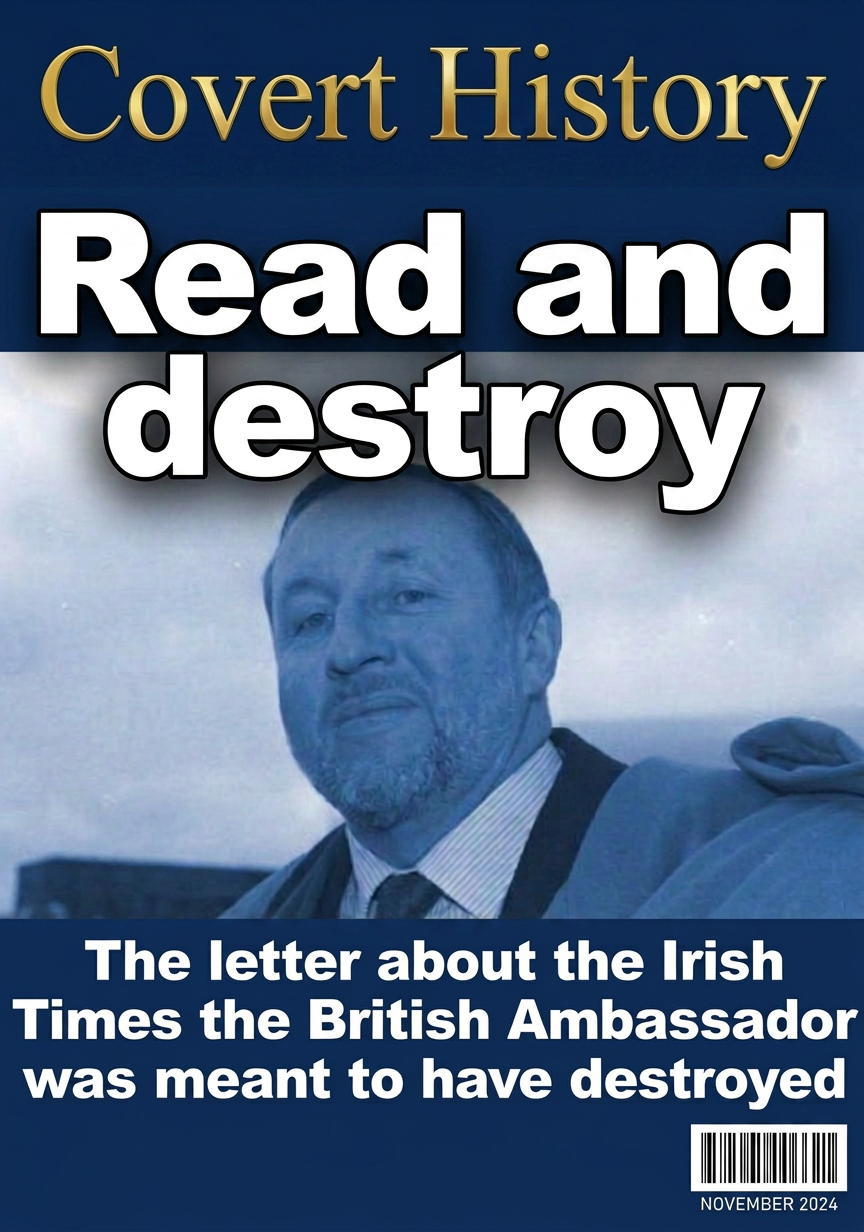
In October 1969, Maj. Thomas McDowell, an ex-British army officer from Belfast, asked the British Ambassador to Dublin, Sir Andrew Gilchrist, for “guidance, in respect of which lines were helpful and which unhelpful” for publication in The Irish Times. McDowell and a number of his colleagues owned the paper.

The request was recorded in a letter addressed to Kelvin White of the Foreign and Commonwealth Office. It was marked ‘SECRET’. Gilchrist stated at the end of it that: “I am destroying the correspondence.” However, a copy of the letter survived.
Douglas Gageby was editor of The Irish Times at the time. McDowell complained that “apart from Gageby’s editorial influence, there is difficulty lower down, whereby sometimes unauthorised items appear and authorised items are left out”. This demonstrates that McDowell and certain of his colleagues interfered with – and intended to continue to interfere with – the content of the paper.
Now, they wanted to do so in co-operation with Britain’s Foreign Office.

Ambassador Gilchrist wrote that McDowell “now felt that a certain degree of guidance, in respect of which lines were helpful and which unhelpful, might be acceptable to himself and one or two of his friends on the Board; this was what [McDowell had had in mind in telephoning to No. 10 [Downing Street]”.
The content of this letter is not new. It has even appeared on the cover of a book about the paper, John Martin’s ‘The Irish Times: Past and Present’. There was some outcry over the passage where Gilchrist described how McDowell had described Gageby as a “white nigger”. (Some apologists have suggested that the racist slur emanated from Gilchrist’s vocabulary, not McDowell’s. The letter is reproduced hereunder. Readers can make up their own minds.)

The article will focus on how Maj. McDowell was prepared to let Britain’s Foreign Office manipulate his newspaper, not the racist slur.
Maj. McDowell controlled The Irish Times from the start to the end of the Troubles.
The Foreign Office had a vast black propaganda department that employed hundreds of people. It was called the Information Research Department (IRD). It was once directed by John Peck. Peck was responsible for the black propaganda during ‘Operation Boot’, the MI6-CIA plot that toppled the secular, democratically elected government of Iran in 1953. McDowell was put in touch with Peck. Then, in early 1970, Peck became Britain’s ambassador to Dublin.

Gilchrist, the outgoing ambassador, also had strong links to British Intelligence. He had served with Britain’s special forces in Asia and as Chairman of the Joint Intelligence Committee (Asia). As Chair of the JIC (Asia), MI5 and MI6 reported to him. (MI5 was active inside the UK and in Britain’s colonies while MI6 operated on foreign soil).
The British embassy in Dublin, MI6 and the IRD worked hand in glove.

2. McDowell’s service “in M.I.5” and his “faux-English carry-on, as if imitating Colonel Mahon of the Munster Fusiliers, who was important in Intelligence”.
It has been alleged by a reliable source that Maj. McDowell had served in MI5. Cecil King, who owned The Daily Mirror, was an asset of MI5. King not only knew Maj. McDowell, but stated that McDowell was a former MI5 officer. King’s diary entry for Sunday, 23 January 1972, touched upon McDowell’s service with MI5. Having enjoyed a lunch with McDowell and his wife, King recorded that McDowell:
“asked us to talk about Irish affairs. He is a man with a very varied background – a Protestant father from the North, mother from the South, service in the British Army (Ulster Rifles), and had served on the staff in Edinburgh, and in M.I.5.“
In his book, John Martin revealed that his sources:
“within The Irish Times have indicated to me that [McDowell] worked for British Intelligence in Austria at the end of the [second world] war”.
Andrew Whittaker, who knew both Maj. McDowell and Gageby, had this to say of them:
Both Gageby and McDowell were brought up and schooled in Belfast, a desperate and bitter city. Both were bright, scholarship boys. They had close families and rather few friends. Gageby was a private man, McDowell I think a lonely one. Both stood sideways to the norms of post-war Irish society. Gageby was trying to enlarge boundaries, McDowell’s manner aped the recent colonial past. They had short military careers, one in Ireland the other in England. Gageby, while intensely proud of his, cherished it in his bloodstream. McDowell flaunted his in his mustachios and fob watches and faux-English carry-on, as if imitating Colonel Mahon of the Munster Fusiliers, who was important in Intelligence and who captivated the salons in Claude Cockburn’s autobiography of his time in Budapest in the 1920s, In Time Of Trouble. [Bright, Brilliant Days, Douglas Gageby and The Irish Times, page 9.]
Maj. McDowell’s approach to the Foreign Office was welcomed by it. Gilchrist wrote that: “Oddly enough I had had McDowell in mind in certain conversations I had in London a fortnight ago. His present approach requires rather careful handling and I shall discuss it in London next week. I am writing this letter merely in case you wish to brief No. 10 and assure them that we will do what we can to exploit this opening.”

Maj. McDowell had complained to Ambassador Gilchrist about the “difficulty lower down [the pecking order inside the paper], whereby sometimes unauthorised items appear and authorised items are left out”. Whatever attempts Maj. McDowell made to correct these difficulties, they did not involve Gageby. Martin Mansergh, who served as Northern Ireland adviser to Charles Haughey, Albert Reynolds and Bertie Ahern, wrote that:
“Douglas Gageby more than once expressed utter contempt for British Intelligence, and there is not the slightest evidence that he was deflected from his editorial line by any intervention by McDowell.” (Martin Mansergh, Bright Brilliant Days page 162
3. Gageby’s “soft spot” for Haughey.
Gageby proved an obstacle to MI6’s attempts to misrepresent Haughey as a Provisional IRA godfather in the 1970s. The editor “had a soft spot for Charles Haughey” according to those who worked with him including Conor O’Clery. [Bright, Brilliant Days, page 102.]
The Haughey-Provisional IRA-godfather myth was first put into circulation by Garda Patrick Crinnion of C3, Garda intelligence, and his MI6 handler John Wyman.
The myth circulated far and wide after the Arms Crisis of 1970.
The Arms Crisis sprang from an attempt by Irish military intelligence (G2) to import arms secretly in April 1970 for possible distribution to the defence committees in Northern Ireland in the event of a ‘doomsday’ scenario.
Crinnion, Wyman and others created the myth that the importation was destined for the Provisional IRA. Capt. Capt. James Kelly of G2 was smeared as a pro-Provisional IRA supporter alongside Haughey.
Gageby had served with G2, Irish military intelligence during the Second World War, and was aghast at the treatment of Capt. Kelly during the Arms Crisis and the trials that followed it.

All of the Arms Trial defendants were acquitted. They included Capt. Kelly and Haughey.
Gageby was not taken in by the myth (or the industrial scale perjury at the Arms Trials and the criminal forgery of a key witness statement by Peter Berry of the Department of Justice). No doubt, much to the ire of Maj. McDowell and MI6, the Arms Crisis debacle caused Gageby to develop a “soft spot” for Haughey.
Douglas Gageby was dropped as editor in 1974.
The loss of Gageby contributed to a downturn in the fortunes of the publication. Patrick Lyons, a management account, was called in to look at its finances in 1977. Andrew Whitaker, who worked at the paper records that “Ever-more deplorable circulation, advertising and cash figures kept coming in. With Pat’s figures I projected the timing of the company’s decline (unless corrected) into insolvency – that condition in which unless something were done it would be unable to pay its bills as they fell due. I already wasn’t paying its tax bills on time, so far as I recall, for the Revenue was a complacent creditor in those days. The company’s finances were slaloming to a condition in which the directors would become liable at law if they continue trading.“
Gageby was brought back in 1977 to save the paper. He did, and served as editor until 1986.

During this phase he continued to be protective of Haughey who became Taoiseach in late 1979.
Conor Brady, editor of the paper (1986 – 2002), wrote how Gageby “could be infuriatingly indulgent. He took a benign view of Charles Haughey, mediated through the judgement of [journalist John] Healy, forgiving him almost everything. [ Conor Brady, page 224]
I have outlined how MI6 planted stories in Private Eye magazine after Haughey became Taoiseach, in my book, ‘Enemy of the Crown’. (2020). Sir Maurice Oldfield, the Chief of MI6, had a line into that publication. It printed a series of lurid and absurd stories about Haughey’s relationship with Terry Keane. They were completely ignored by the Irish media, most particularly by Gageby, arguably the most senior and respected media figure in the country. Had The Irish Times covered the Private Eye attack, Haughey would have faced a storm of indignation and may even have fallen.
(The Irish public would have been even more shocked to have learned that one of Haughey’s most vocal political opponents in Fine Gael was also engaged in an illicit relationship but he was never exposed by Private Eye.)

Conor O’Clery, a senior reporter at the paper, has provided another example of Gageby’s “soft spot” for Haughey. O’Clery described how Gageby “had little direct contact with the Fianna Fail leader, leaving Irish Times ‘Backbencher’ columnist, John Healy – who had a line into Haughey’s Kinsealy, Co Dublin home – to act as an intermediary. This enabled him to avoid writing off Haughey’s career on the famous night [in early 1983] when the Irish Press, generally sympathetic to Fianna Fail, published [Haughey’s] political obituary, for which it was never forgiven. Haughey told Healy that rumours of his imminent resignation were premature. (Bright Brilliant Days, page 102.] Haughey survived the 1983 heave against his leadership and remained in place as leader of Fianna Fail until 1992.
4. Other MI6 machinations
One wonders what might have happened at the paper generally and, more specifically, to Haughey, if Gageby had not returned to the paper and Maj. McDowell had instead managed to infiltrate a cohort of journalists who were prepared to take “guidance” from the Foreign Office.

In the early 1970s, Hugh Mooney of the IRD did his best to influence the paper, along with Peter Evans from the British Embassy. Ambassador Peck did his damnedest too. MI6 tried – and failed – to recruit Dennis Kennedy, the deputy editor of the paper, as an asset in the late 1970s. It appears that when it came to ‘dirty tricks’, McDowell, the IRD and MI6 were forced to rely in the main upon a small but influential cohort of reporters, some of whom worked hand in glove with the Official IRA. (The Official IRA came into existence aftet the IRA split in 1969. It was led by Cathal Goulding, a Marxist. It engaged in lethal feuding with the Provisional IRA in the 1970s.)
When MI6 attempted – and failed – to recruit Dennis Kennedy, deputy editor of the paper (1982-86), one of the tactics they deployed was the purchase of expensive dinners at Bloom’s Hotel in Dublin along with financial bribes (cast as offers of “research” work). Kennedy, a man of upmost integrity, repulsed the man from MI6. Kennedy then “began to wonder if my experience was unique; how many of my colleagues had similarly been approached, and how had they reacted? I never found out, but I could not help noticing how some of them spoke highly of the food in the restaurant at Bloom’s Hotel.”
Details about these machinations can be found in two other stories on this website. (See the links in red font at the end of the next section.)
5. The ‘SECRET’ Gilchrist letter to Kelvin White
The ‘SECRET’ Gilchrist letter to Kelvin White, dated 2 October 1969, is reproduced hereunder:
SECRET AND PERSONAL
Dear Kelvin,
Your letter of September 24th – Major McDowell and No. 10 Downing Street.
2. I had McDowell to lunch today. It is all about something he mentioned to me before, but now he is hotter under the collar about it.
3. McDowell is one of the five (Protestant) owners of the Irish Times, and he and his associates are increasingly concerned about the tone the paper is taking under its present (Protestant, Belfast-born) Editor, Gageby, whom he described as a very fine journalist, an excellent man but on Northern questions a renegade or white nigger. And apart from Gageby’s editorial influence, there is difficulty lower down, whereby sometimes unauthorised items appear and authorised items are left out.
4. So far (except for last item) nothing new. But McDowell went on to say that he now felt that a certain degree of guidance, in respect of which lines were helpful and which unhelpful, might be acceptable to himself and one or two of his friends on the Board; this was what he had had in mind in telephoning to No. 10.
5. Oddly enough I had had McDowell in mind in certain conversations 1 had in London a fortnight ago. His present approach requires rather careful handling and I shall discuss it in London next week. I am writing this letter merely in case you wish to brief No. 10 and assure them that we will do what we can to exploit this opening. I am destroying the correspondence.

See also: MI6’s Assets at the Irish Times (and other dirty secrets of the newspaper). By David Burke


David Burke is the author of four books published by Mercier Press.
