
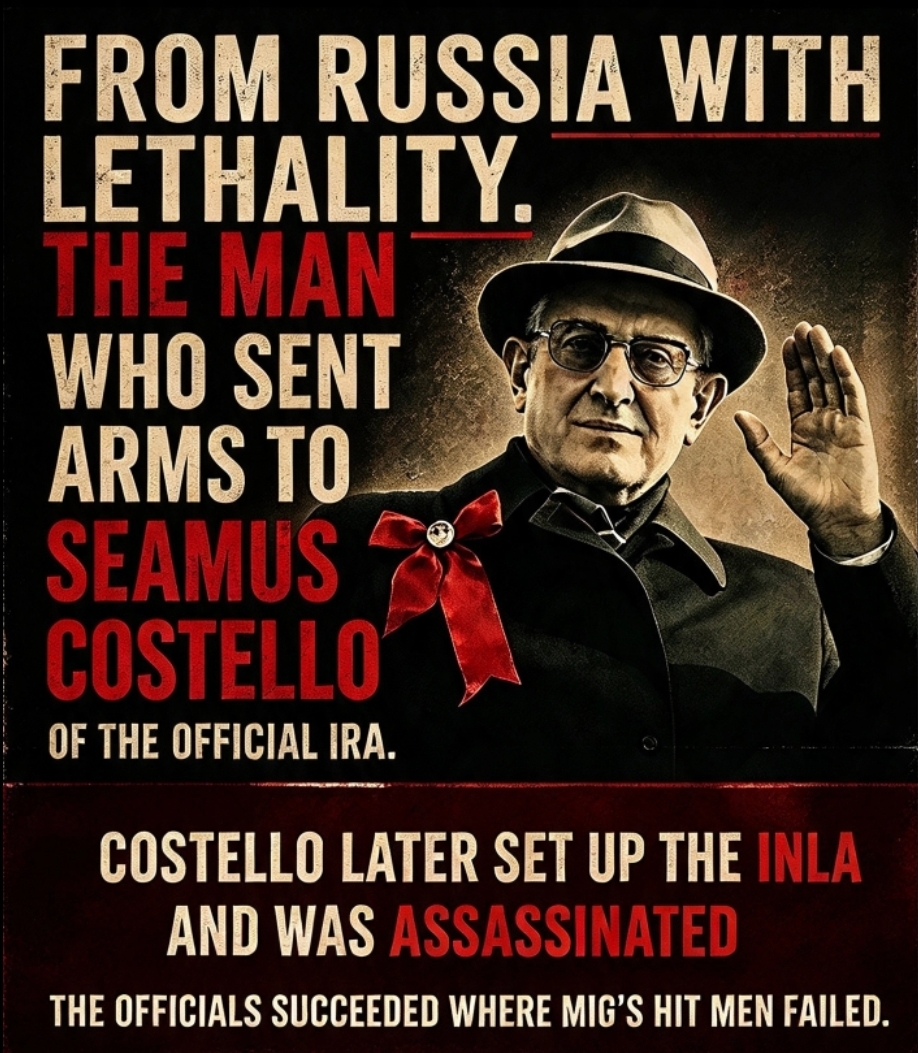
By David Burke.
In October 1977, Hibernia, a weekly Dublin periodical, published an article by Brian Trench about the assassination of Seamus Costello, Chief of Staff of the Irish National Liberation Army (INLA).
The Hibernia article is rich in detail about the feuding between the INLA and the Official IRA. Costello had once been a leading Official before he was expelled and set up the INLA.

The Hibernia article appeared on page 5 and is reproduced below. A more readable version of the article is set out at the end of this story.

Costello had also been the target of a number of earlier assassination attempts.
1. MI6 targets a series of key IRA figures, including Seamus Costello, then of the Official IRA.
[For clarity: the “old” IRA split in December 1969 into the Official (left wing/Marxist) IRA and the Provisional IRA. The Officials declared a ceasefire in 1972 but retained their weapons. The ceasefire was a factor in the emergence of the Irish National Liberation Army (INLA) in December 1974, a left-wing organisation which wanted to pursue an active military campaign against Britain. The INLA drew support from members of the Official IRA. A feud between the Officials and the INLA began in early 1975.]

John Wyman of MI6 tasked two of his agents, Kenneth Littlejohn and his brother Keith, with the assassination of Seamus Costello, along with others such as Cathal Goulding and Sean Garland of the Official IRA (OIRA) and Sean MacStiophain of the Provisional IRA.
Some details about the plots against MacStiophain are known – less about Costello.

Kenneth Littlejohn explained later that:
‘One of my main functions was to assassinate a man called [Seamus] Costello, who was the effective number one of the Officials, and had been trained in Moscow. I was also to assassinate another high-up member in the Officials, Sean Patrick Garland, who I believe was trained in Cuba.‘
There isn’t a shred of evidence – nor even a suspicion – that Garland was trained in Cuba or Costello in Moscow. Unfortunately for MI6, their intelligence about Republicans in Ireland was often very faulty.

Costello had approached the Chinese embassy in Paris in 1964 – not the Soviets – looking for support for the Republican movement. He made three approaches that year seeking military aid, help with training for guerrilla warfare and guidance in the use of printing presses for the production of propaganda materials. He was rebuffed.
We can attempt to gauge the type of danger MI6 posed to Costello in 1972 by examining the attempts to murder other IRA leaders.

Wyman and Kenneth Littlejohn met in Dublin, Belfast and Newry during 1972. One of Wyman’s haunts in Dublin was Buswell’s Hotel beside Dail Eireann. Wyman and the Littlejohn brothers devised a scheme to kill MacStiofain. Littlejohn said later that MI6 was
‘convinced that if it had not been for [MacStiofain] the whole problem could have been solved’.
An attempt on MacStiofain’s life took place on 4 March 1972, when he was sent a letter bomb. It arrived while MacStiofain was away from home. When MacStiofain got back, his wife showed him a parcel that had arrived. He and another IRA man took it out of the house where it exploded. The other man’s hands suffered burns, and his beard and hair were ‘badly singed’. MacStiofain was ‘slightly burnt on the face, and had a cut in one eye’. He felt that if the charge had been more powerful, the pair of them might have been killed or badly injured. He attended his local hospital where an optician advised him ‘to wear an eyeshade for a while’.

MacStiofain wrote that although much of Kenneth Littlejohn’s story about planning to assassinate him was
‘pure cock-and-bull, it is nevertheless interesting that he said one way this was to be tried was by “disintegrating” me. In other words, a bomb.’
When Littlejohn spoke to the press later, he described a more sophisticated plot that involved him driving to the neighbourhood in which MacStiofain lived, where he waited to see if he might turn up:
‘I [Kenneth Littlejohn] was also told to assassinate MacStiofain in the summer of 1972, just after Operation Motorman.‘
Operation Motorman took place on 31 July 1972. This was after the collapse of the Chelsea talks between William Whitelaw MP, Secretary of State for Northern Iteland, and the IRA and the violence that followed, including Bloody Friday, which took place on 21 July 1972. Littlejohn continued:
‘Keith and I waited in a car outside MacStiofain’s house, which is at Navan, Co. Westmeath, but we never saw him. The instructions we were given were that MacStiofain’s body was to be blown up so that it was completely unrecognisable. We should also take his car to Dublin Airport, and thereafter money would be sent from Canada to his family so that it would appear that he had absconded with IRA funds. They would also spread rumours to this effect, which they had previously attempted to do so.‘
This smear was a variation on a slander MI6 and its colleagues at the Information Research Department (IRD) – the UK’s black propaganda unit – were circulating in Northern Ireland that Ian Paisley had stolen money from his supporters to purchase farmland in Canada.
MacStiofain believed he was also the victim of a hostile propaganda campaign which ran in parallel with the plan to kill him. The plot was designed to diminish his reputation in the eyes of his supporters. One of the conduits, he alleged, was the Daily Telegraph. He accused one of the paper’s former editorial executives of having been in MI6. Another, who had died recently, had been a ‘very big wheel in naval intelligence and was a leading authority on intelligence in general’. The cabal at the paper, he alleged, had close ties to the Tories.
‘The first inkling of the latest move against me was when Dublin was plastered with posters advertising a forthcoming article in The Sunday Telegraph. The posters referred to “the Englishness of Sean MacStiofain”. When the article itself came out, it proved to be merely a personal attack on me. It’s essential theme was that my Irish connections were thin …’
Further attacks were perpetrated against other leading Republicans. A booby-trapped parcel was sent to Cathal Goulding through the Dunleer post office, Co. Louth, not far from ‘Smuggler’s Cottage’, Clogherhead, Co. Louth, where the Littlejohns had made their headquarters. Goulding defused the device.

Tomas MacGiolla, president of Official Sinn Fein, and Ruairi O Bradaigh, his counterpart in Provisional Sinn Fein, were sent bombs in the post. O Bradaigh’s was intercepted by the Roscommon post office.
Tony Ruane, an IRA general in the 1920s, who was now the treasurer of Provisional Sinn Féin, was badly burned when a parcel exploded inside Sinn Féin’s head office at Kevin Street.
By now, Wyman was in danger himself. Kenneth Littlejohn provided him with a warning that the IRA was aware that a man matching his description had been visiting Belfast pubs and that it was their intention to kill him.
2. Seamus Costello and Operation Splash, KGB gunrunning to Ireland.
The KGB was led by the taciturn, cunning, and manipulative Yuri Andropov from 1967 to 1982. One of his key objectives was to foment unrest in the West.

Soviet era files establish that Andropov meddled in Irish affairs.
In 1972, Andropov orchestrated the supply of weapons to the Official IRA. At the time, the Official IRA was competing with the Provisional IRA for the support of Nationalists in Ireland. The Officials, under leaders such as Cathal Goulding, Sean Garland, and Seamus Costello, were Marxists by ideology and, therefore, natural allies of the USSR.

To facilitate this, Andropov sent an intermediary to establish contact with them. This initiated a gun-running operation codenamed ‘Operation Splash’. On the Irish side, Seamus Costello took charge of the operation.
On 21 August 1972, Andropov presented details of Operation Splash to the Central Committee of the Soviet Communist Party in a document titled ‘Plan for the Operation of a Shipment of Weapons to the Irish Friends.’ The term ‘Irish friends’ was KGB code for the Official IRA.

The Central Committee approved the plan, after which KGB technical specialists assembled a shipment comprising two machine guns, 70 automatic rifles, 10 Walther pistols, and 41,600 cartridges—all of non-Soviet manufacture. Notably, the Walther pistols were lubricated with West German oil, and the packaging materials were sourced from multiple locations worldwide by KGB agents. This careful preparation was intended to prevent anyone tracing the weapons back to Moscow.

Although the details of the plan were recorded in a secret KGB archive, the information was eventually leaked to the West by one of those who worked at the archive, Vasili Nikitich Mitrokhin.
The weapons were transported aboard a Soviet intelligence-gathering ship, the Reduktor, disguised as a trawler and commanded by an officer from the KGB’s ‘8th Department of Directorate S.’ The cache was wrapped in waterproof protection and submerged at a depth of approximately 40 metres on the Stanton sandbank, some 90 kilometres off the coast of Northern Ireland.

To mark the location, the KGB used a marker buoy similar to those employed by fishing boats to warn of the presence of fishing nets. As part of their efforts to mislead any potential investigation, these markers were selected in advance to be of Finnish or Japanese origin.
The first shipment was a success. Within hours of the delivery, a fishing boat controlled by the ‘Irish Friends’ arrived at the sandbank and retrieved the weapons.
Several further Soviet arms shipments to the Official IRA were delivered by similar methods.

Yuri Andropov would later go on to become the President of the Soviet Union.
Clearly, fomenting trouble in Ireland was on the agenda for the KGB and the Central Committee of the Soviet Communist Party in the early 1970s.
3. The Official IRA court-martial of Seamus Costello.
Sean Garland told me during an interview at the office of his solicitor in Phibsborough, in 2019, that Seamus Costello was responsible for the Official IRA atrocity at Aldershot, the HQ of the Parachute Regiment. The attack took place after Bloody Sunday. Garland was critical of the attack.
At the time Costello was Director of Operations for the Official IRA. The atrocity took the lives of a number of domestic workers and a chaplain. No soldiers died.
The Officials claimed – falsely – that they had killed soldiers whose remains were removed from the scene of the bombing.
Goulding was outraged at the mess at Aldershot. He wasn’t the only Official who was aghast. The Officials declared a ceasefire against the Crown – with one exception: Brigadier Frank Kitson remained on their death list.

4. The INLA feud with the Official IRA.
Costello set up the INLA at the Spa Hotel in Dublin with approximately 80 other Republicans on 8 December 1974.
An OIRA-INLA feud erupted in early 1975.
On 1 March 1975, Sean Garland of the OIRA was shot as he drove home to his house in Ballymun, Dublin with his wife. He was badly wounded but survived.
In May 1975, Costello survived an assassination attempt outside Waterford City.

Costello was finally shot dead on 5 October 1977, while he sat in his car reading a newspaper on Northbrook Avenue, off the North Strand Road, in Dublin, by a member of the OIRA called Jim Flynn from Crossmaglen. The OIRA denied responsibility at the time, although no one believed them.
5. Dick Walsh of The Irish Times, an ally of the Official IRA.
James Downey, a former deputy editor of The Irish Times, revealed in his memoirs that
‘…the position of Dick Walsh [at The Irish Times] was, to say the least, anomalous. He was so close to the ‘Official’ chiefs that he was able to show me a transcript of the court-martial (in absentia) of Seamus Costello, a noted [Official IRA] defector. Costello was sentenced to death, and the sentence was carried out [in 1977], long after the Official IRA had announced the cessation of violent activities North and South [in 1972]. The organisation tried to attribute the murder to a dissident group, but indubitably the Official IRA “executed” Costello’. (Downey, page 102.)
On 4 June 1982, the INLA exacted their revenge by shooting Flynn dead in Dublin.

The Irish Times presents itself as a reputable paper of record. It may one day care to explain to its readers why Walsh failed to publish a story that would have revealed the names of the participants in the ‘court-martial’ of Seamus Costello, or even vague details of the event. His assassination – ordered by the court-martial – was one of the most momentous events of the Troubles.
None of the conspirators was ever brought before a court of law.
6. The Gardai turn a blind eye to the murder of Seamus Costello.
A former special branch officer has revealed to me that an OIRA hitman with a voice he recognised instantly as that of Jim Flynn rang Sean Garland immediately after the Costello hit, on a tapped phone line. ‘That job has been done’, Flynn told Sean Garland.
The information was sent up the line.
Hence, the Gadai had credible evidence against Flynn, yet he never faced charges.
Why?

The force was led by Garda Commissioner Ned Garvey who – according to the Barron inquiry – held illegal meetings with Fred Holroyd. Holroyd, a British military undercover operative, met Garvey on behalf of Craig Smellie, the Head of MI6’s station at Lisburn. Garevy’s head of intelligence at C3 was Larry Wren, who had multiple links to British intelligence.
Garvey told Barron that he had no recollection of these meetings.
If the Officials were shooting people like Costello, something that suited MI6, Garvey and Wren may have left Flynn alone as a favour to London.

The Provisional IRA believed that by the mid-1970s the OIRA had begun to supply information about them to the RUC Special Branch and MI5. In return, the Crown turned a blind eye to Official IRA protection rackets and building site extortion and fraud operations. If the Provisionals are correct, this might help explain why the Gardai who were close to MI6 – Garvey and Wren – let Flynn slip through their fingers.
7. The Hibernia article.
Brian Trench’s article is reproduced below:


David Burke is the author of four books published by Mercier Press.

One response to “From Russia with Lethality.”
[…] The Official IRA was responsible for the Aldershot massacre. For details see: From Russia with Lethality. […]