
Introduction.
It says a lot about The Irish Times that a bust of Dick Walsh – the most revered journalist in The Irish Times pantheon – takes pride of place in the foyer of paper.

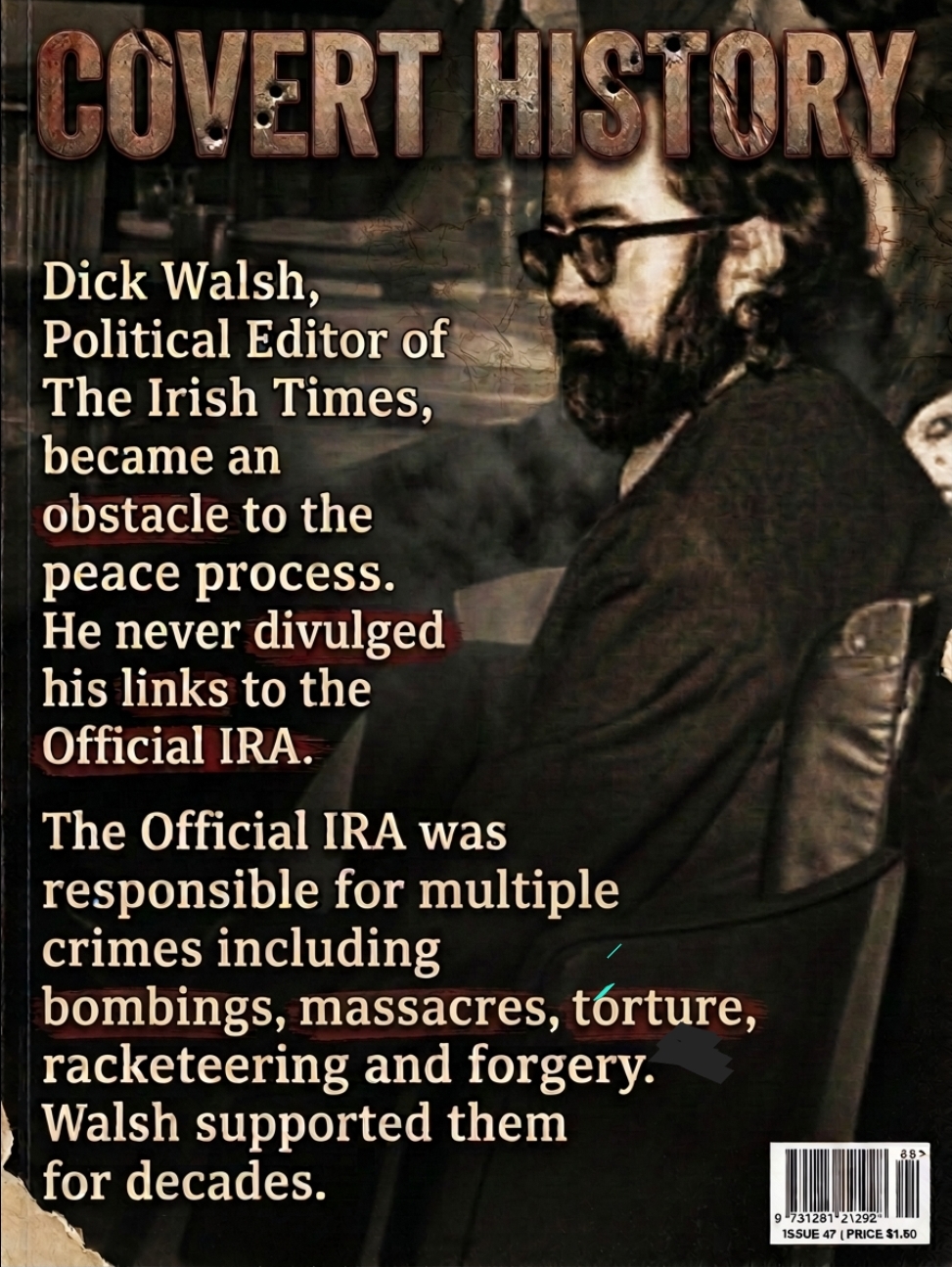
Dick Walsh was an adviser to Cathal Goulding, chief of staff of the Official IRA.
Between 1970 and 1983 the Official IRA killed at least 54 people, probably more. They also attempted to have journalist Ed Moloney murdered by their contacts in the UDA. A plot was hatched to kill Vincent Browne in what was to appear as an accidental death as well.

Walsh allowed his political bias to become an obstacle to the peace process.
Walsh and the Official IRA.
The Official IRA came into existence in 1969 after the split in the Republican movement. Gerry Adams and others joined the Provisional IRA after the fracture.
Throughout the 1970s, both factions engaged in violent confrontations, including assassinations and attacks on each other. This was fuelled by accusations and retaliatory actions.
The rivalry intensified in Belfast, where both groups competed for support in nationalist areas. This led to numerous violent incidents, including shootings and ambushes.
The Official IRA was responsible for the Aldershot massacre. For details see: From Russia with Lethality.

Insofar as the victims of IRA bombs are concerned, it hardly mattered whether they were planted by the Officials or the Provisionals. Both organisations believed they had the right to shoot, torture and murder to advance their political objectives. The UVF, UDA, UFF and other Loyalist terror groups shared this belief.
Some activists who had supported Goulding during his peaceful phase in the mid-1960s. Roy Johnson, told me that he had served on the IRA Army Executive. It is the body which appoints and oversees the Army Council. He walked away from the movement after Cathal Goulding and the Officials resort to killing and criminality. Johnson had once been very close to Goulding. Dick Walsh could have done so too but didn’t.

Johnson confirmed that Walsh was one of Goulding’s advisers
Another senior Official has confirmed Walsh’s role as an adviser.
Details about Walsh’s involvement with the Official IRA can be found elsewhere on this website, including: Hidden agendas.

In 1982 the Official IRA engaged in a plot to murder one of Walsh’s colleagues, Ed Moloney. Details about that scandal can be found here: Ed Moloney murder plot.

See also: The Irish Times, the Official IRA and the UDA.

Walsh advises against speaking to Gerry Adams.
Conor Brady, the editor of the Irish Times, 1986 – 2002, described in his 2005 memoirs, ‘Up The Times’, how:
‘On the other hand, the political staff, led by Dick Walsh, was more harshly critical of [Charles] Haughey [leader of Fianna Fail] in particular and of his government in general. Dick’s political voyage had been complex. He was originally close to Sinn Fein, during its Marxist years. He was a man of extraordinary acuity and intelligence as well as great personal charm. He was not the only journalist with [Official] Sinn Fein associations within the newspaper. A cohort of five or six, none at senior level but nevertheless influential, were members or had been members of the so-called “Stickies”.’ (Brady p. 100)

James Downey, deputy editor of The Irish Times, wrote in his memoirs that:
‘Much as I liked Dick Walsh and loved his company, I could not think it proper that he could combine such intimacy with a job as political correspondent of the Irish Times. It amazed me that so few people appear to know his record, of which he made little secret, and that speakers at his funeral praised what they called his dedication to parliamentary democracy”.
Walsh was much admired and liked by his colleagues. Geraldine Kennedy, who later became editor, recalls how, ‘I met Dick Walsh on my first day in The Irish Times in February 1973. He was a giant in journalism but, even then, always found time to encourage cub reporters’.
In early 1987, Conor Brady, editor of The Irish Times, considered speaking to Gerry Adams as part of a series of meetings with other party leaders. He sought Dick Walsh’s views. Walsh advised against it. Walsh was still a covert supporter of Cathal Goulding, the Marxist chief of staff of the Official IRA. Adams was still a hated figure for the Official IRA.
Brady decided not to meet with Adams but changed his mind the following year and arranged a visit to Belfast, where he spoke to Adams.
Meanwhile, the then Taoiseach, Charles Haughey, was taking a few tentative steps that would commence the peace process. He hesitated, afraid that if it became known that he was opening back channel talks between his administration and Provisional Sinn Fein/Provisional IRA all the old smears from the Arms Crisis were likely to resurface. His successor, Albert Reynolds, who did not carry the same baggage, was able to operate far more freely. Haughey might have moved faster if Brady had spoken to Adams. The Irish Times could hardly have criticised Haughey for doing what its own editor had done.
Conor Brady wrote in his memoirs that
“it became necessary to view Haughey through two different prisms – and to report him and write about him at two different levels. He was Taoiseach, a Taoiseach with energy and a certain style. He had to be reported fully. And where appropriate, it was necessary to praise him. He contributed significantly, if belatedly, to the Northern Ireland peace process. Not everybody in the Dublin establishment was willing to recognise this. To many, including some in Irish Times, he could do no good. His every action was suspect. (p. 191)
Walsh and the Labour Party.
Walsh struck up a friendship with Fergus Finlay, an adviser to the leadership of the Labour Party. The relationship was in place during Labour’s participation in coalition with Fine Gael 1982-87, and beyond. Walsh was defensive of the Coalition and, as Brady makes clear in his memoirs, favoured them over Fianna Fail in the 1987 general election. Walsh even sought to blame the economic mismanagement and disaster over which the Coalition had prevailed for four years on Haughey’s short lived nine month 1982 administration.
Official Sinn Fein (the political wing of the Official Republican movement) became Sinn Fein the Workers Party and then the Workers Party.
In 1990 Walsh wrote a column urging the Workers’ Party and Labour to put aside their differences and work together.
It still did not matter to Dick Walsh that the Official IRA, now referred to as ‘Group B’ by those in the Official movement who ran it, was still involved in widespread criminality.
Members of the Workers Party quit due to the criminality of ‘Group B’.
In 1992 many of The Workers’ Party’s leading lights left it to set up a new party, the Democratic Left. There were at least two major issues: ideological differences and concerns about criminality. In his book on The Democratic Left, Kevin Rafter, spoke to Catherine Murphy who had joined the exodus. Rafter describes it thus:
‘While the ideological debate had been developing throughout the 1980s, the question of members with links to criminal activities had been a recurring theme since the 1970s and eventually pushed the divisions to a stage where even a reconstitution of the party was not going to overcome the deep internal tensions. For many of those who ultimately exited the Workers’ Party, criminality was the main motivation for the split. “For myself and almost everyone in our branch in Kildare the predominant issue that caused the split was criminality,”Catherine Murphy asserted”.‘
Catherine Murphy went on to become a TD and co-leader of the Social Democrats.

Since Walsh wrote in a positive fashion about the arrival of the Democratic Left, it is safe to say that he had drifted from Goulding by 1992.
The friendship with Finlay continued well into the 1990s. Indeed, Walsh once even berated Conor Brady for pointing out to Finlay – by reference to hard facts – that The Irish Times had not only been fair in its coverage of Labour’s defeated candidate in the 1997 presidential election but had actually given her marginally more coverage than the other candidates. Brady’s exact words:
‘Later Dick Walsh, a good friend of Finlay’s, berated me for being so hard on him [i.e. Finlay] “I’m like any other animal, Dick”, I replied. “I defend myself when I’m attacked”.'(Brady p. 142)
The Democratic Left became part of the Irish Labour Party in 1999 with two if its leaders, ex-Official Sinn Fein members, subsequently becoming leader: Pat Rabbit and Eamon Gilmore. Gilmore became Tanaiste 2011 – 2014.
Walsh’s challenged to his face about his Official IRA background by the editor of The Phoenix.
By the 2002 general election, the Workers’ Party was a spent force. Walsh never acknowledged his relationship with Goulding.
Walsh was however confronted once – in person – for covertly promoting the agenda of the Workers Party. The charge was levelled by the editor of The Phoenix magazine, Paddy Prendeville, at Buswells hotel in aftermath of 2002 general election. Aghast at the affront, and stunned into silence, Walsh did not deny the charge.

Dick Walsh died in Dublin on 11 March 2003.
In the years after this, the Workers’ Party failed to make a recovery.
In 2011 Sean Garland, the then leader of the Workers’ Party, fought off an attempt to extradite him to the US over counterfeit charges.
The Workers Party still exists in 2026 but, as one senior member puts it, “Nowadays we are just a pressure group.”


See also: Misrepresenting Haughey’s relationship with the Provos.

See also: Irish Times fraud.
